HappyHorse, Alibaba's Counterattack
 04/16 2026
 631
631
Source | Bohu Finance (bohuFN)
Author | Lu Fei
A few days ago, a model named HappyHorse-1.0 surged to the top of the Video Arena rankings, outperforming industry leaders like ByteDance's Seedance 2.0 and Kuaishou's Kling 3.0. As speculation swirled about the model's origin, Alibaba promptly claimed credit, expressing gratitude for the attention while clarifying that HappyHorse was its creation.

Anonymous ranking submissions are common in the industry, serving to avoid brand bias in testing while leveraging suspense to boost engagement—both of which Alibaba needed.
The departure of Junyang Lin, a key figure in the Qwen team, while raising awareness of Alibaba's contributions to open-source models, also fueled renewed doubts about the company's AI investments.
Alibaba's establishment of the ATH Business Unit was a strategic response. From March 30 to April 2, Tongyi Lab released three flagship models within days: Qwen3.5-Omni (omni-modal interaction), Wan2.7-Image (visual generation), and Qwen3.6-Plus (large language model). Just a day after launch, Qwen3.6-Plus, focused on coding capabilities, topped the daily leaderboard on the large model API platform OpenRouter.
Last week marked a second counterattack. Alibaba restructured its organization again, forming a Technical Committee led by Wu Yongming, with members including Zhou Jingren, Wu Zeming, and Li Feifei. Tongyi Lab was upgraded to the Tongyi Large Model Business Unit under Zhou's leadership, while Lei Yanqun, a veteran from Alibaba's China Supplier team, took over as CEO of Taobao Flash Sale.
These moves signaled a heightened focus on large model R&D at Alibaba, with HappyHorse serving as a bold technical showcase.
01 A Narrative Disrupted
For the past year, Alibaba and ByteDance have been seen as China's AI powerhouses, at least from a third-party commercial perspective.
Alibaba's AI strategy has been clear: comprehensive development. The company has steadily advanced its plans.
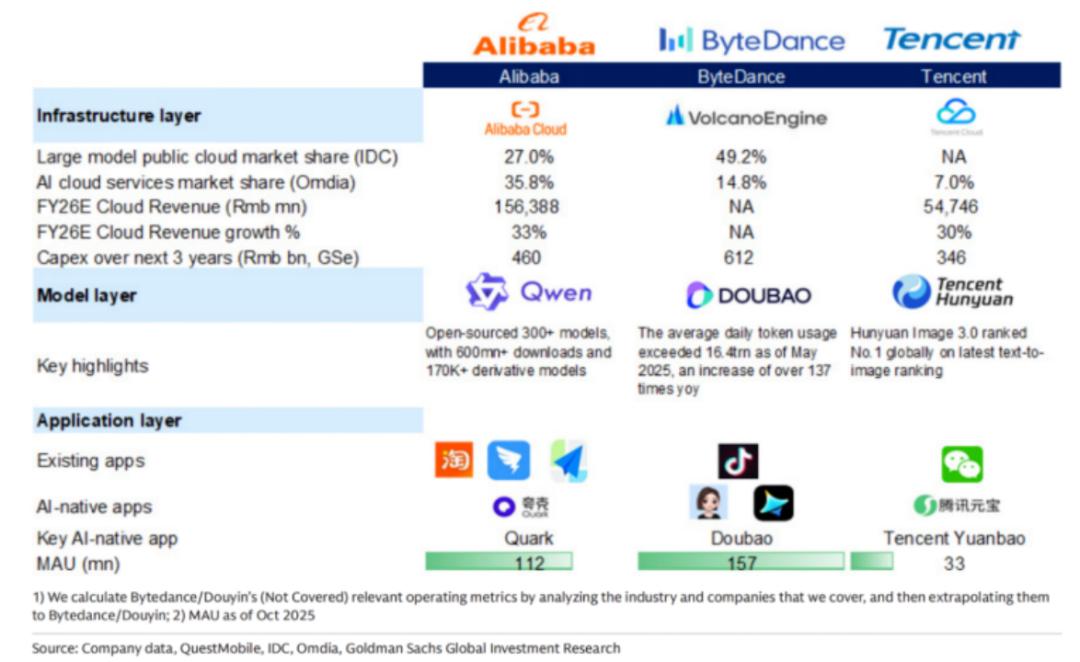
According to Goldman Sachs, Alibaba leads in enterprise external AI cloud revenue with a 35.8% market share, compared to ByteDance's 14.8% and Tencent's 7%.
Among models, the Qwen series is the most influential open-source offering. In the B2B market, Alibaba's Alibaba Cloud BaiLian platform helps enterprises transform production and operations with AI. On the consumer side, apps like Kuake and Qianwen have launched, while sibling company Ant Group has introduced "Lingguang" for office scenarios and "Afu" for lifestyle services, covering diverse user needs from search and creation to finance and daily interactions.
Even in hardware, Alibaba launched "Kuake AI Glasses," selling over 3,000 units in three days.
However, ByteDance's Seedance 2.0 dominance during the Lunar New Year and Lin's departure threatened to disrupt this narrative.
Internally, Alibaba faced inefficiencies.
As revealed by 36Kr, during a post-resignation meeting, Zhou Jingren acknowledged "resource constraints" within the Qianwen team, citing historical issues and ongoing planning. This highlighted a lack of internal consensus, leading to common pitfalls: model teams complaining about insufficient computing power, cloud teams about heavy models, and platform teams about poor adaptation.
Questions arose: Can AI-era foundational model R&D succeed without founder-level expertise—or must responsibility be delegated to experts? Can strategy and systems alone drive progress?
The secondary market's sentiment was clear. Over the past two months, Alibaba's stock price has retreated 30–40% from its peak, underperforming other tech stocks. Despite growth in cloud and AI revenue, doubts about Alibaba's AI narrative have risen. Meanwhile, ByteDance's valuation has soared, echoing Anthropic's trajectory.
Thus, Alibaba's organizational reshuffles—ATH's creation and new appointments—aim to better align with the AI era.
First, Tongyi Lab's upgrade to a business unit, with Zhou Jingren in full charge (stepping down as CTO), reflects a strategic shift. Zhou, a cross-functional leader with proven success in models and commercialization, can now focus solely on R&D, strengthening model development.
Second, roles in model technology, cloud infrastructure, and business operations have been clarified. The Technical Committee divides responsibilities: Zhou explores model capabilities, Li Feifei optimizes infrastructure efficiency and costs, and Wu Zeming integrates AI with other businesses.
Alibaba aims to reassure the market that "AI-first" remains its top priority, with cutting-edge model development taking precedence.
02 Why HappyHorse?
HappyHorse is a bold technical statement because it originated not from Tongyi Lab (central to past controversies) but from ATH's Innovation Business Unit.
After ATH's formation, its five units took on distinct roles: Tongyi Lab pushes model capabilities, Maa builds model service platforms, Qianwen focuses on consumer AI assistants, Wukong targets B2B AI workspaces, and Innovation explores AI applications and new markets.
Reportedly, HappyHorse's core team came from Taobao Group's Future Life Lab, led by Zhang Di, former VP at Kuaishou and technical lead of Kling AI. Backed by Alimama, the project secured top-tier computing resources. "HappyHorse used Alibaba's most powerful cards, internally called 'Big Cards,' specifically H100s."
Video generation is one of the hottest AI track (sectors).
Seedance 2.0's debut stunned the industry, prompting foreign creators to seek Chinese phone numbers. Its simplicity and realistic output made it a top choice for content creators and short drama teams. Tan Dai, president of Volcano Engine, noted that producing high-quality animated dramas previously cost over 10,000 RMB per minute, but Seedance 2.0 cuts this by 4,000–5,000 RMB.
This sparked an industrial wave. DataEye Research estimates China's animated drama market will reach 16.8 billion RMB in 2025 and 24.4 billion RMB in 2026, with AI driving rapid supply growth. A live stream by "Internet Thief Group" revealed monthly AI-generated drama output now exceeds 1,000 episodes.
Yet Seedance 2.0 faces bottlenecks. On social media, users complain of 100,000-person queues and hours-long waits for 15-second videos, with no guarantee of success. Some creators report improved queues but declining video quality, noting "dumbed-down" results.
For example, Seedance 2.0's fast version renders clear structures and basic camera movements but struggles with multi-person interactions or fine textures, often producing unrealistic physics. While acceptable for casual users, short drama creators now need to generate 7–8 clips to find one usable one, up from 2–3 previously.
On April 8, ByteDance indirectly raised prices: monthly points for basic, standard, and premium memberships were reduced from 1,080, 4,000, and 15,000 to 725, 2,210, and 6,160, respectively, while prices remained unchanged.
In video generation, ByteDance leads but hasn't widened its gap.
During beta testing, Alibaba Cloud began recommending HappyHorse to clients. While Alibaba will face Seedance 2.0's challenges post-launch, HappyHorse has more time to refine pricing and strategy.
Alibaba and ByteDance will soon clash again in video generation.
The cover image and illustrations belong to their respective copyright holders. If copyright owners object to their use, please contact us promptly, and we will correct the issue.
-
![]()
AI Giants Start Borrowing to Fuel Computing Power Race
-
ByteDance Initiates Largest B2B Structural Adjustment, This Time It's Truly Different
-
![]()
Let's Talk About Kingsoft Office's Mid-Year Outlook and the True Strength of Its AI-Powered Office Solutions
-
Despite 150 Million Users, Struggles Persist: AIShige Faces Tough Competition from Seedance and Kling in AI Video Monetization
-
![]()
Ensuring Safe Gear Shifting in the Automotive Industry: Transitioning from 'Product Oversight' to 'Full-Chain Governance'
-
![]()
Net Profit Soars to $133.7 Billion! Azure Revenue Tops $100 Billion, with AI Fueling Microsoft's Growth
-
![]()
Before 6G Hits the Market, the U.S. Forges a 'Rules Alliance': What Challenges Await Chinese IoT Enterprises?
-
![]()
Intelligent Driving's 'Little Blue Light' Faces Ban: Night Glare and Cut-in Risks Prompt Official Action