Global New Energy Vehicle Market: Short-Term Pressure, but Pure Electric Vehicles Still Expected to Rise by Year-End
 04/16 2026
 418
418
According to the latest data from CleanTechnica, global new energy vehicle registrations reached approximately 1.1 million units in February 2026, down 11% year-on-year. This marks the worst single-month decline since the COVID-19 pandemic. Among them, pure electric vehicles fell by 8%, while plug-in hybrid electric vehicles dropped by 16%.
The "reduction of incentives" in the Chinese and U.S. markets was the primary reason for the global sales decline. The termination of U.S. federal tax credits in October last year, combined with China's cancellation of some vehicle purchase subsidies at the end of 2025, significantly suppressed demand in these two major markets. Notably, excluding China and the U.S., electric vehicle sales in other global markets increased by 36% year-on-year, with pure electric vehicles growing by 30%. In other words, the so-called "global decline" is merely a short-term fluctuation in some policy-sensitive markets, and the overall trend toward electrification remains unreversed.
The latest data shows that new energy vehicles accounted for 16% of the global market share in February, with pure electric vehicles making up 11% and plug-in hybrids 5%. By comparison, these figures are lower than those at the end of 2025, when new energy vehicles held a 26% market share and pure electric vehicles accounted for 17%. However, industry analysts believe that with the launch of several new models and continued policy support, the market is expected to see strong growth in the second half of the year, with pure electric vehicles' market share surpassing 20% by year-end.
Affected by the Chinese New Year holiday and the reduction of subsidies, China's global sales share of electric vehicles dropped to 43% in February, the lowest in years. This provided overseas brands with a rare opportunity to gain visibility. The best-selling model rankings showed that the Tesla Model Y took the top spot with 72,710 units sold, up 53% year-on-year, indicating that the production bottleneck caused by last year's redesign has been fully resolved. The Tesla Model 3 came in second with 32,234 units sold, though it saw a 23% year-on-year decline. Third place went to the Geely Xingyuan, with approximately 29,000 registrations. This small electric vehicle compensated for weak domestic demand by increasing exports.
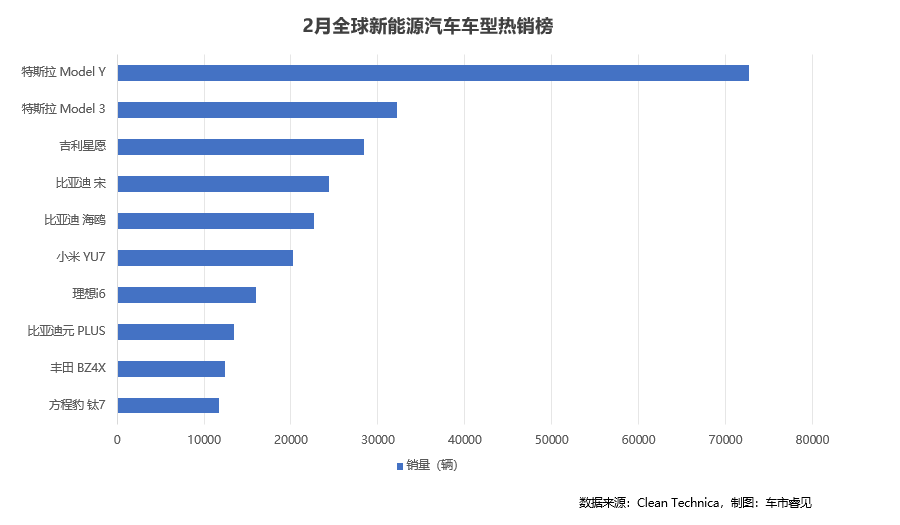
The biggest highlight this month was the Toyota BZ4X, which entered the top 10 best-sellers with a record-breaking 12,419 units sold, marking Toyota's first appearance in the global electric vehicle best-seller list in years. This success was attributed to its recent redesign, which included price reductions and rationalized configurations, enabling the BZ4X to achieve over 1,000 monthly sales in markets such as Japan, Denmark, Canada, and the U.S. Speculation arose: Has Toyota finally "awakened"?
Other notable models include the Skoda Elroq and Hyundai IONIQ 5 (up 30% year-on-year), ranked 17th and 18th, respectively. The Kia EV5 (4,512 units) set a new record, while the EV4 (3,209 units) and PV5 (3,372 units) continued to gain traction. The Volkswagen ID.4 ranked 20th, with consumers holding off on purchases due to the upcoming launches of the ID.Cross and ID.Tiguan.
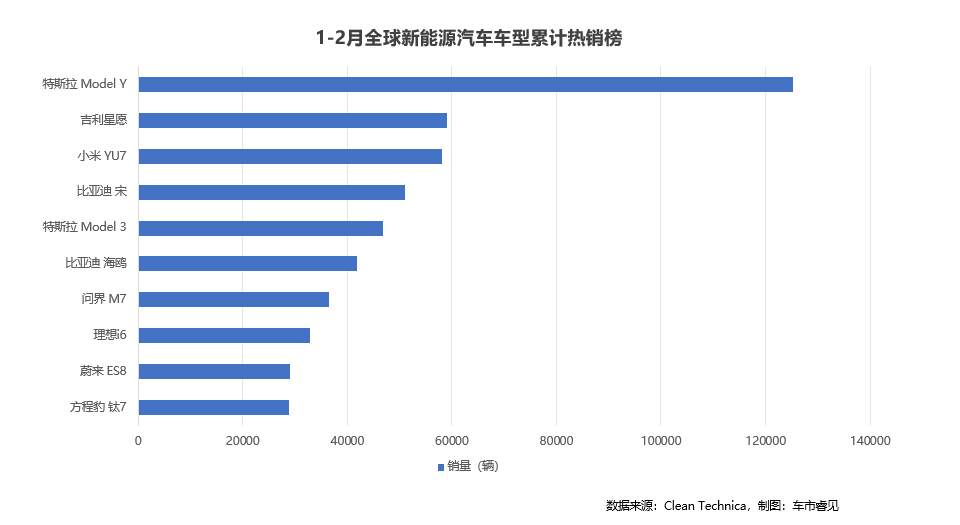
In the cumulative sales rankings for January-February, the Tesla Model Y secured the top spot with 125,220 registrations, while the Geely Xingyuan emerged as the new runner-up. The Xiaomi YU7 took third place with 58,092 units sold. The Tesla Model 3 climbed to fifth place, and analysts predict it could compete for the annual third-place spot with a strong end-of-quarter push in March. The Li Auto i6 continued its ascent to eighth place, proving its market popularity. Among BYD's lineup, the Yuan Plus, Dolphin, Seal 06, and Seal 06 all showed steady growth.
In terms of manufacturer sales rankings for February, BYD, Tesla, and Geely remained on the podium. Kia performed exceptionally well, rising to sixth place—its highest ranking to date. With multiple models continuing to gain traction, Kia's prospects for the year look optimistic. Toyota unexpectedly took ninth place. While Toyota is the world's best-selling automaker, ranking ninth in the electric vehicle segment may not seem cause for celebration, but it represents significant progress compared to its past performance.
When considering pure electric vehicles only, global registrations reached 1.5 million units in January-February 2026, accounting for 67% of total new energy vehicle sales. Tesla temporarily led with an 11.7% share, while BYD (10.6%) saw some consumers delay purchases as they awaited the second-generation Blade Battery. Once this new battery technology is fully rolled out, BYD is expected to quickly reclaim the top spot.
Geely (8.8%) held steady in third place, while the Volkswagen Group (7.7%) and SAIC Group (6.6%) ranked fourth and fifth, respectively. Hyundai-Kia (5.2%) surpassed Xiaomi to take sixth place, but with the Xiaomi SU7 still undergoing updates, a counterattack is expected in the coming months.
Despite the short-term pressure reflected in the February data, the global electric vehicle market, excluding the policy-driven fluctuations in China and the U.S., maintained growth of over 30%. Geopolitical tensions in the Middle East may accelerate the decline in demand for fuel-powered vehicles, further opening up space for electric vehicles. While short-term pain persists, the long-term trend remains unchanged. With the implementation of China's new battery technology, sustained growth in the European market, and gradual adoption by traditional giants like Toyota, the electric vehicle market share is expected to rebound in the second half of 2026, with a full-year share surpassing 20% well within reach.
Layout 丨 Zheng Li
Source 丨 CleanTechnica
Image Source 丨 Qianku.com
-
![]()
Jitian Xingzhou: A Pioneer in Optical Payloads Secures Hundreds of Millions in Series B Funding!
-
![]()
Orders Secured Through to the Second Half of the Year! The Rationale Behind the 'Surge' in Demand for This Company’s Optical-Grade Base Films
-
![]()
Beyond Patents: The Retail Rivalry of Insta360 and DJI Unfolds
-
![]()
180 Billion Market Cap Vanished! How Did Seres Fall So Far?
-
![]()
Blockbuster! Domestic storage takes the global double crown for the first time, from an AI company
-
![]()
China Spearheads Formulation! World's Pioneering Global Technical Regulation for Automated Driving Systems Greenlit and Unveiled
-
![]()
Farewell to Pulsed Support Policies: Three Major Auto Policy Directions from Multiple Departments Take Effect on the Same Day
-
![]()
Embercore AI’s Accelerated Funding: The Robot Industry’s Shift Toward ‘Learning Systems’