OpenAI Shuts Down Atlas: Who Has the AI-Powered Browser Yielded To?
 08/14 2026
 507
507

The AI-powered browser has experienced a dramatic shift, moving from the height of excitement to a cooling-off period.
Last year, OpenAI, Perplexity, Google, Microsoft, and several leading domestic companies ventured into this market. AI was once heralded as the game-changer for browsers, promising a future where users wouldn't need to manually search, click, and navigate between web pages. Instead, they could simply convey their goal to the Agent, and AI would take care of the rest.
However, less than a year later, the narrative took a turn.
Recently, OpenAI officially discontinued its AI-powered browser, Atlas. Launched in October 2025, the product exited the market after operating for less than a year. Atlas was once hailed as the "Chrome killer," with OpenAI aiming to demonstrate that as AI transitioned from answering queries to executing tasks for users, browsers could serve as a new portal for Agents to access the real internet.
Ultimately, OpenAI opted for a different strategy, abandoning the standalone browser model. The browser Agent capabilities developed by Atlas will be further integrated into ChatGPT and Codex.
Over the past year, AI-powered browsers have failed to revolutionize the traditional browser market. According to StatCounter data, in June 2026, Chrome still dominated with a 70.01% share of the global desktop and mobile browser market. Giants like Google and Microsoft have also chosen to integrate AI directly into Chrome and Edge.
From the initial capital frenzy to Atlas's demise, why has the hype surrounding AI-powered browsers subsided? Is it a flawed concept, or is it simply evolving into a different form?
A year ago, AI-powered browsers were among the hottest topics in the AI industry.
As AI Agents began to transition from "chatting" to "performing tasks for users," browsers suddenly emerged as a promising new frontier.
The rationale was simple: if AI could only answer questions, it remained an assistant; but if AI could open web pages, read information, fill out forms, place orders, or even complete entire tasks for users, then browsers would evolve beyond mere web-browsing tools and become the true "extensions" of Agents.
Suddenly, a wave of new entrants flooded the long-stagnant browser market.
Overseas, Perplexity launched Comet, The Browser Company shifted its focus from developing Arc to the AI-powered browser Dia, Opera subsequently launched Neon, which emphasized Agent execution, and OpenAI joined the fray. At the time, OpenAI embedded ChatGPT directly into the browser, enabling AI to comprehend the pages users were browsing and further execute tasks such as searching, shopping, and researching.
After OpenAI's entry, the narrative of AI-powered browsers as the next-generation portal reached its zenith, with Atlas even being dubbed the "Chrome killer" by the media.
The capital market also began to bet on this narrative.
In September 2025, enterprise software company Atlassian announced the acquisition of The Browser Company for $610 million in cash, which owned the AI-powered browser Dia. Previously, Browser Use, which built AI Agent browsing infrastructure, secured $17 million in seed funding. A browser market that was once highly mature and offered limited entrepreneurial opportunities suddenly regained capital interest due to AI.
Domestic enthusiasm also surged rapidly.
In May 2025, 360 announced a comprehensive AI upgrade for its entire browser lineup, allowing users to leverage large models within the browser to complete tasks such as searching, reading, and writing. Tencent subsequently upgraded QQ Browser to an AI-powered browser, launching QBot, which integrated both Hunyuan and DeepSeek models.
Alibaba's Kuake also continued to enhance its AI search and AI assistant capabilities, further evolving into an AI-powered browser. By 2026, Meituan's GN06 team took an even bolder approach, directly launching the AI-native browser Tabbit, which integrated browsing, searching, conversing, and Agent task execution into a single product.
At the time, the industry believed in a future where users wouldn't even need to browse web pages themselves. They could simply tell the Agent what they wanted to accomplish, and the browser would find information, operate websites, and deliver results. If this vision held true, browsers could become the new portal in the AI era.
However, less than a year later, this browser revolution quickly lost steam.
ChatGPT Atlas, once seen as the "Chrome killer," officially ceased operations on August 9 this year, about 10 months after its launch. OpenAI did not abandon browser Agents but instead planned to migrate Atlas's capabilities to ChatGPT and Codex.
Other players are also evolving their strategies.
Perplexity's Comet continues to progress, but its product strategy has shifted from early invitation-only, paid models to free and open access. The often-discussed idea of "AI-powered browsers replacing Chrome" has not materialized today.
From a market share perspective, AI-powered browsers have not yet disrupted the traditional landscape. StatCounter data shows that in June 2026, Chrome still held a 70.01% share of the global desktop and mobile browser market, while Safari and Edge accounted for 15.05% and 5.24%, respectively.
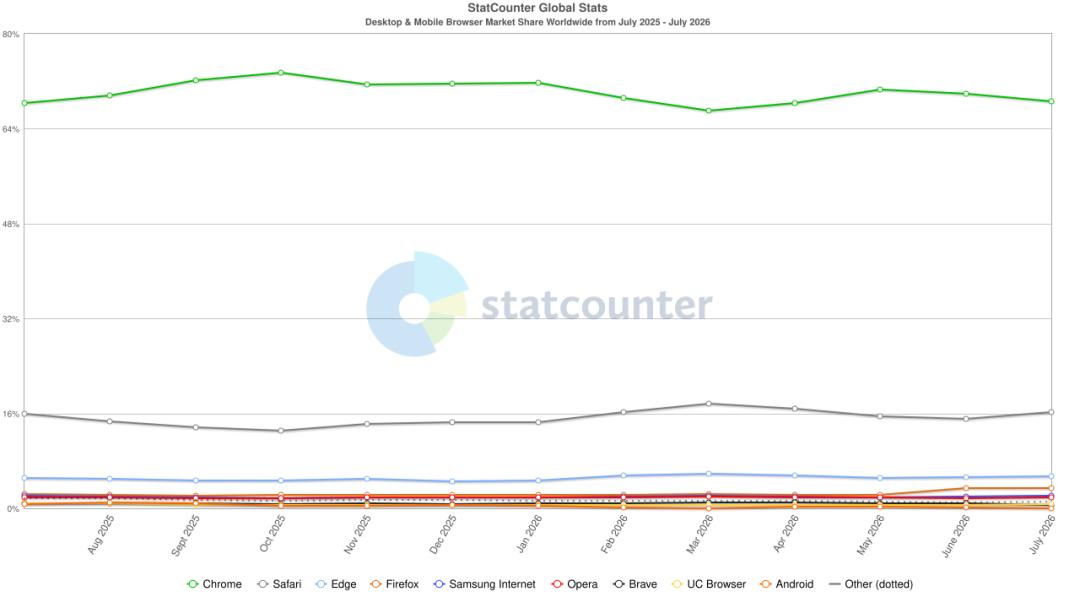
From last year's capital frenzy and tech giant entries to today's Atlas exit and the continued dominance of traditional browsers, AI-powered browsers are undergoing a transition from being the next-generation portal to redefining their positioning.
Why has the hype surrounding AI-powered browsers cooled so quickly? Is it because AI-powered browsers lack value, or is there an issue with the concept of creating a standalone AI-powered browser?
Over the past year, players in the AI-powered browser space have diverged into two distinct paths.
One approach is to upgrade existing browsers, which is what Google, Microsoft, Tencent, and 360 are doing. The other is to build an AI-native browser from scratch, represented by players like OpenAI Atlas, Perplexity Comet, The Browser Company's Dia, and Meituan's Tabbit.
The former adds AI capabilities to browsers, while the latter attempts to fundamentally change how users browse. Traditional browsers rely on users seeking information—searching, clicking, and switching tabs—while AI-powered browsers aim to shift to users setting goals and Agents completing tasks, transforming browsers from web page display windows into AI task execution environments.
This is what makes AI-powered browsers so appealing. But the question remains: how many users are willing to switch browsers?
Even for OpenAI, which commands massive traffic, migration is challenging. When Atlas was launched, ChatGPT already had over 800 million weekly active users, but according to third-party estimates by Presenc AI, Atlas had around 11 million monthly active users in the first quarter of 2026, far below ChatGPT's user base.
Google's browser investments also highlight the difficulty of establishing a new portal. Documents disclosed in the U.S. Department of Justice's antitrust lawsuit against Google revealed that Google paid Apple approximately $20 billion in 2022 to maintain its default search engine status on Safari and other devices.
What hurts standalone AI-powered browsers the most is the speed at which tech giants catch up.
In the past, startups' biggest opportunity was that large companies moved slowly, leaving a window for new products. Browsers are different. Google integrated Gemini into Chrome, Microsoft put Copilot into Edge, and users didn't need to download a new browser at all.
Startups must convince users to switch browsers, while big tech only needs to make their existing browsers smarter.
More importantly, a key premise underlying AI-powered browsers is being undermined by chatbots themselves.
A year ago, if users wanted AI to search web pages, read multiple sources, and organize information, browsers were a natural fit. However, as ChatGPT, Gemini, and other products continue to enhance their search, Deep Research, and Agent capabilities, more tasks that once required "AI + browser" can now be completed directly in chat windows.
Thus, the value of AI-powered browsers as a portal is being weakened.
AI needs to read web pages, gather information across sites, and complete transactions and tasks within web environments. But these capabilities can easily be integrated into Agents like ChatGPT and Claude or become native features of Chrome and Edge.
Eventually, once Agents are sophisticated enough, browsers may not even need to be "seen" by users.
For users, browsers are tools for opening and reading web pages; for Agents, browsers are more like execution environments connecting to internet services. They can open web pages, gather information, and call services in the background, delivering final results to users without necessarily requiring browsers as portals.
OpenAI has already demonstrated that standalone AI-powered browsers are unlikely to become a new mass-market portal, but some players are still exploring, such as Meituan.
In June 2026, Meituan's GN06 team officially launched Tabbit. Instead of following the traditional browser route of "adding an AI sidebar," Tabbit makes AI the core interaction method, integrating browsing, searching, conversing, and Agent execution into a single workspace.
Users can directly use multiple tabs, screenshots, favorites, and even local files as AI context, allowing Agents to autonomously read web pages, extract information, fill out forms, and execute tasks across websites.
This may seem like retracing OpenAI's path, but what Meituan is betting on may not be the next browser portal.
According to Liu Jiong, head of Meituan's GN06, Tabbit emphasizes "building products tailored to specific scenarios." The team focuses on whether it can save users from repetitive tasks. In public interviews, Liu mentioned that cross-border e-commerce practitioners have used Tabbit to automate tasks across their operational chains, while students have used it to organize papers in bulk.
This creates a subtle difference between Tabbit and Atlas.
Atlas seemed to seek a new internet portal, while Tabbit aims to become a new productivity tool.
In media interviews, Liu noted that Meituan and those gateway-level chatbots define two different things. While the latter may serve as a versatile portal capable of many tasks, the Tabbit team is more focused on building a workstation—a tool—for knowledge workers, students, and white-collar professionals.
For people who frequently use web pages for work, browsers are already productivity tools.
Cross-border e-commerce operators may need to open dozens of backends simultaneously, moving information between multiple websites. Researchers may need to read numerous web pages at once, and recruiters may need to process resumes in bulk. The common thread in these scenarios is that users handle tedious tasks on web pages.
This is precisely where Agents can most easily create value.
Tabbit's official positioning now leans toward an "AI workbench." It targets a specific user group: those who switch between multiple web pages daily, move information, and process tasks. The question is whether these users are willing to install an additional browser for greater efficiency.
This question is entirely different from "whether users are willing to switch their default browser."
If the goal is to become a mass-market portal, users must be convinced to change long-established browsing habits. If the focus is on specific work scenarios, users have a reason to keep it as long as it significantly improves efficiency in certain tasks.
This means standalone AI-powered browsers don't necessarily have to become the next Chrome. For some people who frequently use the internet for work, they could first become genuinely useful productivity tools.
Compared to chatbots, browsers have a key advantage: they naturally grasp the work context in which users are engaged. Which web pages users have opened, what content they've seen, and which tabs they've used—this information itself serves as crucial material for Agents to complete tasks.
For example, when asking about a professional term, asking AI in isolation can only yield multiple explanations based on general knowledge. If AI knows what page the user is viewing and the surrounding context, the answer could be entirely different.
Retreating from "mass-market portal" to "productivity tool" may be the viable path for AI-powered browsers.
-
![]()
Dongfeng VOYAH’s New Car Makes a Splash, Targeting More Than Just the 30s and 40s Crowd
-
![]()
Annual Salary of 700 Million Fails to Retain Him! AI Genius Jiahui Yu Departs Meta to Launch His Own Startup
-
Qianwen Seeks to Move Beyond Its 'Alibaba Identity'
-
![]()
How Can We Comprehensively Resolve Ctrip's Monopoly Issue?
-
![]()
From Computing Power Supply-Demand Dynamics to Capital Integration: Jin Jing New Energy Embarks on a New Business Phase
-
![]()
Top Domestic Computing Power Supplier Exceeds Net Profit Forecasts for First Half of the Year
-
![]()
Wanwei Advanced Materials Plans to Raise 2.3 Billion Yuan through Private Placement to Boost PVA Optical Film Production!
-
![]()
Tencent Launches WeChat AI + WorkBuddy: A Strategic Long-Term Play