From Computing Power Supply-Demand Dynamics to Capital Integration: Jin Jing New Energy Embarks on a New Business Phase
 08/14 2026
 322
322
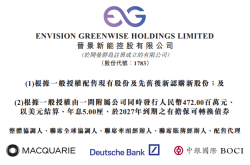
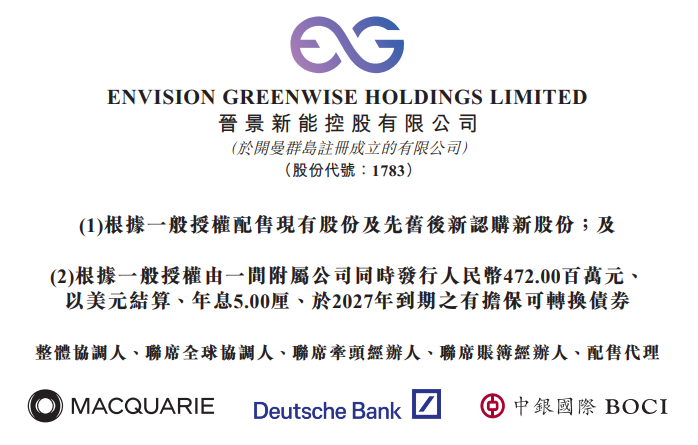
On August 10th, Jin Jing New Energy unveiled a fresh round of equity placement and convertible bond financing, amassing a total of approximately HK$1.098 billion from these two transactions.
The most striking element is that a subsidiary of MiniMax, as a potential investor and subscriber, aims to participate concurrently in both the equity placement and convertible bond subscription.
This signifies that the relationship between Jin Jing New Energy and MiniMax has started to evolve from a potential computing power supply-demand linkage to a capital-based alliance. This marks the inaugural instance, following Jin Jing New Energy's relentless advancement in AI computing power deployment over the past two months, where a model company has been observed participating at the capital level.
Why Did MiniMax Participate in Jin Jing New Energy's Subscription?
The most direct rationale is that computing power is emerging as a long-term cornerstone for model companies. Various model manufacturers are securing long-term computing power resources, as possessing computing power equates to having the opportunity to generate more revenue in the future.
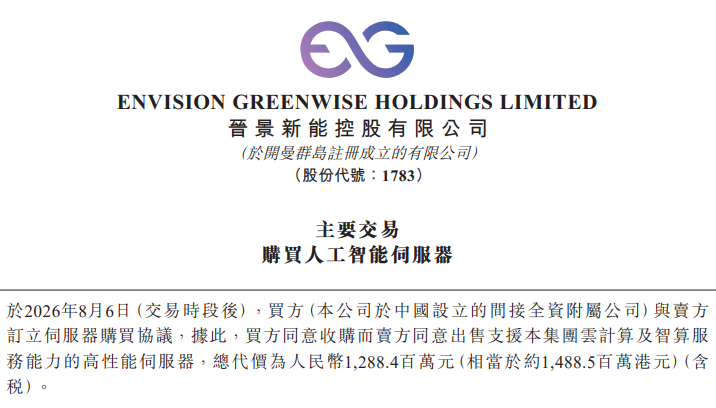
Jin Jing New Energy has already made strategic moves in this direction over the past few months. For instance, on August 6th, it acquired computing power servers worth 1.288 billion yuan.
Historically, when the market discussed AI computing power, it predominantly focused on large-scale model pre-training.
However, with the ongoing evolution of the AI industry, the computing power requirements of model companies have broadened to encompass model training, post-training, reinforcement learning, multimodality, agents, and large-scale inference.
Thus, for model companies like MiniMax, computing power is no longer a one-time procurement need but a pivotal infrastructure for long-term operations.
Whether in China or the United States, model companies will further ponder a question: as their needs escalate, can cloud service providers scale up concurrently?
Consequently, a stable supply of computing power inherently possesses strategic value. This is a long-term infrastructure development process, and every model company necessitates a trustworthy partner.
If it's merely a short-term acquisition of a batch of GPU computing power, both parties can simply enter into a service contract.
However, if a model company's computing power needs are enduring, continuous, and ever-growing, then forging a deeper relationship with computing power infrastructure suppliers holds stronger industrial logic.
From an industry standpoint, what Neocloud genuinely lacks is not just GPUs themselves. Servers can be procured, and data centers can be constructed, but the ability to efficiently and stably operate large-scale GPU clusters and continuously scale up with customer needs is what the industry truly demands long-term validation of.
From the trajectory of model companies in the United States, it is evident that once a model company establishes a stable cooperation with a cloud service provider, both parties often maintain the relationship for an extended period.
The rationale behind this is straightforward: the data environment, hardware architecture, and operation and maintenance systems all necessitate long-term collaboration and adjustment. Once deployed, there are also significant migration costs associated with changing core infrastructure suppliers.
Therefore, MiniMax's participation in Jin Jing New Energy's equity and convertible bond subscription can be interpreted as a signal of further deepening the relationship between the model demand side and the computing power supply side.
What Does MiniMax's Participation in the Subscription Mean for Jin Jing New Energy?
The first level of significance is that the industrial implications behind this investment are more noteworthy than purely financial investments.
If it were just ordinary institutions participating in the subscription, the market might still harbor doubts about Jin Jing New Energy's subsequent computing power operations and customer acquisition capabilities. However, MiniMax itself is a demander of computing power, and its willingness to participate in the subscription at least indicates that this transaction involves more than just capital support; it also carries a layer of endorsement from the industrial side.
As mentioned earlier, the computing power business is ultimately not just a matter of asset scale but whether customers are willing to use it long-term and continuously scale up.
The second level of significance is that for Jin Jing New Energy, customers and capital may start to form a virtuous cycle.
Currently, we are witnessing a rapid development phase of open-source models. The higher the quality of Chinese open-source models and the lower the inference costs, the more scenarios that can leverage AI, ultimately potentially leading to greater token usage and computing power demand. This is the "Jevons effect" manifesting in the large-scale model industry.
As model efficiency increases and inference prices decrease, it may seem that computing power consumption would diminish, but the reality may be the opposite.
After the cost per unit of intelligence decreases, many scenarios that were previously not economically viable for AI usage become feasible. Companies can utilize AI for customer service, programming, marketing, data analysis, office automation, and agent workflows, ultimately potentially leading to greater total token usage and total computing power demand.
For Jin Jing New Energy, these transformations may be transmitted in two directions.
On the one hand, as MiniMax's model capabilities continue to evolve, if both parties further extend their capital cooperation to long-term computing power cooperation in the future, the growth in MiniMax's own model invocation volume and computing power demand is expected to directly translate into potential business growth for Jin Jing New Energy.
On the other hand, as more and more companies begin to use lower-cost open-source models to handle a substantial amount of work, broader computing power demands will also surface.
Because the vast majority of enterprises do not have the necessity or capability to build large-scale GPU clusters themselves. With the widespread adoption of AI applications, they are more inclined to choose to rent GPU computing power, cloud computing resources, or related AI infrastructure services.
For cloud computing and AI infrastructure service providers like Jin Jing New Energy, the true long-term opportunity does not lie solely in serving a few large-scale model companies but in the increasingly vast enterprise computing power market that emerges as AI capabilities continue to proliferate.
The More Prosperous the AI Industry, the Easier It Is for Jin Jing New Energy to Demonstrate the Value of Its Computing Power
No matter which model company ultimately prevails, the entire industry shares a common need: more and more stable computing resources.
Competition at the model layer may be fierce, and models themselves may continuously decrease in price or even become open-source. However, from an infrastructure perspective, the cheaper and more widely applied models are, the greater the computational load they may ultimately need to bear.
Therefore, for AI infrastructure companies, their business logic is akin to that of a "water seller" in the AI industry.
From a capital market perspective, these transformations will also influence a company's valuation logic.
Pure data center or server assets are more readily perceived by the market as heavy-asset infrastructures. However, if these assets can bind long-term customers and generate stable income through continuous scaling, the market's focus will gradually shift from "how many assets there are" to "how much sustainable cash flow these assets can generate."
This is also why AI infrastructure companies ultimately still need to revert to several core indicators: customer quality, contract duration, computing power utilization rate, and delivery capability.
MiniMax's participation in Jin Jing New Energy's subscription also precisely reflects that although model enterprises and infrastructure enterprises occupy different positions in the industrial chain, their interests are increasingly deeply intertwined.
For the rapidly expanding AI computing power market, the earlier stable relationships are established with model companies, the more opportunities there will be to continuously scale up in line with customer demand growth in the future. This is also why MiniMax's participation in the subscription is worth monitoring.
Looking at our peers who are already leading the way, there is actually a relatively clear path.
Overseas, CoreWeave achieved $2.575 billion in revenue in the second quarter of 2026, a year-on-year increase of 112%. Its backlog has reached $104.2 billion, a year-on-year increase of 246%. While long-cycle orders are rapidly expanding, they also provide high visibility for future revenue.
CoreWeave's example illustrates that what truly matters for AI cloud providers is not just how many GPUs they possess but whether they can first secure long-term, definite customer demand and then continuously expand their infrastructure around these demands. Long-term contracts essentially mitigate the demand uncertainty faced by large-scale capital expenditures.
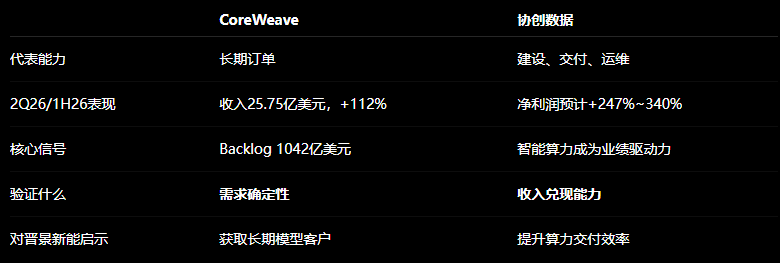
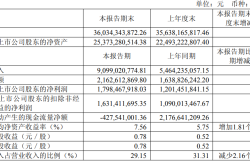
Domestically, Xiechuang Data provides another illustration. The company anticipates its net profit attributable to shareholders for the first half of the year to increase by 247%-340% year-on-year, with intelligent computing power products and services becoming the core driver of performance growth. The company specifically mentioned that by enhancing its computing power cluster construction, delivery, and operation and maintenance capabilities, it has shortened project delivery and acceptance cycles.
Although the models of the two companies are not exactly identical, the underlying logic is consistent: long-term contracts alleviate demand uncertainty, while operation and delivery capabilities determine how swiftly these demands can be converted into revenue and profits.
From this vantage point, CoreWeave and Xiechuang Data also furnish Jin Jing New Energy with two very clear indicators for future observation: first, whether it can continuously secure high-quality, long-term customers; second, whether it can swiftly and stably deliver additional servers and computing power clusters.
For Jin Jing New Energy, this is precisely the significance of MiniMax's participation in the subscription.
The company has already commenced establishing capital-level connections with genuine model demanders. The next step is to ascertain whether this relationship can continue to translate into long-term computing power demand and whether the company can swiftly convert this demand into revenue through server deployment and cluster operations.
If this path can gradually be validated as effective, then the significance of MiniMax's participation in the subscription will not be confined to a one-time capital cooperation but may become a pivotal milestone for Jin Jing New Energy's AI computing power business to transition from infrastructure construction to customer acquisition and revenue realization.
-
![]()
Samsung Galaxy Z Fold 8 Review: Ultra-Slim Dual Design Shines, but Telephoto Absence is a Bummer
-
![]()
Dongfeng VOYAH’s New Car Makes a Splash, Targeting More Than Just the 30s and 40s Crowd
-
![]()
Annual Salary of 700 Million Fails to Retain Him! AI Genius Jiahui Yu Departs Meta to Launch His Own Startup
-
Qianwen Seeks to Move Beyond Its 'Alibaba Identity'
-
![]()
How Can We Comprehensively Resolve Ctrip's Monopoly Issue?
-
![]()
From Computing Power Supply-Demand Dynamics to Capital Integration: Jin Jing New Energy Embarks on a New Business Phase
-
![]()
Top Domestic Computing Power Supplier Exceeds Net Profit Forecasts for First Half of the Year
-
![]()
Wanwei Advanced Materials Plans to Raise 2.3 Billion Yuan through Private Placement to Boost PVA Optical Film Production!