Japan's XR Offline Experiences: A Slowly Expanding Market with Evolving Content
 04/16 2026
 575
575
The Overseas XR Offline Track Hasn't Gotten Competitive Yet
By VR Gyro
Since last year, there have been numerous cases of large-scale XR projects going overseas, promoting Chinese cultural IPs and immersive technologies globally. For example, 'Eternal Tang Dynasty' was launched at the Centre Pompidou in France, while 'Dunhuang: A Journey of a Thousand Colors,' 'Hidden Qin Mausoleum,' 'Tang Palace Night Banquet,' and 'Exploring the Kingdom of Haihunhou' made their debuts in Japan.
According to incomplete statistics from VR Gyro, nearly 200 large-scale XR projects will be launched nationwide by 2025, covering various aspects such as history, culture, film/TV/anime/literature IPs, scientific exploration, and art. The range of content themes is becoming increasingly diverse. Related Reading: 'Over 200 New Projects in 2025: Where Will XR Large-Scale Spaces Head in 2026? | Annual Feature'
Starting in the second half of 2025, the number of offline XR experience projects in Japan has noticeably increased, forming a content-driven form of offline entertainment that maintains a 'steady but unhurried' development pace.
*The following information is primarily sourced from public data, corporate press releases, and industry reports.
01
Stable Pattern of Japanese XR Offline Experiences Embedded in Shopping Districts and Entertainment Venues
As consumer demand for immersive experiences continues to grow, shopping malls, theme parks, entertainment centers, and game arcades in Japan have begun to deploy XR entertainment experiences, primarily in major cities like Tokyo, Osaka, and Yokohama. These cities have high population densities, developed tourism industries, and a high acceptance of entertainment content and new technologies. Core shopping districts such as Tokyo Tower, Roppongi, Shinjuku, and Shibuya are ideal locations for immersive offline entertainment activities.
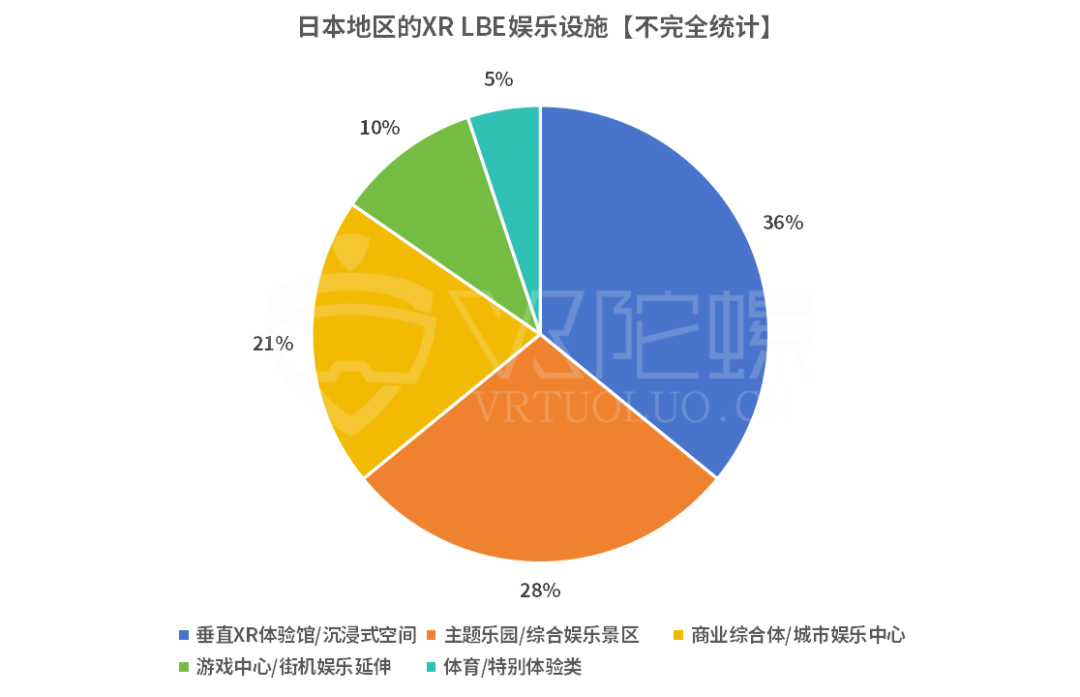
According to incomplete statistics from VR Gyro, there are currently at least 60 XR experience spaces open to the public operating offline in Japan (including dedicated experience venues and XR projects within complexes), with relatively mature standardized franchise systems from brands like HADO and Immersive Journey. However, few of these brands have scaled to over a hundred locations.
Take HADO as an example, a well-known AR multiplayer competitive game featuring dodgeball-style gameplay. Players wear custom AR headsets and arm sensors to form teams, using moves like energy balls and shields to compete for points in 80-second matches. Its content developer, meleap, claims that its AR game HADO has over 1,000 corporate users, reaches 2,000 schools, and operates in more than 40 countries.
In the current landscape with significant gaps in AR consumer applications, these achievements are remarkable. HADO has successfully transitioned from the consumer (C-end) market to the business (B-end) sector, including enterprises and schools, while also pioneering a unique track for XR offline experiences. This model reflects that Japan's approach to achieving scalable expansion in XR offline experiences through 'lightweight devices + competitive gameplay' is feasible locally.
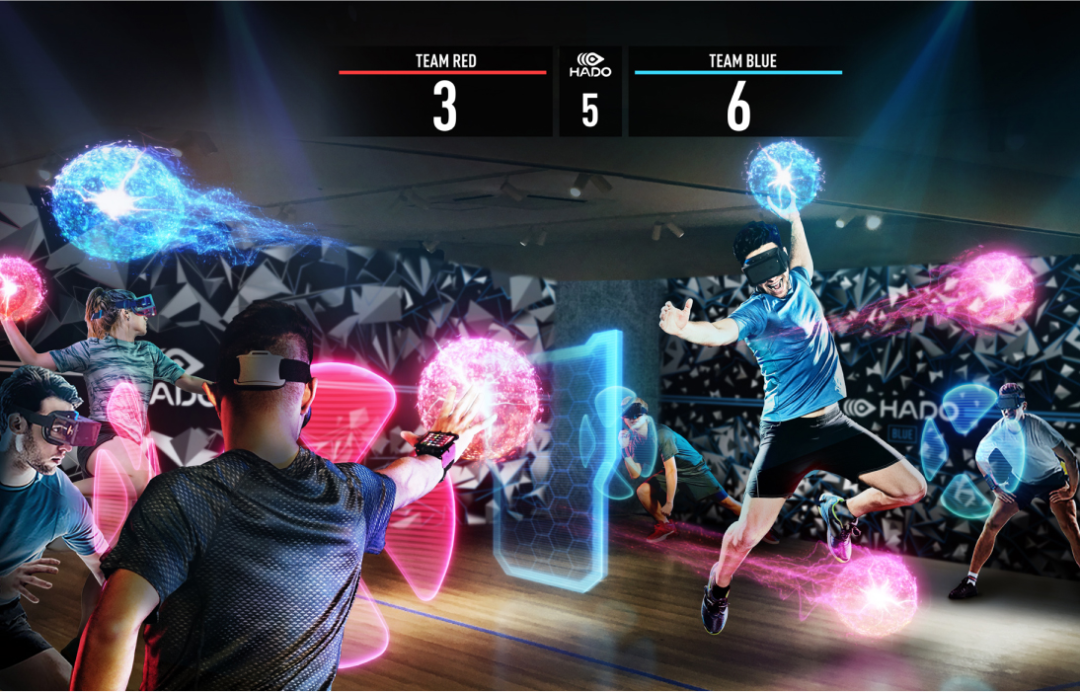
From a location perspective, most Japanese XR offline experiences are concentrated in shopping districts, tourist landmarks, and established entertainment facilities, such as the XR entertainment space within Tokyo Tower. These venues already have stable foot traffic, with XR experiences primarily serving to enrich the entertainment offerings. These entertainment spaces or multi-purpose venues, distributed across different floors of the venues, often host pop-up or short-term exhibitions, typically offering short-duration experiences themed around art exhibitions, flight simulation, shooting, horror, and more.
On one hand, single experiences are relatively short and have low operational barriers, making them more suitable for mall visitors or tourists. On the other hand, most venues achieve periodic content updates by continuously introducing IP collaborations or limited-time offerings. This indicates that Japan's large-scale XR spaces generally prefer integrating distinctive XR experiences into existing entertainment and consumer venues.
In contrast to the rapid expansion of large-scale XR spaces in China, the Japanese market—with its high real estate costs—has a limited overall scale and steady growth. The industry's focus is not on venue quantity or franchise expansion but on content iteration, IP collaboration, and scene integration, becoming part of a mature offline consumer ecosystem.
02
Japanese XR Offline Entertainment Landscape: Rich IP Resources, but XR Experiences Remain Niche
Looking back over a longer timeline, Japan was one of the earliest global markets to explore XR offline experiences.
During the previous VR boom, VR experiences based in theme parks, arcades, and commercial complexes were already established in Japan, with some even forming large-scale attempts. Bandai Namco, for instance, developed multiple VR experiences on a large scale. Data from VR ZONE Shinjuku in 2017 is particularly representative: it received 500,000 visitors in nearly a year of operation, with an average spending of 5,500 yen (approximately 326 RMB at the time), and a peak daily foot traffic of 2,000 people.
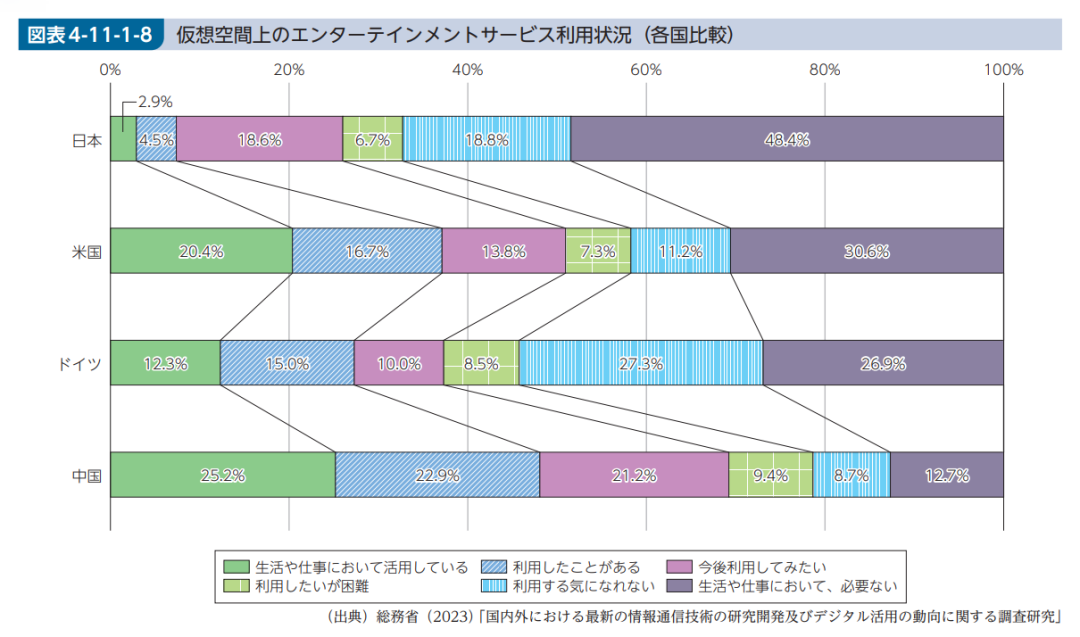
Usage of Virtual Space Digital Services (XR Content) Across Countries
However, in terms of current market penetration, XR remains niche in Japan.
According to data released by Japan's Ministry of Internal Affairs and Communications in 2023, the proportion of the population that has used XR content is 20-30% in the United States and Germany, over 50% in China, but only 7.4% in Japan. Looking at usage by age group in Japan, people in their 20s have the highest usage rate (12.6%), and the proportion of those who 'want to use it in the future' is also highest among this group (30.6%). This data suggests that XR remains a non-essential experience form in Japan.
During the prolonged impact of the COVID-19 pandemic, people's entertainment activities shifted to their homes. Major manufacturers withdrew from the market, while some companies increased their use of virtual spaces not only for online events like virtual exhibitions and internal corporate activities but also for education and training, customer service, and online retail shopping experiences. Online entertainment and virtual socializing, primarily on platforms like VRChat, saw rapid growth. Coupled with collaborations with well-known IPs, this further intensified the demand for 'content expressiveness' and 'sensory immersion' in Japan's XR offline experiences.
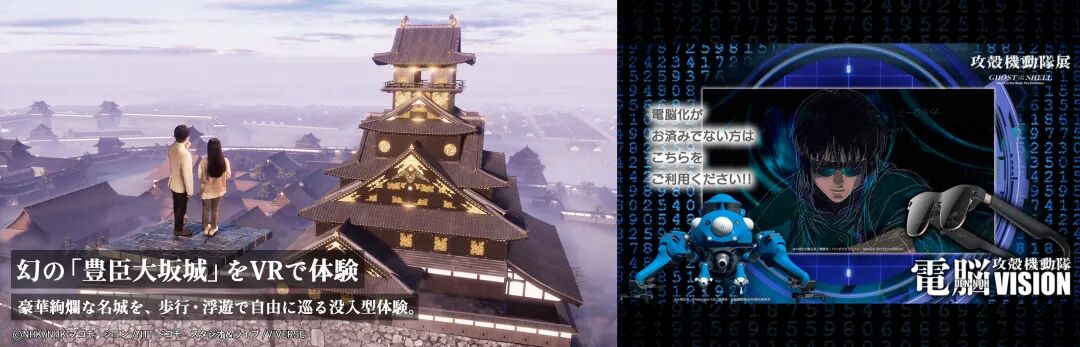
After the pandemic, people returned to the streets. The participants in Japan's offline XR experiences have changed but are gradually recovering, driven by three factors: first, device advancements have improved user experiences; second, there has been a significant short-term increase in demand for offline socializing; third, many consumers who had never experienced XR content before are now trying it out.
Relying on its mature anime, gaming, and film industries, Japan possesses strong IP reserves and cross-media development capabilities. For the local market, XR is more of a new expressive medium rather than a necessity. By continuously introducing new IPs or themes, Japan's XR offline experiences can achieve content updates and user revisits at a lower cost, without relying entirely on large-scale spaces or complex interactions to sustain appeal.
From a consumer habits perspective, Japan's mature entertainment market allows XR experiences to fit naturally into existing activity systems, appearing in short-duration, low-barrier forms that also reduce content and space pressures for operators.
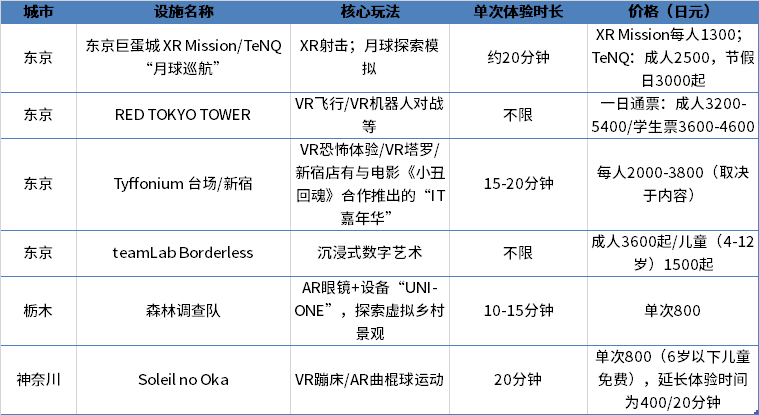
Source: MoguraVR
From the XR projects open for experience during the 2026 New Year period shown in the chart above, it is evident that low-priced projects around 800 yen are mostly concentrated in AR interactions or lightweight VR sports, suitable for embedding in family entertainment centers or outdoor attractions. In the 2,000 to 4,000 yen range, immersive XR experiences dominate, emphasizing narrative content and immersive atmospheres. Many projects have already been integrated into comprehensive entertainment centers, packaged with XR interactive projects through combo tickets.
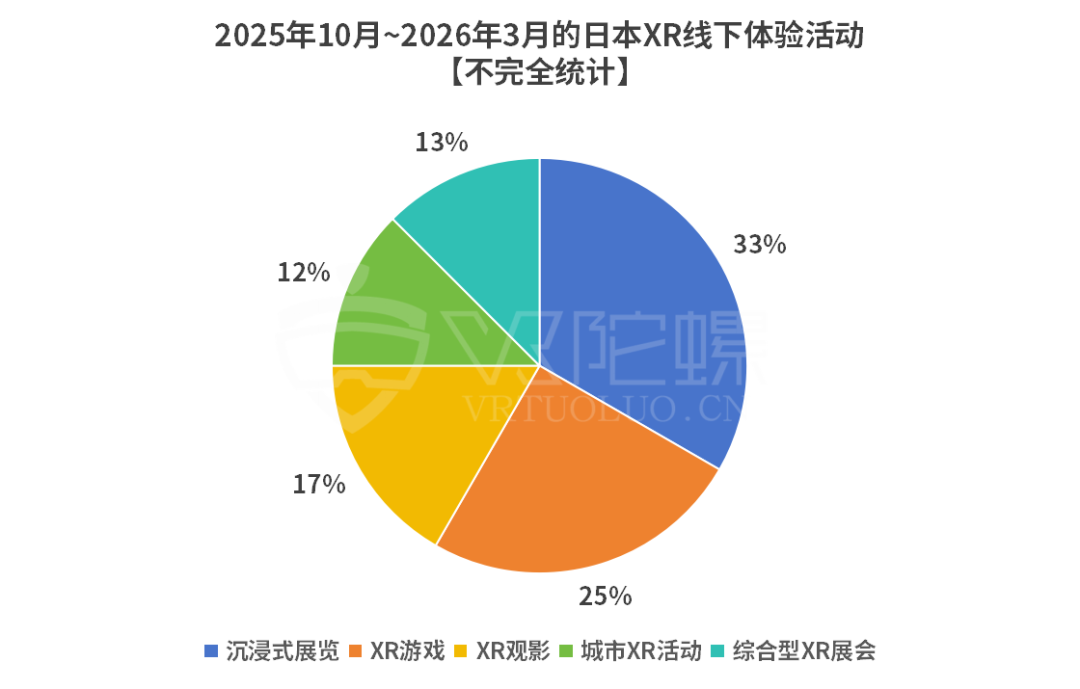
It is clear that there are two types of projects: one focuses on devices or gameplay, driving user consumption through novelty, with low content update costs but high substitutability; the other is content-centric immersive experiences. According to statistics, out of 24 XR offline events from October 2025 to March 2026, IP-linked XR content accounted for 30%, including IPs like Ghost in the Shell, Ultraman, Monster Hunter, VTubers, and Fuji-Q Highland's haunted house. These projects build differentiation through storytelling, the IP itself, or spatial narratives, offering stronger potential for repeat purchases.
Compared to the rapidly expanding XR offline market, Japan's exploration of XR offline experiences seems to emphasize refining individual projects' content and commercial closures. Given that the local industry is still in its early stages, this approach may provide valuable insights for Chinese XR large-scale space companies planning to enter the Japanese market.
03
Japanese XR Large-Scale Spaces: 'It Will Be a Battle of Precision'
The competition in XR large-scale spaces is shifting toward quality, with blockbuster content like 'The Disappearing Pharaoh' landing in the Japanese market further stimulating demand for high-quality XR content locally.
In November 2025, CinemaLeap announced that its XR experience venue 'Immersive Journey' in Yokohama had surpassed 120,000 visitors after a year of operation, with women accounting for 60% of the audience and a higher concentration among people aged 40 to 60. The brand has opened multiple chain locations, including Yokohama, Nagoya, and Hiroshima, each with different operational methods and content themes.
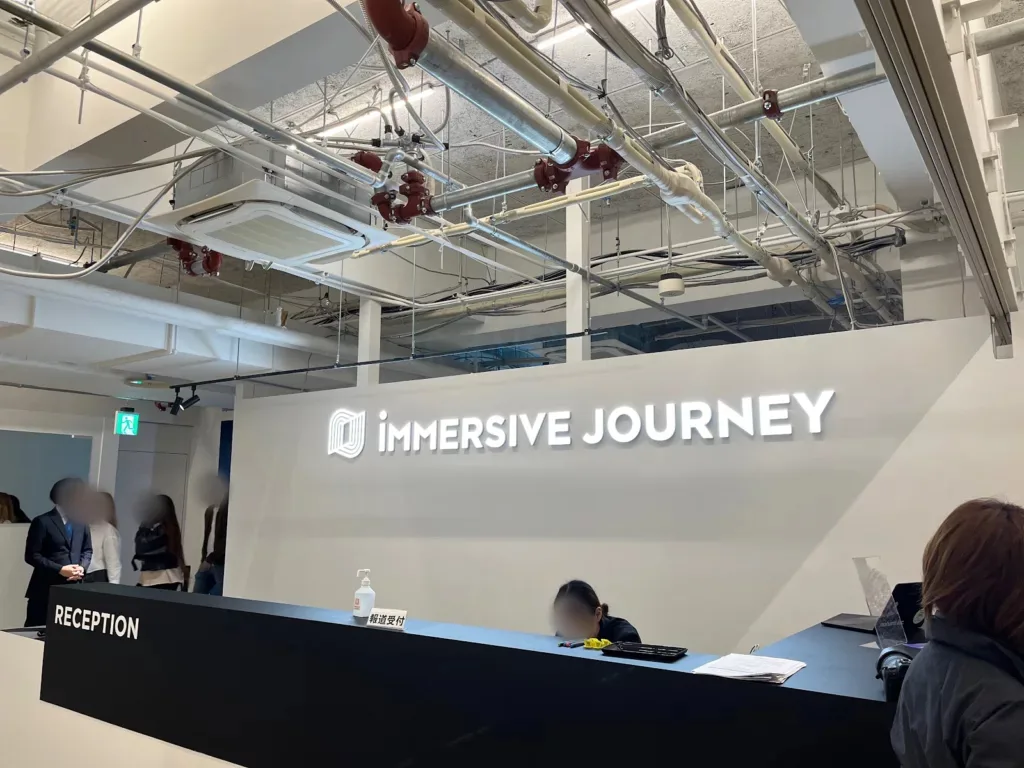
CinemaLeap's CEO, Tetsuya Ohashi, mentioned in an interview with MoguraVR that 'free roaming' is not just an upgrade in experience form but also extends users' dwell time (dwell time) in the space, which is a key factor in enhancing the commercial efficiency of surrounding venues and promoting consumption in current XR large-scale spaces.
Ohashi stated that the Immersive Journey project originated from the desire to transcend time and geographical limitations to fulfill people's desire to 'go somewhere,' hoping to expand globally. To achieve overseas dissemination, the themes must have cross-cultural recognition. For example, while the 'Great Wall of China' is well-known in China, many world heritage sites are unfamiliar to foreigners.
'We envision that, just like in cinemas, the characteristics of the crowd gathered here will change with the attractiveness of different content. Initially, we will use specific themed content to expand the market (develop the market), but ultimately, we hope to offer various themed works to attract diverse audiences.' Rather than simply importing works, CinemaLeap even employed a luxury voice actor lineup, including Hiroyuki Kagawa and Takehito Koyasu, during the localization of 'Paris 1874: A Night of Impressionism' to enhance local appeal.
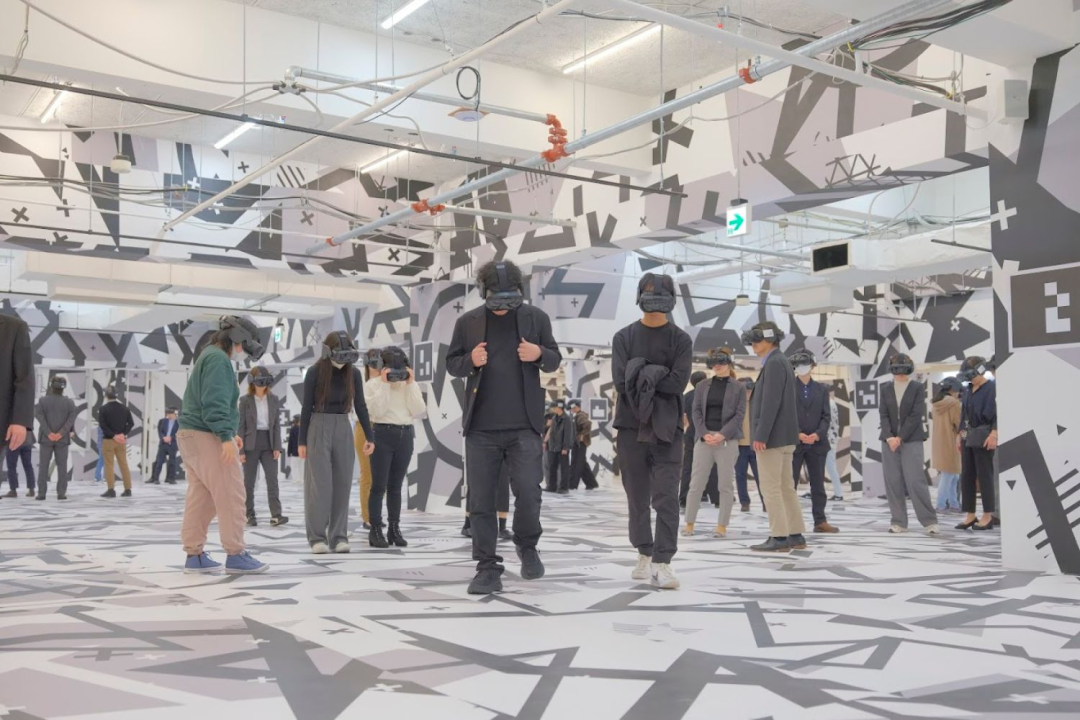
Ohashi categorizes Immersive Journey's offline experience stores as 'second-generation players' in Japan's XR LBE industry:
'In terms of the entire XR LBE industry, France and China are indeed ahead, and examples like the globally successful Sandbox VR continue to emerge. We feel that the path for this business model is gradually becoming clear, and 'second-generation' companies are now emerging in Japan. The key going forward lies in what kind of content is offered and how it is operated—this will be a battle of precision.'
Whether through introducing mature content IPs, strengthening local production, or expanding audiences through multi-theme operations, the essence of XR large-scale spaces is to improve the 'efficiency of matching content with space.' The challenge lies in what Will continue to attract users (continuously attracts users) to XR large-scale spaces.
04
Final Thoughts
Japan's XR Offline Experiences Are Entering a Phase of Application Integration
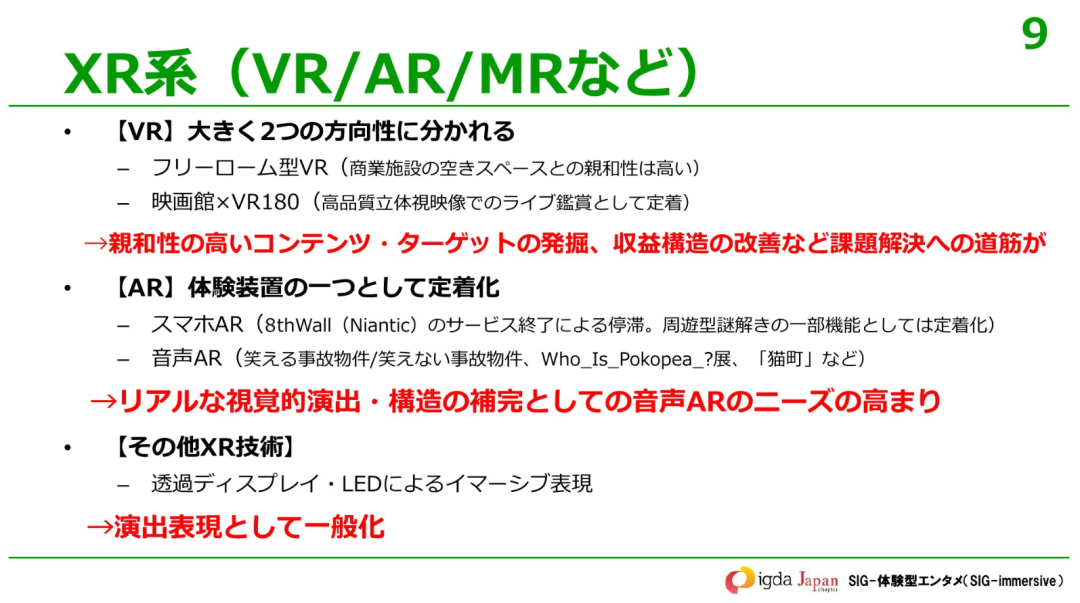
XR offline experiences, whether in the form of XR LBE highly adapted to commercial spaces or cinema-like content represented by VR180 videos, are moving away from early industry explorations of gameplay and formats. Instead, the focus has shifted to validating and optimizing business models.
In comparison, while AR glasses are developing rapidly, changes in AR offline experiences are more subtle yet decisive. What is most lacking is the exploration of application scenarios with greater breadth and depth.
Mainstream AR applications can now naturally integrate into various experiences, becoming part of information enhancement and content guidance, as amply demonstrated in domestic cultural tourism and museum education scenarios. The Japanese market is also exploring content formats like IP + offline events + AR/AI glasses, which are relatively rare in the domestic market. Only high-quality content can enhance a company's long-term competitiveness. There is still a long way to go in the transition of XR from a technological concept to a commercial infrastructure.
-
The Backside Knife Skills of vivo S60 and OPPO Reno16
-
![]()
Breaking News | Core Chip Team Member Unexpectedly Changes Jobs! OpenAI Transforms into Anthropic's Talent Hub, with Over 15 Ex-OpenAI Core Members Now Holding Key Roles at Anthropic
-
![]()
When European Factories Face Idle Capacity, Chinese Brands Offer a ‘Traditional Chinese Remedy’
-
![]()
SEER Robotics Passes IPO Hearing: How Valuable Is the 'First Robot Brain Stock?'
-
![]()
5 Years, 170 Billion Yuan Wealth Vanishes: Where Did Wei Jianjun Go Wrong?
-
![]()
What Exactly Has Changed with the AI That Automatically Opens a Browser to Search Xiaohongshu?
-
![]()
Over 3,000 Heat-Related Deaths Daily, Yet India Imposes Ban on Chinese Air Conditioner Imports: Unraveling the Underlying Motives
-
![]()
Second-Hand Car Prices Plummet: Are Gasoline Vehicles on the Verge of Collapse?