Wang Tao Builds a Fortress, Liu Jingkang Sets Up a Ladder: Decoding the Billion-Dollar Shadow War Between Shenzhen's Imaging Titans
 04/16 2026
 671
671

If Liu Jingkang is the 'Red Boy,' then who is Wang Tao?
Content/YoYo
Edited by/Goose
Proofread by/Mangu
In a recent interview with *LatePost*, DJI founder Wang Tao was asked, 'What is the biggest difference between Insta360 and the competitors DJI has faced before?' Wang Tao responded with a vivid metaphor: Insta360's boss is 'young and dynamic, reminding me of the 'Red Boy' from *Journey to the West*.'
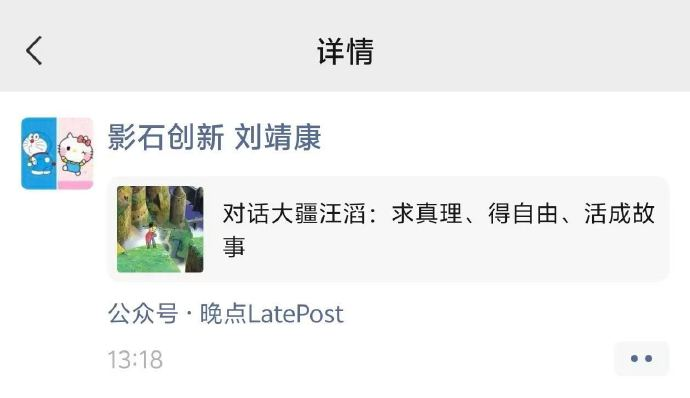
The remark quickly spread. Liu Jingkang, founder of Insta360, subsequently reposted the interview on his WeChat Moments without any comment. This silent repost was interpreted by the outside world as a tacit acknowledgment of the challenge.
In *Journey to the West*, the Red Boy is a powerful and fearless figure, wielding fire as his weapon. However, due to his lack of experience and unstable foundation, he is ultimately subdued by Guanyin and becomes her disciple. Wang Tao's metaphor conveys both a restrained admiration and an unmistakable sense of superiority.
Behind this Literati style (literati-style) banter lies an escalating rivalry between the two companies. Just a month ago, DJI formally sued Insta360 in the Shenzhen Intermediate People's Court over six patent ownership disputes, directly targeting the patent attribution involving several former core DJI R&D personnel.
Earlier, in July 2025, Insta360 released its first panoramic drone. Three days later, DJI countered with a 360-degree camera priced at 2,999 yuan. The product war, characterized by mutual undercutting, has now raged for nine months.
During the interview, Wang Tao added, 'We hope for a healthy competitive business environment and a higher level of tacit understanding (tacit understanding) among entrepreneurs regarding rules, rather than constantly creating media buzz for publicity.' The statement was diplomatic, but it was clear that he was subtly criticizing Insta360 for its skill in generating public discourse.
However, Wang Tao himself gave an exclusive interview to the media, made the aforementioned remarks, and sparked widespread discussion. At this level, both are waging the same narrative war, albeit with different methods and postures.
This is what makes this competition so fascinating—it's not just a disagreement over product strategies but also a fundamental divergence in how the battle should be fought.
Part.1
Breaking Boundaries
The Erosion of Distinctions Between Shenzhen's Imaging Titans
In Shenzhen's Nanshan District, two streets less than ten kilometers apart house the two leading companies in China's smart imaging industry.
On Liuxian Avenue, DJI Innovation's glass-walled office building is so understated that its logo is barely visible. Yet, it dominates over 70% of the global consumer drone market. On the other end of the tech park, Insta360's office is adorned with creative posters by young people. This company, founded less than a decade ago, was once crowned the 'King of 360-Degree Cameras' with an 85% market share.
For a long time, this was the most harmonious duopoly in Shenzhen's tech ecosystem—DJI ruled the skies, while Insta360 documented the ground. The two even complemented each other: DJI's drones carried Insta360's panoramic cameras, jointly defining extreme imaging.
But the iron law of business dictates that when growth in a vertical market peaks, giants must seek a second act by crossing boundaries into each other's core territories.
Why now?
DJI's challenge lies in the maturity of the consumer drone market. By 2024, China's consumer drone shipments reached approximately 3.5 million units, with penetration nearing its ceiling. Price wars and functional homogenization have put pressure on profit margins.
In the action camera segment, DJI's Action series excels in hardware performance but trails Insta360's Ace series in popularity among young users. Insta360's AI auto-editing and panoramic features have created a formidable barrier. For DJI, failure to act proactively would mean its product line faces a midlife crisis.
Insta360's predicament is more fundamental. As a publicly traded company, it needs a continuous growth narrative, but the ceiling for the panoramic camera market is inherently low.
In 2025, Insta360's revenue approached 10 billion yuan, but growth was driven primarily by action cameras. The absolute market size for panoramic cameras remains limited. If Insta360 cannot break into the larger consumer imaging market and transition from a panoramic specialist to an all-scenario imaging platform, its market capitalization will hit a ceiling. Drones represent Insta360's narrative anchor for upward breakthrough (breakthrough).
Thus, the 2025 'sky-and-ground offensive' was no by chance (coincidence) but an almost inevitable clash after both companies pushed their respective growth logics to their limits.
This war is not just about product lines but also about two fundamentally different survival philosophies.
Wang Tao is a quintessential tech geek—obsessed with engineering and uncompromising on performance. DJI's moat—its fully self-developed flight control, image transmission, and gimbal systems, along with over 38,000 granted patents and annual R&D investment accounting for 15% of revenue—is a product of this obsession.
With estimated total revenue of 85-90 billion yuan in 2025, DJI, as a private company, is not beholden to quarterly financial reporting to the capital markets. It has ample resources to wage price wars, patent battles, and talent wars.
Insta360's DNA is entirely different. Founder Liu Jingkang has an internet background and operates more like a product manager. His intuition lies in understanding users, dissecting scenarios, and lowering the barrier to creation through algorithms and user experience. When Insta360 launched its first panoramic camera in 2015, its core selling point was not hardware specifications but a revolutionary creation experience—shoot first, select later, and AI auto-editing.
As of mid-2025, Insta360 had been granted 998 patents, including 222 invention patents. The rest were primarily utility and design patents, covering software algorithms such as panoramic stitching, FlowState electronic image stabilization, and AI post-production.

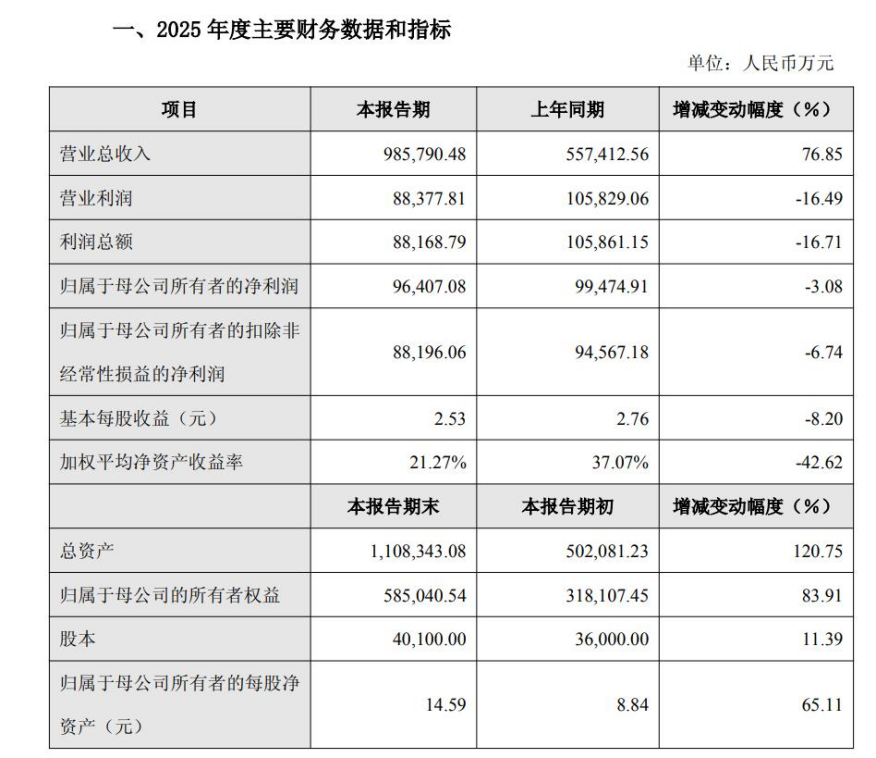
In 2025, Insta360's revenue reached 9.858 billion yuan, with R&D investment of 1.649 billion yuan. This lightweight hardware, heavy algorithm approach led it to choose a differentiated breakthrough strategy against DJI.
These two philosophies coexisted peacefully until they collided, resulting in intense friction.
Part.2
Clash
Real Offensives and Defenses Across Four Fronts
The mutual incursions into each other's territories in July 2025 marked the shift from differentiated coexistence to direct confrontation between DJI and Insta360. The war now spans four domains: 360-degree cameras, action cameras, handheld gimbal cameras, and drones.
360-degree cameras are Insta360's stronghold. Since 2018, it has held the global top spot for eight consecutive years, with a market share as high as 91% in Q1 2025. However, DJI's entry with the Osmo 360 reshaped the landscape in just three months.
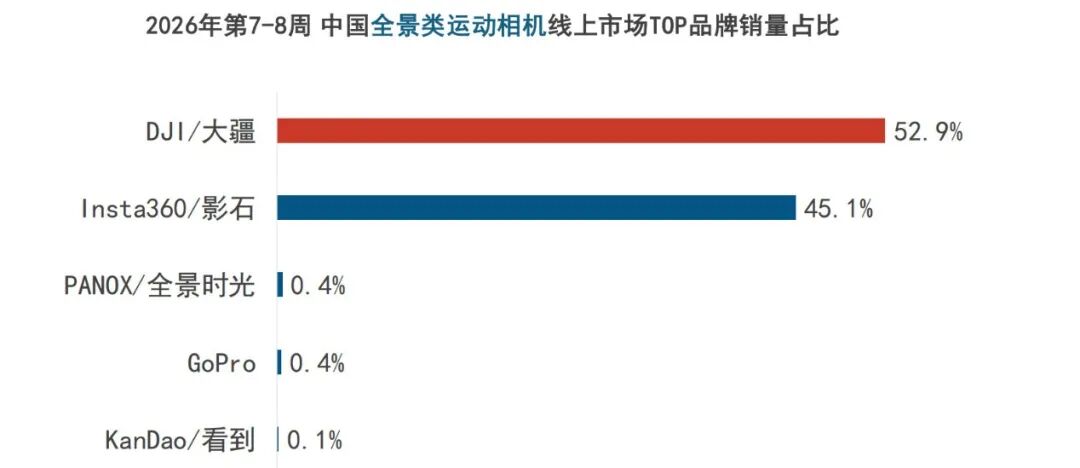
According to Jiutian Zhongtai data, DJI surged from zero to a 43% global share in Q3 2025, while Insta360's share plummeted to 49%. Luotu Technology's 2026 Spring Festival weekly tracking showed DJI dominating with a 62.9% total sales share, compared to Insta360's 28.6%. In the 360-degree camera segment, a single DJI model captured 52.9% of the market, while Insta360's three models combined accounted for 45.1%.
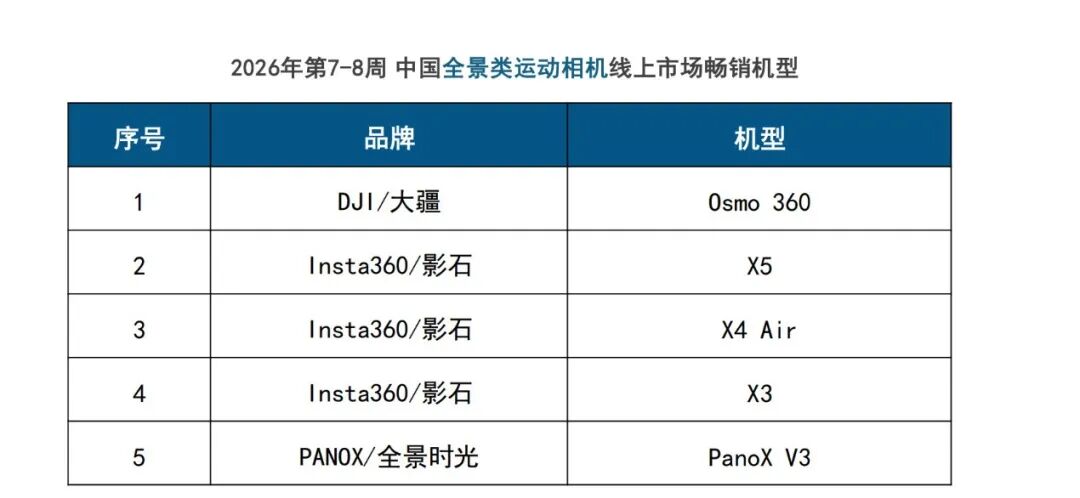
But the fundamental battle in 360-degree cameras is over content ecosystems. Insta360's years-built creator community, influencer partnerships, and vast UGC content library represent its most authentic defense against DJI. Hardware can be matched, algorithms replicated, but the network effects of a content ecosystem take time to accumulate and cannot be bought with money.
The action camera front is where differences are most stark. DJI's Action 5 Pro emphasizes mechanical stabilization, a large sensor, and professional color science. Insta360's Ace Pro 2 focuses on dual-lens switching, AI smart tracking, and fun shooting modes.
The gap between the two products reflects not just technical differences but also user positioning. DJI targets professionals, while Insta360 caters to young creators seeking ease of use.
These two groups could coexist, but with the proliferation of AI creation tools, the demand for effortless creativity is rapidly penetration (penetrating) mainstream users. If DJI fails to offer compelling experiences, its professional label could become a barrier.
Insta360's 'Yingling A1' panoramic drone represents the highest-risk surprise attack in this campaign. Facing DJI's flight control technology and patent fortress, Insta360 avoided direct competition on flight performance and instead promoted the concept of an 'aerial panoramic camera.' On its first day, it generated 20 million yuan in sales. However, this move also ignited DJI's patent artillery.
Insta360's success hinges on whether its panoramic shooting experience is compelling enough for users to accept compromises in flight performance. For Insta360, drones may remain a money-burning strategic track in the short term.
Part.3
Shadow War
Who Will Define the Next Wave of Creation?
In April 2026, DJI initiated six patent ownership disputes against Insta360—its first domestic ownership lawsuit, focusing not on infringement damages but on the ownership of the patents themselves.
The essence of this lawsuit is DJI's attempt to legally defend its technological monopoly while increasing Insta360's R&D and legal costs, as well as impacting its market value and capital market performance. For Insta360, this is also a public public opinion battlefield it must confront head-on. Retreating would signal weakness, while countersuing and positioning itself as an 'innovator suppressed by a giant' could garner public sympathy.
Regardless of the lawsuit's outcome, the true deciding factor lies in who can define the next paradigm of smart imaging.
DJI's organizational culture is designed to create the world's best professional tools, not to enable effortless creation for everyone. As incremental users increasingly shift from professional photographers to ordinary people seeking to produce good content, DJI's professional tool DNA may alienate young users sensitive to fun and creativity.
The release of the Osmo 360 suggests DJI recognizes this issue, but adjusting product logic is far more complex than launching a new product.
Insta360's greatest survival risk is not product competition but the combined pressure of patent wars and supply chain constraints.
If DJI's patent lawsuit succeeds, Insta360 could face product removals and hefty damages. Price war-induced profit shrinkage would squeeze R&D investment.
For a publicly traded company, such dual pressures could erode market confidence—the first domino to fall.
But Insta360 holds a potent card: its algorithm-led content ecosystem barrier. Panoramic content has a much higher social media share rate than ordinary action camera content. Insta360's AI auto-editing has enabled tens of millions of users to create effortlessly.
Once the network effects of a content ecosystem take hold, they are difficult to break through mere hardware competition. Insta360's best hope is to leverage the rapid advancement of AI technology to scale 'panoramic + AI creation' to a large enough user base, positioning itself as the standard-bearer—not just a participant—in the next wave of creation.
The hardware empire's fortified walls are colliding with the flexible defenses of the AI content ecosystem. Whatever the outcome, on the streets of Shenzhen's Nanshan District, more fascinating business stories are destined to unfold in this charge toward consumer electronics massification and the AI creation wave.
END
-
On the Eve of Its IPO, Avatr Finds Itself Embroiled in a 'Farce of Controversy and Belittlement'
-
![]()
Yutong Optics' Japanese Subsidiary Unveiled in Tokyo, Shifting Strategic Focus to Technology-Driven Growth
-
![]()
Half-Year Revenue Outstrips Last Year’s Total! Zhongrun Optics Forecasts 80.2% H1 Revenue Growth
-
![]()
Why Does AI Competition Start with Computing Power?
-
![]()
Apple AI Finally Makes Its Debut in China, Yet iPhone's 'AI Autonomy' Faces Uncertainty
-
![]()
Apple AI and QianWen Make Up Lessons: Alibaba Has Its Own 'Doubao Phone'
-
![]()
QianWen Joins Apple, Signal for Large Models to ‘Fade into the Background’
-
![]()
The ‘Anchor’ Strategy of Google Hidden Behind the Bleeding Financial Report