Gree and Hisense Unveil Industry Secrets, Stripping Away the Air Conditioning Sector's 'Fig Leaf'
 04/17 2026
 432
432
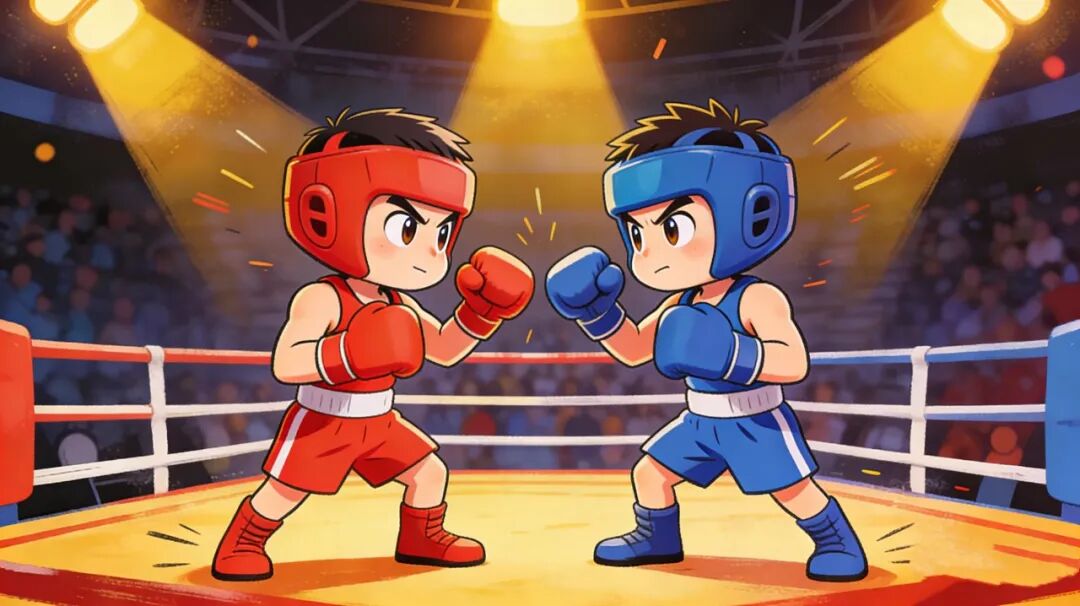
Beneath the surface of this verbal clash lie the strategic decisions of both companies, driven by performance pressures and deep-seated concerns over shifting market dynamics.
/
By Luo Peng | Edited by Yang Xiaoruo
Produced by Business Show
Just as the peak season for the air conditioning industry approaches, a 'verbal dispute' between Gree Electric Appliances and Hisense Air Conditioners has once again thrust industry controversies into the spotlight.
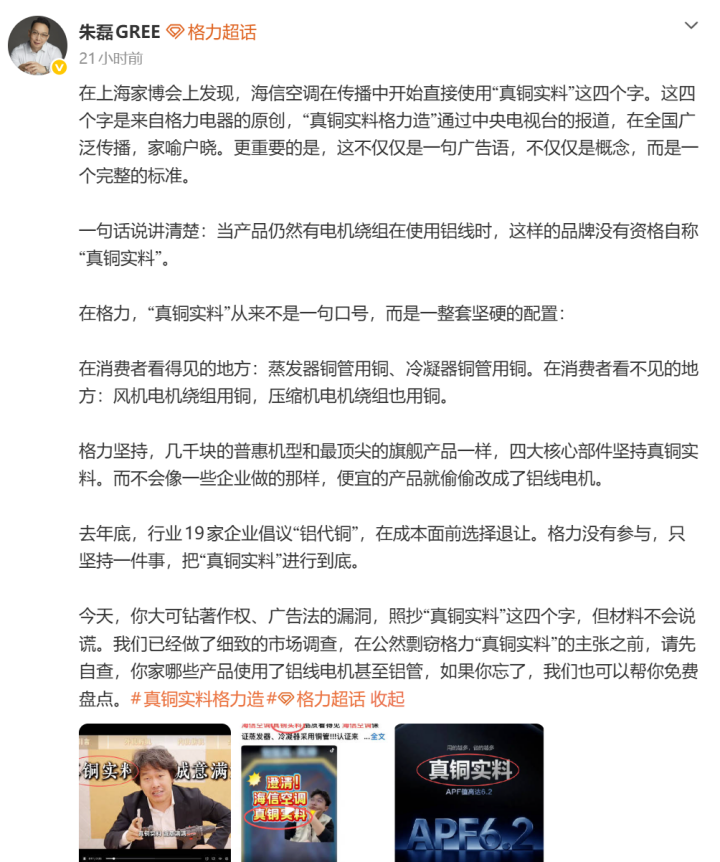
On the evening of April 14, Zhu Lei, CMO of Gree Electric Appliances, took to Weibo, accusing Hisense Air Conditioners of allegedly copying Gree's 'Genuine Copper' marketing message during its promotion at the Shanghai Home Appliances Expo. He also urged Hisense to scrutinize the use of aluminum wire motors and aluminum tubes in its products.
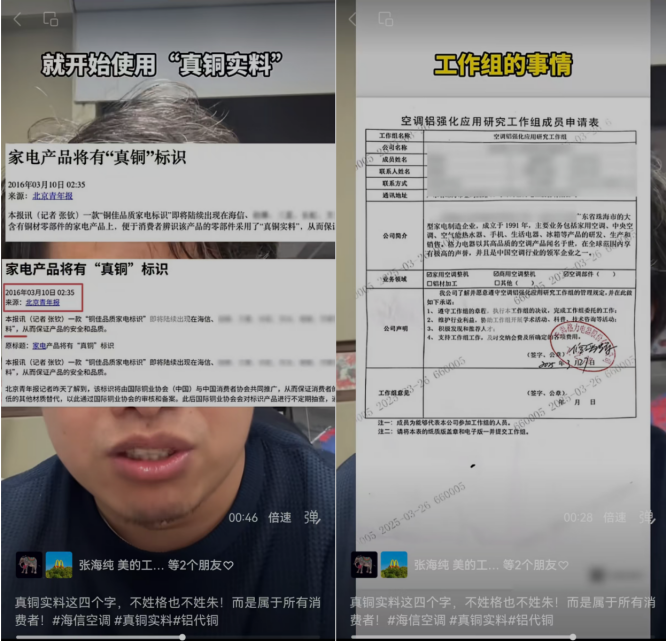
In response, Yang Wanshou, Brand Director of Hisense Air Conditioners' Domestic Marketing Center, released a video stating, 'As early as 2016, media reports highlighted home appliance companies adhering to 'Genuine Copper,' mentioning Hisense, Changhong, Skyworth, and others, but not Gree. It remains unclear who originally coined the term 'Genuine Copper.' In his view, the phrase 'Genuine Copper' is not the exclusive property of Gree or Zhu Lei but belongs to all Chinese people.
Gree's CMO Zhu Lei and Hisense Air Business Division's Brand Director Yang Xiangxi engaged in a heated exchange on social media, clashing over the ownership of advertising slogans, technological approaches, and even energy efficiency standards, resulting in three intense rounds of debate that escalated rapidly.
Yang Xiangxi further alleged that since Gree refuses to replace copper with aluminum, its decision to join the 'Aluminum Application Enhancement Working Group' in March of the previous year was 'hypocritical.'
Gree's CMO Zhu Lei, in a conversation with the 'BUG' column, responded that Chinese companies should conduct themselves with dignity and that Hisense should not 'appropriate' Gree's 'Genuine Copper' concept, which had been widely disseminated through national media. He expressed frustration, stating that Hisense, as a renowned national brand with numerous innovations, had no need to copy Gree's promotional phrases.
Regarding the accusation of 'hypocrisy,' Zhu Lei clarified that Gree's participation in the aluminum application research working group was distinct from advocating for the replacement of copper with aluminum. He emphasized that researching aluminum substitution is entirely different from promoting it.
The 'verbal dispute' between Hisense and Gree, two titans in the air conditioning industry, ostensibly revolves around the ownership of the promotional slogan 'Genuine Copper,' but in reality, it reflects a deeper struggle over cost pressures and technological route choices within the industry. It is evident that both sides are vying to define industry standards and gain market influence.
As early as 2016, brands like Hisense and Changhong incorporated 'Genuine Copper' into their promotions, perhaps foreshadowing today's dispute over originality. Gree's Chairwoman Dong Mingzhu, a staunch advocate of all-copper solutions, has repeatedly stated in public that Gree air conditioners will not replace copper with aluminum until there is absolute certainty, emphasizing copper's superiority in thermal conductivity and corrosion resistance. Hisense, on the other hand, leans more towards balancing cost and technology, attempting to align itself with the industry mainstream.
01 From 'Genuine Copper' Ownership to the 'Energy Efficiency' Controversy
The spark for this controversy was ignited on April 14 when Gree Electric Appliances' CMO Zhu Lei posted on social media, accusing Hisense Air Conditioners of 'plagiarizing' Gree's original 'Genuine Copper' marketing message at the Shanghai Home Appliances Expo.
Zhu Lei emphasized that these four words represent Gree's commitment to using all-copper materials in its four core components (evaporator, condenser, fan, compressor) and hinted at some companies secretly switching to aluminum wire motors in lower-priced models, urging Hisense to conduct a self-investigation.
Hisense responded swiftly. Yang Wanshou (also known as Yang Xiangxi), Brand Director of Hisense Air Conditioners' Domestic Marketing Center, released a video stating that 'Genuine Copper' had been used by brands like Hisense and Changhong as early as 2016 and was not Gree's original creation, asserting that these four words 'do not belong exclusively to Gree or Zhu Lei but to all Chinese people.'
The clash between the two sides did not stop at the ownership of the advertising slogan but quickly escalated into a 'mutual exposure' of technological routes. Yang Xiangxi posted Gree's 'Application Form for Membership in the Air Conditioning Aluminum Application Enhancement Research Working Group,' signed in March 2025, accusing Gree of publicly resisting 'aluminum substitution for copper' while privately applying to join the relevant working group, calling it 'hypocritical.' In response, Zhu Lei explained that joining the 'research working group' was for technological储备 (reserves) and was different from advocating for the commercialization of 'aluminum substitution for copper.' He emphasized that Chinese companies should conduct themselves with dignity and not 'appropriate' Gree's promotional phrases.
The most intense round of debate focused on a marketing poster. Zhu Lei pointed out that while Hisense prominently featured 'Genuine Copper' in its promotion, it also highlighted an APF (Annual Energy Consumption Efficiency) value as high as 6.2.
From Gree's perspective, this poster exposed a logical inconsistency in Hisense's products: true 'Genuine Copper' implies high raw material costs, yet Hisense's product was competitively priced, contradicting the commercial principle that 'high-quality materials equate to high costs.'
Zhu Lei further questioned that APF values exceeding 6.0 were not technological breakthroughs but essentially a numerical game of 'algorithmic cheating' by exploiting national standard testing conditions. Faced with dual accusations of 'algorithmic cheating' and 'questionable materials,' Hisense insisted that its products had passed national certification and dismissed the claims as 'nonsense.'
02 The 'Strategic Offensive and Defensive Battle' Under Performance Pressures
Beneath this verbal dispute lie the strategic choices of the two companies under performance pressures and the deep-seated anxieties over shifting market dynamics.
According to publicly available financial data, Hisense Home Appliances reported revenue of 87.928 billion yuan in 2025, a year-on-year decrease of 5.19%; net profit attributable to shareholders was 3.187 billion yuan, a year-on-year decrease of 4.82%. Within this, the air conditioning business segment faced revenue of 38.829 billion yuan, a year-on-year decline of 3.61%, with product gross profit also declining by 1.12%.
Gree Electric Appliances, on the other hand, reported revenue of 137.18 billion yuan in the first three quarters of 2025, a year-on-year decrease of 6.5%, with its core air conditioning business also declining. What adds pressure to Gree is the changing market landscape.
According to data from Zhilian in January 2026, the domestic market share of Midea, Gree, and Haier was 35.7%, 22.2%, and 16.9%, respectively. Midea remained first, while the gap between Gree and Haier was narrowing. Meanwhile, emerging brands like Xiaomi quickly entered the market with a high cost-performance strategy, briefly surpassing Gree in air conditioner shipments in the second quarter of 2025, sparking discussions about Gree's market position being threatened.
Under the dual pressures of copper prices exceeding 100,000 yuan per ton and sluggish industry demand, every advertising slogan represents a fierce battle for market share.
Some analysts suggest that Gree's choice to launch a marketing campaign around 'Genuine Copper' aims to strongly associate all-copper materials with top-tier quality, attempting to etch the image of 'Gree equals genuine copper equals conscience' into consumers' minds, thereby countering the pressures of cost curves and declining market share.
03 Route Differentiation and Standard Gameplay
The controversy sparked by Hisense's poster, to some extent, reflects the severe differentiation within the current air conditioning industry amid energy efficiency standard upgrades.
Currently, two major camps have formed in the market: one is the '6.0+' camp represented by Hisense, Kelon, Hualing, and others, which have launched models with APF values of 6.0 or even higher, emphasizing 'extreme energy savings' and 'high cost-performance'; the other is the '5.x' camp led by Gree and Daikin, whose main models generally have APF values below 6.0, focusing more on stability and reliability in actual use.
The root of this differentiation lies in the 'exam-taking space' in the current national standard GB 21455-2019. Although dubbed the 'strictest standard ever,' its fixed testing conditions provide opportunities for manufacturers to 'cram for exams.'
Some companies achieve perfect performance at testing points through algorithmic optimization but fall short in actual user experience. Gree's critique of APF 6.2 is essentially a public declaration of war against marketing practices that exploit regulatory loopholes.
This debate is not a solo act by Gree and Hisense but reflects the ongoing transformation of the entire industry, with the root of the controversy lying in the technological route of aluminum substitution for copper.
According to information from the China Household Electrical Appliances Research Institute and other sources, copper prices remain persistently high, while aluminum costs are only a quarter of copper's, significantly impacting corporate profits. Meanwhile, China's high external dependence on copper resources and its 60% share of global electrolytic aluminum production capacity have led national policies to encourage aluminum conservation through substitution.
Against this backdrop, in late 2025, 19 companies, including Midea, Haier, Hisense, and Xiaomi, signed the 'Self-Discipline Pact of the Air Conditioning Aluminum Application Enhancement Research Working Group' to promote research and scientific promotion of aluminum substitution technology. Gree was the only major air conditioning brand absent.
This marks the formation of two major camps in the industry: one is the cost-innovation camp represented by Hisense, attempting to maintain value at reasonable costs; the other is the value-defense camp represented by Gree, which guards brand premium and pricing power by adhering to the highest quality standards.
In 2026, more than 20 new national standards for household appliances will be implemented sequentially, covering safety service life, intelligence levels, energy efficiency requirements, and more. For example, the new version of 'Energy Consumption Limits and Energy Efficiency Grades for Household Refrigerators' will significantly raise energy efficiency thresholds.
This indicates that the industry is shifting from price and parameter competition to value competition centered on safety, experience, and sustainability.
This debate has no absolute winner or loser, but it serves as a reminder to consumers to pay more attention to the actual materials and energy efficiency performance of products when purchasing air conditioners, rather than being swayed by marketing rhetoric.
Meanwhile, this verbal dispute also heralds that the air conditioning industry is entering a new competitive stage centered on standard upgrades and technological innovation.「End」
【References】
02 Gree and Hisense Engage in a Remote Clash, Reigniting the 'Copper vs. Aluminum' Debate in the Air Conditioning Industry, Source: International Finance News
03 Hisense Air Conditioners Respond to Accusations of Plagiarizing the 'Genuine Copper' Concept from Gree Executives, Source: Jiemian News
-
![]()
Proceed with Caution Before Entering the Indian Auto Market: Even Musk Faced Challenges, What Makes Chery Think It Can Succeed?
-
![]()
EU Intends to Engage in Trade War with China Amid Chinese Cars Nearing 10% of Monthly Sales in Europe
-
![]()
Shenzhen Rolls Out 'Ten Measures' for New Energy Vehicle Insurance: Integrates Innovative Risk Factors and Adopts Battery-Body Separation Model
-
![]()
If You Can’t Drive a Ferrari Yourself, What’s the Point of Owning One?
-
![]()
ByteDance Clarifies: 'No Car Production, No Investment in Saido!' Seres' Stock Price Plummets to New Lows!
-
![]()
New Energy Vehicles Boast Over 60% Penetration Rate: Joint Venture Automakers Must Accelerate Their Efforts
-
![]()
Why Are New Energy Vehicles Becoming Increasingly 'Bulky'?
-
![]()
Over 12 Years, the Average Passenger Vehicle Has Gained Nearly 400 kg, Sparking Netizens' Queries: When Will New Energy Vehicles Revert to Their 'Standard Size'?