Insta360: The 'Hot Commodity' Being 'Hunted' by Everyone
 04/28 2026
 478
478

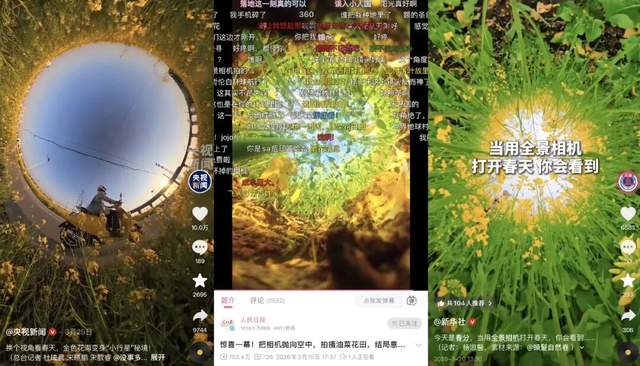
On April 22, World Earth Day, a video quickly became a sensation across social media platforms. Titled "A Snapshot with Earth" and released by the Ministry of Natural Resources and Xinhua News Agency, this short film was captured using a panoramic camera. Its 360° "panoramic mini-planet" view comprehensively showcases the breathtaking beauty of various Earth ecosystems, including glaciers, rice fields, maple forests, and lakes.
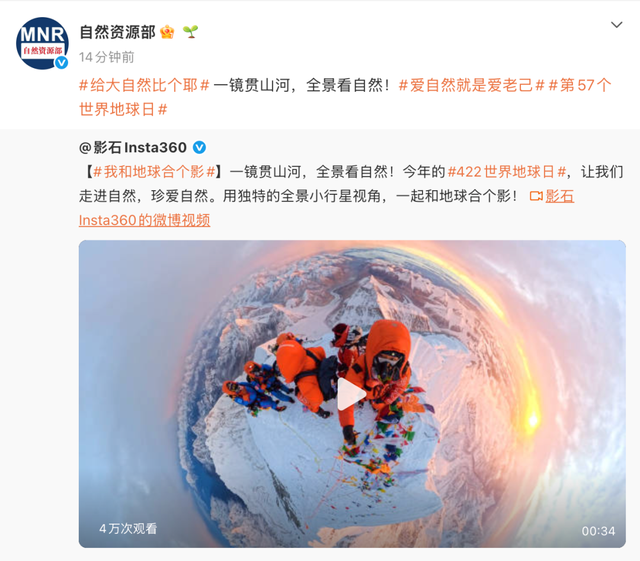
Just a few years ago, panoramic cameras were niche gadgets primarily used in bungee jumping and off-road events. Today, they have become the go-to choice for national-level media and celebrities for content creation—a significant shift in itself.
According to the "Global Handheld Smart Camera Tracker Report" released by IDC (International Data Corporation) in March 2026, the global market for panoramic cameras exceeded $1.212 billion in 2025, marking an 88% year-over-year increase. During the same period, the broader global action camera market grew by 72%. Within this category, panoramic cameras demonstrated remarkable growth, far outpacing the industry average.
Action cameras are transitioning from niche to mainstream, with panoramic cameras leading the charge.
01 Action Cameras Go Mainstream
In 2025, action cameras experienced explosive growth worldwide.
IDC data reveals that global shipments of handheld smart cameras reached 16.65 million units in 2025, an 83% year-over-year increase, with total sales amounting to ¥46.1 billion, up 86% year-over-year. China's market growth was even more staggering. Data from Aowei Cloud Network indicates that online retail sales of consumer-grade action cameras in China reached ¥9.71 billion in 2025, a 223% year-over-year surge.
This trend continued into 2026. This spring, primary and secondary schools in multiple regions introduced pilot spring breaks. Combined with the Qingming Festival, this created a six-day holiday, leading to a surge in family travel demand and directly boosting the action camera category, which is deeply tied to outdoor scenarios. During the "Spring Golden Week" (March 23–April 5), online sales of consumer-grade action cameras in China reached 265,000 units, generating ¥609 million in revenue.
Behind this product boom lies a structural context.
Data from the General Administration of Sport shows that by 2024, over 400 million people in China were participating in outdoor activities, with the camping market reaching ¥213.97 billion, a year-over-year increase of over 60%. On Xiaohongshu, hiking-related posts received 16 billion clicks, while cycling, rock climbing, and urban exploration are transforming from niche hobbies into weekend staples. More and more people are venturing outdoors, and all of them need a reliable camera.
Within this overall growth, panoramic cameras are the primary growth engine.
During the same "Spring Golden Week," panoramic action cameras saw a 19.7% month-over-month increase, outpacing the industry average. Yien Data provides a more detailed user profile: For panoramic camera brands like Insta360, 53% of social media discussions focus on sports scenarios, with travel and daily recording accounting for nearly half of the remaining buzz. Insta360-related content generated 320 million interactions on Douyin, while Xiaohongshu mentions surged by over 300% year-over-year.
A series of data points confirm one thing: The consumer base for panoramic cameras has expanded far beyond extreme sports enthusiasts, spreading into broader everyday life scenarios.
02 Panoramic Cameras: Why Them?
The ability of panoramic cameras to outpace the market lies in the simultaneous maturity of technology, products, and social media, enabling them to cross the "niche" threshold.
According to a Huatai Securities research report, the synchronous maturity of hardware and algorithms is a prerequisite for the large-scale adoption of panoramic imaging. From a technological standpoint, the hardware performance of panoramic cameras has undergone a critical leap in recent years. Mainstream market products have upgraded from 5.7K to 8K resolution, with sensor area increasing by 144%, far surpassing the "good enough" threshold for image quality. The integration of AI has significantly lowered the barrier to entry for consumers. Features like auto-editing, intelligent tracking, and one-click video creation have transformed post-processing from a specialized skill into a single-button operation.
In essence, panoramic cameras solve the challenge for ordinary people to capture "high-quality content" in mobile scenarios—a task that was once difficult.
At the same time, content demand is driving the mainstream adoption of hardware products. "Immersive" and "first-person" content continues to trend on short-video platforms, and panoramic cameras are naturally suited to this format. On Xiaohongshu, there are over 920,000 posts tagged "Skiing with Insta360" and over 810,000 related to cycling.
More importantly, panoramic cameras can capture "impossible perspectives"—scenes that are difficult to shoot with ordinary action cameras.
This spring break, a large number of tourists flocked to Luoping, Yunnan, with panoramic cameras to capture 360° views of the vast rape flower fields. The "Rape Flower Mini-Planet" short videos went viral across major platforms, sparking a wave of imitative check-ins. Panoramic views are naturally suited to such expansive scenes—once one video trends, the next group follows, and the urge to buy a camera grows. Scenes drive demand, which in turn reinforces scene awareness.
The combination of these three drivers has enabled panoramic cameras to transition from "tech products" to "mainstream imaging tools."
However, not all players in this field have reached this stage.
GoPro, once the dominant player in action cameras, has nearly disappeared from the panoramic segment. Frost & Sullivan data shows that its panoramic market share plummeted from 21.5% in 2021 to 9.2% in 2023, and by Q3 2025, it was relegated to the "Other" category. Additionally, Jiuqian Consulting data indicates that its overall market share dropped from 84% in 2022 to 18% in the first three quarters of 2025.
The space left by GoPro is being rapidly filled by Chinese brands, with Insta360 leading the charge.
Currently, in the panoramic camera field, Insta360 dominates with a 70% domestic market share, far ahead of competitors. On a global scale, the numbers are similar: IDC data shows that Insta360 held a 66% global market share for panoramic cameras in 2025. Under Frost & Sullivan's metrics, this figure rose to 75% by Q3 2025. This means that three out of every four panoramic cameras sold globally are made by Insta360.
03 Insta360: The Leader in the Panoramic Camera Field
A market concentration of 70% is rare in the consumer electronics industry. Its formation tells a decade-long story.
In 2015, Insta360 made a counterintuitive choice: At a time when GoPro was at its peak and panoramic cameras had virtually no market presence, the company bet on the panoramic field.
That year was GoPro's heyday—after going public in 2014, its market cap peaked at $13 billion in 2015. At the time, Insta360 was just a startup in Shenzhen. Panoramic cameras were considered technical demos, gimmicks at trade shows. The mainstream view was that their "image quality was too poor, user experience was terrible, and there was no value in mass production." Choosing to invest in this direction at this time required foresight into two things: hardware would mature, and content platforms would rise.
In hindsight, both predictions came true.
Over the past decade, Insta360 has completed five generations of product iterations, from the ONE X to the X5, each pushing the boundaries of resolution, sensors, and AI algorithms. Today, these efforts have translated into quantifiable barriers: Insta360 holds nearly 1,400 global patents in the panoramic field, with invention patents accounting for 60%. The company applies for nearly 140 new technologies and designs annually, averaging one new patent every two and a half days. Patent pools, algorithm libraries, and supply chain influence—these cannot be replicated overnight.
Market performance validates this strategy. In 2025, Insta360's revenue reached ¥9.858 billion, a 76.85% year-over-year increase, setting a new record and joining the ranks of Chinese smart hardware companies with over ¥10 billion in annual revenue. On the channel side, the company has over 300 global stores, with the number of outlets growing more than fivefold in a year, covering all first- and second-tier cities in China—a sign of brand mainstreaming.
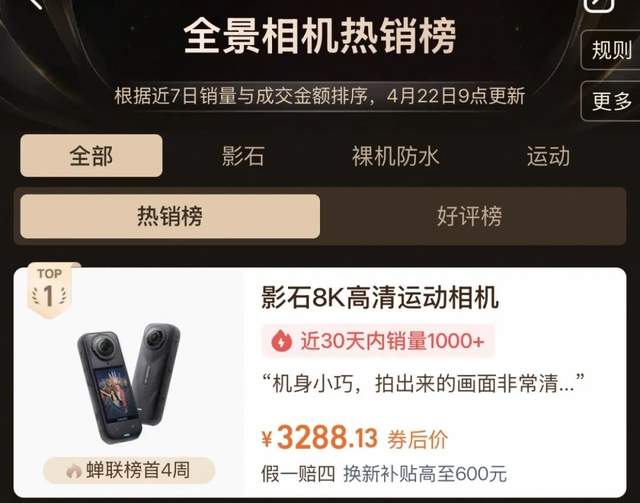
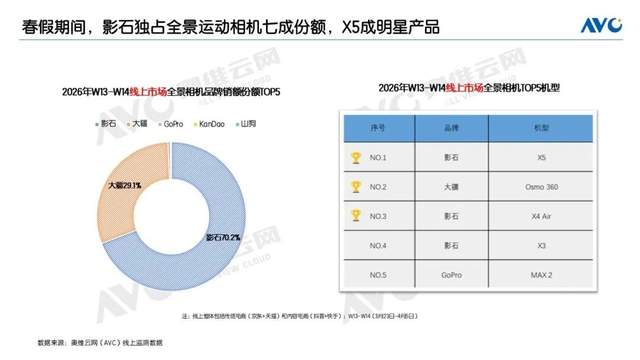
According to Aowei Cloud Network data, during the Spring Golden Week, Insta360 saw a 28.5% month-over-month increase, significantly outpacing the industry average (19.7%) and topping the panoramic camera rankings for three consecutive weeks. In terms of models, the Insta360 X5, X4 Air, and X3 secured three of the top five spots. The further expansion of market share during peak seasons indicates strengthening head effects.
Technological accumulation and market dominance have also given Insta360 the confidence to expand outward.
In December 2025, Insta360 launched the "Antigravity A1" panoramic drone, generating over ¥30 million in sales within 48 hours of its China debut, extending panoramic algorithms to aerial perspectives. In April 2026, the handheld gimbal camera "Luna" made its global debut at Insta360's NAB exhibition, with a Q2 release expected, opening up new possibilities beyond panoramic imaging.
Both new business lines share the same underlying logic: leveraging the algorithmic capabilities and product experience accumulated over a decade in the panoramic field to expand into broader imaging categories.
Epilogue
A Huatai Securities research report clearly states that the current market penetration of action cameras and panoramic cameras remains low. Frost & Sullivan predicts that the global market for handheld smart imaging devices will grow at an annual rate of 15.9%, reaching ¥79.93 billion by 2030. The 2025 market size is just the starting point.
In other words, this wave of mainstreaming has only just begun.
Authoritative media outlets are beginning to use panoramic imaging for ecological communication, while spring break rape flower short videos go viral across platforms. These signals collectively describe the same phenomenon: The popularization of imaging tools is happening in reality, and at an accelerating pace. In this process, whoever can maintain leadership in the field and continue to define product standards will hold the discourse power for the next round of growth.
That position clearly belongs to Insta360.
-
![]()
Q1 Color TV Summary: Five Major Trends Propel the Industry Towards High-Quality Development and Transformation
-
![]()
Revenue Hits 3.4 Billion, Non-Recurring Profit Rockets 52%! Yutong Optics Embarks on Its Second Growth Phase
-
![]()
Labubu Fridge Falls Short of Best-Seller Status
-
![]()
Large Models in Vehicles: Consumers Show Indifference
-
![]()
Seven Ways to Start a One-Person Company in the AI Entrepreneurship Era
-
![]()
400 Billion Market Cap Reversal: The Twilight of the AI Four Little Dragons and the Dawn of New Large Model Contenders
-
![]()
Insta360: The 'Hot Commodity' Being 'Hunted' by Everyone
-
![]()
SpaceX's $1.25 Trillion IPO Eve: Musk's Final Gamble Bets on a Full-Stack Space AI Ecosystem