IDC: Q1 Global Smart Glasses Shipments Surge 130.1% YoY, Audio & Camera Glasses Dominate Market
 06/17 2026
 361
361
On June 15, data released by the International Data Corporation (IDC) revealed that global smart glasses shipments reached 3.566 million units in Q1 2026, marking a significant 130.1% year-on-year (YoY) increase and underscoring the market's rapid expansion. Specifically, shipments of audio and audio-camera glasses soared to 2.248 million units, up 167.4% YoY, while AR/VR glasses shipments hit 1.318 million units, rising 85.9% YoY. These figures highlight that audio glasses with basic smart features are currently more favored by the market, exhibiting a higher growth rate than their AR/VR counterparts.
In the Chinese market, Q1 shipments reached 610,000 units, a 23.5% YoY increase, securing the third-largest global market share. Notably, smart glasses were included in the national subsidy catalog for the first time, spurring channel stocking and end-user demand, which became a key driver of market growth this quarter. Sub-categories such as camera glasses, AI large model-equipped glasses, and display glasses all achieved triple-digit YoY growth. Continuous product optimization in terms of lightweight design, wearing comfort, and AI capabilities, coupled with frequent new product launches and channel expansion, intensified industry differentiation and competition.
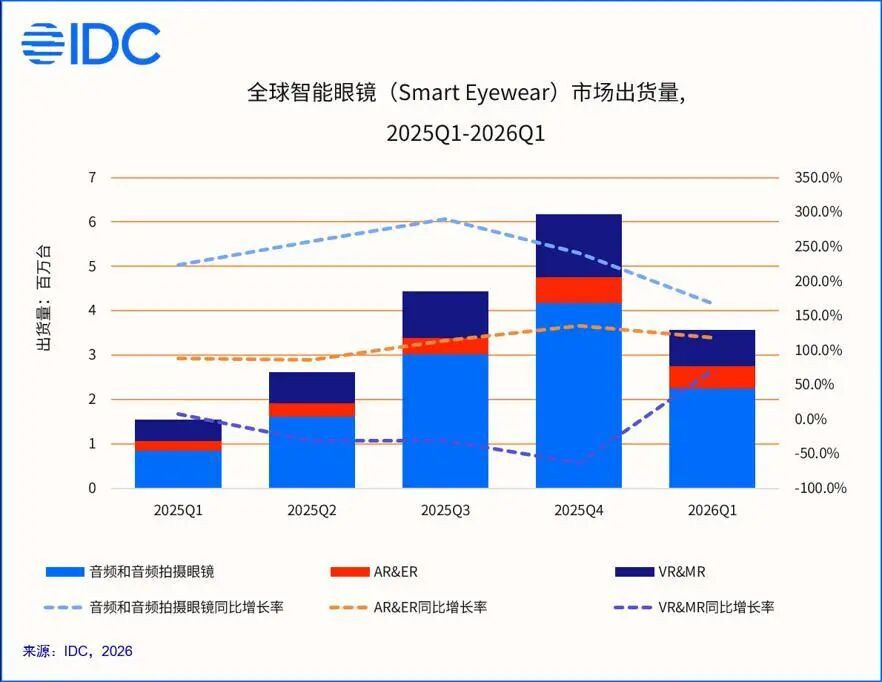
From a product structure perspective, China's Q1 shipments of audio and audio-camera glasses totaled 358,000 units, experiencing a slight 0.1% YoY decline. However, the proportion of audio-camera glasses rose to 43.4%, a staggering 513.1% YoY increase. This shift indicates that camera functionality is emerging as a crucial differentiator for audio smart glasses, with user demand for "lightweight + image recording" combinations growing rapidly. Meanwhile, China's AR/VR market shipments reached 252,000 units in the same period, up 86.2% YoY, roughly in line with global growth trends.
IDC analysts noted that smart glasses products currently face challenges in user retention. While consumers are willing to pay for novel experiences, they will not tolerate long-term experience flaws. If products fail to maintain sustained functional appeal, the risk of user churn will rise. Therefore, manufacturers must adopt a more pragmatic approach to product definition and resource allocation, focusing on core scenarios and making strategic trade-offs rather than pursuing feature overload.
According to the "2026-2027 China AI Glasses Industry Trends White Paper" released by iiMedia Research, the global smart glasses market was valued at $12.58 billion in 2025 and is projected to reach $138.73 billion by 2029. The report suggests that AI glasses have experienced a market explosion since 2025, driven by technological turning points, the entry of leading companies, and the gradual implementation of application scenarios. Currently, functions such as recording, photography, translation, and payment have been implemented in essential scenarios, supporting the expansion of incremental user groups.
However, the industry still faces challenges related to insufficient ecosystem development. iiMedia Research pointed out that the current application and content ecosystem for AI glasses remains underdeveloped. Building a comprehensive ecological linkage system is crucial for AI glasses to transition from a "niche tech toy" to the "next-generation smart terminal."
Overall, the smart glasses market has entered a phase of rapid growth, with continuously improving technological maturity and scenario adaptability. To transition from early adopters to mass adoption, the industry must continue investing in user experience continuity and ecological content development to prevent user churn due to experience gaps, thereby ensuring more sustainable market growth.
-
Trillion-Dollar Commercial Space Industry: Profits Start Not with Rockets
-
![]()
Baidu Netdisk Encounters a 'Significant' Challenger: Tencent Netdisk Makes Its Debut
-
![]()
Tencent Cloud Drive: A Rising Contender to Baidu Cloud
-
![]()
AR Optical Leader Quietly Achieves 1 Million Units in Mass Production!
-
![]()
Raising 289 Million for Optical R&D! Olight Technology Prepares for GEM IPO
-
![]()
【OFweek Weike Cup】Cybernetics Officially Nominated for the 2026 Outstanding Contribution Award for Optical Industry Application Solutions
-
![]()
Precocious Ideals, Rebuilding A New Ideal
-
![]()
DeepSeek Finally Accepts 50 Billion Yuan in Funding