Wang Tao Outmaneuvers Liu Jingkang
 06/17 2026
 571
571
In a recent review video of the Pocket 4P by a prominent film and television influencer on Bilibili, the comment section was inundated with a recurring sentiment: Thank You, Insta360.
The rationale behind the audience's gratitude is simple: Had it not been for Insta360's Luna pushing the boundaries, DJI might not have developed dual-camera telephoto capabilities so swiftly or priced them so competitively.
During their review of Insta360's Luna, comparisons to the Pocket 4 were frequent, likely influenced by client requests. At least initially, Luna stood out as the premier handheld gimbal camera globally, but this dominance was short-lived, lasting only five days.
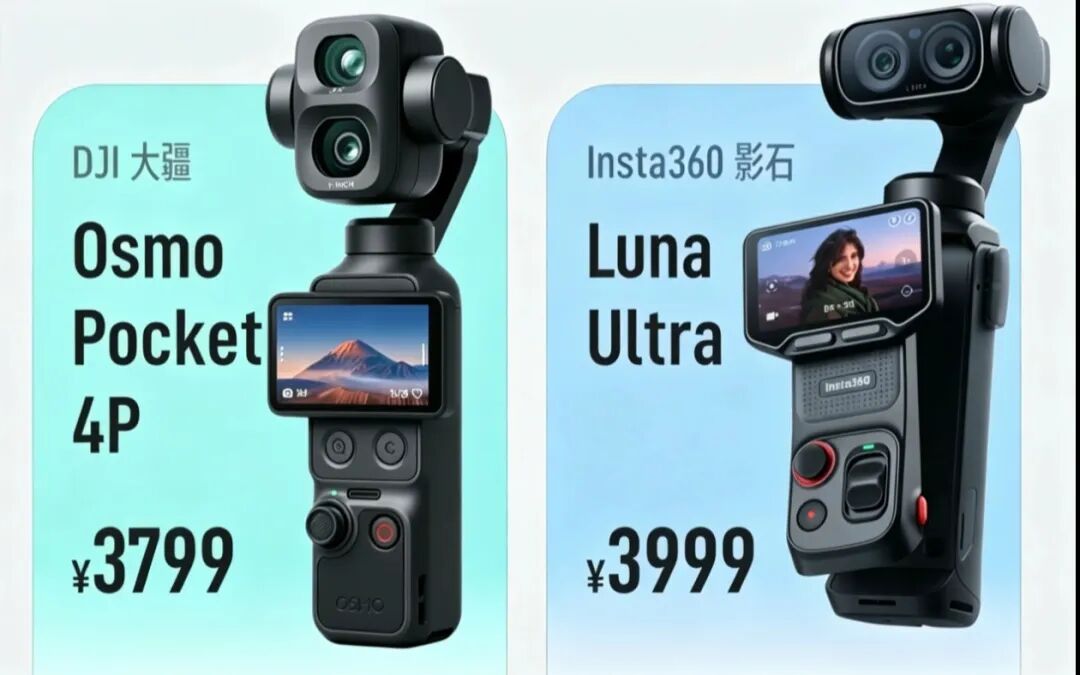
On June 10, 2026, Insta360 unveiled the Luna Ultra. Just five days later, on June 15, DJI countered with the Pocket 4P, priced 200 yuan lower. This strategic move by Wang Tao, the mastermind behind DJI, was a calculated strike. While the handheld gimbal camera market is far from saturated, Wang Tao's seven-year-long strategy has undoubtedly sent shivers down the spines of Honor, OPPO, and Vivo, who are gearing up to enter the fray.
I wholeheartedly concur with the sentiment of 'Thank You, Insta360.'
Without Insta360's aggressive push, users might still be content with their Pocket 3, oblivious to the advancements on the horizon.
Over the years, Wang Tao has led DJI to gradually corner Insta360 and its competitors into the 'handheld gimbal camera' niche—a path they were neither well-suited for nor the safest. Yet, this seemingly promising avenue for product development is being systematically closed off by Wang Tao.
Wang Tao's Seven-Year Strategy
Wang Tao approaches business with a calculated mindset.
In 2019, DJI ventured beyond drones with the Osmo Action sports camera, priced at 2,499 yuan. Within 48 hours, GoPro, in a panic, slashed the price of its flagship Hero7 Black from 3,398 to 2,798 yuan. DJI's strategy was straightforward: leverage its imaging technology, supply chain, and image transmission ecosystem, honed from drone manufacturing, to create a superior product and deliver a knockout blow with a price advantage. The current scenario mirrors the past, with GoPro now replaced by Insta360.
The essence of this tactic lies not in strategy alone but in patience. Wang Tao once remarked in 'LatePost': 'Hardware lacks the network effects of the internet; each generation must win the market anew.' Thus, he eschews short-term gains in favor of laying traps. As early as late 2018, he created the 'pocket gimbal camera' category with the first-generation Osmo Pocket—a territory Insta360 didn't dare to tread until 2026.
Insta360's foundation was built in the corners DJI once overlooked: panoramic cameras. With its X series, it dominated the global panoramic camera market for six consecutive years, achieving a 67.2% market share in 2023. Coupled with the GO series of thumb cameras, these formed its competitive moat. However, the reality was different.
In 2025, the hunter began to close the net.
On July 31, DJI unveiled its first panoramic camera, the Osmo 360, starting at 2,999 yuan, featuring a custom square sensor with nearly 70% more usable pixels than Insta360's X5. Insta360 responded by reducing the price of its X5, released just in April, by 500 yuan to 3,298 yuan—but the Osmo 360 remained nearly 300 yuan cheaper. Two months later, in September, the Osmo Nano thumb camera arrived, priced at 1,998 yuan (1,698 yuan after subsidies), matching the specs of Insta360's GO Ultra but priced 600 yuan lower (900 yuan cheaper with subsidies). The most ruthless move: the Osmo Nano was compatible with old DJI Action accessories, while Insta360 nearly changed interfaces with each generation, forcing users to repurchase accessories. This not only poached customers but also turned Insta360's existing users against them without the need for new accessory purchases.
Panoramic and thumb cameras, the two areas where Insta360 built its foundation, were each stabbed by DJI within a year, each blow bloody and costly.
Insta360 had to retaliate, turning its sights to DJI's most lucrative drone territory, launching the 'Yingling' drone brand on July 28, 2025. This was both an offensive and a breakout. When the categories you rely on for survival are being eroded by lower-priced competitors one by one, not seeking new growth means losing the initiative. But where to find new growth? Looking around, the strongest, most profitable area DJI dominated—and where Insta360 had never ventured—was precisely handheld gimbal cameras.
Thus, starting in 2023, Insta360 invested tens of millions to develop a gimbal camera called Luna. Rather than 'expanding territory,' it was more like walking into a trap—this land had been guarded by Wang Tao for seven years, an ambush he would never let slip.
The Fear of a Hunter's Follow-Up
To understand why Insta360 would jump into a fire pit knowing full well the risks, one must first look at who's at the helm.
Liu Jingkang is no less formidable. At 21, he deciphered Zhou Hongyi's phone number from a keypad tone in a phone interview and actually called him. His viral 'average face' project, which synthesized 7,000 classmate photos, was aimed at raising donations for a classmate with cancer. For him, technology was always a toy, but his ability to rapidly make Insta360 a formidable rival to DJI was his true skill.
Such a person chooses battles with a formula. Liu Jingkang once outlined his three criteria for entering a new category: a clear, unsolved pain point; a gross margin of around 50% for the market leader; and annual market sales reaching the 10 billion yuan level. Handheld gimbal cameras met all three criteria—DJI had nurtured it into a 10 billion yuan business with fat margins, and telephoto capabilities had long been a weakness of the Pocket series. For Liu Jingkang, attacking DJI's core was like solving an inevitable problem. The only issue was that the problem setter was waiting at the finish line.
DJI's closing move unfolded in two steps.
The first step: seize volume and position. On April 16, DJI released the single-camera Pocket 4, starting at 2,999 yuan, with standard and pro kits priced 500 and 700 yuan lower than the previous Pocket 3's debut. By increasing specs while lowering prices, DJI clearly sacrificed profit margins to raise the barrier for later entrants.
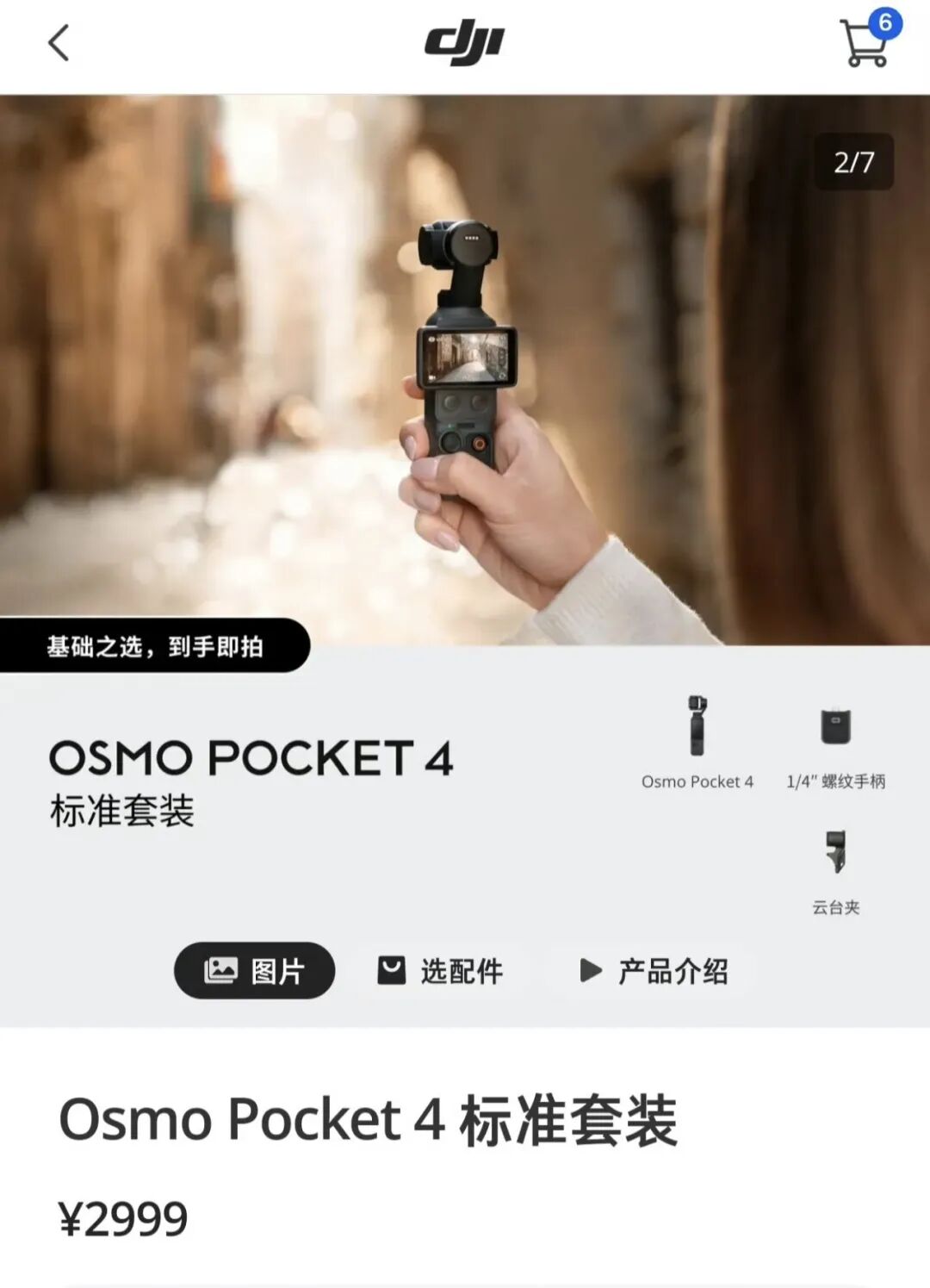
But the truly ruthless move was the post-credits teaser at the end of the launch event: the dual-camera Pocket 4P, shown but not for sale. On the surface, this was about positioning—Insta360's dual-camera wasn't even out yet, so those wanting dual-camera telephoto would wait for DJI. But the deeper implication was that Wang Tao was telling everyone: I've already made this; when to release it and whether to upgrade it further depends on what Insta360 brings. Insta360's strategy of 'wait for the opponent to show their hand' collapsed against someone who had already held all the cards, just waiting for the right moment.
The Pocket 4 itself was a hit. According to Japanese retail agency BCN+R, it captured 21.5% of Japan's video camera market within nine days of release. Domestically, it sold out instantly, with backorders stretching a month. Complaints about shortages persisted until June 2, prompting DJI to hold a press conference to deny hunger marketing.
The second step: the follow-up strike. On June 10, Insta360 unveiled the Luna Ultra, laying all its cards on the table: a dual-camera setup with a 1-inch main sensor and 70mm Leica telephoto, 8K resolution, a detachable screen for remote control, priced at 3,999 yuan, endorsed by Li Xian, and selling out in the first batch. Then, five days later, on June 15, DJI casually released the Pocket 4P—the first dual-camera in the Pocket series, featuring a 1-inch main sensor and 60mm telephoto, 3x optical zoom (up to 12x), priced at 3,799 yuan, 200 yuan cheaper than the Luna. After Insta360 revealed all its cards, DJI undercut its price.
Five days was a telling number. The gap between Insta360's reveal and DJI's release suggested the Pocket 4P was likely a finished product all along, needing no firmware updates or fine-tuning—it had been sitting in a warehouse, loaded and ready, waiting for Insta360 to make the first move. All Wang Tao had to do was glance at the competitor's price and pull the trigger.
The ability to hold back a finished product and release it precisely five days after a rival, mastering product and timing control, is truly formidable. It nearly absolutely stifled the opponent's survival space in the short term.
Insta360's toll is evident in its financials. In 2025, revenue hit 9.741 billion yuan, up 74.76% year-on-year, but net profit fell 6.62% to 929 million yuan. In Q1 2026, revenue surged 83% year-on-year, but net profit plummeted 52% to 84.62 million yuan. Nearly all the money was poured into R&D and new products. Liu Jingkang himself said strategic investments in Q1 alone roughly equaled three times the net profit attributable to shareholders for the same period. At this point, they're truly betting the company.
Someone who fights on others' turf as if it were his own once told 'LatePost' that he didn't actually like seizing others' markets. The words sounded nice, but the formula kept running.
The show has just begun.
Has Insta360 been strangled? Certainly not. In fact, its approach has won it fans.
This is why the review comments were filled with 'Thank You, Insta360': by burning profits, Insta360 managed to stake a claim in DJI's territory, which it had guarded for seven years. The Luna Ultra also sold out instantly, filling the previously blank space in its handheld gimbal portfolio. DJI held its market share and suppressed Luna's momentum with a 200-yuan price difference, but it could no longer crush Insta360 as it had GoPro. Moreover, some features in the Pocket 4P bore traces of Luna's influence.
More importantly, while this shot was aimed at Insta360, the real audience was seated in the back rows. Honor has already unveiled a concept phone with a built-in folding gimbal arm, while OPPO and Vivo have initiated projects and are preparing to enter the market with their phone supply chains. If they only see the '200 yuan cheaper' aspect, they're missing the bigger picture—what should send shivers down their spines is the strategy of teasing a product without selling it and then striking precisely five days later: I've guarded this land for seven years, and even the timing of my shots is up to me. Think carefully before entering. IDC says global gimbal camera shipments surged over 100% year-on-year in 2025. New players are inevitable, but Wang Tao aims to make them feel the pain before they even step inside.
So when I see 'Thank You, Insta360,' I taste something else. The audience thanks the rival that forced DJI to improve and lower prices; but that rival was precisely the prey Wang Tao had spent seven years, category by category, herding into his ambush.
A veteran who trusts in systems and supply chain layouts versus a youth who trusts in formulas and solving pain points—they collided over a pocket camera.
When the hunter pulled the trigger, he stood in another's sights too.
-
Trillion-Dollar Commercial Space Industry: Profits Start Not with Rockets
-
![]()
Baidu Netdisk Encounters a 'Significant' Challenger: Tencent Netdisk Makes Its Debut
-
![]()
Tencent Cloud Drive: A Rising Contender to Baidu Cloud
-
![]()
AR Optical Leader Quietly Achieves 1 Million Units in Mass Production!
-
![]()
Raising 289 Million for Optical R&D! Olight Technology Prepares for GEM IPO
-
![]()
【OFweek Weike Cup】Cybernetics Officially Nominated for the 2026 Outstanding Contribution Award for Optical Industry Application Solutions
-
![]()
Precocious Ideals, Rebuilding A New Ideal
-
![]()
DeepSeek Finally Accepts 50 Billion Yuan in Funding