Changxin Refuses to be a 'Worker in Apple’s Supply Chain', Chinese Consumer Electronics Giants See Profit Revaluation
 08/07 2026
 470
470
Amid the wave of price hikes for end-user devices, 'wait-and-see' consumers may indeed miss out on lower prices.
Following Xiaomi's third round of price increases in early August, which affected the broadest range and largest magnitude of its main models, Huawei's Executive Director and Terminal BG Chairman Yu Chengdong publicly stated that due to soaring memory prices, smartphones may see large-scale price hikes; otherwise, the original prices would result in losses.
Previously, Apple announced iPad/Mac price increases in June, raising market expectations for potential iPhone price hikes.
More unusual changes are occurring in the secondary market for older devices. In the past, after the release of new models, older models typically entered a continuous cycle of price reductions. Now, some models on sale have not seen significant price drops, and channel prices have remained firm.
This breaks the long-standing pricing pattern in the consumer electronics industry: continuous performance improvements accompanied by gradual price declines, allowing consumers to purchase similar configurations at lower prices if they were willing to wait.
Now, rising upstream memory prices are providing smartphone and computer manufacturers with an opportunity to readjust their pricing systems. Terminal companies are not only addressing cost pressures but also tackling declining profit margins caused by long-term low-price competition, rampant channel promotions, and ineffective pricing for new product launches.
The consumer electronics industry may be shifting from competing on shipment scale to repairing profit margins per unit.
The Second Half of the Memory Super Cycle: Focus Shifts from Price Increases to Pricing Power
In the first half of 2026, rising memory chip prices were one of the most closely watched industrial trends in the capital markets.
Rapid price increases for DRAM and NAND, coupled with the siphoning effect of AI infrastructure construction on memory production capacity, have tightened consumer-grade memory supply, which has rippled through to end-user devices like smartphones and PCs.
However, the narrative in the memory industry changed in the second half of the year.
Prices continued to rise, but the pace of increase slowed significantly. In the third quarter, TrendForce expected DRAM contract price growth to narrow to 13%-18% quarter-over-quarter, with NAND growth narrowing to 10%-15%.
As a result, capital markets began to shift from enthusiasm to caution regarding memory. How long can high prices be sustained? Will new production capacity alter the supply-demand balance?
Over the past month, shares of Samsung Electronics and SK Hynix have retreated sharply, reflecting the market's revaluation of the memory cycle logic.
Just when everyone thought Changxin's listing would further impact the two giants, Changxin was rumored to have done something conducive to maintaining high memory prices.
On July 27, Changxin Technology listed on the STAR Market, marking a significant milestone for China's domestic memory industry. Shortly after its listing, reports emerged that Changxin had rejected Apple's price reduction demands, insisting on quotes no lower than those of Samsung and SK Hynix.
While relevant news requires confirmation from company disclosures and official supply chain information, the high market attention to this rumor itself indicates that the commercial role of domestic memory companies is changing.
In the past, Chinese consumer electronics supply chain companies entering Apple's ecosystem often had to offer lower quotes in exchange for orders, scale, and certification. Apple, in turn, strengthened competition and lowered procurement costs by introducing more suppliers.

If Changxin can maintain its quotes without relying on Apple's orders, it suggests that domestic memory companies now have a more stable foundation of local demand.
Terminal companies like Huawei and Xiaomi have locked in part of their DRAM production capacity through long-term agreements, while cloud computing and internet firms like Tencent and ByteDance have also created new demand for domestic memory.
With a more diversified customer base, Changxin no longer needs to rely on a single overseas client to absorb its production capacity, nor does it have to engage in significant price reductions to secure a supply chain position.
This memory cycle has thus entered a new observation phase.
In the first half of the year, the market primarily focused on the speed of price increases. In the second half, the more critical questions have become whether memory manufacturers can maintain supply discipline and whether domestic companies can enter the global mainstream pricing system.
Narrowing price increases do not imply an immediate price decline. Long-term supply agreements, AI memory demand, and the transition to advanced production capacity may shift memory prices from rapid escalation to sustained high levels.
In this process, Changxin and domestic terminal manufacturers are forming a supply chain interest alignment: memory companies gain stable orders and expansion certainty, while terminal manufacturers secure production capacity and relatively controllable procurement costs, thus benefiting from the price hikes.
Smartphones Enter a High-Price Era, Restructuring the End-User Pricing System
Over the past six months, the market has been accustomed to viewing consumer electronics as victims of memory price hikes.
The traditional logic is that rising memory prices increase overall material costs for smartphones, leading manufacturers to raise prices, with consumers ultimately bearing the additional costs.
This logic only explains the direct cause of price hikes but fails to explain why smartphone manufacturers have begun to raise prices consecutively and why some older models no longer follow the convention (customary practice) of continuous post-launch price reductions.
Apple's adjustment of Mac and iPad prices, Xiaomi's three consecutive price increases within the year, and Huawei's public warning of widespread smartphone price pressures indicate that the current changes extend beyond cost responses by individual brands or products.
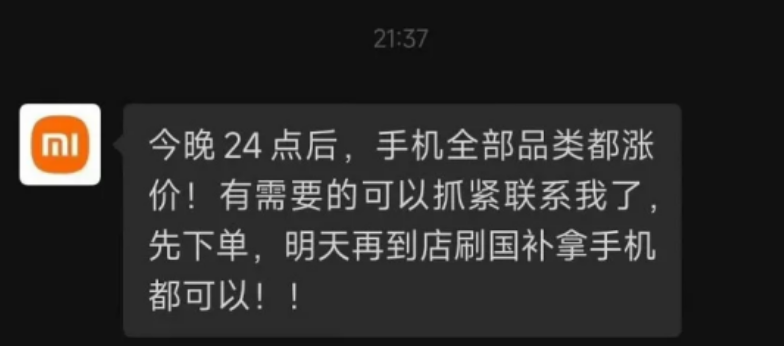
Smartphone manufacturers are leveraging upstream cost changes to redefine the relationships between initial launch prices, channel prices, and product lifecycle pricing.
For many years, the smartphone market has relied heavily on promotions and price reductions to compete for market share. Shortly after new product launches, platform subsidies, channel rebates, and major promotional discounts became common, continuously shortening the validity period of official launch prices.
This model could be sustained in a growing market. As long as shipments continued to increase, manufacturers could dilute R&D, channel, and supply chain costs through scale.
However, in a mature market, the cost of low-price competition has become increasingly high.
IDC data shows that in the second quarter of 2026, smartphone shipments in China were approximately 66.01 million units, down 4.3% year-over-year, marking the fifth consecutive quarter of decline. According to a report by the China Academy of Information and Communications Technology, the average replacement cycle for domestic consumers has extended from about 22 months in 2018 to 40.2 months earlier this year.
The prolonged replacement cycle means that smartphone manufacturers can no longer rely on sales growth to absorb costs. The more intense the promotions, the thinner the profit margins per unit; launching too many low-priced products to maintain market share also increases channel inventory and product line management pressures.
In this context, rising memory prices provide a window for the entire industry to adjust prices collectively.
If a single manufacturer raises prices first, it may face consumer loss and competitors seizing market share. However, when most brands simultaneously face rising costs for memory, flash storage, and other components, the competitive pressure from price hikes decreases significantly.
Consumers are also more likely to attribute price increases to industry-wide cost changes rather than a single brand's profit-seeking behavior.
Therefore, rising memory prices are being used by leading smartphone manufacturers to drive three key adjustments:
1. Reducing low-margin models and redundant SKUs, focusing channel resources on mid-to-high-end products.
2. Enhancing the stability of new product launch prices, reducing the erosion of brand value and user trust caused by significant short-term price reductions after launch.
3. Accepting slower growth in shipment volumes and instead increasing average selling prices, per-unit gross margins, and ecosystem revenue.
For Xiaomi, these changes are particularly critical.
In the first quarter of 2026, Xiaomi's smartphone revenue declined by 12.5% year-over-year, with shipments down 19.2%. However, the average selling price increased by 8.2% year-over-year, reaching a record high. While the previous ASP increase did not fully cover rising component costs, the smartphone business remained under profit pressure.
With the implementation of the third round of price adjustments this year, if the final transaction prices of end-user devices can increase further without a significant drop in shipments, Xiaomi's smartphone business may gradually shift from cost pressure to profit recovery.
However, price hikes do not automatically equate to profit growth.
The market needs to observe whether actual transaction prices rise synchronously, whether promotional discounts narrow, and whether per-unit revenue growth can cover comprehensive material costs, including memory, processors, and panels.
Regardless, this round of smartphone price hikes holds significant industrial importance, gradually helping leading companies move away from relying on low prices to maintain scale and prompting the market to reassess the profitability of the smartphone business.
Revaluation: Upstream Shifts from Cyclical to Growth, Downstream from Scale to Profit
As the value distribution method across the industrial chain changes, capital markets are also adjusting their evaluation criteria for consumer electronics companies upstream and downstream.
On the one hand, upstream memory manufacturers are expected to shift from 'strong cyclical (PB valuation)' to 'growth-like (PE valuation).'
More stable global memory prices and Changxin's decision to 'follow prices' and consolidate the high-price landscape are expected to reverse pessimistic valuation expectations for Samsung and SK Hynix.
Goldman Sachs recently addressed this concern in a research report, arguing that the actual supply-demand dynamics still support sustained high memory prices.
In the medium to long term, amid the narratives of AI and consumer electronics upgrades, memory giants and newcomers remain in a growth dividend phase.
Goldman Sachs expects the supply-demand tightness for traditional DRAM, NAND, and HBM to persist until 2028. Samsung's traditional DRAM ASP is projected to increase by 326% and 27% year-over-year in fiscal years 2026 and 2027, respectively.
For 'industry newcomer' Changxin, being locked into long-term agreements (LTAs) means that future production capacity will translate into guaranteed revenue growth. After fully exercising the over-allotment option for its STAR Market fundraising, the company could raise up to RMB 66.6 billion, with a strong focus on advanced process iteration, 12-inch production line expansion, and HBM high-end memory R&D, significantly enhancing its growth visibility.
On the other hand, downstream terminal manufacturers are diverging, with high-performing companies poised for a revaluation from 'scale-focused' to 'profit-focused.'
In the past, capital markets paid more attention to smartphone sales volumes, global market share, and new product shipment performance. In a mature market, while selling more smartphones remains important, how much revenue and profit each unit sold contributes has become a more direct operational metric.
Against this backdrop, the market once viewed consumer electronics as merely 'paying the bill' for memory price hikes. However, leading brands are protecting profits through price hikes and clearing competitors through industry consolidation, transforming from 'cycle victims' to 'landscape beneficiaries.'
Apple and Huawei possess stronger brand recognition, product ecosystems, and high-end user bases, giving them greater ability to pass costs on to consumers.
Xiaomi is in the midst of premiumization and product mix adjustment. Whether its price hikes can translate into profits depends on observing its high-end model mix, market share, and channel inventory simultaneously.
Small and medium-sized manufacturers lacking brand premium, supply chain lock-in capacity, and channel control will struggle to fully pass on costs and may face both rising procurement costs and sales volume losses.
Looking ahead, if industry giants can seize the opportunity to raise prices, optimize product mixes, eliminate low-margin models, and widen the cost gap with smaller brands, the industry landscape may actually improve.
Therefore, consumer electronics terminal giants are transitioning from being cost bearers of memory price hikes to potential beneficiaries of increased industrial concentration.
Conclusion
When 'wait-and-see' consumers find that waiting only leads to higher prices, the industry's pricing logic has fundamentally reversed.
Changxin Storage has the confidence to say 'no' to Apple, while Apple, Huawei, and Xiaomi collectively raise prices. The consumer electronics industry is gradually bidding farewell to two decades of 'cost-performance ratio internal competition.'
The memory super cycle is an external shock, but it has catalyzed an endogenous change: major consumer electronics companies are shifting from 'scale competition' to 'profit competition,' from 'cost-performance ratio' to 'brand premium.'
Whoever can seize the initiative in the 'post-cost-performance era' will usher in a new round of growth.
For investors, this is an opportunity to reunderstand the value distribution landscape of the consumer electronics industrial chain.
Source: Hong Kong Stocks Research Society
-
![]()
Final Ruling: What’s Behind the Sluggish Sales of Domestic Cars?
-
![]()
ByteDance Restructures ToB Business: What New Roles Do Doubao, Feishu, and Volcano Play?
-
How Does Yusys Technologies Redefine the Banking Business with AI When Banks No Longer Just Purchase Systems?
-
Microsoft and Amazon Surge Over 20% in Three Days: Is AI Entering a Phase of 'Profit Rotation' Trading?
-
![]()
STO Express Stalls Amid Safety Concerns, Abandons 3 Billion Yuan Convertible Bond Plan
-
Two Battles Among Tencent, Alibaba, and ByteDance: Settling Past Coding Debts and Betting on the Future of Work
-
![]()
Is Blue Mountain Production Coming to an End? Wey CEO Zhao Yongpo Responds: No Discontinuation Plans, and It’s Thriving Overseas
-
![]()
Lexus, Eager to Keep Its Dealerships Afloat, Seeks Solutions in Audio Systems