Is Blue Mountain Production Coming to an End? Wey CEO Zhao Yongpo Responds: No Discontinuation Plans, and It’s Thriving Overseas
 08/07 2026
 485
485
Speculation about the discontinuation of Wey Blue Mountain has resurfaced following a month-long absence of sales data.
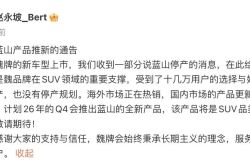
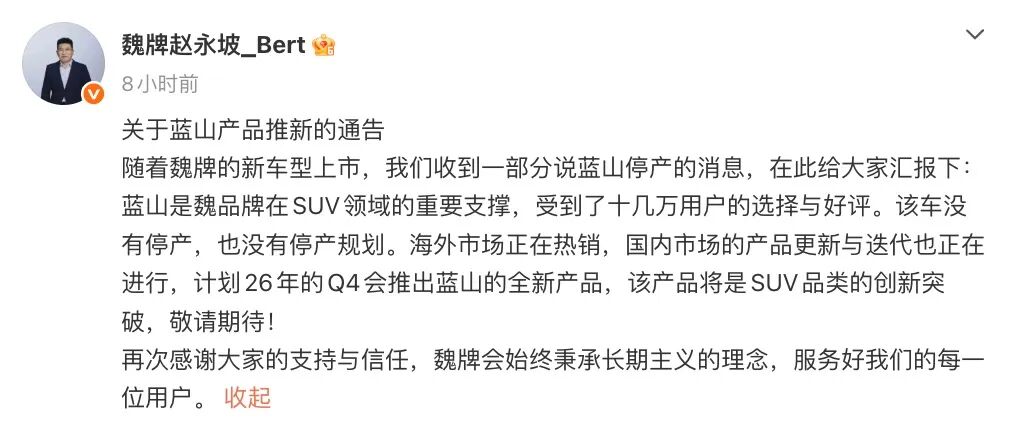
On August 5th, Wey’s CEO addressed these rumors on Weibo. Zhao Yongpo clarified that Blue Mountain remains a cornerstone of Wey’s SUV lineup, having been selected and embraced by over a hundred thousand users. He emphasized that the model has not been discontinued, nor are there any plans to do so. Zhao also mentioned that Blue Mountain is currently enjoying strong sales in overseas markets, while undergoing product updates and iterations domestically. A new version of Blue Mountain is slated for release in the fourth quarter of 2026, promising to be an innovative leap forward in the SUV category.
This marks Wey’s first official response to rumors surrounding the future of Blue Mountain. In the context of Wey’s development, Blue Mountain stands as a landmark product. Historically, after its launch in 2016, Wey’s VV series achieved significant market success, pioneering China’s new high-end autonomous vehicle segment. In 2018, Wey sold approximately 140,000 units, reaching its peak. However, sales declined to 100,000 units in 2019 and nearly halved to about 78,500 units in 2020. Following the departure of the original VV series designer, Great Wall Motors gradually phased out all VV series models in 2021 and embarked on a new round of product planning.
Subsequently, three models named after coffee varieties—Mocha, Macchiato, and Latte—were introduced. Yet, these models failed to replicate the success of the VV series. After more than a year of uncertainty, in March 2022, Wey fully transitioned from a fuel-focused SUV brand to a high-end new energy brand. This period marked a low point for Wey, with cumulative sales in 2022 dropping to 36,400 units, a year-on-year decline of 37.24%. By December 2022, monthly sales had plummeted to just 1,380 units.
Against this backdrop, the first-generation Blue Mountain DHT-PHEV was officially launched in April 2023, positioning itself as a competitor to the Ideal L8. The uniqueness of Blue Mountain lies in its status as Wey’s first product in its comprehensive shift toward new energy and the first in Great Wall Motors’ history to be redesigned based on user feedback.
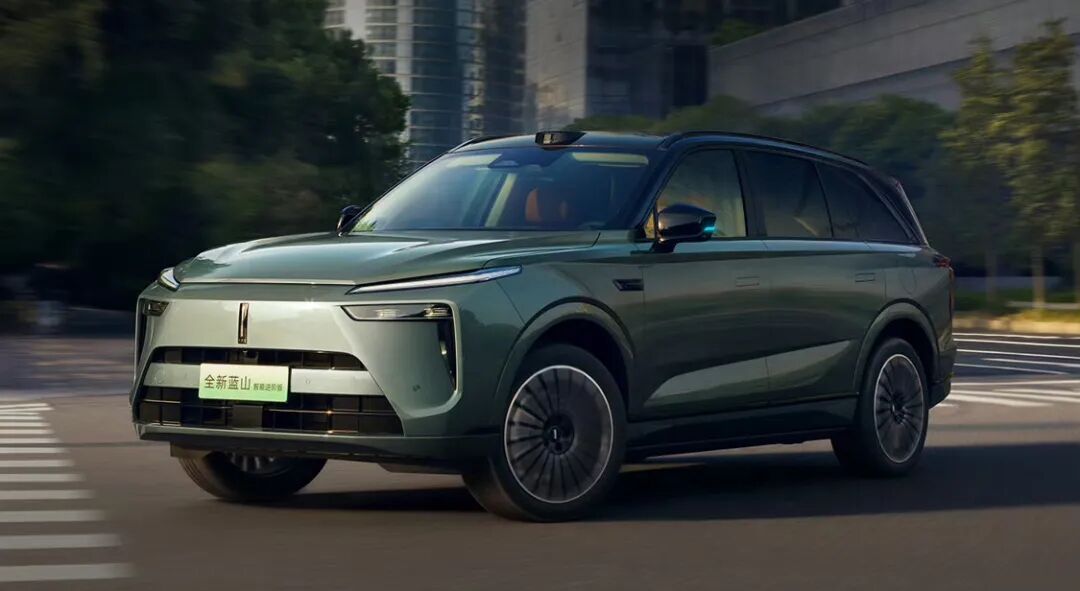
Initially named Wey 80, the Blue Mountain DHT-PHEV faced significant criticism for its dot-matrix diamond matrix front grille design following its declaration with the Ministry of Industry and Information Technology. In response, Wey launched a user co-creation event on October 20, 2022. According to Wey, this event drew participation from 160,000 users and netizens. The brand engaged in 17 in-depth face-to-face exchanges with users, receiving a total of 11,195 co-creation suggestions and nearly 200 original design works.
Just two months later, the new Blue Mountain, unveiled at that year’s Guangzhou Auto Show, showcased a completely redesigned appearance. The front grille, previously criticized in declaration images, was transformed from a dot-matrix near-grille to a closed front fascia, flanked by split LED headlight assemblies. Notably, Blue Mountain became the first product in Wey’s history to experience a resurgence in popularity.
Since its launch, the Blue Mountain DHT-PHEV has emerged as Wey’s sales leader, rescuing the brand from its slump. However, this sales momentum proved short-lived. The true breakthrough for Blue Mountain came in 2024, with the launch of the Blue Mountain Intelligent Driving Version in August, propelling the vehicle into a period of explosive growth. In 2024, its sales approached 50,000 units, frequently ranking first in its segment and surpassing competitors like the Ideal L8, solidifying its position as a top contender in the large six-seater market.
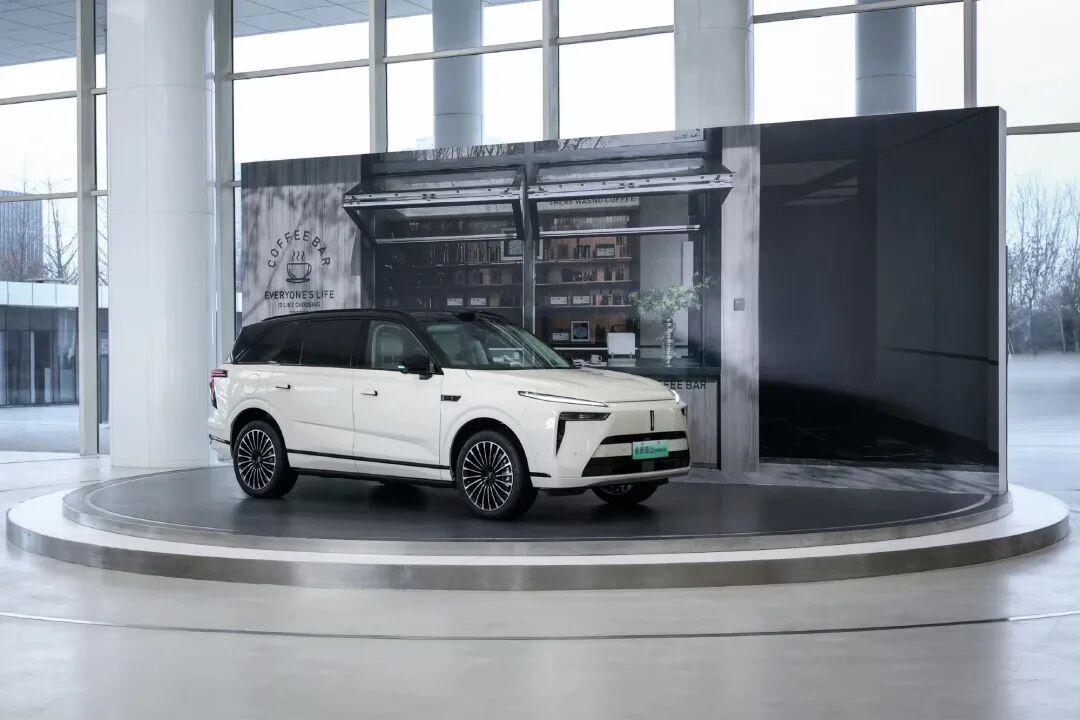
Rumors about the discontinuation of Blue Mountain production arose due to a drop in sales below 1,000 units this year and the absence of corresponding sales data in June. Previously, Wey had discontinued several models multiple times, such as the VV series, which fans regarded as a regrettable loss, and some models in the coffee series have also been discontinued. As for Wey’s future development, the brand has now entered a new phase.
In response to these concerns, Wei Jianjun, a key figure at Wey, emphasized the importance of perseverance. He reiterated at the end of last year Wey’s unwavering commitment to maintaining a high-end positioning. Wei believes that a true high-end brand must possess a spiritual value proposition, with values recognized by users and backed by high-end credit guarantees. However, he noted that the current high-end positioning in the Chinese automotive industry largely remains at the product level, lacking brands with true added value. “Regardless of current sales volume, we are producing high-end products, but we have not yet established ourselves as a high-end brand,” Wei stated.
In terms of product strategy, Wei proposed a “one vehicle with multiple powertrains, one vehicle with multiple forms, and one vehicle with multiple categories” approach. This strategy will not only be applied to Wey but will also extend to brands like Ora. The implementation of this strategy is exemplified by the Guiyuan platform and the Wey V9X. Currently, the second model in the V series, the V8X, has also been launched. For Blue Mountain, a new category will be introduced. Great Wall Motors has consistently been a pioneer in category innovation, with models like the Big Dog, Menglong, Tank, and Gaoshan SUVs, as well as the recently launched Great Wall H10 on August 5th, successfully tapping into new blue ocean markets. It is evident that Wey will continue to pursue an “innovative” approach to gain a competitive edge, rather than engaging in internal product competition.
-
![]()
Final Ruling: What’s Behind the Sluggish Sales of Domestic Cars?
-
![]()
ByteDance Restructures ToB Business: What New Roles Do Doubao, Feishu, and Volcano Play?
-
How Does Yusys Technologies Redefine the Banking Business with AI When Banks No Longer Just Purchase Systems?
-
Microsoft and Amazon Surge Over 20% in Three Days: Is AI Entering a Phase of 'Profit Rotation' Trading?
-
![]()
STO Express Stalls Amid Safety Concerns, Abandons 3 Billion Yuan Convertible Bond Plan
-
Two Battles Among Tencent, Alibaba, and ByteDance: Settling Past Coding Debts and Betting on the Future of Work
-
![]()
Is Blue Mountain Production Coming to an End? Wey CEO Zhao Yongpo Responds: No Discontinuation Plans, and It’s Thriving Overseas
-
![]()
Lexus, Eager to Keep Its Dealerships Afloat, Seeks Solutions in Audio Systems