After 600 Days at the Helm, Li Jian Leads Honor to Launch a Phone Beyond Huawei’s Realm
 08/14 2026
 507
507
A Desperate Counterattack After Slipping Out of the Top Five
Author|Xinjian
Editor|Xiaobai
Produced by|Qiangdiao Next
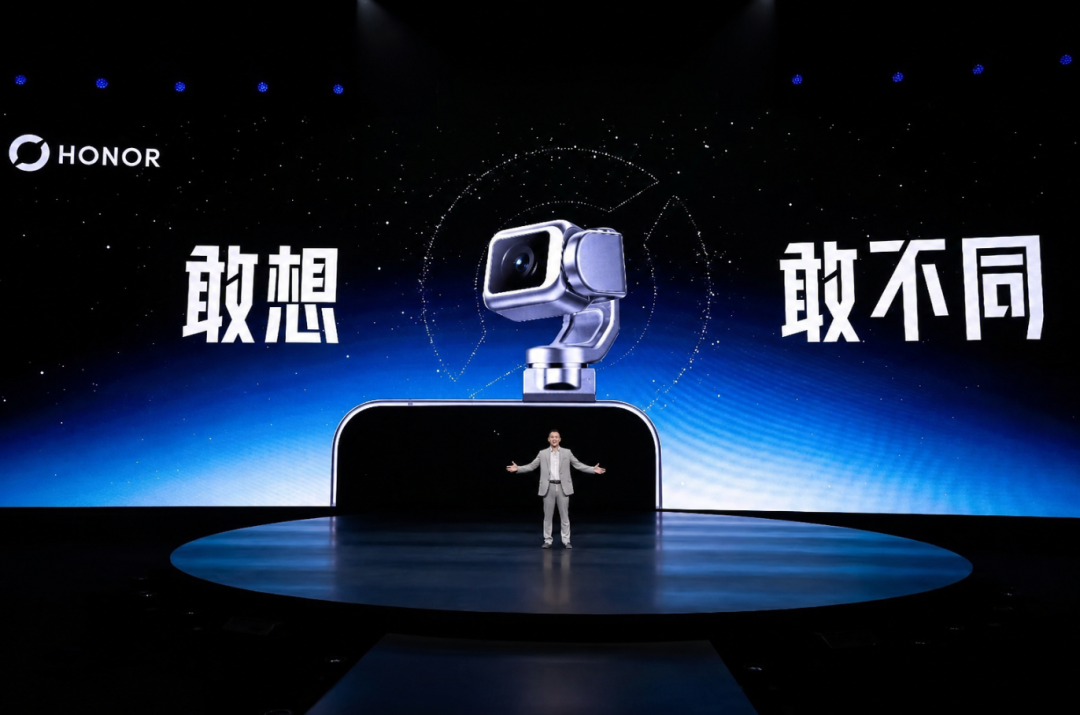
On the evening of August 12, at the Greater Bay Area Cultural and Sports Center in Guangzhou, Honor CEO Li Jian took to the stage, with a large screen behind him displaying a figure: 9999 yuan. This marked the starting price of Honor's Robot Phone. Hidden at the top of this phone is a four-degree-of-freedom titanium alloy gimbal that pops out in just 0.8 seconds, capable of automatic focusing, tracking shots, and even "nodding and shaking" to the rhythm of music. Honor has dubbed it the "world's first robot phone," signaling that it is far more than just a novel hardware innovation.
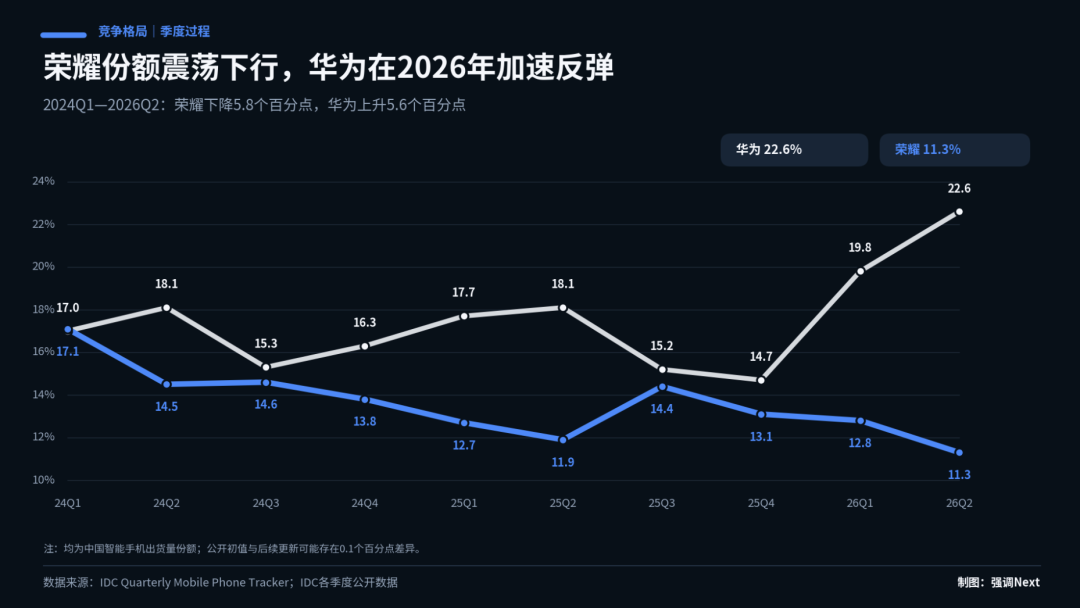
According to data from IDC, Counterpoint, and other research institutions, over the past two years, Honor's market share has declined from 17.1% to around 11% (ranging between 11%-13% depending on the institution), dropping from first to sixth place in the Chinese smartphone market. Huawei has made a comeback, capturing the mid-to-high-end users that Honor once heavily relied on. With Zhao Ming's departure and Li Jian taking over, Honor has launched the "Alpha Strategy," investing $1 billion in AI with a singular goal: to prove that Honor is not merely a "cheaper alternative to Huawei" but an independent AI terminal company.
The Robot Phone represents the boldest step yet in this "de-Huawei-ization" process.
───
01 The Peak Lasted Only One Quarter ■
In the first quarter of 2024, Honor topped the Chinese smartphone market with a 17.1% share, marking the peak of the Zhao Ming era. However, this peak lasted only a single quarter. On August 29, 2023, Huawei's Mate 60 Pro suddenly went on sale, marking the return of the Kirin chip. Since then, Huawei's market share has been steadily climbing: 13.9% in Q4 2023, around 17% in Q1 2024, and reaching 22.6% in Q2 2026, solidifying its position as China's market leader.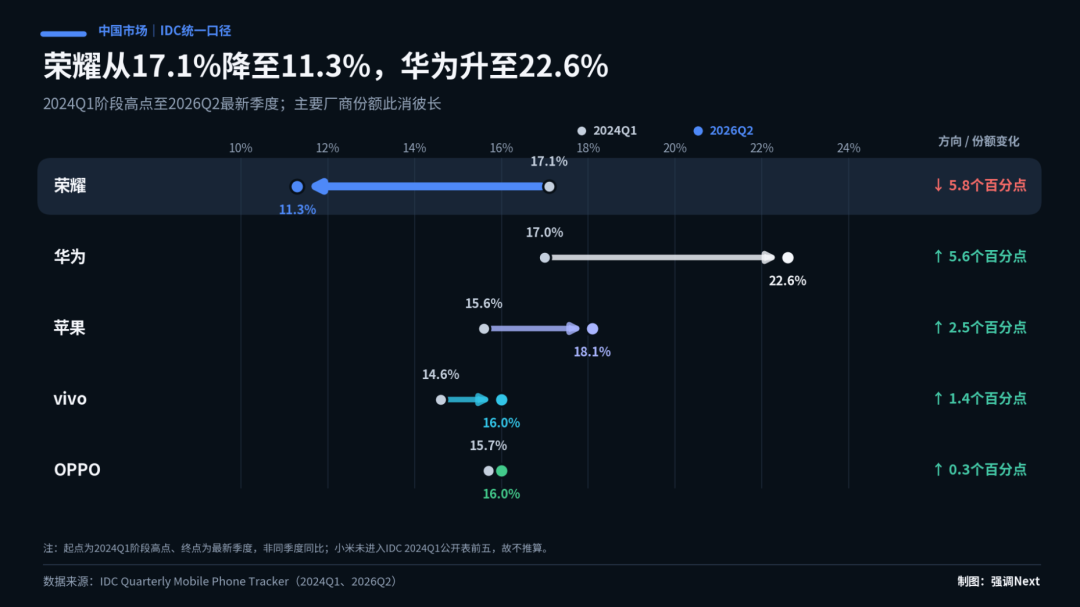
Huawei's resurgence was swifter than Honor anticipated. The core issue lay in user overlap. The target customer base for Honor's Magic and number series highly overlapped with Huawei's Mate/P series. These mid-to-high-end consumers, with budgets exceeding 4000 yuan and strong brand loyalty, had little incentive to continue purchasing a cheaper alternative once Huawei returned to the market.
At the time, Zhao Ming remarked that Huawei's return would "make the industry more rational and fair," implying that Honor would need to rely on its own strengths. However, Honor was not fully prepared to stand alone. Within two years, its market share had shrunk by a third. According to IDC, in Q2 2026, total smartphone shipments in China were approximately 66.01 million units, with a 5.8 percentage point gap in market share translating to a quarterly shipment deficit of about 3.8 million units. If this gap persists, it could amount to 15 million units annually.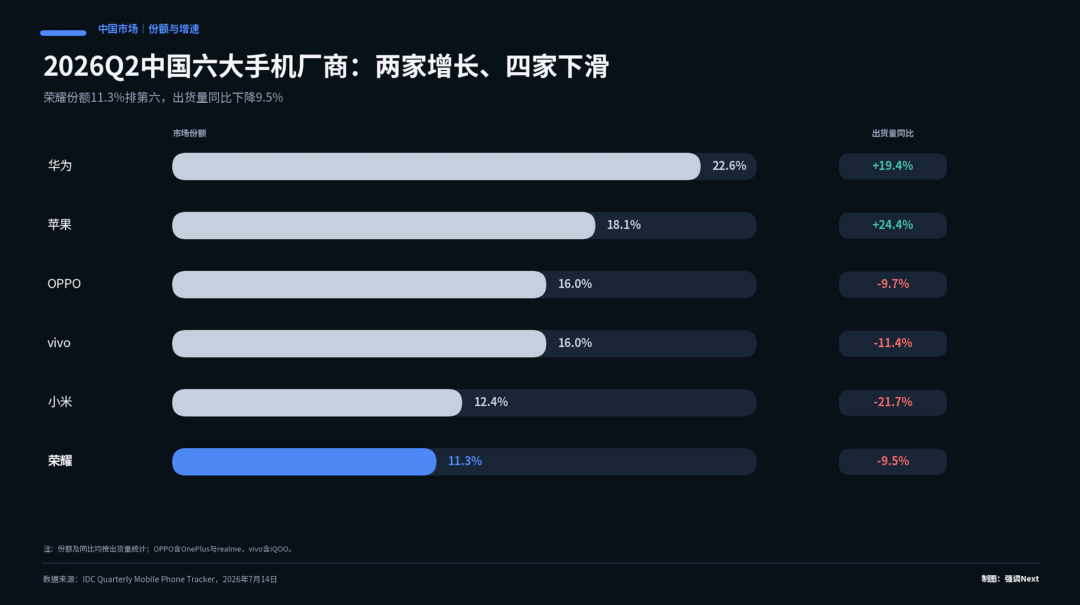
Zhao Ming's counterattack came in the form of the Magic7. This flagship model, released in 2025, struggled to differentiate itself from competitors in terms of hardware, relying instead on the YOYO intelligent assistant's ability to "order milk tea" as a selling point. However, a single AI feature was insufficient to justify the premium price of a flagship phone. The Magic8, released in October 2025, fared even worse.
According to observational data from third-party monitoring agency RD, the Magic8 sold only 120,000 units in its first five days, about 65% of the Magic7's sales during the same period; after 60 days on the market, cumulative sales reached 454,000 units, less than one-sixth of Xiaomi's 17 series sales during the same period. By this point, Honor had lost its label as a "cheaper alternative to Huawei" without establishing its own high-end brand recognition. Zhao Ming departed, and Li Jian took over.
───
02 Taking a Path Huawei Hasn't Taken ■
A key highlight in Li Jian's resume is his "overseas expansion" expertise. According to public reports, he joined Huawei in 2001 and served as Representative of Huawei's Nigeria Office, President of the West Africa Region, President of the Europe Region, and President of the Americas Region. He is widely recognized within Huawei as a top executive for international business. In 2021, he joined Honor, serving as Vice Chairman and Director before succeeding Zhao Ming as CEO. After taking over, Li Jian's first move was not to release a new phone but to redefine the company's narrative. In March 2025, at MWC (Mobile World Congress), he announced the "Alpha Strategy," declaring Honor's transformation from a smartphone manufacturer to an "AI terminal ecosystem company," with a $10 billion investment over the next five years.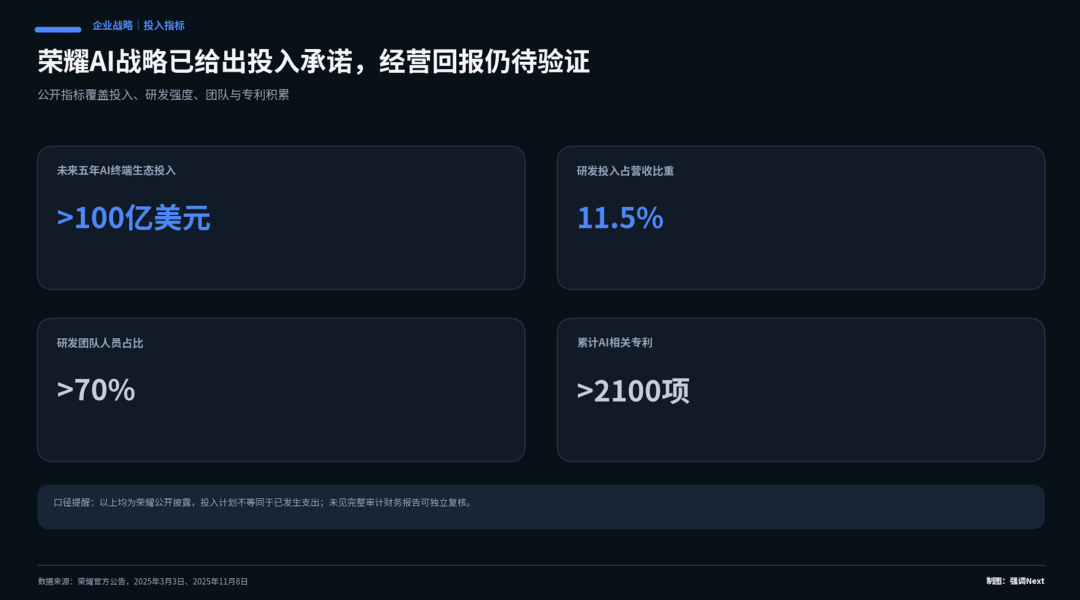
This repositioning is more significant than it appears. As a smartphone manufacturer, the capital market values a company based on shipment volume and average selling price; as an AI terminal ecosystem company, it is valued based on imagination and potential. Honor's $180 billion unicorn valuation hinges on this narrative. However, a narrative cannot exist solely in PPT presentations. Li Jian needed a product to prove that an "AI terminal ecosystem company" is more than just a concept.
The Robot Phone is that product. The logic is straightforward: if Honor continues to compete with Huawei in areas like chips, imaging, satellite communication, and foldable screens—where Huawei excels—it will never catch up. The Magic7 and Magic8 have already proven this. Only by taking a path Huawei hasn't taken can Honor redefine itself. The Robot Phone represents that path.
Huawei's continuous advancements in imaging and foldable screens essentially push parameters to their limits in existing markets. Honor's "robot phone" directly changes the approach, transforming the phone from a passive screen into a terminal with mechanical degrees of freedom, capable of active perception and action.
Honor has given this concept a name: "embodied intelligence." Simply put, it means letting AI grow a body rather than just staying inside a screen. The 9999 yuan pricing also makes a statement. This is not a volume-driven price point. In 2025, Honor shipped 71 million units globally. Assuming an average selling price of 2000 yuan (estimated), annual revenue would be around 142 billion yuan.
Even if all 400,000 Robot Phone pre-orders convert, at 9999 yuan each, revenue would be about 4 billion yuan, accounting for only 2.8% of annual revenue. This is not a product meant to generate profit. It is a product meant to define a category.
Fang Fei, President of Honor's Terminal Product Line, revealed a detail: the yield rate for the micro-motors in the first batch of 500,000 mass-produced units was only 63%, with daily production capacity for the gimbal components falling short of 8000 units. Over 100 precision parts and more than 60 precision processes, with a machining accuracy of ±0.005mm. Such manufacturing barriers mean that "assembly plants" cannot replicate it in the short term.
At the launch event, Li Jian spoke three words: "dare to imagine, dare to act, dare to be different." Together, they mean one thing: Honor will do what Huawei has not done.
───
03 Can the AI Narrative Outpace Declining Market Share? ■
Two days before the Robot Phone's release, on August 10, media revisited Honor's IPO progress. According to CITIC Securities' fourth-phase coaching report, the coaching period lasted from April to June, with the fundraising direction still undetermined. From an external perspective, this means Honor has not yet clarified the specific use of IPO proceeds to its coaching institutions. For a company that has been in coaching for over a year, this is noteworthy. Even more subtle was the internal meeting in May. According to Jiemian News, because Honor failed to complete its IPO within a year of share reform, it held an internal employee shareholding meeting, opening a channel for employees to reduce or exit their holdings at the original subscription price.
CEO Li Jian explicitly stated at the meeting that "the IPO has not been terminated" but did not disclose a specific timeline. With IPO delays, employee share withdrawals, and declining market share, Honor needs a compelling story to sustain capital market confidence. Hurun's 2026 Unicorn List values Honor at 180 billion yuan, up 10 billion from last year. But compare this to its peers: OPPO rose from 180 billion to 225 billion yuan, a 45 billion yuan increase; vivo climbed from 160 billion to 220 billion yuan, a 60 billion yuan increase. Honor's 5.9% increase lags behind OPPO's 25% and vivo's 37.5%.
While the overall market is growing, Honor is merely being carried along. The 10 billion yuan valuation increase is primarily driven by the AI narrative. But currently, the AI narrative is supported by only one physical product: the Robot Phone. If the Robot Phone fails in market validation, Honor's valuation logic will take a hit. Li Jian has essentially placed two bets.
The first is whether the Robot Phone can define the "robot phone" category.
The second is whether this category can generate data before the IPO.
The time window is tight. According to IDC forecasts, smartphone shipments in the Chinese market may decline by up to 20% year-on-year in the second half of 2026. Additionally, Counterpoint data shows that compared to the end of 2025, contract prices for smartphone memory chips rose by over 200% on average by mid-2026, with the cost of 8GB+128GB storage combinations increasing by up to 290%.
All Android manufacturers have been forced to raise prices, further suppressing consumer upgrade willingness. As the overall market shrinks and Huawei grows, Honor's core market continues to decline. The window for AI transformation may be shorter than Li Jian anticipated.
───
04 Overseas Markets: Another Gamble ■
A fact overlooked in domestic discussions: Honor's overseas shipments grew by 47% year-on-year in 2025, with overseas shipments accounting for over 50% of the total for the first time. In Q1 2026, Honor's global shipments increased by about 25% year-on-year. In Malaysia, it surpassed Apple and Samsung to claim the top spot in overall market share. In the Middle East, Q1 shipments grew by 73% year-on-year, ranking second in the region. In Europe, shipments increased by over 60%, making it the fastest-growing among leading local vendors. In China's foldable smartphone market, Honor held a 21% share, nearly doubling year-on-year, solidifying its second-place position.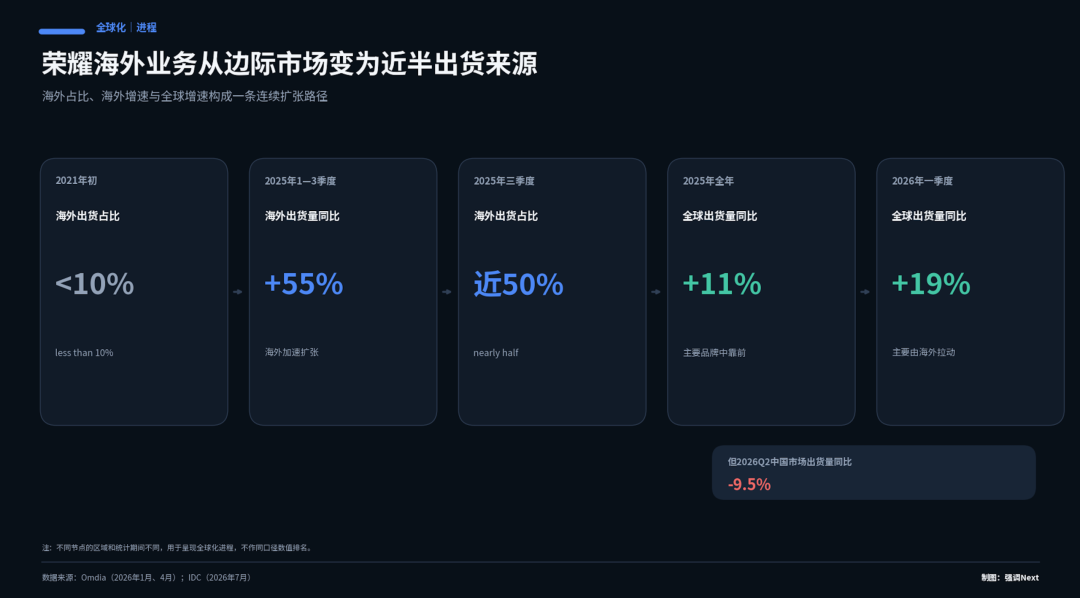
While the numbers look promising, the issue overseas is "high volume, low profit." According to multiple media reports, Honor's low-price strategy to capture emerging markets has incurred high logistics, marketing, and localization costs, resulting in extremely low gross margins, with some markets operating at a loss. The Indian market dealt a double blow: in August 2025, Taiwan's Largan Precision sued Honor in an Indian court over alleged lens patent infringement in the Honor 200 series, leading to a temporary injunction by the Delhi High Court; in early 2026, overseas tech media discovered during a teardown of the Honor Power2 that its third lens was a decorative fake opening, sparking trust issues.
Here, the Robot Phone has a strategic value that is often overlooked: if the "robot phone" can establish a high-end perception overseas, Honor has the opportunity to shift from low-price volume sales to brand premium pricing. According to Honor and Sina Finance reports, 500 Alpha Stores have already landed in China, with overseas coverage in core regions like Kuala Lumpur and Dubai. These stores do not sell the Magic series but the concept of an "AI terminal ecosystem." However, how many 9999 yuan robot phones can be sold overseas remains unknown.
───
05 The Time Left for Li Jian ■
Li Jian's tenure as CEO is approaching 600 days. In these 600 days, he has taken several actions: announcing the Alpha Strategy, establishing a new AI industry department and an embodied intelligence lab, having a humanoid robot complete a half-marathon and win, upgrading MagicOS to Agentic OS, and launching the Robot Phone. The direction is correct. Honor cannot survive indefinitely as a "cheaper alternative to Huawei"—a track switch was inevitable.
Honor's current situation: its smartphone core market is declining, its AI narrative needs a blockbuster product for validation, the IPO window is narrowing, employees are withdrawing their shares, and competitors are accelerating. The Robot Phone is Li Jian's best card. Whether this card succeeds depends on how many of the 400,000 pre-orders convert after the August 18 launch. If conversion exceeds 50%, the "robot phone" category can be considered initially established. Honor's announcement that the Magic9 series will feature YOYO Pro and inherit ARRI imaging capabilities suggests that the Robot Phone serves as a technological "lead goose," with more products to follow in a "flock." The category logic can continue.
If conversion falls below 30%, the market will relegate it to the "concept phone" drawer. The 180 billion yuan AI story would then be missing its most critical piece. Before the end of 2026, Honor needs to answer a question with real sales: Is the robot phone the starting point of a new category, or merely a fireworks display at a launch event? This answer will determine what story Honor can tell in its IPO.
Note: Data in this article comes from IDC, Counterpoint, Hurun Research Institute, and public reports and does not constitute investment advice.
- END -
-
![]()
SanDisk is More Profitable Than NVIDIA
-
![]()
Is Western Digital No Longer Attractive?
-
![]()
Goldman Sachs' Net Profit Rockets 78%: The AI Surge Propels Wall Street Investment Banks to All-Time Highs
-
![]()
Review | From 360° Imaging to 3DGS, Insta360 X6 is Changing Panoramic Cameras
-
![]()
Seed has its own sense of mission
-
![]()
After 600 Days at the Helm, Li Jian Leads Honor to Launch a Phone Beyond Huawei’s Realm
-
![]()
The 'Lin Junyang Phenomenon' in AI Venture Capital
-
![]()
JD's Profit Increases While Revenue Stagnates: What is Liu Qiangdong After?