JD's Profit Increases While Revenue Stagnates: What is Liu Qiangdong After?
 08/14 2026
 428
428

Historic First: Revenue Declines by 2.9%
Author|Jin Wen
Editor|Xiaobai
Produced by|Qiangdiao Next On August 13, JD released its Q2 2026 financial report: net revenue reached RMB 346.4 billion, down 2.9% YoY, marking the first quarterly revenue decline since JD's listing in 2014. In response, JD's stock price fell by over 8% at market open that day. However, operating profit turned from a RMB 900 million loss in the same period last year to a RMB 4.5 billion gain this quarter. 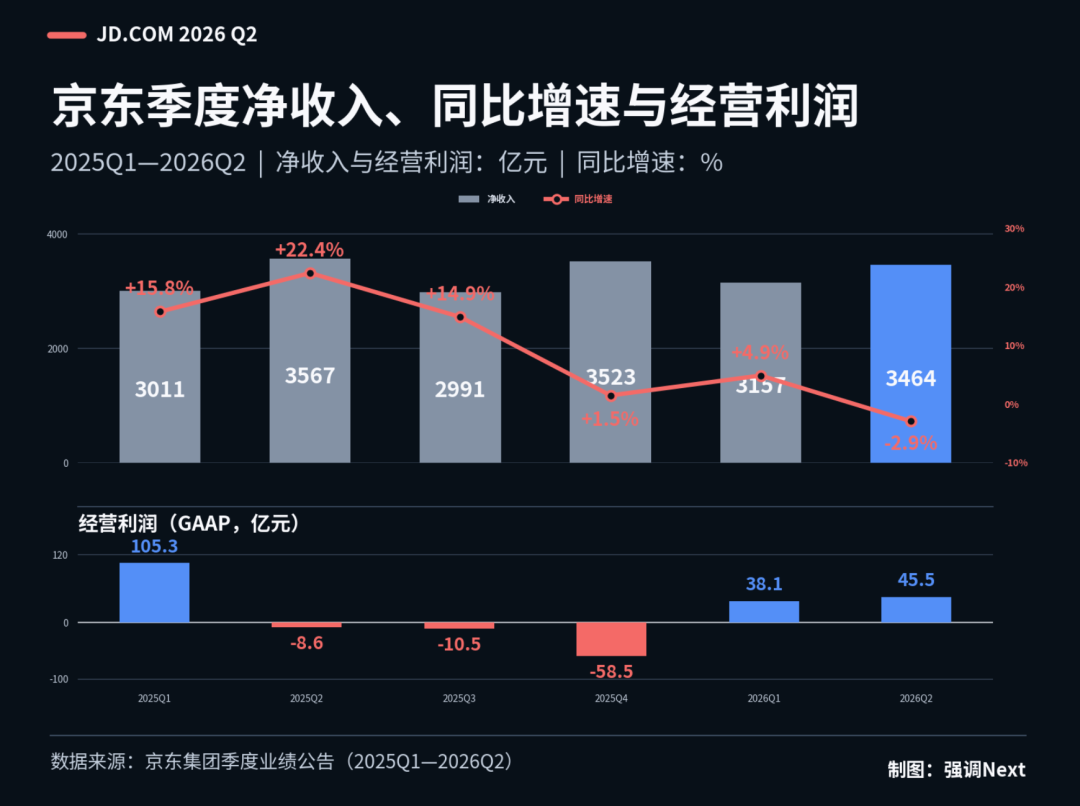
Over the past year and a half, Liu Qiangdong has made two critical decisions: investing heavily in food delivery (with new business losses of RMB 46.6 billion for the full year) and personally leading exploration into embodied AI research. Both decisions target the supply chain. The Q2 profit inflection point represents the first return on this strategic Chess game ( Chess game translated as 'game plan'). However, extending the timeline, this inflection point still requires validation. In H1 2026, JD's revenue grew by only 0.7% YoY, while operating profit declined by 13.6% and non-GAAP net profit fell by 19.1%. Q2's profit recovery largely built on the low base created by concentrated food delivery investments in the same period of 2025. JD has proven its ability to apply brakes but not yet demonstrated stable returns from new businesses.
The truly significant change lies not in net profit but in JD's growth model. Home appliances and 3C products can no longer solely drive growth. The company is using food delivery to achieve higher consumption frequency, open platforms and advertising to improve revenue quality, and logistics to meet more third-party fulfillment demands.
This represents a migration from commodity e-commerce to high-frequency fulfillment networks, plunging JD into more complex merchant governance, cost control, and organizational coordination than traditional self-operated retail.
───
01
Where Does the RMB 4.5 Billion Profit Come From ■
JD's Q2 operating profit reached RMB 4.5 billion, compared to a RMB 900 million loss last year. The RMB 5.4 billion turnaround comes from three directions. 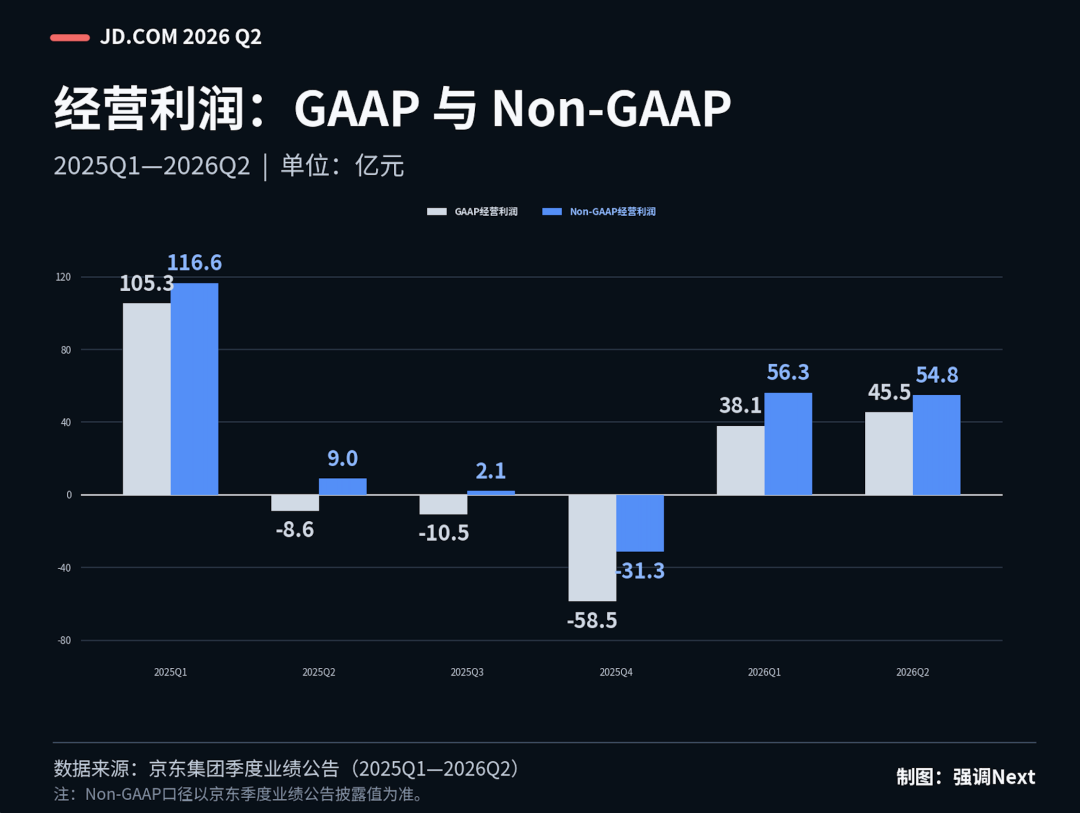
Retail stabilizes the foundation. JD Retail's operating profit reached RMB 13.5 billion, roughly flat with RMB 13.9 billion last year, though growth slowed from the previous quarter. The operating profit margin was 4.6% (vs. 4.5% last year). CFO Ian Su Shan stated in the earnings report that margin improvement came from higher gross margins in key categories and platform/advertising revenue outperforming the market. Food delivery burns nearly RMB 5 billion less. New business operating losses narrowed from RMB 14.78 billion to RMB 9.85 billion, a RMB 4.93 billion reduction representing the largest contributor to profit improvement. In 2025, JD's food delivery business lost RMB 46.6 billion for the full year, nearly wiping out JD Retail's annual operating profit. 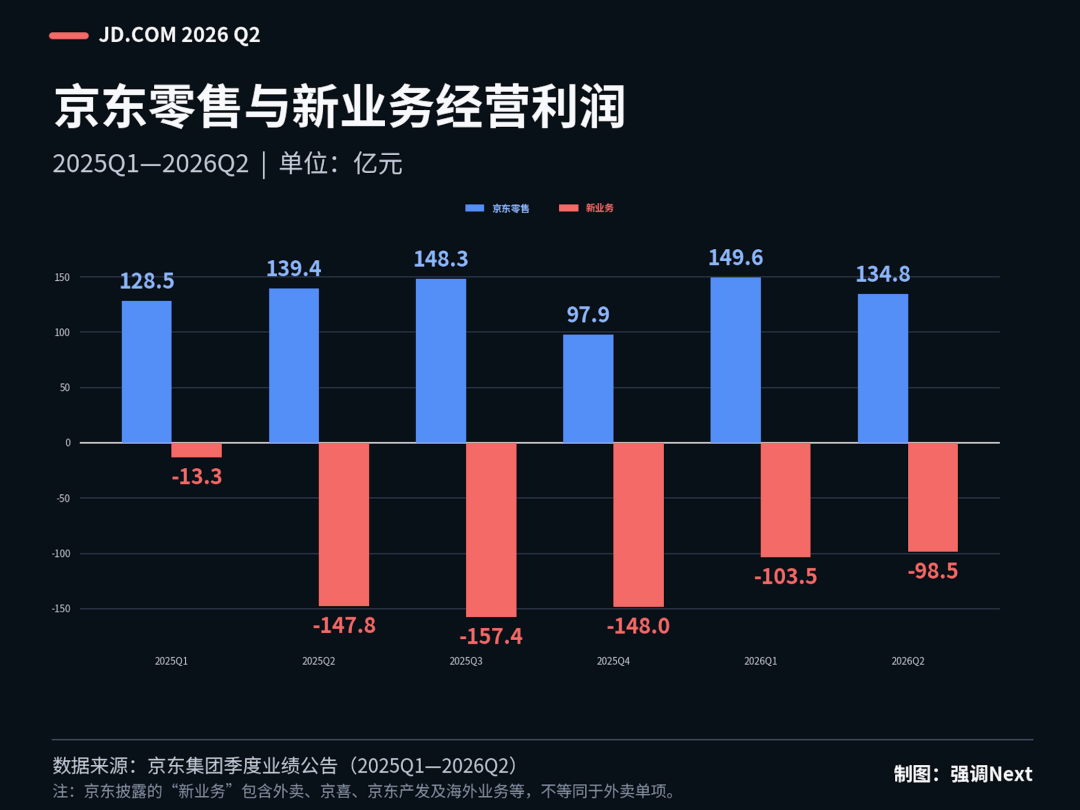
Marketing expenses cut by RMB 6.7 billion. Q2 marketing spending reached RMB 20.3 billion, down RMB 6.7 billion YoY, with the expense ratio dropping from 7.6% to 5.9%. This contraction mainly came from reduced new business promotion costs—Q2 2025 marketing expenses had surged from RMB 11.9 billion to RMB 27 billion (up 128% YoY) and are now normalizing. In contrast, R&D spending rose 37.7% YoY to RMB 7.3 billion, while fulfillment expenses grew 10.4% to RMB 24.5 billion. The key focus lies in this reallocation of expense structure—cutting marketing while increasing technology and fulfillment investments. 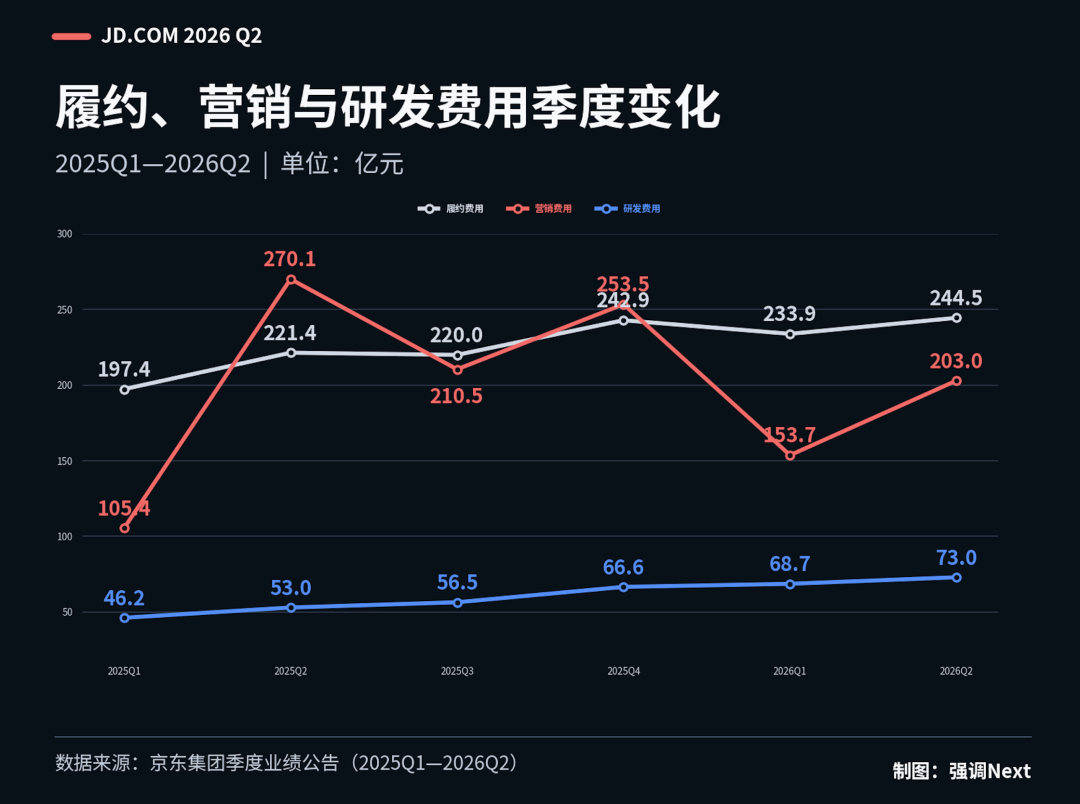
Thus, the "profit inflection point" primarily results from reordering the expense structure rather than accelerating revenue growth. Combined, these factors increased free cash flow from RMB 22 billion to RMB 31.8 billion. Rolling 12-month free cash flow reached RMB 31.4 billion, compared to just RMB 10.1 billion last year. In H1 2026, JD repurchased approximately 2.5% of its outstanding shares for $1 billion, with $1 billion remaining in its buyback program.
───
02
3C Stalls While Service Revenue Rises ■
JD's 2.9% revenue decline stems primarily from an 11.8% drop in electronics and home appliance revenue (from RMB 178.9 billion to RMB 157.9 billion). Over 12 years since listing, JD has never experienced YoY quarterly revenue decline. Q2's -2.9% indicates stress on its growth model. The official explanation cites "high base effect": 3C/home appliance consumption surged in Q2 2025 due to trade-in policies, creating pent-up demand. However, the high base merely masks the reality—normalized consumption after subsidy withdrawal, compounded by Pinduoduo and Douyin E-commerce encroaching on 3C territory. 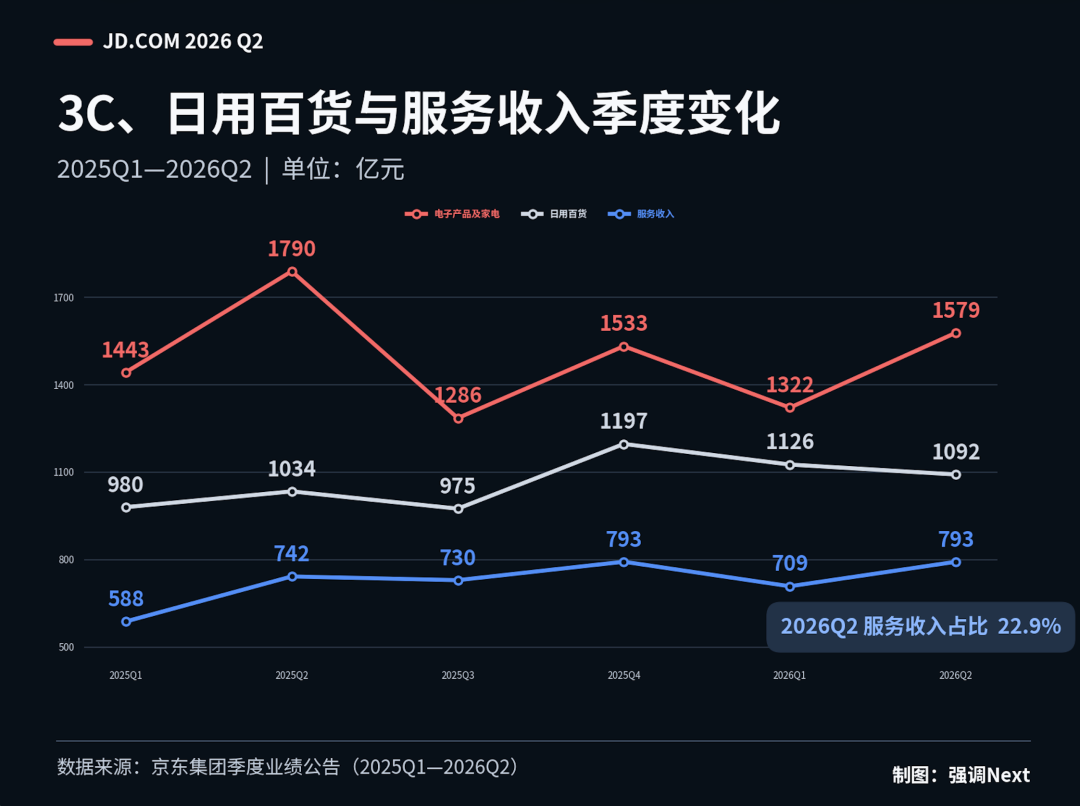
In contrast, daily necessities revenue grew 5.6% to RMB 109.2 billion, while service revenue rose 6.8% to RMB 79.3 billion. This includes 8.3% growth in platform/advertising services (RMB 30.9 billion) and 5.9% growth in logistics/other services (RMB 48.4 billion). For H1 2026, service revenue grew 12.9% YoY, significantly outpacing the -2.4% decline in commodity revenue. 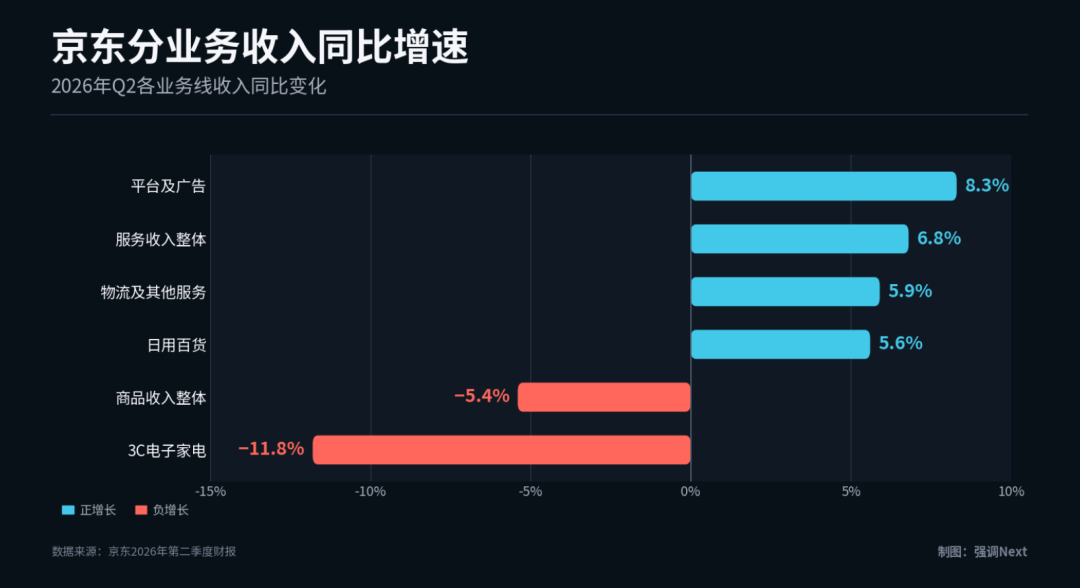
3C products offer low margins but high average order values, while platform advertising and logistics provide high margins. Service revenue consistently outpacing commodity revenue signals JD's transformation from a "markup reseller" to a "rent-collecting + service-providing" platform company. However, this transition comes with trade-offs.
JD is reducing spending on purchasing traffic while increasing investments to maintain fulfillment experience and technological capabilities. The new profit model isn't lighter but aims to dilute the cost of an expensive network through higher-frequency orders.
Additionally, TTM inventory turnover days increased from 34.1 to 40.5, while accounts payable turnover days extended from 59.0 to 64.2, indicating JD is imposing longer payment terms on suppliers to improve cash flow. The deterioration magnitude of these metrics warrants attention. 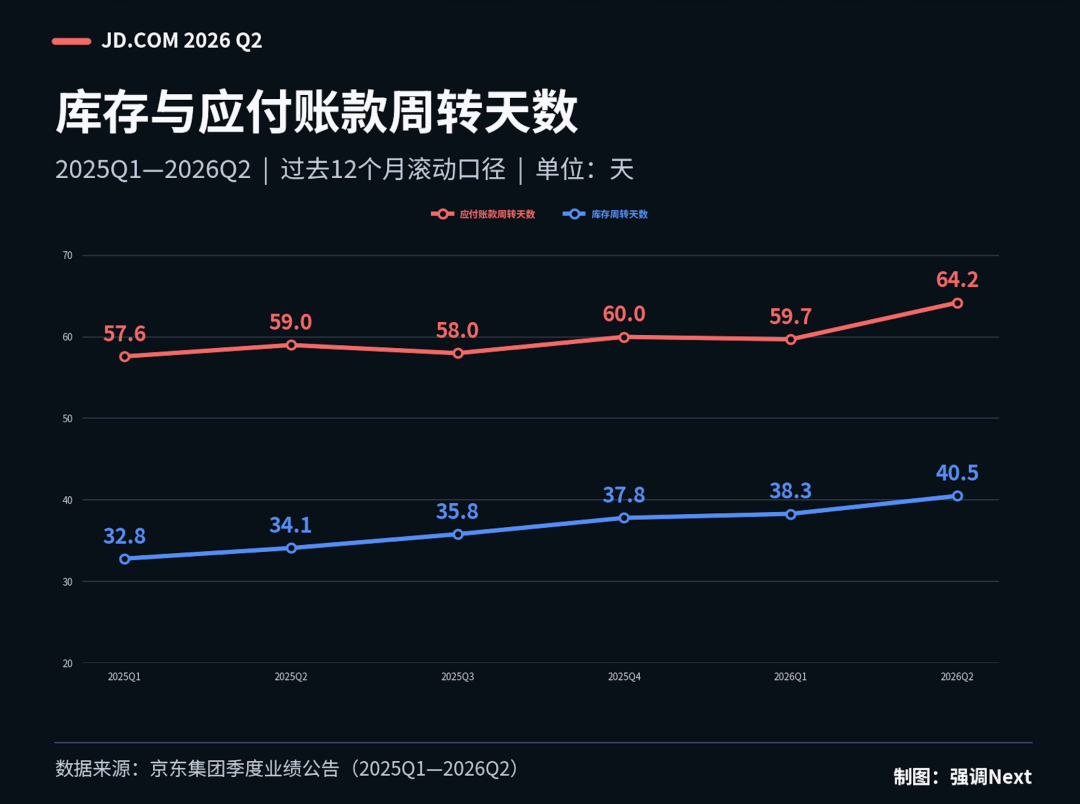
───
03
Food Delivery: Liu Qiangdong's "Supply Chain Strategy" ■
In February 2025, JD entered the food delivery market with zero commissions for the year and heavy subsidies. By multiple estimates, cumulative subsidies across three platforms reached RMB 80-100 billion for the year, with JD contributing approximately RMB 35.5 billion. Outsiders see a subsidy war for market share, but Liu Qiangdong's calculations extend beyond food delivery itself. "When customers come for delivery, 40% now buy JD e-commerce products. Losing money on food delivery proves cheaper than buying traffic from Douyin or Tencent," Liu explained publicly. QuestMobile data shows JD's user base grew 11.3% in H1 2026, the fastest among top apps. 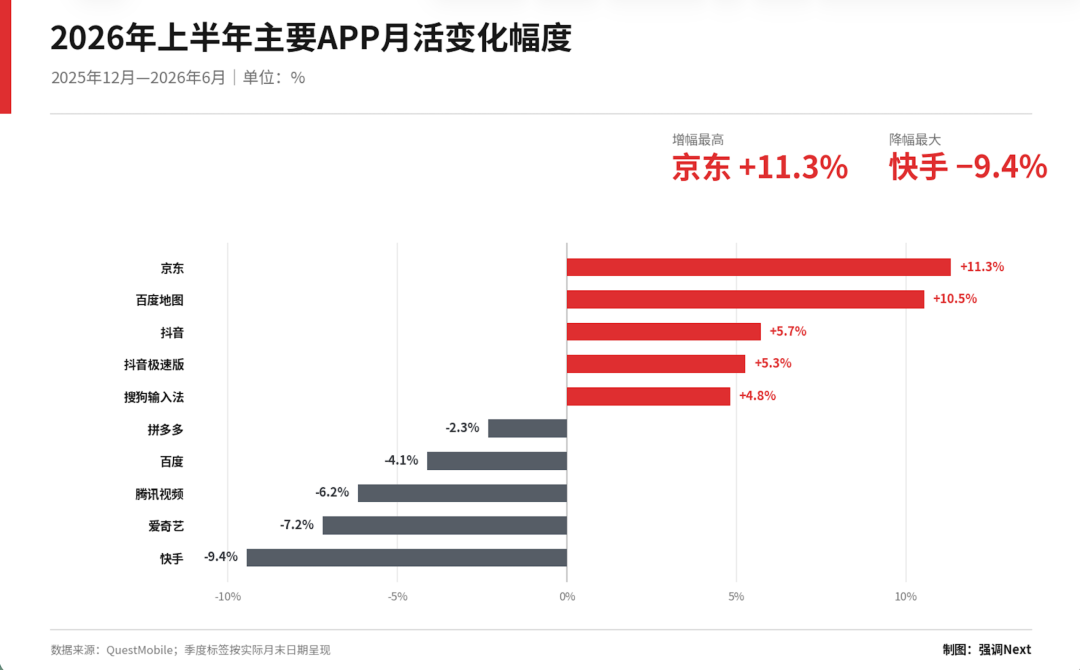
However, JD hasn't disclosed crucial metrics like food delivery order volume, per-order economics, active users, frequency, or cross-category conversion rates.
Organizational adjustments reveal more. In October 2025, JD Logistics acquired the group's instant delivery business (previously under new businesses). Since January 2026, instant delivery shifted from serving internal group businesses to directly supporting third-party merchants on the platform.
This adjustment clarifies JD's true objective: food delivery isn't an isolated traffic entry point but completes the logistics network with minute-level fulfillment capabilities, supplements open platforms with local merchants, and adds high-frequency demand to the retail hub. If order density proves sufficient, JD can simultaneously earn delivery revenue, merchant service fees, and retail cross-sales. Without successful synergy, food delivery becomes a standalone battlefield that chronically drains core retail profits.
Notably, the room for food delivery loss reduction is rapidly shrinking. New business quarterly losses reached RMB 9.85 billion, down nearly RMB 5 billion YoY but only RMB 500 million QoQ (Q1 2026 losses: ~RMB 10.4 billion). Improvement through "subsidy compression" is closing. JD Food Delivery's daily orders remain an order of magnitude below Meituan and Taobao Flash Sales, with insufficient scale effects representing the core obstacle to loss reduction. Instead of halting "money-burning," Liu Qiangdong shifted directions.
In February 2026, JD launched the "RMB 10 Billion Supermarket" channel, announcing over RMB 20 billion in subsidies for supermarket categories over three years, targeting RMB 200 billion in incremental sales. The shift from food delivery subsidies to supermarket subsidies still aims for dominance in instant retail. This time, Meituan preemptively acquired Dingdong Maicai (after JD's failed negotiations), while Alibaba reportedly engaged with Pupu Supermarket. The three-way war continues, requiring JD to catch up in self-operated supermarkets and front-end warehouses.
───
04
AI: Liu Qiangdong's Other Strategic Move ■
Q2 R&D spending reached RMB 7.3 billion, up 37.7% YoY, with its revenue share increasing from 1.5% to 2.1%. H1 2026 R&D investment grew 53% YoY.
Increasing R&D amid declining revenue represents Liu Qiangdong's second critical decision.
In 2025, JD Explore Academy upgraded from a JD Technology subsidiary to a group-level institution, with Liu Qiangdong personally serving as dean and proposing "All in Embodied AI." JD's AI strategy follows a three-phase route: digital intelligence → embodied intelligence → physical-world intelligence. Its self-developed JoyAI large model now applies to over 3,000 business scenarios, with token usage 7.7x higher than last year. However, compared to rivals like Alibaba investing hundreds of billions, JD's AI commitment operates on a different scale.
JD's AI focuses on industrial applications rather than chasing model parameter leadership, prioritizing conversion rates and efficiency in specific business scenarios. But Liu Qiangdong's direct leadership elevates AI from a "tech department matter" to a "CEO-level initiative."
Going forward, three variables will determine whether JD's profit improvement continues: 3C stabilization, food delivery loss reduction pace, and service revenue growth sustainability. Liu Qiangdong's strategy has progressed halfway: food delivery shifted from market share acquisition through subsidies to profit generation through loss reduction, AI penetrated 3,000 scenarios, and the "RMB 10 Billion Supermarket" replaced food delivery as the new investment focus. The past 18 months proved that food delivery losses could fund supply chain infrastructure and user growth.
The H2 test lies in whether this infrastructure converts into sustainable revenue and profits. Whether the inflection point leads to ascent or stagnation depends on whether Liu Qiangdong's supply chain trump card can truly be played. Cover Image: The Godfather
- END -
-
![]()
Seed has its own sense of mission
-
![]()
After 600 Days at the Helm, Li Jian Leads Honor to Launch a Phone Beyond Huawei’s Realm
-
![]()
The 'Lin Junyang Phenomenon' in AI Venture Capital
-
![]()
JD's Profit Increases While Revenue Stagnates: What is Liu Qiangdong After?
-
![]()
Creating "Liquid Lenses" with 70-Millisecond Focal Length Switching: Is XR Headset Zooming on the Horizon?
-
![]()
Xingyun Technology’s Remarkable Surge Over the Past Six Months
-
![]()
Chery Enters Korean Market with $75 Million Investment: A Strategic Model Combining Defense and Offense
-
![]()
JD Delivers an 'Above Expectations' Earnings Report, but the Market Doesn't Buy It