Soaring Storage Prices Leave Legacy Issues! China's Smartphone Market Sales Decline Intensifies Post-618, Huawei Maintains Top Position
 08/14 2026
 406
406
Kuaikeji, August 14 - The cascading impact of escalating memory chip prices has gradually filtered down to consumers, taking a significant toll on the overall sales performance in China's domestic smartphone market.
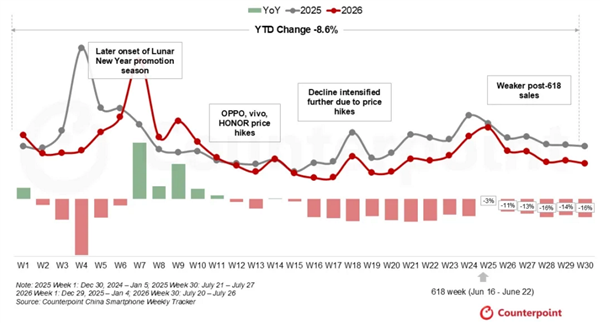
According to the latest data from market research firm Counterpoint, in the first 30 weeks of 2026, the cumulative total smartphone sales in China witnessed an 8.6% year-on-year decrease, with the overall market performance falling below the industry's initial expectations set at the beginning of the year.
The report highlights that following the 618 shopping festival, the year-on-year decline in China's smartphone sales further widened into the double-digit territory. Specifically, from weeks 26 to 30, the weekly year-on-year declines were 11%, 13%, 16%, 14%, and 16%, respectively, indicating a trend of progressive expansion.
As the market steps into the traditional seasonal slowdown phase, compounded by the continuous cost hikes of core components like upstream memory, smartphone manufacturers are finding it challenging to offer the same level of price reductions and subsidies as in previous years. This situation is further dampening the demand for device upgrades across the entire consumer electronics market.
In terms of individual manufacturer performance, Huawei currently dominates China's smartphone market, with its weekly sales share consistently surpassing 20% since the second quarter.
This remarkable performance can be primarily attributed to the sustained robust demand for the Enjoy 90 Pro Max model, coupled with a long-standing stable pricing strategy across its product range. This approach has effectively minimized users' hesitation in making purchasing decisions.
Since July, Apple has entered its seasonal sales lull, with major channels concluding the 618 promotional campaigns and reverting to regular pricing. Moreover, many users' purchasing needs were already fulfilled during the 618 shopping festival, causing Apple to enter a relatively quiet phase of natural demand. This state is expected to persist until the official launch of the new generation of iPhone products, which will likely bring significant relief.
Xiaomi's sales share surged to the second position in the market during week 30, primarily driven by the newly launched REDMI Note 17 series on July 14. This budget-friendly model, boasting long battery life and AI capabilities, precisely caters to the upgrade demands in the lower-tier market.
Brands like OPPO and vivo, which boast a strong offline channel presence, typically experience robust demand among young consumers and student groups during the summer vacation, achieving notable growth. However, this year, affected by the general increase in upstream component costs, the intensity of summer promotions has significantly diminished compared to previous years, directly impacting market performance during this period.
After unveiling the Honor X80 Pro Max, a key volume-driving model, at the end of June, Honor's recent market performance has shown signs of a gradual recovery.
From an industry-wide development perspective, the era of dividends (bonus period, referring to the benefits derived from falling storage prices that enhanced the cost-effectiveness of devices) that persisted for years has come to an end. Looking ahead, manufacturers aiming to drive sales recovery will need to concentrate on delivering differentiated product experiences and implementing practical AI features, as relying solely on price cuts to stimulate the market is becoming increasingly challenging.
-
![]()
Top Domestic Computing Power Supplier Exceeds Net Profit Forecasts for First Half of the Year
-
![]()
Wanwei Advanced Materials Plans to Raise 2.3 Billion Yuan through Private Placement to Boost PVA Optical Film Production!
-
![]()
Tencent Launches WeChat AI + WorkBuddy: A Strategic Long-Term Play
-
![]()
Tencent's Grand Move: Leveraging WeChat AI+WorkBuddy
-
![]()
AR Optical Film Sees 110% Surge! Rijiu Optoelectronics’ Q2 Net Profit Rockets 135% QoQ
-
![]()
Global Panel Giant Finds No Buyers
-
![]()
OpenAI Shuts Down Atlas: Who Has the AI-Powered Browser Yielded To?
-
Stay Alert! Avoid Over-Reliance on AI Chats—It Can’t Address Core Issues