RF Chips Spark a New Era of Strategic Positioning
 01/22 2026
 714
714
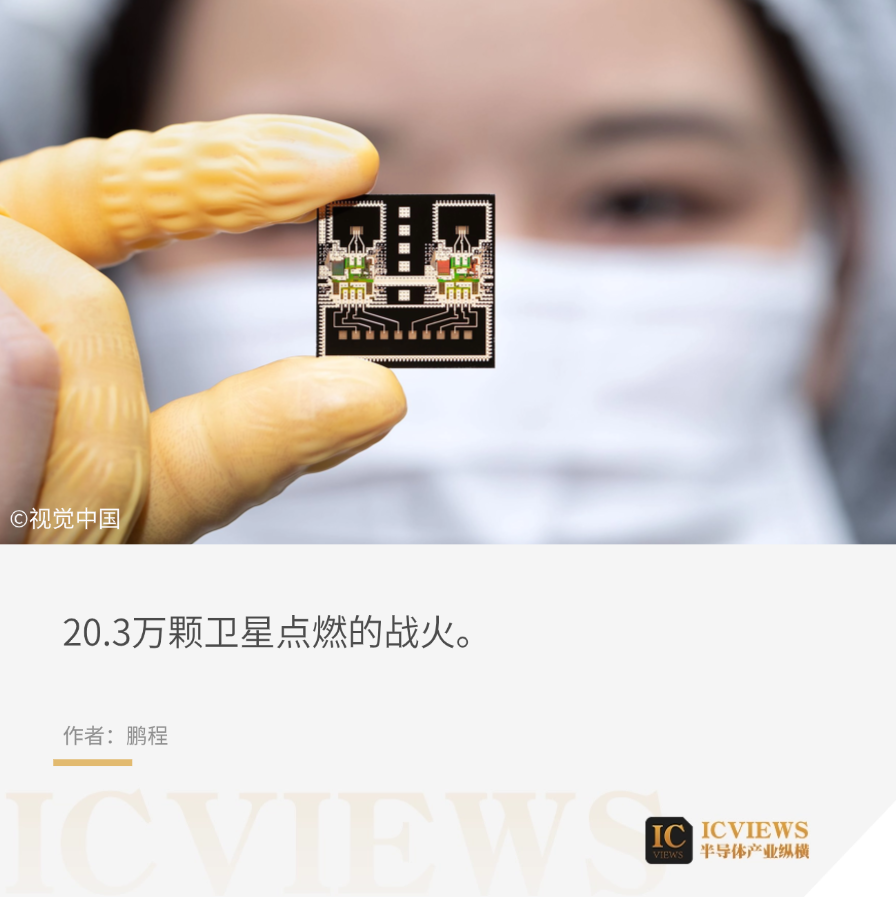
As terrestrial 5G-A networks accelerate towards delivering 10-gigabit experiences, low-Earth-orbit (LEO) satellite constellations are quietly but significantly reshaping the global communications landscape.
By the end of 2025, an application for frequency and orbital resources covering 203,000 LEO satellites was submitted to the International Telecommunication Union (ITU). This move has sparked industry enthusiasm and thrust the core technology behind satellite internet—RF chips—into the forefront of industrial competition.
Meanwhile, 2026 marked a historic milestone for the aerospace and capital markets: Elon Musk's SpaceX officially commenced preparations for an Initial Public Offering (IPO), targeting a valuation of $1.5 trillion and aiming to raise over $30 billion. For investors, this move represents a bet not on SpaceX's current status but on the long-term value of its space technology ecosystem, which is centered around Starlink, Starship, and space-based computing.
The previous year, European chipmaking titan STMicroelectronics delivered over 5 billion RF antenna chips to SpaceX for its 'Starlink' satellite network. A senior executive from STMicroelectronics revealed that the number of chips delivered through this partnership could double over the next two years (by 2027). The accelerated deployment of space technology ecosystems is becoming increasingly intertwined with the RF chip industry.
In this strategic positioning race for space-ground integrated communications, RF chips serve as both the linchpin for technological breakthroughs and the arena where domestic players compete with global giants.
01
RF Chips: The 'Heartbeat' of Communication Systems
RF communication systems are intricately composed of core components such as antennas, RF transceiver chips, baseband chips, and RF front-ends. Antennas handle the transmission and reception of wireless electromagnetic waves, RF transceiver chips are responsible for frequency conversion, channel selection, and signal amplification, while baseband chips focus on baseband signal synthesis and decoding.
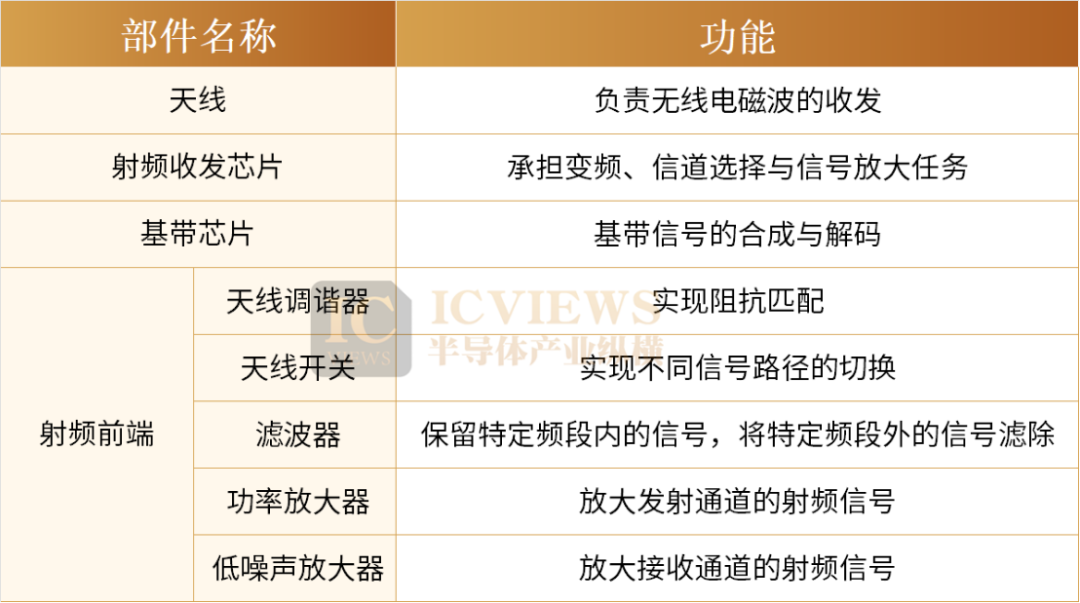
As a critical component, the RF front-end comprises multiple sub-modules, typically including power amplifiers (PAs), low-noise amplifiers (LNAs), filters (Filters)/duplexers (Duplexers), RF switches (Switches), and antenna tuners (Tuners).
The antenna tuner, or simply 'tuner,' operates between the transmitter and antenna. During tuning, a microprocessor controls an analog-to-digital converter to convert sampled parameters from the detection circuit into digital signals. These signals are then read into memory, processed, and used to adjust the matching network state to achieve impedance matching.
RF switches connect one or more RF signal paths through control logic, enabling switching between different signal paths, including transmission and reception, antenna switching, and frequency band switching. This facilitates antenna sharing and reduces terminal product costs.
Filters are frequency-selective devices that allow specific frequency components in a signal to pass while significantly attenuating others. They are frequency-selective two-port networks composed of inductors, capacitors, resistors, or ferrite devices. Duplexers, on the other hand, are essential components in frequency-duplex radios and relay stations, isolating transmission and reception signals to ensure simultaneous normal operation. They consist of two groups of bandpass filters with different frequencies to prevent the transmission of the device's own signal to the receiver.
Power amplifiers boost RF signals in the transmission channel, while low-noise amplifiers enhance RF signals in the reception channel to ensure reception quality.
RF chips are often hailed as the 'crown jewel of analog chips.' Processing high-frequency analog signals, RF chips require development based on specialized processes such as gallium arsenide, bulk silicon, silicon-on-insulator, and piezoelectric substrate materials. With high signal frequencies, large bandwidths, and increasing power demands, RF chips represent a high-threshold and technically challenging segment within analog chips. They demand extensive long-term experience and technical accumulation from RF front-end companies. For a long time, the global market has been dominated by international leading manufacturers, with the top five RF front-end vendors—Skyworks, Qorvo, Broadcom, Qualcomm, and Murata—collectively occupying 84% of the market share, with Skyworks leading at 21%.
02
Satellite Internet: China Hits the 'Launch Button' in 2026
As terrestrial 5G-A races towards 10-gigabit speeds, low-Earth-orbit satellites are also vying for orbital supremacy. The feasibility of launching 200,000 satellites hinges on rocket capacity. The good news is that the Long March 12B (CZ-12B) has successfully completed static firing, bringing China's version of a 'reusable' commercial rocket closer to launch.
Satellite internet, as the third-generation internet infrastructure revolution following wired and wireless internet, relies on low-Earth-orbit satellite constellations and is directly linked to national security strategies. It offers both industrial stimulation and strategic defense value. With their wide coverage, large capacity, and low latency, LEO satellites complement geostationary satellites and will dominate the evolution of next-generation communication technologies. Given the scarcity of LEO satellite orbital resources and intensifying international competition, China is compelled to accelerate its satellite internet construction. From an industrial structure perspective, satellite internet can be divided into two stages: networking and applications. Networking businesses, such as satellite manufacturing, launch, networking, and maintenance, as the front-end market, will enter a high-growth phase during the hardware-intensive investment period. Data from the Satellite Industry Association (SIA) shows that global satellite industry revenue reached $277.4 billion in 2018, with satellite manufacturing revenue at $19.5 billion, growing at a rate of 28%, demonstrating strong industrial vitality.
The iteration of communication technologies and the upgrading of information warfare demands are driving wireless communication systems towards multi-mode fusion. The U.S. military's Joint Tactical Radio System (JTRS) has already achieved single-terminal integration of ad hoc networks, tactical internet, data links, and satellite communications, supporting modular expansion and providing a model for multi-system communication interconnection. This trend underscores the inevitability of space-ground integration—no matter how dense terrestrial base stations are, they cannot cover vast oceans, deserts, and polar regions, making space the next battleground for communication.
03
Why Are RF Chips the 'Lifeblood' of Satellite Internet?
The large-scale deployment of low-Earth-orbit commercial satellites is a critical prerequisite for 6G network construction. Compared to previous generations of communication technologies, 6G's most distinctive feature is space-ground-sea integration, meaning that 6G networks and satellite internet are intertwined and deeply fused. Satellite internet will no longer be an independent system but rather a space extension of 6G terrestrial networks. In satellite communication systems, RF devices, as the core carriers for signal generation, processing, and transmission, directly determine the upper limit of network performance.
Notably, the three-dimensional heterogeneous integration technology for RF micro-front-end systems is undergoing profound transformations, becoming a key path to overcoming traditional RF front-end performance bottlenecks.
This technology aims to break through the limitations of single-plane integration by achieving high-density stacking and interconnection of chips or dies with different materials, process nodes, and functions in the vertical direction (three-dimensional space). This encompasses 'heterogeneous' and 'heterostructured' units such as high-performance III-V compound semiconductor devices, silicon-based complementary metal-oxide-semiconductor (CMOS) control/digital circuits, high-quality passive components, microelectromechanical systems (MEMS), and even photonic devices. Ultimately, it constructs a more functionally complete, compact, and high-performance miniaturized RF system with high integration. Relying on advanced interconnection technologies such as through-silicon vias (TSVs), microbumps, redistribution layers (RDLs), and hybrid bonding, this system enables ultra-short-distance, low-loss, and wide-band signal transmission between chips, effectively weakening interconnection parasitic effects and significantly improving overall system efficiency and integration density.
This technology surpasses single-plane integration by stacking and interconnecting chips or dies with different materials, process nodes, and functions in the vertical direction (three-dimensional space) to construct a more powerful, compact, and high-performance miniaturized RF system with high integration. Through advanced interconnection technologies such as TSVs, microbumps, RDLs, and hybrid bonding, it achieves ultra-short-distance, low-loss, and broadband signal transmission between chips, significantly reducing interconnection parasitic effects and improving overall system efficiency and integration. This technology holds particular promise in the aerospace sector.
In terms of miniaturization and lightweighting of aerospace equipment, aerospace payloads are highly sensitive to volume and mass. Traditional RF systems, which adopt discrete devices and two-dimensional planar integration, struggle to meet the stringent requirements for miniaturization and lightweighting in spacecraft. Taking large-scale phased array antennas for synthetic aperture radar (SAR) payloads or communication payloads as an example, the mass and size of traditional RF and antenna TR (TR) components are increasingly difficult to meet the demanding requirements of the latest models. RF microsystems, through three-dimensional heterogeneous integration technology, integrate RF, power, control, and other functional units at a microscale with high density, significantly reducing system volume and mass. For instance, in satellite communications, SAR payloads, and other equipment, RF microsystems can integrate complex RF front-ends, signal processing modules, etc., into extremely small spaces, saving valuable payload space for spacecraft while reducing launch costs.
In terms of high performance and reliability of aerospace equipment, the aerospace environment is complex and harsh, with limited satellite resources demanding RF systems with exceptional performance and high reliability. RF microsystems incorporate various advanced technologies, such as using compound semiconductor devices like GaN and GaAs to enhance RF performance, leveraging silicon-based CMOS processes for high-integration digital logic design, and employing TSVs, wafer-to-wafer (W2W) bonding, and other processes to achieve low-loss, high-reliability signal transmission. These technologies enable RF microsystems to achieve high-power, low-noise, and wide-bandwidth RF signal transmission and reception under limited mass and power consumption, meeting the high-performance demands of aerospace radar, remote sensing, and communication equipment. Meanwhile, three-dimensional integration technology reduces the number of solder joints and wires in traditional interconnection methods, lowering the risk of failure due to environmental factors such as vibration and temperature changes, and improving system reliability.
In terms of multifunctionality and intelligence of aerospace equipment, future aerospace missions are trending towards diversification and intelligence, requiring RF microsystems to possess multifunctional integration and adaptive capabilities. RF microsystems, through modular design and reconfigurable architectures, can flexibly configure functions according to different mission requirements. For example, in spacecraft communication, radar, electronic warfare, and other systems, RF microsystems can achieve rapid switching between multiple modes and resource sharing, improving system multifunctionality and intelligence. Additionally, RF microsystems can integrate with control, sensor, energy, and other units to form miniaturized electronic information systems with autonomous perception, decision-making, and execution capabilities, providing technical support for the development of intelligent spacecraft.
Thus, core devices such as RF chips are of paramount importance for the industrialization of satellite internet, directly determining the pace of the space-ground integration strategy.
04
Domestic Players: Armed and Ready for Action
Faced with the historic opportunities brought by satellite internet, domestic RF chip enterprises have accelerated their strategic positioning and achieved breakthroughs in niche areas, gradually breaking international monopolies.
ST Chengchang focuses on multi-channel, multi-beam amplitude-phase multifunctional chips with high integration, low power consumption, and excellent noise figures, giving them strong competitiveness. These chips have been applied in next-generation low-Earth-orbit satellites and ground support equipment. The latest news indicates that the company has completed stockpiling according to core customer delivery requirements and is proceeding with industry deliveries as planned, accelerating project timelines.
Feixiang Technology's satellite communication PAs have achieved bulk shipments and have been adopted by Honor's next-generation flagship foldable smartphone, marking domestic RF devices' recognition by leading players in the consumer terminal satellite communication sector.
Li'on Micro's controlled subsidiary, Li'on Dongxin, possesses the industry's first quantifiable integrated process technology. The pHEMT process can integrate power transistors with a gate length of 0.15 μm, low-noise transistors, PN diodes, E/D logic, and RF switches into a single chip and achieve commercial mass production. Currently used in low-Earth-orbit satellite communication, it has achieved large-scale shipments, including functions such as power amplifiers (PAs), low-noise amplifiers (LNAs), and RF switches (SWs). Additionally, Li'on Dongxin's gallium nitride RF chip process aims for satellite applications.
Zhongci Electronics' subsidiary, Bowei Company, is actively driving critical technological advancements and product development in RF chips and devices tailored for next-generation communication systems, including satellite communication. Presently, the company has developed core technologies and products for chips and devices used in applications like direct-to-phone low-Earth-orbit satellite communication, and is making steady progress in industrial applications based on user demand.
CETC Chip has identified satellite communication as a pivotal business area. Its subsidiary, Southwest Design, was honored with the "2024 Top Ten Technological Advances in Chongqing" award for its "key breakthrough in RF chips for satellite internet," marking a significant achievement in the field.
Vanchip's RF front-end chips, which support satellite communication, have seen widespread adoption and deep integration in the smartphone and automotive sectors, enabling a seamless "space-ground integrated" communication experience. Currently, the company is relentlessly pursuing the integration of satellite communication with cutting-edge technologies such as IoT and 6G, actively strategizing (replacing "layout" with the more natural "strategizing") for broader terminal and vertical industry applications. It is dedicated to providing essential support for the construction of the next-generation communication network with space-ground integration capabilities.
The competition for RF chips has transcended mere technological rivalry; it now represents the "right to issue cards" in shaping the communication landscape for the next decade. As the Long March 12B rocket ascends into the sky, domestic RF chips have concurrently reached the launch pad. In the space race, there are no shortcuts—only relentless, straight-line acceleration. The entity that crosses the strategic positioning line first will truly cement the "jewel" in their crown.
-
The RTX 3060 Makes a Comeback Amid a Mix of Old and New Hardware, Making 2026 the Worst Year for the PC Industry
-
![]()
Zhang Yiming Achieves Jack Ma's 'Dream': Douyin Surpasses 1 Billion Monthly Active Users First!
-
The Complete Decline of Fuel-Powered Vehicles! Only One Model in July's Top 10 Sales
-
![]()
What Are the Three World Models in BYD's HyWorldVLA: Pixel-Level, Latent Space, and Hybrid?
-
Raking in 23.7 Billion Yuan in Just Half a Year! Has Foxconn Industrial Internet Turned a New Leaf?
-
Offline Competition Among Big Companies for Customers: The Battle for Desktop Access with Office Agents
-
![]()
Starting at 3199 yuan, the REDMI K100 series has been launched, making me start to worry for the Xiaomi 18
-
![]()
Xiaomi's MiMo Stages a Two-Year Comeback to Top Global Inference Volume Rankings