Semiconductor Lasers in High-Speed Fiber-Optic Communications: A Deep Dive
 04/16 2026
 692
692
Optical communications are experiencing exponential growth, with lasers serving as a pivotal component. How do these two elements harmoniously coexist?
1. Stringent Requirements for Light Sources in High-Speed Communications
Dynamic SLM Demand: As transmission rates soar to 10~20 Gb/s, systems necessitate the use of single-mode fibers and dynamic SLM (Single Longitudinal Mode) lasers to maintain signal integrity.
Limitations of Conventional Lasers: Traditional Fabry-Pérot (F-P) lasers, while operating in a single longitudinal mode under DC conditions, exhibit significant dynamic spectral broadening (chirping) and a deterioration in side-mode suppression ratio under high-speed direct modulation. This is attributed to carrier transient effects, leading to multi-longitudinal-mode operation and subsequently degrading system performance.
2. The Optimal Solution: Distributed Feedback (DFB) Lasers
Principle and Benefits: DFB lasers achieve selective feedback for a specific Bragg wavelength by incorporating a periodic grating within the active layer. This design renders them the most effective and ideal SLM light source for high-speed communications. When coupled with quantum well structures (particularly strained quantum wells), further improvements in linewidth compression and modulation bandwidth enhancement are realized.
Limitations of Uniform Gratings and Mitigation Strategies: Uniform gratings suffer from symmetric longitudinal mode threshold degeneracy on both sides of the Bragg wavelength, posing challenges in ensuring stable SLM operation.
*Mitigation Approaches*: Asymmetric structures, such as coated cleaved facets, can be employed. However, the most effective solution involves introducing a λ/4 phase-shift region, which yields extremely high SLM yields.
Technological Advancement: Gain-Coupled (GC) DFB Lasers: Compared to traditional refractive index-coupled (RC) DFB lasers, GC-DFB lasers offer distinct advantages. They are independent of cleaved facet reflectivity, achieve extremely high SLM yields (>90%), effectively eliminate spatial hole burning, are insensitive to external reflected light, and exhibit reduced chirping.
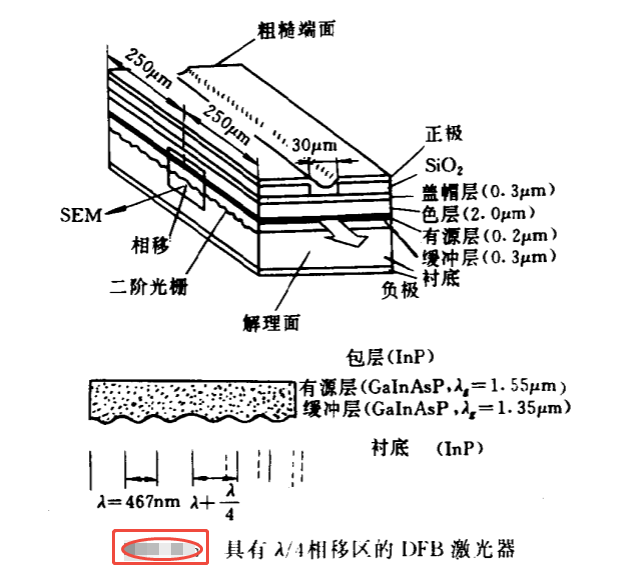
3. Wavelength Division Multiplexing (WDM) Applications: Multi-Terminal Tunable Lasers
To cater to the multi-channel and flexible routing demands of WDM systems, this section introduces multi-terminal tunable semiconductor lasers, such as three-electrode DFB and four-terminal DBR lasers. By independently controlling the injection currents in the active, phase, and grating regions, continuous wavelength tuning across a range of several nanometers can be achieved, facilitating efficient and versatile optical communication.
4. Conclusion and Future Prospects
High-speed systems mandate extremely narrow dynamic linewidths, necessitating the synergy of "high differential gain in quantum wells" and "selective feedback from gratings." Consequently, quantum well DFB lasers are widely acknowledged as the optimal light sources for high-speed (≥2.5 Gb/s) fiber-optic communications.
Future development trajectories encompass the monolithic integration of lasers with external modulators (e.g., electro-absorption modulators) into photonic integrated circuits (PICs). This integration aims to completely eradicate the chirping effects induced by direct modulation, paving the way for even more efficient and reliable high-speed optical communications.
-
![]()
Proposed to Raise 955 Million Yuan through Private Placement! Huicheng Vacuum Boosts Localization of Ultra-Precision Optical Coating Equipment
-
![]()
Cash Flow Soars 13-Fold! What Major Strategic Move is Wuhan Five Square Optoelectronics Planning?
-
![]()
Leaked Design of vivo X500: Reverts to Circular Camera Module in Top-Left Corner, Pays Homage to Classic X90 Aesthetic
-
![]()
DeepSeek Shows Signs of Foraying into Code Agents, Launches WeChat Official Account Focused on Harness
-
![]()
Auto Companies Deny Claims That ‘Cooperation with Huawei Is Non-Essential’, as Huawei Transforms into a ‘Public Platform’
-
![]()
Starship to Independently 'Return to the Launch Tower': SpaceX's Ambitions Extend Beyond Rocket Building to Dominating Space Transportation
-
![]()
Starship Set to Independently 'Return to the Launch Tower': SpaceX is Revolutionizing Space Transportation, Not Just Building Rockets
-
![]()
Anthropic and OpenAI Face Off Against Deepseek