Zhuque-3 Rocket Successfully Recovered: Why This Achievement Bears More Resemblance to SpaceX Than the Long March 10B Mission
 08/19 2026
 355
355
This morning, I was greeted by the news that LandSpace's Zhuque-3 Yao-2 rocket had successfully launched and been recovered, a story that dominated my newsfeed.
The rocket's first stage made a steady descent to the landing site in Minqin, Gansu, with its four landing legs fully extended, allowing the rocket to stand upright upon touchdown.
This "upright landing" marked several firsts for China: the inaugural land recovery of an orbital-class rocket, the first recovery utilizing landing legs, and the pioneering accomplishment of this feat by a private space company.
Why is this recovery such a significant milestone?
This isn't the first time China has successfully recovered a rocket. On July 10, the Long March 10B embarked on its maiden flight, with its first stage being recovered at sea using a net system—a global innovation in sea-based net recovery. For more details, please refer to our previous article, Net Recovery + Centimeter-Level Positioning! Long March 10's Dual Sea Recovery—Every Detail Reveals Cutting-Edge Technology.
However, Zhuque-3 took a distinct approach—vertical recovery with landing legs.
While it may seem like a mere difference between "catching with a net" and "standing on legs," these two methods represent fundamentally different technical philosophies.
Net recovery demands high precision in site selection but minimizes the loss of payload capacity since the rocket doesn't need to carry the extra weight of landing legs.
On the other hand, landing leg recovery requires the rocket to bear the weight of four legs throughout its mission, sacrificing some payload capacity and demanding extremely precise control due to the narrow margin for error during the final landing phase.
Yet, the benefits are undeniable: it enables landings on both land and sea, offers flexible mission scheduling, and supports high-frequency, routine launches.
Consider this: Why can SpaceX's Falcon 9 launch multiple times a week? It's because it relies on a vertical recovery system with landing legs.
Thus, Zhuque-3's success isn't merely "another recovery"—it's China's first complete emulation of the path SpaceX has paved.
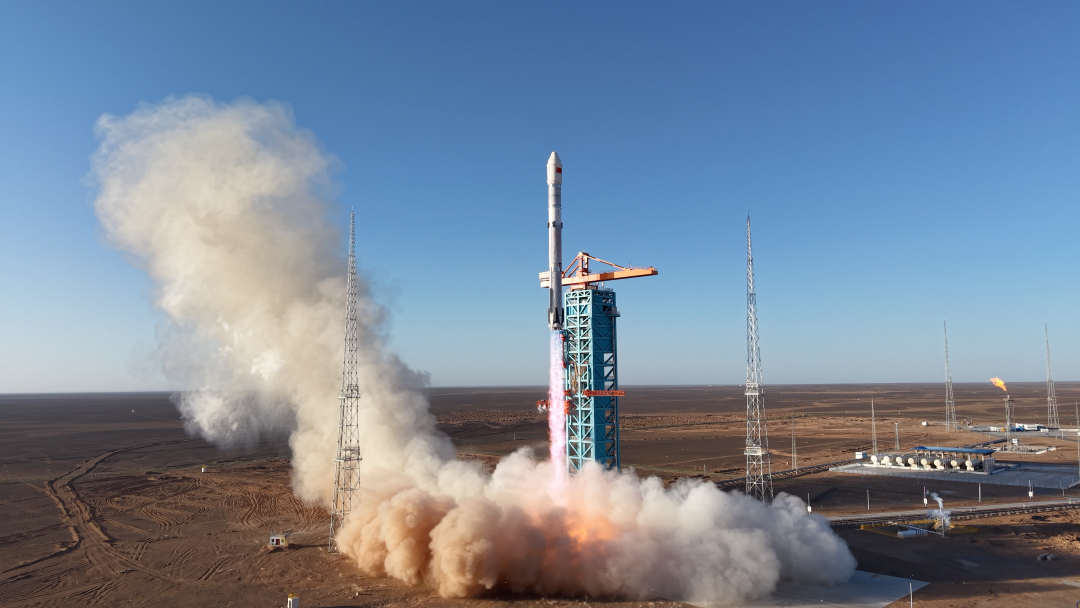
Image Source: LandSpace
What Makes It So Challenging? Dropping a Rocket from 100 Kilometers Above
To appreciate the magnitude of this challenge, envision this scenario: The rocket's first stage returns from an altitude exceeding 100 kilometers and must land precisely within a 60-meter-square landing zone—akin to hurling a pen from the 100th floor and having it land in a pen holder on the ground.
Moreover, this "pen" stands 66 meters tall, weighs 570 tons, and must withstand hypersonic re-entry, aerodynamic deceleration, multiple engine restarts, grid fin adjustments, and precise final deceleration before touchdown to ensure the four landing legs stabilize the rocket.
There's no margin for error at any stage.
During the Yao-1 mission, issues arose during the landing phase, preventing a successful soft landing. However, that flight provided invaluable data on hypersonic re-entry, grid fin control, and multiple engine ignitions.
Yao-2 incorporated targeted optimizations based on that data: fewer landing ignition engines for simpler systems, enhanced safety control for predicted landing points, and improved re-entry thermal protection.
The outcome? Success on the first attempt.
Recovery Is Just the First Step; Reusability Is the Ultimate Goal
What's the purpose of rocket recovery? In essence: cost savings.
For expendable rockets, fuel accounts for a mere 1-3% of launch costs, while the first stage comprises 70% of the total rocket cost. Discarding the most expensive component after a single use is highly inefficient. Reusing the first stage can dramatically reduce launch costs.
By design, Zhuque-3's first stage can be reused no fewer than 20 times. Its recovery payload capacity to low Earth orbit is 18.3 tons, compared to 21.3 tons for expendable launches. This capacity perfectly aligns with the demands of satellite internet constellation deployment.
LandSpace plans to refly the recovered rocket within six months, establishing a closed loop of "launch—recovery—inspection—reuse."
While the successful recovery is cause for celebration, industry insiders understand: merely recovering the rocket is just the starting point. The real challenges lie in rapid inspection, relauching, and stable reuse.
From project inception to successful recovery, Zhuque-3 took less than three years—a pace that's competitive on the global stage.
But the journey is far from over. The next reflight, the 10th reuse, the 20th reuse—each step presents new challenges and tests.
The good news? The most arduous first step has been taken.
All content is sourced from publicly available information and represents personal viewpoints only.
-
![]()
Exclusive! Dongfeng Peugeot Citroen Automobile (DPCA) Embarks on a Fresh Start: A New Joint Venture Entity Emerges, with the Original DPCA Focusing Exclusively on Manufacturing
-
![]()
63-Year-Old Li Shufu Paves the Way for Leadership Transition: Geely Shifts from Family Control, What Will Great Wall and BYD Do?
-
Can the Elephant Turn Around? Volkswagen Takes Only Three Years to Reshape Its 'Soul'
-
![]()
DeepSeek Hikes Prices as 'Price Butcher' Liang Wenfeng 'Retreats'
-
![]()
Starting at 1799 yuan! Dimensity 7500 with 10,000mAh battery, who is the iQOO Z11S for?
-
![]()
BMW 5 Series Price Plummets to 280,000 Yuan: Early BMW Owners Lament 'Significant Losses'; BMW Dealers Offer 285,000 Yuan for Base Model, Financing Deals More Affordable Than Full Payment
-
![]()
Geely's Strategic Shift: Unpacking a Key Question and a Major Anticipation Post Li Shufu's Departure
-
![]()
Starting at 3399 Yuan! iQOO Neo11 Supreme Edition Launched: Featuring the Dimensity 9500M and Exceptional Battery Life