Hongruan Hi-Tech: Unveils Awoda-cn Cleaning Autonomous Vehicle, Harnessing Large AI Models to Revolutionize Autonomous Driving's Future
 01/07 2026
 700
700
Introduction
Recently, Beijing Hongruan Hi-Tech Information Technology Co., Ltd. (hereinafter referred to as 'Hongruan Hi-Tech') has officially introduced the Awoda-cn cleaning autonomous vehicle. This groundbreaking model has been pioneeringly deployed at Ningbo Software Park and is now in regular operation.
What's even more thrilling is Hongruan Hi-Tech's innovative stride in integrating large AI models into autonomous driving, unveiling a pivotal trend:
The key determinant for high-level autonomous driving is transitioning from hardware accumulation and algorithmic rivalry to systematic engineering prowess centered around large AI models, along with the capacity to tackle the three industrialization cornerstones: cost, efficiency, and reliability.
(For more insights, please click: 'Xuanli Intelligence: Hefei-manufactured unmanned cleaning vehicles and boats make their debut, capable of self-cleaning, packing, and disposing of garbage!')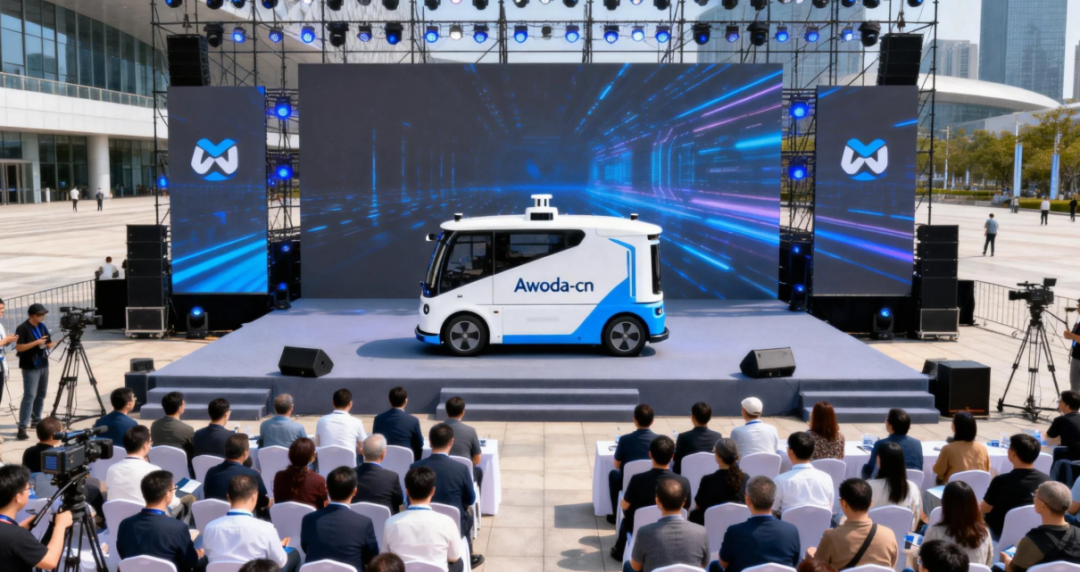
I. Tackling the Three 'Achilles' Heels' of Industrialization: Data, Computational Power, and Synergy
The three primary challenges Hongruan Hi-Tech addresses—imbalanced computational latency, scarcity of high-quality data, and inadequate multi-system coordination—are global bottlenecks impeding the large-scale commercialization of L4 autonomous driving.
The significance of its technical approach lies in offering systematic engineering solutions rather than isolated optimizations.
1. Resolving 'Data Hunger' and the 'Cost Curse':
By establishing a closed loop of 'automated labeling-semantic retrieval-virtual generation,' automated labeling accuracy has been elevated to 99%. Utilizing NeRF technology to generate vast virtual scenarios directly addresses the industry's most pressing issue:
Dependence on costly manual labeling and the challenge of covering numerous long-tail scenarios.
This breakthrough not only substantially reduces data costs but also accelerates the iterative and verification cycles of algorithms, paving the way for tackling the myriad 'corner cases' in complex urban traffic.
2. Taming the 'Computational Beast' for Onboard Deployment:
Compressing end-to-end inference latency of a 1 billion-parameter model to under 100ms and boosting computational utilization to over 85% are pivotal achievements concerning 'onboard' feasibility.
This implies that large models, previously confined to cloud operations, can now be deployed on the vehicle's limited computational resources while adhering to safety and real-time response standards.
This 'full-link lightweight' technology serves as the crucial bridge connecting large models from training to application 'the last mile.'
3. Reconstructing 'Vehicle-Cloud Synergy' for Dynamic Evolution:
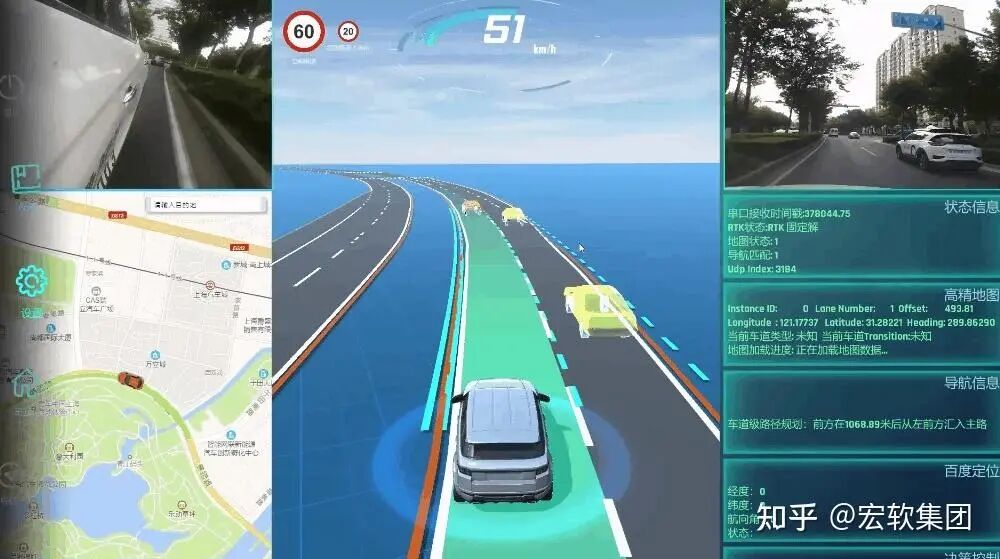
Through lightweight communication middleware and incremental update technology, data flow latency and transmission loads are significantly diminished, forging an efficient 'neural pathway' between the vehicle and the cloud brain.
This enables vehicles to continually acquire the latest models and knowledge from the cloud, achieving collaborative evolution of fleet capabilities and swift adaptation to unknown scenarios, transforming autonomous driving systems from 'fixed at factory exit' to 'lifelong learning, continuous growth' entities.
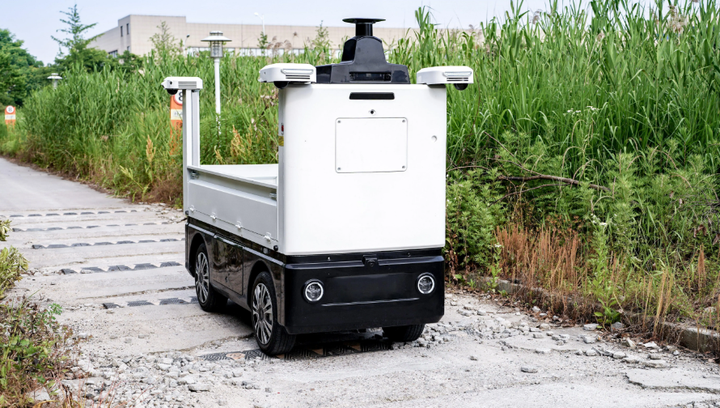
For instance, compared to traditional manual cleaning methods, the Awoda-cn cleaning autonomous vehicle developed by Hongruan Hi-Tech offers substantial advantages:
It can operate around the clock, covering over 180,000 square meters daily, enhancing operational efficiency by over 30% while significantly reducing labor costs and safety risks.
In terms of cleaning functions, the vehicle integrates multiple capabilities such as sweeping, sprinkling, and garbage collection. It can dynamically plan operational routes through a cloud-based scheduling platform based on the cleaning needs of different areas in the park, precisely matching cleaning intensity to achieve 'on-demand sweeping, intelligent operation and maintenance.'
II. Industrial 'Spillover Effects' and Path Insights Behind Technological Breakthroughs
Hongruan Hi-Tech's breakthroughs transcend technical parameters, offering multiple insights into the direction of industrial development.
Firstly, it validates the engineering path for 'end-to-end' autonomous driving.
Its BEV+Transformer multimodal fusion perception framework and 'perception-prediction-decision-control' full-link optimization represent the mainstream direction of the industry's evolution from traditional modular 'pipelines' to large model-based 'end-to-end' systems.
This not only enhances decision-making rationality but also simplifies system complexity from an architectural standpoint, opening up avenues for eventual cost reductions (over 30% cost reduction).
Secondly, it facilitates the dimensionality reduction empowerment of L4 technology to the L2+ market, accelerating intelligent accessibility.
Hongruan Hi-Tech's low-computational-power L2+ solution has secured bulk orders.
This reveals a clear business rationale: refining and optimizing advanced perception, prediction, and control capabilities developed during the pursuit of high-level autonomous driving to feed back into the massive mass-produced assisted driving market.
This not only dilutes R&D costs through scale applications but also provides richer data feedback for high-level autonomous driving, forming a virtuous cycle of 'high-level technological breakthroughs, tiered market harvesting.'
Finally, it aids in constructing a secure and controllable industrial technology foundation.
Five national invention patents break foreign monopolies, and the solution is compatible with hardware from multiple brands, enhancing China's self-controllability in the core software stack of autonomous driving and avoiding reliance on others in the future intelligent mobility ecosystem.
III. Marching Toward 'Trustworthy Intelligence': The New Long March After Breakthroughs
Despite significant achievements, the journey toward fully autonomous driving remains arduous.
Hongruan Hi-Tech's next directions—large model interpretability and driving ethics rule systems—precisely highlight deeper challenges.
As systems increasingly resemble 'black boxes,' ensuring that their decisions are not only efficient but also safe, compliant, and aligned with human ethics and expectations will become the ultimate test of social acceptance.
Meanwhile, expanding into niche scenarios such as heavy trucks and park logistics means that technology needs to adapt to vastly different operational design domains (ODDs), with its generalization capabilities facing a new round of testing.
IV. Conclusion: Catalyzing the Transition from Laboratory 'Bonsai' to Industrial 'Forest'
Since its inception in 2016, Hongruan Hi-Tech has amassed extensive experience in software R&D, boasting a robust R&D team and technological advantages. It has forged solid partnerships with numerous leading enterprises such as Xiaomi, Tencent, and Baidu and obtained multiple qualifications, including '3A Credit Enterprise in the Internet Electronic Technology Field' and 'ISO Quality Management System Certification.'
In recent years, leveraging its technological accumulations, the company has ventured into the autonomous driving sector. The Awoda series of products has been successfully applied in multiple scenarios such as tourist attractions and port logistics. The launch of the Awoda-cn cleaning autonomous vehicle and its deployment at Ningbo Software Park represent a significant extension of its technological achievements into the smart sanitation field.
Hongruan Hi-Tech's technological breakthroughs serve as a crucial catalyst in the evolution of the autonomous driving industry from carefully cultivated 'demonstration bonsai' to a lush and towering 'commercial forest.'
It demonstrates that through systematic engineering and technological innovation, the core bottlenecks hindering industrialization can be gradually dismantled and overcome.
Its value lies not only in a series of optimized percentage figures but also in pointing out a pragmatic path for the industry from 'technological feasibility' to 'commercial feasibility':
That is, utilizing large models as the engine, data closed loops as fuel, and vehicle-cloud synergy as an accelerator to ultimately achieve a balance between safety, cost, and experience.
In conclusion, the WeChat public account 'Autonomous Vehicles Are Here' believes:
When such core technological breakthroughs continue to emerge and synergize, the 'singularity moment' when autonomous driving massively integrates into daily life will truly shift from a distant future into a clearly visible horizon.
What are your thoughts, dear readers?
Source: Autonomous Driving World
Note: This article has undergone slight editing, and the title has been modified.
#AutonomousVehiclesAreHere #AutonomousDriving #SelfDriving #AutonomousVehicles
-
![]()
Enflame Tech's IPO Journey: Navigating Over 5.9 Billion Yuan in Losses and Soaring Debt in Q1 This Year
-
![]()
Trillion-Yuan Giant Li Shufu 'Streamlines': Could Levc Be the Casualty?
-
![]()
AI Competes for Electricity and Generates Power in the Gobi Desert
-
![]()
The First Batch of Victims of the AI Bubble: Programmers
-
![]()
ByteDance, DJI, and Xiaohongshu Secure Top Three Positions Among China’s Fastest-Growing Unicorns
-
Tesla's in-car voice system in China is finally learning to 'understand human language'
-
![]()
Foreigners Are Amazed: Chinese Electric Vehicle Drive Systems Unveil Innovative 'Poses'
-
![]()
700,000 Brothers and the Future of Robots: Behind JD.com's 'Nirvana Plan'