Sailing Towards 2030: The Commercialization Wave of Autonomous Driving and Rule Reconstruction
 02/27 2026
 644
644
In February 2026, the United Nations'
However, as we look ahead to 2030, this AI-powered autonomous driving revolution is evolving along a path strikingly similar to the 'AI Prosperity Paradox': Full commercialization of Level 4 autonomous driving → Elimination of professional driver roles → Restructuring of mobility consumption patterns → Collapse of traditional transportation industry chains → Revaluation of financial market estimates. From LiDAR in the perception layer to large model algorithms in the decision-making layer, and from AI network collaboration to human-machine synergy in mobility ecosystems, AI is propelling autonomous driving from technological experimentation to the core of socioeconomic transformation. Behind this revolution lies a clash between efficiency and equity, a mismatch between technological acceleration and institutional lag, and a 'mobility grand challenge' affecting hundreds of millions of jobs and trillion-dollar industry chains.
This article takes 2030 as a temporal anchor to explore the technological evolution path of deep AI-autonomous driving integration, dissect the economic reflexivity loops behind Robotaxi and Robobus commercialization, analyze the profound impacts of this revolution on employment, finance, and urban governance, and examine the rule reconstruction and value reevaluation that human society must confront in this transformation.
The Singularity Moment: AI Defines the 3.0 Era of Autonomous Driving
The development of autonomous driving has never been an isolated technological iteration but rather a progressive advancement of AI capabilities from 'perception-assisted' to 'decision-dominant' and finally to 'autonomous evolution.' By 2026, Level 2 assisted driving has become standard in vehicles, and Level 3 conditional automation has achieved legalization in some countries. However, the true qualitative leap occurs when AI large models and Agent intelligence integrate into the full autonomous driving chain, inaugurating the Autonomous Driving 3.0 era—featuring multimodal large models as the 'brain,' Agent intelligence as the 'nervous system,' and AI networks as the underlying support, enabling a leap from 'passive perception' to 'active decision-making,' from 'single-scenario' to 'omni-domain adaptation,' and from 'manual training' to 'autonomous evolution.'
Perception Layer: AI Pushes 'Automotive Vision' Beyond Human Limits
The foundational logic of autonomous driving begins with 'seeing' the world. Before 2020, the perception layer relied on hardware stacking, with combinations of LiDAR, millimeter-wave radar, and cameras attempting to reconstruct road conditions through physical means. However, constrained by algorithmic recognition capabilities, this approach often failed in rain, fog, snow, or when encountering irregular obstacles and sudden road situations. The intervention of AI large models has achieved dual breakthroughs in the perception layer: 'hardware lightweighting + algorithmic hyper-evolution.'
Multimodal fusion perception algorithms based on visual large models can process heterogeneous data from cameras and radars in real time, not only accurately identifying conventional targets like vehicles, pedestrians, and traffic signs but also predicting sudden scenarios such as 'ghost pedestrians,' road construction, and vehicle breakdowns, boosting recognition accuracy from 95% to over 99.9% and reaction speeds more than ten times faster than humans. Wayve's 'mapless' AI mode has even subverted traditional perception logic by using onboard large models to model road environments in real time, eliminating the need for pre-labeled high-definition maps and adapting to non-standard scenarios like rural paths and urban old streets, expanding autonomous driving's geographical coverage from first-tier city cores to all urban and rural areas.
Simultaneously, AI-driven hardware cost reductions are breaking down industry barriers. By 2026, LiDAR unit prices have dropped from tens of thousands to the thousand-yuan range, while in-vehicle CIS chip computing power has increased tenfold with a 50% reduction in power consumption. Behind this lies AI algorithms' reverse optimization of hardware—enhancing sensor utilization efficiency through algorithms, enabling mid-to-low-tier hardware to achieve high-level perception effects. Today, autonomous driving is no longer about who installs more radars but about whose algorithms maximize the value of each sensor.
Decision-Making Layer: Large Models + Agents Grant Vehicles 'Human-Level Thinking'
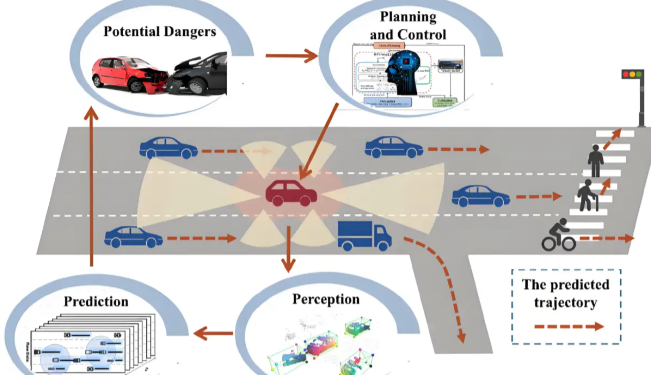
If the perception layer is the 'eyes' of autonomous driving, the decision-making layer is the 'brain'—the core battleground where AI transforms autonomous driving. Before 2024, decision-making algorithms relied on rule-based programming, with engineers pre-defining responses to various road conditions, limiting vehicles to predefined frameworks and causing 'system failures' when encountering unprogrammed scenarios. The combination of large models and Agent intelligence now enables autonomous driving decision systems to 'think autonomously' and 'continuously evolve.'
Multimodal large models like GPT-5 and MogoMind can deeply learn from massive driving data, extracting response strategies from millions of hours of human driving behavior and continuously optimizing decision logic through reinforcement learning. For example, in urban congestion, large models can predict cut-in intentions of adjacent vehicles based on multi-dimensional information like leading vehicle trajectories, traffic light durations, and road widths, making proactive decelerate or avoidance decisions. On highways, they can automatically plan optimal following distances and overtaking timings based on road conditions, weather, and vehicle performance, balancing safety and efficiency.
The integration of Agent intelligence upgrades autonomous driving from 'single-vehicle decision-making' to 'multi-agent collaborative decision-making.' Each autonomous vehicle acts as an independent Agent, interacting in real time with other vehicles, roadside intelligent devices, and urban traffic systems via V2X (Vehicle-to-Everything) communication, enabling 'vehicle-vehicle,' 'vehicle-edge,' and 'vehicle-city' synergies. For instance, when an autonomous vehicle detects a road accident ahead, it immediately shares the information with nearby vehicles and traffic control centers. The Agents in surrounding vehicles automatically plan detour routes, while the traffic control center's Agent adjusts traffic light timings synchronously, achieving intelligent traffic system scheduling. Such collaborative decision-making boosts urban traffic efficiency by over 50% and highway capacity fivefold, fundamentally resolving congestion issues.
Execution Layer: AI-Driven Steer-by-Wire Revolution Enables Precise 'Vehicle Limbs'
The ultimate realization of perception and decision-making relies on precise execution. Traditional mechanical control systems in vehicles suffer from response delays and precision deficiencies, unable to meet the millisecond-level response demands of autonomous driving. AI-driven steer-by-wire chassis technology achieves a leap from 'mechanical connection' to 'electronic control,' enabling more precise, rapid, and smooth steering, braking, and acceleration.
The steer-by-wire system adjusts steering ratios via AI algorithms, automatically modifying steering sensitivity based on vehicle speed and road conditions—light and agile at low speeds, stable and reliable at high speeds. The brake-by-wire system controls brake calipers through electrical signals, reducing response time from 0.3 seconds (mechanical braking) to 0.05 seconds and cutting braking distances by over 30%. The drive-by-wire system optimizes motor output via AI algorithms, enabling stepless speed changes that enhance both power performance and energy efficiency. McKinsey data shows that AI-optimized steer-by-wire execution systems can reduce autonomous vehicle energy consumption by 15%-20%, helping the global fleet cut 300 million tons of CO2 emissions annually—equivalent to the annual emissions of global commercial aviation.
More critically, AI enables self-diagnosis, self-repair, and self-optimization in the execution layer. By continuously monitoring the vehicle's chassis, powertrain, and electronic control systems, AI algorithms can preemptively identify fault risks, issue timely warnings, and even automatically repair minor faults. Simultaneously, they optimize control parameters based on vehicle usage, maintaining peak operational performance. This intelligent execution capability makes autonomous vehicles far safer and more reliable than human-driven cars, laying the core foundation for the large-scale operation of Robotaxi and Robobus services.
2030: The Era of Universal Autonomous Driving Adoption
2026 marks the 'ice-breaking year' for autonomous driving commercialization—the UN's global regulations clear legal barriers, technological maturity validates safety and reliability, and cost reductions shift autonomous driving from high-end experiments to mass markets. From 2026 to 2030, autonomous driving will transition from 'pilot operations' to 'large-scale adoption,' forming a full-scenario commercial ecosystem covering personalized Robotaxi travel, Robobus public transit, intelligent logistics freight, and specialized operations, reshaping the trillion-dollar mobility market landscape.
Robotaxi: From 'Novelty Experience' to 'Mainstream Mobility'
In 2026, Robotaxi services in London, Beijing, and San Francisco remain novelty experiences for a few, operating only in specific core urban areas and priced higher than traditional ride-hailing. By 2030, Level 4 Robotaxi services will achieve full-domain coverage and affordable pricing, becoming the dominant urban mobility mode.
AI technological maturity will slash Robotaxi operating costs. In 2026, the per-kilometer operating cost of a Robotaxi is approximately 1.5 yuan; by 2030, algorithm optimizations, hardware price drops, and economies of scale will reduce this to 0.8 yuan—60% lower than traditional ride-hailing and 80% lower than private cars. Price reductions will make Robotaxi a daily choice for ordinary citizens, covering non-licensed groups like the elderly, children, and disabled, achieving 'universal mobility freedom.'
Waymo's expansion sets the global benchmark for Robotaxi commercialization. By 2026, it operates in ten U.S. cities with a fleet of about 3,000 vehicles, providing over 400,000 weekly rides and aiming for a million weekly orders by year-end. With $16 billion in financing, its valuation reaches $126 billion. In China, Wuhan becomes the 'autonomous driving capital,' offering citywide driverless taxi services. Surveys show 95% of users plan to continue using the service, with over 70% expecting driverless mobility to become the future mainstream. 'No driver interaction, clean environments, and tech experiences' are core attractions.
Meanwhile, Robotaxi operation models will upgrade from 'single-enterprise operations' to 'platform-based collaborative operations.' Ride-hailing platforms like Didi, Gaode, and Uber will integrate regional Robotaxi resources, using AI algorithms for intelligent vehicle dispatch to boost utilization rates above 80%, eliminating 'difficult and expensive' traditional ride-hailing issues. Vehicle interiors will transform from 'driver cabins' to 'third spaces,' where passengers can work, entertain, or rest, turning commuting time from 'consumption' to 'value creation.'
Robobus: The New Core of Public Transit, a 'Lightweight Breakthrough' for Large-Scale Adoption
If Robotaxi represents the 'tech ceiling test' for autonomous driving, Robobus serves as the 'popularization vehicle' for large-scale deployment and the core component of urban public transit by 2030. With fixed routes, low speeds, standardized scenarios, and high AI network adaptability, Robobus faces lower technical barriers and easier commercialization, becoming the key to global autonomous driving's transition from 'pilots' to 'universal adoption' and a critical track for China to overtake in autonomous driving.
Globally, the Robobus market is in high-growth mode. In 2024, the global market size reaches $1.8 billion, projected to surge to $5.09 billion by 2029 with a 23.1% CAGR. China leads global growth, with its market size reaching 1.9 billion yuan in 2024 and soaring to 6.63 billion yuan by 2029 at a nearly 29% CAGR, becoming the core growth engine for the global Robobus industry. By 2030, Robobus will deeply penetrate public transit, accounting for over 50% of the urban bus market.
In terms of operational scenarios, 2030 Robobus will achieve 'multi-scenario full coverage.' Cultural tourism venues, the most profitable current scenario, will sustain high growth, with single autonomous sightseeing buses generating 1-2 million yuan in annual revenue, becoming 'tech landmarks' for scenic spots. Urban transit will become the primary battleground, with Robobus deeply integrating into public transit networks for community micro-circulation and metro feeder services. A 49-seat Robobus can achieve a 25% annual gross margin. Closed scenarios like airports, ports, and large factories will also expand applications, forming a diversified scenario layout.
Technologically, Level 4 autonomous driving will fully penetrate the Robobus sector by 2030. The deep integration of AI large models and physical-world AI systems will grant Robobus human-like logical reasoning capabilities, effectively solving decision-making challenges in complex urban edge scenarios. Simultaneously, declining sensor costs and mature end-to-end algorithms will further reduce Robobus production costs. Combined with AI networks' omni-domain perception and collaborative scheduling, Robobus's full-lifecycle operating costs will drop 40%-50% compared to traditional buses.
Domestically, the Robobus sector features a competitive landscape led by autonomous driving tech firms and supported by traditional bus manufacturers. Mogo Auto, WeRide, and QCraft dominate through technological differentiation and scenario deep cultivation , holding major market shares. Mogo Auto leads in comprehensive market share, with a single order worth 289 million yuan. Its MOGOBUS operates in over ten provinces, serving over 200,000 passengers, and won Singapore's first official Level 4 autonomous bus project, achieving tech export. WeRide launched the world's first factory-installed, zero-cabin Robobus, operating in nearly 30 cities across ten countries, with Singapore's Sentosa project achieving Southeast Asia's first fully driverless operation. QCraft leads in domestic deployment scale, serving over 650,000 passengers cumulatively, with its 'Dragon Boat ONE' model serving over 200,000 passengers and deep collaborations with mainstream bus manufacturers for mass production.
Smart Logistics: Autonomous Driving Reshapes the Freight Industry Chain
If Robotaxi and Robobus are transforming human mobility, then autonomous freight is reshaping the entire logistics industry chain. By 2030, L4 autonomous heavy trucks, light trucks, and unmanned delivery vehicles will fully cover all logistics scenarios, including mainline logistics, urban distribution, and last-mile delivery, achieving a "driverless, intelligent, and efficient" logistics industry. This will create a synergistic development pattern with autonomous driving in the mobility sector.
In mainline logistics, autonomous heavy trucks will become the primary force. Through AI network collaboration, these trucks can operate in platoons, with a safety officer monitoring the lead vehicle while subsequent trucks automatically follow at intervals of less than 10 meters. This improves transport efficiency by over 40% and reduces fuel consumption by over 20%. Additionally, autonomous heavy trucks can operate 24/7, cutting transport time between Beijing and Shanghai from 20 hours to just 12 hours, effectively solving the challenges of "low efficiency, high costs, and driver shortages" in mainline logistics.
In urban and last-mile delivery, unmanned delivery vehicles will become the core force. Utilizing AI-based route planning algorithms, these vehicles can accurately avoid pedestrians and vehicles while automatically planning optimal delivery routes, enabling contactless delivery in residential areas, office buildings, campuses, and other settings. With AI Agent coordination, delivery efficiency can improve by over 50%, and costs can be reduced by over 60%, addressing the traditional issues of "high labor costs, low delivery efficiency, and last-mile delivery challenges."
The widespread adoption of autonomous logistics will reshape the entire freight industry chain. Traditional freight companies will shift from "human-driven" to "technology-driven" operations, with core competitiveness transitioning from fleet size to algorithmic capabilities. Logistics parks will upgrade into "smart logistics hubs," enabling intelligent vehicle dispatch, automated cargo handling, and real-time information exchange. Traditional intermediaries and information departments will be replaced by AI platforms, significantly reducing transaction friction and boosting overall efficiency in the logistics industry chain.
The Undercurrents Behind Prosperity: Economic Reflexivity Loop
As autonomous driving achieves full commercialization powered by AI, the large-scale adoption of Robotaxi, Robobus, and autonomous freight will not only enhance mobility efficiency and upgrade industrial structures but also trigger an economic restructuring highly similar to the "AI Prosperity Paradox." While efficiency gains drive productivity leaps, they also cause employment structure collapses, traditional industry chain extinctions, and financial market revaluations, forming an economic reflexivity loop for autonomous driving: AI enables autonomous driving → Full L4 commercialization → Elimination of traditional driving jobs + Collapse of traditional transportation industry chains → Restructuring of consumption patterns + Income distribution imbalances → Corporate profit squeezes + Financial asset devaluations → Increased corporate AI investment + Further upgrades in autonomous driving technology.
This loop extends from the real economy to financial markets and from employment to urban governance, revealing profound economic undercurrents and social contradictions behind the prosperity of autonomous driving. The large-scale implementation of Robobus, in particular, brings these contradictions to the forefront in public transportation.
First-Level Impact: Restructuring of Employment, Hundreds of Millions of Professional Drivers Face Transition
The impact of autonomous driving on the job market will first affect professional drivers. According to China's Ministry of Transport, by 2026, China will have over 30 million professional drivers, including ride-hailing drivers, taxi drivers, freight drivers, and bus drivers. Globally, this number exceeds 200 million. By 2030, with the full adoption of L4 autonomous driving, these jobs will see large-scale elimination.
The widespread adoption of Robotaxi will leave ride-hailing and taxi drivers unemployed, with their numbers in China expected to drop from 10 million in 2026 to below 2 million by 2030, leaving over 80% of drivers facing unemployment or career transitions. The implementation of autonomous freight will significantly reduce freight driver positions, with mainline logistics driver numbers decreasing by over 90% and urban delivery drivers by over 70%. The full integration of Robobus will make bus drivers the most directly impacted group in public transportation, with over 50% of domestic bus drivers facing job displacement, particularly in third- and fourth-tier cities and specialized scenarios.
However, autonomous driving does not simply "replace humans" but restructures employment. While traditional driving jobs disappear, it creates numerous new technology-driven, operational, and service-oriented roles, such as LiDAR research engineers, algorithm researchers, Robobus remote safety operators, unmanned vehicle maintenance personnel, and data annotators. The UK government predicts that autonomous driving will create 38,000 new jobs in the country, while Chinese studies suggest that by 2030, autonomous driving will generate over 5 million new jobs in China.
Yet, most of these new roles are technical and highly skilled, requiring higher education and specialized expertise. Traditional professional drivers, often with lower education levels and lacking technical skills, will struggle to transition directly into these positions. This creates a structural contradiction in the job market: a surplus of high-skilled vacancies on one side and hundreds of millions of traditional drivers facing unemployment or downward career mobility on the other. Many displaced drivers will flood into low-skilled, low-wage service industries such as food delivery, courier services, and cleaning, leading to labor oversupply and further wage suppression in these sectors. This results in income distribution polarization—where the technological dividends of autonomous driving concentrate among a few tech companies and high-skilled workers, while ordinary laborers face wage reductions and employment difficulties, drastically reducing their consumption capacity.
Second-Level Impact: Collapse of Traditional Transportation Industry Chains, Trillion-Dollar Markets Face Revaluation
The proliferation of autonomous driving not only disrupts the job market but also triggers a structural collapse of traditional transportation industry chains. From automotive manufacturing and parts to mobility services and freight logistics, every segment of the traditional transportation industry will undergo reshuffling under the impact of AI and autonomous driving. The large-scale implementation of Robobus accelerates the restructuring of the traditional bus industry.
In automotive manufacturing, traditional fuel vehicle companies face existential threats. By 2030, fuel vehicles will exit the market entirely, and traditional automakers that fail to transition into smart electric vehicle companies will face bankruptcy. Even successful transitions will mean losing their traditional mechanical manufacturing advantages, with core competitiveness shifting to AI algorithms, smart cockpits, and drive-by-wire chassis systems. In the bus manufacturing sector, small and medium-sized enterprises lacking R&D capabilities and scenario resources will gradually exit the market, while leading companies will achieve mass production of Robobus through partnerships with tech firms like Mushroom Auto and QCraft, further consolidating industry concentration.
In automotive components, traditional mechanical parts companies will decline, while intelligent parts companies will thrive. Components like spark plugs, clutches, and transmissions for fuel vehicles will exit the market entirely, while LiDAR, domain controllers, drive-by-wire chassis systems, and automotive chips will dominate, with market size surpassing trillion-dollar levels. However, the core technologies for these intelligent components are controlled by a few tech companies, and traditional parts manufacturers risk obsolescence without technological upgrades.
In mobility services, traditional ride-hailing platforms, taxi companies, and bus operators will lose their competitive edge. By 2030, the core competitiveness of mobility services will shift from fleet size and driver numbers to AI dispatch algorithms and autonomous vehicle operational capabilities. Tech companies with autonomous driving technologies will dominate the market, while traditional mobility firms that fail to integrate autonomous vehicles or achieve intelligentization upgrades will be eliminated.
The collapse of traditional transportation industry chains will trigger a trillion-dollar market revaluation. In 2026, traditional automakers, parts companies, and mobility service firms will still hold significant market capitalization, but by 2030, their valuations will plummet, while autonomous driving tech companies' market caps will soar. Capital will shift from traditional transportation to autonomous driving tech, creating a "winner-takes-all" scenario. Traditional industry workers and investors will face asset devaluations and income reductions.
Third-Level Impact: Financial Market Chain Reactions, Crises in Private Credit and Automotive Finance
The economic reflexivity loop of autonomous driving extends from the real economy to financial markets, triggering chain reactions in private credit, automotive finance, real estate, and other sectors, accelerating crises. The large-scale implementation of public transportation autonomous products like Robobus also forces a revaluation of financial investments in traditional public transportation.
The first cracks in the private credit market appear in investments in traditional transportation industry chains. From 2015–2026, global private credit markets invested over $1 trillion in traditional automakers, parts companies, and freight logistics firms, based on the assumption of "perpetual growth" in traditional transportation. However, as autonomous driving proliferates, these companies' revenues and profits collapse, leading to bankruptcies and a sharp rise in private credit default rates. By 2030, global private credit default rates for traditional transportation investments will exceed 30%, triggering a liquidity crisis in the private credit market.
The automotive finance crisis stems from autonomous driving's restructuring of the automotive consumer market. Traditional automotive finance assumes "consumers purchase and long-term use private vehicles," but with Robotaxi adoption, more consumers will abandon private car ownership in favor of affordable, convenient autonomous mobility services, drastically reducing car ownership. By 2030, China's car ownership will drop from 300 million in 2026 to below 200 million, with global car ownership falling by over 30%, causing a sharp decline in car sales and deteriorating automotive finance asset quality.
Simultaneously, autonomous vehicles' ownership structures will disrupt traditional automotive finance models. Future Robotaxi and Robobus fleets will be centrally operated by mobility platforms and tech companies rather than individually owned, eliminating traditional personal auto loans and making corporate autonomous vehicle operational loans the norm. However, these loans rely on autonomous vehicles as collateral, which rapidly depreciate due to fast technological iteration (every three years), drastically reducing collateral value and increasing default rates for automotive finance institutions.
More critically, the automotive finance crisis will spread to real estate markets. In many countries, the automotive industry is a pillar of local economies. The collapse of traditional automakers and parts companies will lead to economic decline, job losses, and reduced household incomes, triggering real estate market downturns. In automotive-centric cities like Detroit (USA) and Changchun (China), property prices will plummet, eroding household wealth and consumption capacity, creating a vicious cycle of "economic decline → housing price drops → consumption contraction → further economic decline."
The Global Examination in the Autonomous Driving Era
As autonomous driving reshapes every corner of the economy and society, traditional legal frameworks, regulatory systems, and social governance models face total collapse. Current traffic laws, based on human driving, cannot adapt to autonomous driving's driverless nature; existing regulatory systems, built on "enterprise supervision," cannot handle autonomous driving's cross-domain and cross-regional characteristics; current social governance models, centered on "human-driven" operations, cannot accommodate autonomous driving's intelligent collaboration features.
The core contradiction of the autonomous driving era lies in the gap between rapid technological advancement and lagging institutional frameworks. For sustainable development in this transformation, humanity must confront this global examination of rule reconstruction, establishing legal frameworks, regulatory systems, and social governance models that align with autonomous driving, ensuring its technological dividends benefit all of humanity rather than a select few tech companies and high-skilled workers.
From "Human Responsibility" to "Algorithmic Responsibility"
Current traffic laws center on human responsibility—traffic accident liability is determined based on human drivers' fault. However, in the autonomous driving era, vehicle control shifts from humans to algorithms, especially for public mobility products like Robobus, which involve group safety. New questions arise in liability attribution: When an autonomous vehicle crashes, who is responsible—the automaker, algorithm developer, operational platform, or roadside equipment operator?
This necessitates reconstructing autonomous driving legal frameworks around algorithmic responsibility. First, clarify autonomous vehicles' "legal subject status," defining them as "intelligent products" rather than traditional "mechanical products," with automakers and algorithm developers bearing lifelong responsibility for safe operation. Second, establish an "algorithm filing system," requiring automakers and developers to submit algorithm models, training data, and decision-making logic to regulators for transparency and traceability. Third, create "algorithmic fault determination standards," using technical means to reconstruct accident-time algorithm decisions, identifying design flaws, training deficiencies, or decision-making errors to assign liability.
Simultaneously, new insurance systems must adapt to autonomous driving. Traditional compulsory traffic accident liability insurance, designed for human driving, cannot accommodate autonomous driving risks. New products like "algorithmic liability insurance" and "autonomous vehicle operational insurance" should be introduced, with automakers, algorithm developers, and operational platforms jointly insured to disperse risk. For public mobility products like Robobus, dedicated public transportation autonomous driving insurance systems must safeguard group safety. Big data models for insurance actuarial calculations should set differentiated premium rates based on accident rates and risk levels, incentivizing companies to improve autonomous driving safety.
The UN's "Global Technical Regulation on Automated Driving Systems" provides a foundation for global legal reconstruction. However, countries must tailor regulations to their unique traffic conditions, legal systems, and cultures while strengthening international legal collaboration to address cross-border autonomous driving issues.
From "Segmented Regulation" to "Collaborative Regulation"
Current traffic regulatory systems, built on "human driving" and "segmented regulation," assign road traffic oversight to transportation authorities, automotive production to market regulators, and automotive industry oversight to industrial regulators, with poor interdepartmental coordination and low efficiency. Autonomous driving is a cross-domain, cross-regional, and cross-industry system involving automotive manufacturing, AI, communications, urban transportation, and logistics—especially Robobus's public transportation nature demands multi-department collaborative regulation. A cross-domain, cross-regional, and cross-industry collaborative regulatory system must be established.
First, create a national-level autonomous driving regulatory agency integrating functions from transportation, market regulation, industry, technology, and public security departments to oversee the entire autonomous driving industry chain and lifecycle. This agency would set technical standards, safety norms, and regulatory rules; approve road testing and commercial operations; investigate accidents; and coordinate cross-domain and cross-regional supervision.
Secondly, it is essential to establish a dynamic intelligent supervision platform based on AI, leveraging technologies such as big data, artificial intelligence, and blockchain to achieve real-time, dynamic, and precise supervision of autonomous driving. Through this intelligent supervision platform, regulatory authorities can collect real-time driving data, algorithmic decision-making data, and vehicle status data from autonomous vehicles, monitor the operational status of autonomous driving in real-time, and promptly identify and address safety hazards. Blockchain technology can be utilized to ensure the immutability and traceability of driving data, providing a basis for liability determination in traffic accidents. Big data analysis can be employed to predict safety risks associated with autonomous driving and develop targeted regulatory measures.
Thirdly, it is crucial to strengthen industry self-regulation, fully leveraging the roles of autonomous driving enterprises and industry associations to establish industry self-regulatory norms and guide enterprises in enhancing technological research and development, improving safety standards, and fulfilling social responsibilities. Enterprises should establish safety management systems for autonomous driving, strengthen testing and verification of algorithms, and enhance the safety and reliability of autonomous driving. Industry associations should develop industry technical standards and norms, promote technological exchanges and collaboration among enterprises, and drive the healthy development of the autonomous driving industry.
From 'Passive Response' to 'Proactive Adaptation'
The widespread adoption of autonomous driving not only transforms travel modes and industrial structures but also reshapes urban spatial layouts, social organizational forms, and human lifestyles. This necessitates a reconstruction of social governance in areas such as urban governance, employment security, and income distribution, shifting from a 'passive response' to technological changes to a 'proactive adaptation' to them, enabling all people to share in the technological dividends of autonomous driving.
In terms of urban governance, it is essential to reconstruct urban spatial and transportation planning based on the characteristics of autonomous driving. This involves advancing the construction of AI network infrastructure to achieve intelligent collaboration among roadside intelligent devices, cloud platforms, and autonomous vehicles, addressing infrastructure shortcomings in third- and fourth-tier cities and remote suburbs, and establishing unified industry standards. Urban spatial layouts should be optimized by transforming numerous surface parking lots into parks, green spaces, and commercial facilities, enhancing urban livability. Additionally, by leveraging the public transportation attributes of Robobuses, urban public transportation networks should be optimized to create an intelligent travel system combining 'Robotaxi + Robobus' and improve overall urban transportation efficiency.
In terms of employment security, it is necessary to establish an employment training and transition system adapted to autonomous driving, focusing on helping traditional professional drivers in fields such as public transportation and freight to achieve skill upgrades and employment transitions. The government should increase investment in vocational skills training, offering professional training courses such as LiDAR operation, algorithmic data annotation, Robobus remote monitoring, and driverless vehicle maintenance, providing free skills training for traditional professional drivers. Enterprises should fulfill their social responsibilities by collaborating with vocational colleges to conduct targeted training and provide employment opportunities for traditional professional drivers. Society should foster a culture of lifelong learning, encouraging workers to continuously upgrade their skills and adapt to changes in the job market.
In terms of income distribution, it is important to establish a sharing mechanism for the technological dividends of autonomous driving, enabling all humanity to share in the fruits of its development. The government can impose an intelligence tax on autonomous driving technology companies, using tax revenues to fund employment training, social security, and public services, thereby compensating for the income losses of traditional workers. It can promote equity diversification in autonomous driving enterprises, allowing ordinary workers to share in the development dividends of these companies through stock ownership. Additionally, a social welfare system can be established to provide basic living security for traditional workers who are unemployed or forced to accept lower-paying jobs, narrowing the income distribution gap. Huang Qunhui, a member of the National Committee of the Chinese People's Political Consultative Conference, proposed that autonomous driving, as a representative of new quality productive forces, should have its industrial policies more focused on 'investing in people,' which is precisely the core of reconstructing social governance.
The Future of Autonomous Driving: A Triumph of Technology and a Choice for Humanity
Autonomous driving in 2030 represents a triumph of AI technology—from multimodal fusion at the perception layer to large models + agents at the decision-making layer, from the wire control revolution at the execution layer to AI network collaboration at the operational layer, and from the personalized travel of Robotaxis to the widespread adoption of Robobuses for public transportation. AI has enabled autonomous driving to leap from 'technological experimentation' to 'universal adoption,' reshaping human travel modes and urban transportation systems. The global Robobus market size has surpassed $5 billion, with the Chinese market leading at a compound annual growth rate of nearly 29%. The technological expansion of companies such as Mogo Auto, WeRide, and QCraft has positioned China as a core force in the global autonomous driving industry.
However, the future of autonomous driving is not solely a triumph of technology but also a choice for humanity—a choice between efficiency and fairness, between technological advancement and institutional adaptation, between the dividends for a few and shared prosperity for all. This AI-empowered autonomous driving revolution, like a double-edged sword, brings both a leap in productivity and social progress, making travel more convenient, logistics more efficient, and cities smarter. Yet, it also triggers employment collapses, industrial restructuring, and financial crises, leaving hundreds of millions of traditional workers facing transition challenges and exacerbating income inequality.
For human society to achieve sustainable development amid this transformation, it must confront the contradictions between technology and institutions, as well as the trade-offs between efficiency and fairness. It is essential to establish legal frameworks, regulatory systems, and social governance models adapted to autonomous driving, ensuring that its technological dividends benefit all people. Robobuses should not only serve as new carriers for urban public transportation but also as new links for equalizing public services. Robotaxis should not only represent a new mode of personalized travel but also a new guarantee of travel freedom for all. Autonomous driving should not only be a new symbol of technological progress but also a new driving force for social progress.
The rapid advancement of autonomous driving has never paused, and neither has the profound contemplation of human society. When cars no longer require human drivers and buses navigate city streets without drivers, how should we define human value? When travel becomes fully intelligent and transportation systems are reconfigured by AI, how should we redefine social rules? The answers lie not only in technological progress but also in human choices. This grand examination of travel, the economy, and the future of humanity has only just begun.
-
![]()
Can the Brand-New Hongqi H7 Forge Its Own Identity in the Hybrid Vehicle Market?
-
![]()
Challenges in Redeeming Certificates for New Cars: Mercedes-Benz Dealership Group Grapples with Operational Hurdles Once Again
-
![]()
Porsche Returns to Volkswagen, Ending the 'Electric Ferrari' Story
-
![]()
"Chinese Version of Mythos": Can It Rise to the Challenge and Keep Pace?
-
![]()
Equity Changes Hands Three Times in Seven Years: JMCG Leans on Contract Manufacturing for Survival Amid Brand Deficits
-
![]()
Automotive Market News: Nine Departments Jointly Roll Out Aftermarket Consumption Initiatives
-
How Electronic Fabric Became the Critical Chokepoint for AI’s Trillion-Dollar Computing Infrastructure
-
![]()
Depreciation Rate on Par with Mobile Phones: Just 40% Value Retention After Three Years—Why Do Battery Electric Vehicles Lose Their Worth?