2026 China EV100 Forum: DeepRoute.ai | Small Model Era Fades, Zhou Guang Pioneers Autonomous Driving with 40B Foundation Model
 04/15 2026
 502
502
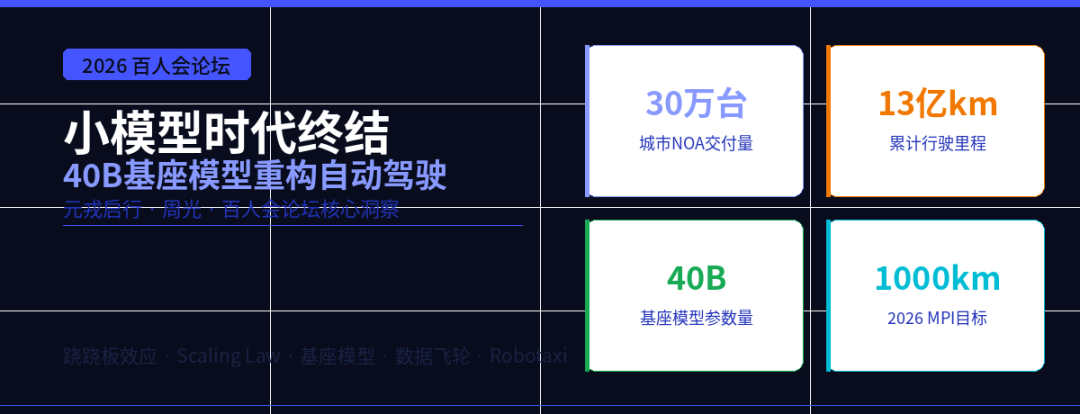
Autonomous driving systems excel during morning commutes but falter in the evening; they navigate Shanghai with ease but struggle elsewhere. This persistent "seesaw effect" stands as the most fundamental challenge confronting China's intelligent driving sector today.
At the 2026 China EV100 Forum, DeepRoute.ai CEO Zhou Guang declared: The sole solution to this problem lies in transitioning autonomous driving from the small model era to the large model era, leveraging a 40B-parameter foundation model to overhaul the entire architecture. This shift represents not merely an iteration but a paradigm revolution.
After delving into this article, you will gain insights into: the underlying cause of the small model seesaw effect, why multimodal large models herald the greatest leap in intelligent driving, the triangular architecture underpinning DeepRoute's 40B foundation model, and the three quantitative goals set for 2026.
The Limitations of Small Models: Endless Patching Exacerbates the Seesaw Effect
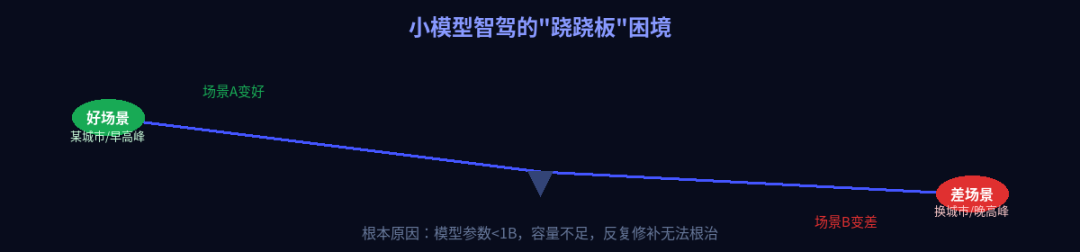
Zhou Guang candidly assessed the situation: Currently, the parameter counts of mass-produced autonomous driving systems in China typically remain below 1B, with many even falling short of 0.1B. These systems predominantly rely on convolution-based architectures with minimal Transformer integration, operating on chips with computing power ranging from 100T to 200T.
The crux of the issue with small models lies in their limited capacity, which prevents them from achieving peak performance across all scenarios simultaneously. Software updates are continually rolled out, enhancing performance in some areas while inadvertently degrading it in others. This sporadic progress and iterative patching reflect structural flaws in model training that cannot be remedied by simply allocating more engineering resources.
He also pointed out a more alarming trend in the industry: 2024 witnessed the swiftest advancements in end-to-end systems, with leading companies achieving significant milestones. However, by 2025, growth among these frontrunners began to plateau, while second-tier companies rapidly closed the gap—a clear indication that the technological benefits of the small model approach are nearing their end.
Industry Predicament: 120 Billion Yuan Invested, Yet Only 15% User Adoption

Zhou Guang presented a sobering statistic: In 2025, the industry poured over 120 billion yuan into autonomous driving, with top-tier chips boasting computing power of up to 750 TOPS. Yet, the real-world adoption rate of urban NOA hovered at a mere 15%. Consumers are not embracing assisted driving as a daily necessity.
How can assisted driving evolve from being merely "usable" to becoming "indispensable"? This is the paramount challenge the entire industry must tackle next, and Zhou Guang believes the solution lies in large models.
DeepRoute's data reveals: To date, nearly 300,000 urban NOA systems have been deployed, accumulating over 1.3 billion kilometers of driving mileage and preventing 140,000 forward collisions and 47,000 rear-end collisions. While this underscores real safety value, it falls short—users have yet to incorporate it into their daily routines.
Breakthrough: 40B Foundation Model, Unifying Three Key Functions in Reconstruction
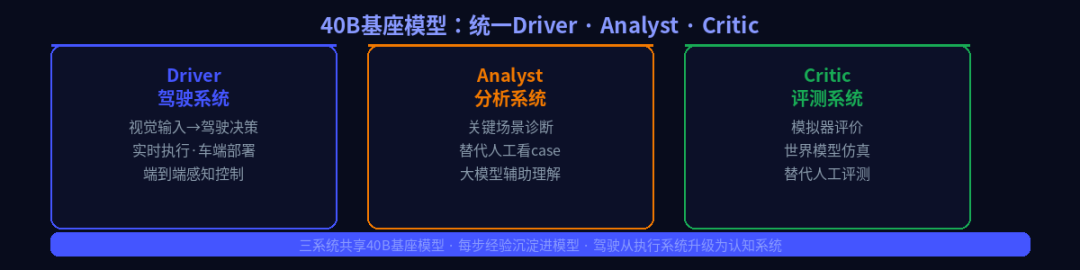
DeepRoute's solution entails utilizing a 40B-parameter foundation model to uniformly encompass the three core functions of an autonomous driving enterprise.
① Driver (Driving System): Processes visual input to make real-time driving decisions, deployed on the vehicle, representing today's end-to-end system.
② Analyst (Analysis System): Diagnoses and comprehends critical scenarios, replacing manual case reviews with large model analysis.
③ Critic (Evaluation System): An evaluation framework that, in conjunction with a world model simulator, is unified through the foundation model.
The three systems share the same foundation model, with information from each step being ingrained into the model. This transforms the driving system from a mere execution system into a cognitive system—not just capable of driving but also understanding the nuances of driving and evaluating performance.
Zhou Guang mentioned an unexpected revelation: Enhancing large models to truly superior levels is an arduous task. Some companies achieve comparable results with 750T chips as others do with 100T to 200T chips. DeepRoute's strategy is to first fortify the foundation model and then distill it into smaller models—only when the large model excels can the smaller models follow suit.
Zhou Guang stated that this year presents the optimal opportunity—multimodal large models like Gemini achieved qualitative breakthroughs early in the year, and the greatest competition stems not from peers but from dimensionality reduction attacks by large model companies.
DeepRoute's Technological Milestones: Consistently Leading in China
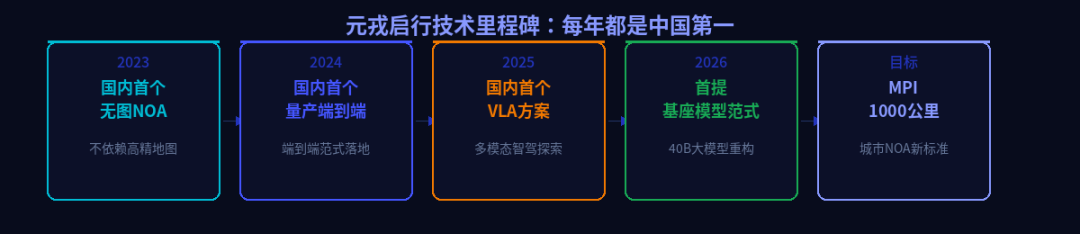
2023: Launched China's first mapless NOA, pioneering the mapless route while the industry was still vying for city coverage. 2024: China's first mass-produced end-to-end system, propelling the entire industry into the end-to-end era. 2025: China's first VLA solution. 2026: Introduced the foundation model paradigm, reconstructing the entire autonomous driving architecture with a 40B large model.
With each paradigm shift, DeepRoute has opted to announce it before the technology was fully mature and then be the first to implement it once the industry was ready. The foundation model represents the next chapter in this pattern.
At the Beijing Auto Show, DeepRoute's Chief Scientist will publicly unveil the latest technical advancements of the foundation model and offer hands-on experiences—marking the first public validation node for DeepRoute's transition from concept to reality.
Three Quantitative Goals for 2026

① 1 Million Urban NOA Deployments: All equipped with data feedback capabilities, serving as a continuous data source for the foundation model and forming a data flywheel.
② Urban MPI Reaches 1000 Kilometers: A significant increase in average miles per intervention, supported by the foundation model + AI Safety dual-layer architecture.
③ User Engagement Exceeds 50%: A substantial leap from 15% in 2025, transforming assisted driving from a mere option to a daily necessity.
A Longer-Term Vision: Achieving 10,000-kilometer MPI, realizing Robotaxi operations, and becoming a tangible AI infrastructure.
After reading this article, you now possess:
① A Core Diagnosis: The insufficient capacity of small models is the root cause of the seesaw effect. Endless patching cannot resolve the issue; a shift to the large model paradigm is imperative.
② An Industry Warning: 120 billion yuan in investment has yielded only 15% engagement. Technological progress has not translated into user habits, and the industry must bridge this gap.
③ A New Architecture: A 40B foundation model unifies Driver + Analyst + Critic, elevating the driving system from an execution system to a cognitive system.
④ Three Quantitative Goals: 1 million deployments + MPI 1000km + 50% user engagement, with results to materialize in 2026.
"Today's fiercest competition does not emanate from peers but from dimensionality reduction attacks by large model companies. Multimodal models predicting the next frame of the physical world are merely a step away from autonomous driving predicting the next action." — Zhou Guang, CEO of DeepRoute.ai, 2026 China EV100 Forum
This article is based on the speech delivered by Zhou Guang of DeepRoute.ai at the 2026 China EV100 Forum, incorporating Jack's insights and AI-enhanced expression. It aims to objectively present the core information and industry trends from the speech, providing the industry with valuable insights and inspiration, and does not represent the stance of Vehicle.
*Unauthorized reproduction or excerpting is strictly prohibited-
-
![]()
Jitian Xingzhou: A Pioneer in Optical Payloads Secures Hundreds of Millions in Series B Funding!
-
![]()
Orders Secured Through to the Second Half of the Year! The Rationale Behind the 'Surge' in Demand for This Company’s Optical-Grade Base Films
-
![]()
Beyond Patents: The Retail Rivalry of Insta360 and DJI Unfolds
-
![]()
180 Billion Market Cap Vanished! How Did Seres Fall So Far?
-
![]()
Blockbuster! Domestic storage takes the global double crown for the first time, from an AI company
-
![]()
China Spearheads Formulation! World's Pioneering Global Technical Regulation for Automated Driving Systems Greenlit and Unveiled
-
![]()
Farewell to Pulsed Support Policies: Three Major Auto Policy Directions from Multiple Departments Take Effect on the Same Day
-
![]()
Embercore AI’s Accelerated Funding: The Robot Industry’s Shift Toward ‘Learning Systems’