Audi RS 5: Can a Foreign Brand Excel in Hybrid Technology?
 04/16 2026
 518
518
There's a Chinese proverb that goes, "Foreign monks recite scriptures better." It reflects a tendency among people to distrust the familiar while blindly placing faith in foreign entities, be it individuals, products, or even cultures. This mindset persists in modern society, often summarized as, "I don't quite grasp it, but I'm impressed nonetheless" (a sentiment of admiration without full comprehension).
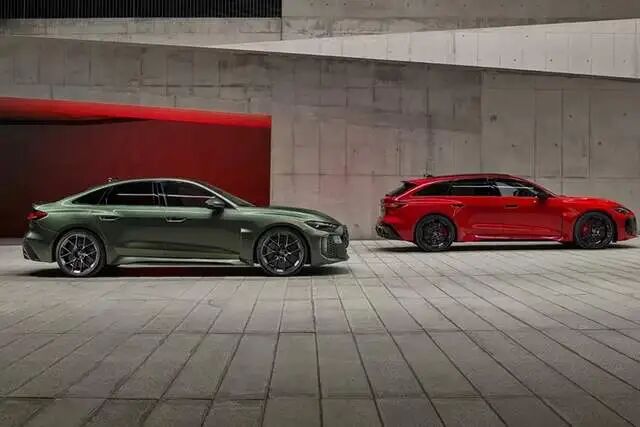
This bias is particularly evident in the passenger vehicle market, especially when it comes to sporty attributes. European and American gasoline-powered vehicles are often idolized, while domestic electric vehicles are dismissed as inferior. However, faced with the performance and handling prowess of these domestic EVs, European and American automakers are now generally embracing electrification for their gasoline vehicles. Today, through the lens of the RS 5 Sportback, let's explore whether Audi, this foreign brand, can master the new hybrid technology scripture.
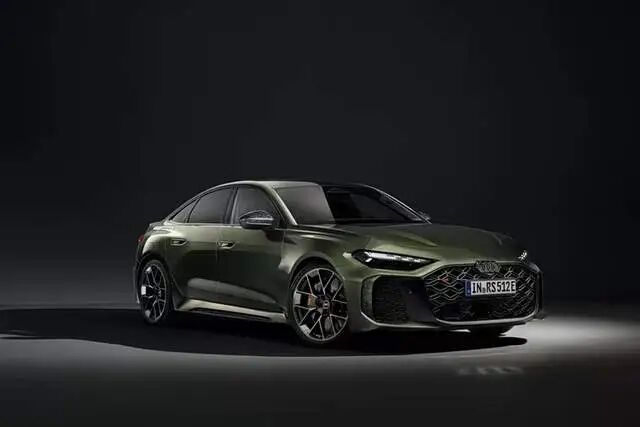
Firstly, for automotive giants like the German BBA (BMW, Benz, Audi), technological and product planning often exhibit significant inertia. Expecting high-premium performance vehicles like the Audi Sport series to immediately transition to full electric drive is unrealistic.
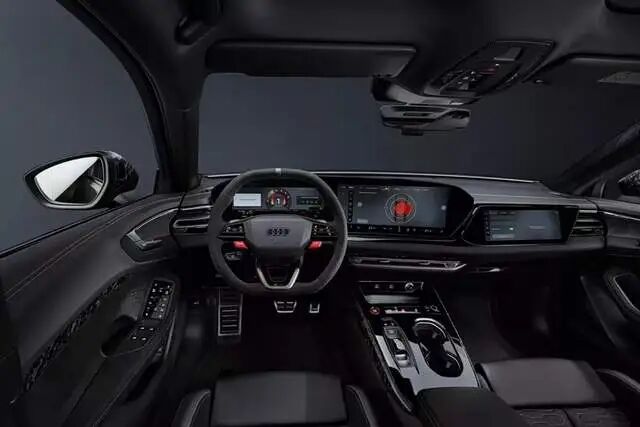
Thus, this generation of the RS 5 family retains the EA839 2.9T V6 twin-turbocharged engine, 8-speed Tiptronic transmission, and Quattro mechanical limited-slip all-wheel-drive system, integrating them with a 400V architecture P2 motor and power battery. Audi lauds its excellent sporty gene inheritance and evolution, while Chinese consumers may view it as a relic of the past, given that achieving 0-100 km/h in 3-4 seconds is now commonplace for domestic electric vehicles.
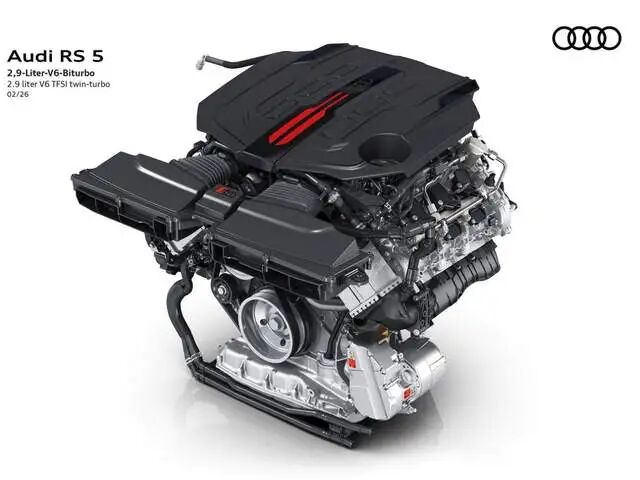
Nonetheless, from a technological application standpoint, this 'East-meets-West' high-performance hybrid solution holds considerable reference value.
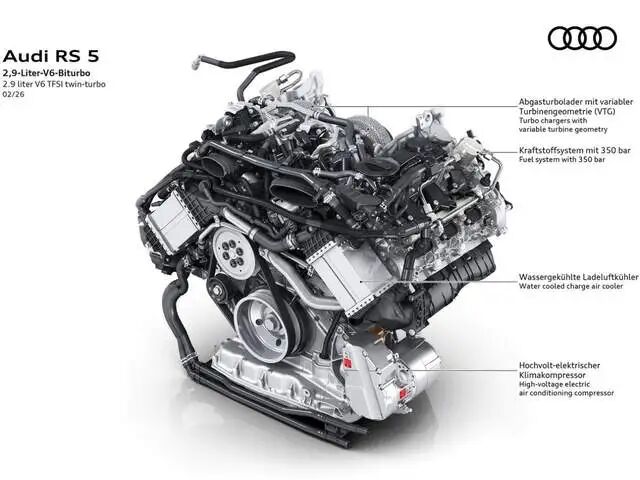
Take the EA839 engine, for instance, with a rated output of 375kW/600Nm. It adopts a 90° inverted layout, allowing the two large exhaust turbochargers to be directly inserted into the V-shaped gap. This design not only makes the engine more compact but also, when paired with an adjustable A/R value VGT twin-turbo system, provides outstanding power response. To today's independent automakers, this might be the only standout feature the German BBA can offer.
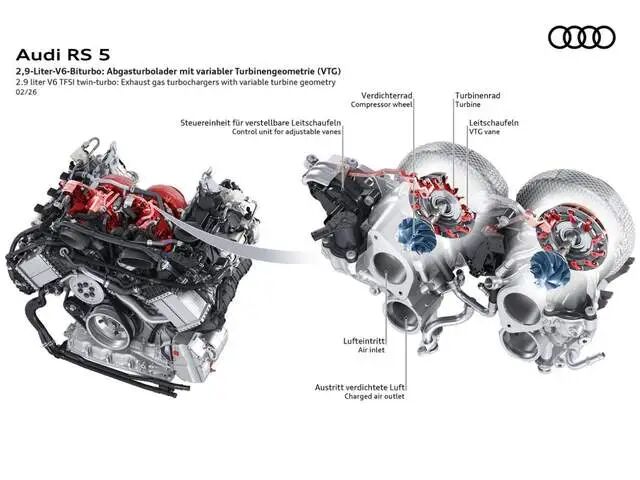
Paired with the engine is an 8-speed Tiptronic transmission, specially tuned by Audi Sport and equipped with an external liquid cooling mechanism to ensure stable operation under high loads. Meanwhile, the internal clutches or gear sets have been lightweighted to reduce inertia and improve shifting efficiency.
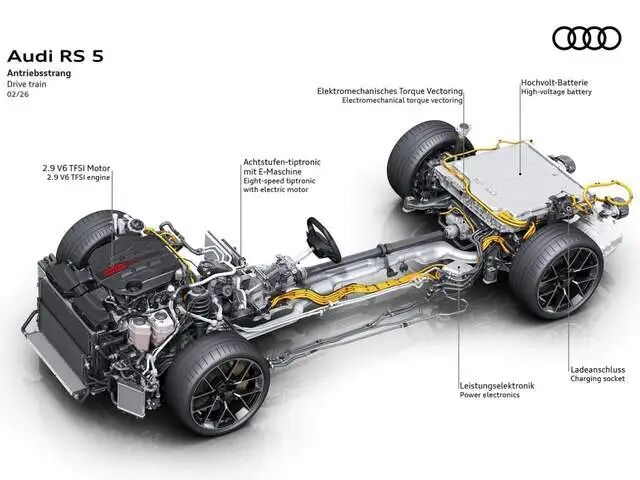
However, no matter how finely tuned, the transmission remains a bottleneck for performance enhancement. Complex gear sets not only introduce higher mechanical losses but also cause brief power output interruptions during shifting. Today's domestic new energy vehicles not only eliminate the need for a transmission in pure electric models but also, in hybrids, have replaced the traditional 'clutch + transmission' setup with electromechanical coupling of the engine and front-axle dual motors.
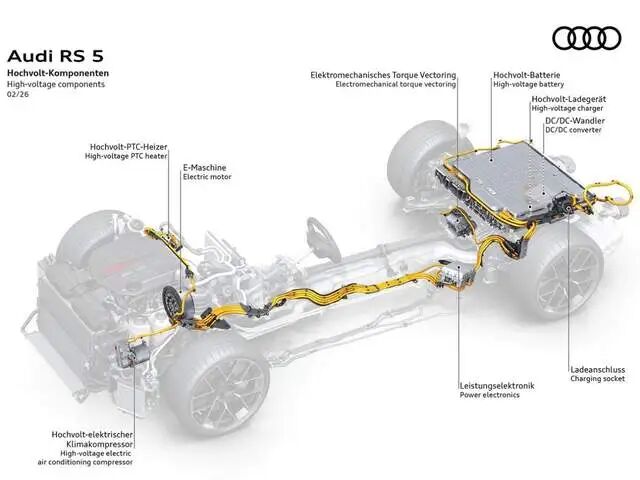
The electric drive unit employs a 400V electrical system, featuring the German staple 'P2 single-motor layout.' A 130kW/460Nm permanent magnet synchronous motor is installed between the engine and transmission, with power coupling achieved through a dedicated clutch. Paired with a net capacity of 22kWh lithium battery pack (located above the rear axle), it enables pure electric and hybrid driving modes, as well as engine auto start-stop and regenerative braking.
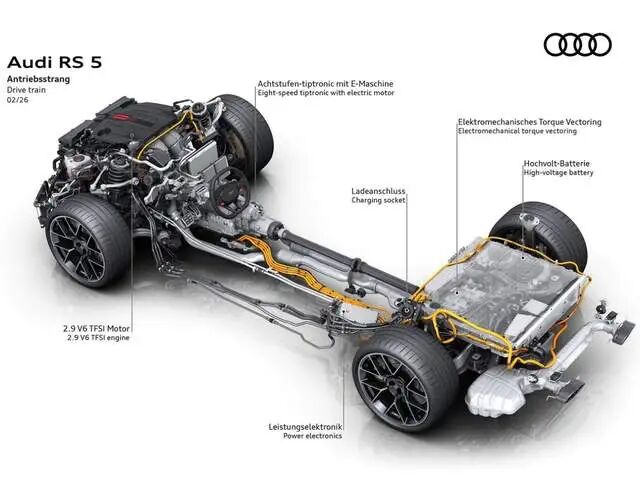
The quattro all-wheel-drive system can be considered the soul of the Audi Sport series. The new RS 5 family adopts the latest mechanical limited-slip central differential, allowing torque distribution between the front and rear axles to vary between 70/30 and 15/85. It also includes a preload function, maintaining mechanical connection between the front and rear axles even when the throttle is released, achieving more precise and reliable traction control.
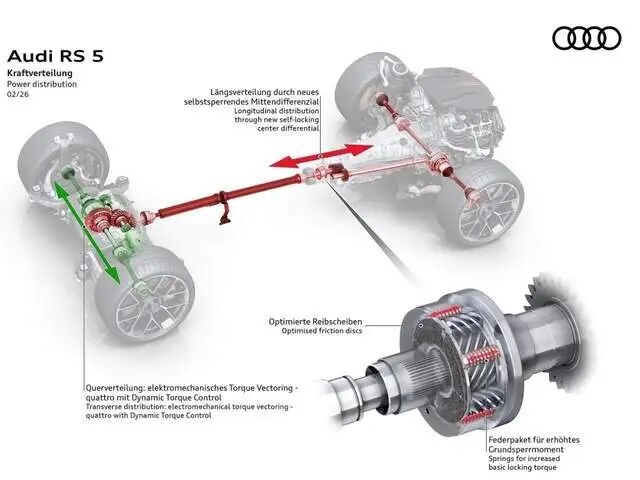
This purely mechanical structure, capable of automatic limited-slip without relying on electronic control, was indeed the pinnacle of non-decoupling all-wheel-drive systems in the gasoline vehicle era. However, in the eyes of today's electric vehicles with four-wheel vector drive (such as BYD's Easy Four), its performance boundaries and functional expansion seem somewhat limited.
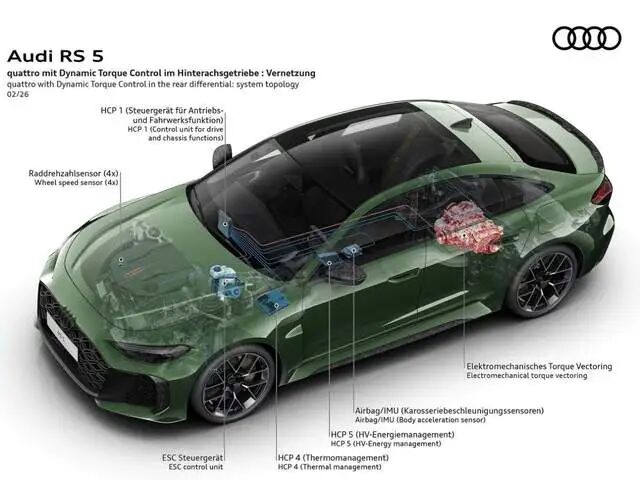
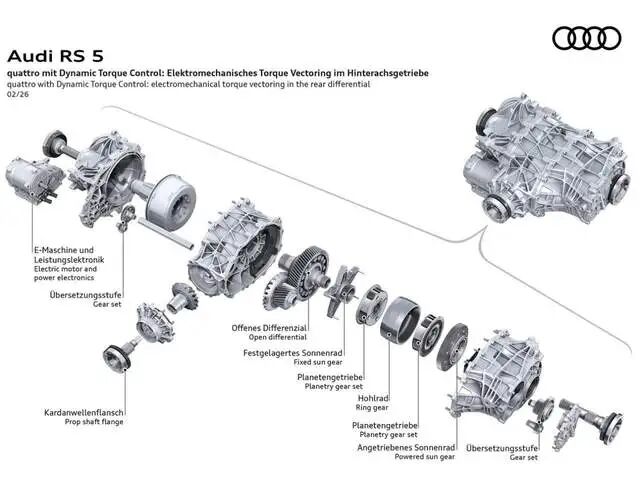
Moreover, compared to the previous generation, the current quattro all-wheel-drive not only supports torque distribution and mechanical limited-slip between the front and rear axles but also achieves torque distribution between the left and right rear wheels through a dedicated electronic control unit. This represents a significant technological advancement in the vehicle's electrification engineering.
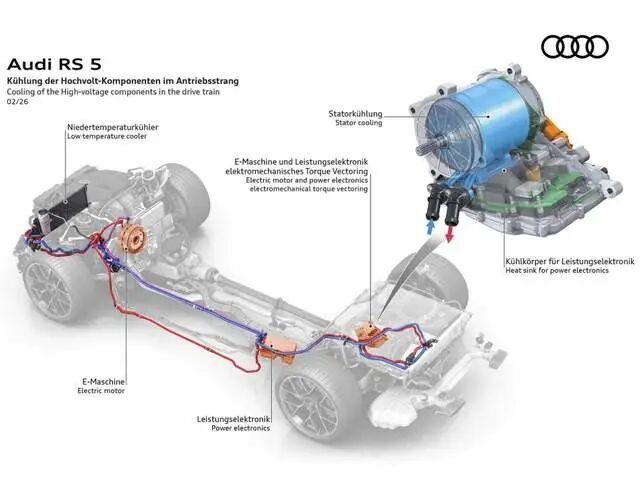
Structurally, the system integrates an 8kW/40Nm water-cooled permanent magnet synchronous motor beside the differential, directly acting on the left and right half-axles. For instance, when exiting a corner, the motor provides more power to the outer wheel, assisting the vehicle in achieving weight transfer more stably without needing to reduce overall vehicle power to prevent understeer.
In Conclusion:
After undergoing electrification transformation, the current Audi RS 5 series indeed showcases more prominent overall performance, not only in terms of power reserves and response brought by electric motor drive but also by further reinforcing the traction control of the traditional quattro all-wheel-drive system through rear-axle vector electric drive.
Compared to the previous pure gasoline-powered Audi Sport series products, the hybrid-powered Audi RS 5 represents a surprisingly transformative change. However, when pitted against domestic electric vehicles on a different technological path, the performance and handling advantages brought by high-voltage electrical architecture paired with distributed electric drive will still pose a formidable challenge to it.
-
![]()
Embrace Freedom, Live Boldly! Great Wall Motor’s Menglong PLUS Launches in the Greater Bay Area, Unlocking Enhanced Lifestyles with One Vehicle
-
![]()
The Agent hasn't arrived yet, but Ascend has already paved the way from hardware to software.
-
![]()
In 71 years, He sold products to 100 million people
-
![]()
First-hand Practical Test! Opus 4.8 Vs ChatGPT 5.5 Vs Kimi 2.6: Which is the Most Usable?
-
![]()
Fourfold Uncertainty Challenges Facing China's Agent Industry - Interpretation of the 'Report' (Part Six)
-
Crazy Anthropic
-
![]()
CNPC’s Kunlun Model Advances with 152 Implemented Scenarios, Showcasing Proactive AI
-
![]()
Revenue Increases, But Profits Don't: Pinduoduo's Anxiety Amidst Billion-Dollar Brand Building