Fourfold Uncertainty Challenges Facing China's Agent Industry - Interpretation of the 'Report' (Part Six)
 05/29 2026
 556
556
Analysys: The Agent wave triggered by OpenClaw is propelling China's AI industry toward unprecedented prosperity. However, beneath the surface of explosive applications, capital inflows, and major corporate investments lie four formidable barriers: computational costs, security & trust, ecosystem competition, and commercial sustainability. These foundational challenges will ultimately determine whether this boom leads to autonomous prosperity or collapses into foam (bubble) and dependency.
In spring 2026, China's AI industry is abuzz with OpenClaw. GitHub stars surge to 315,000 in months, domestic large model costs drop to 1/10th to 1/50th of overseas counterparts, and over a dozen giants including ByteDance, Tencent, and Alibaba launch products within a week. 'One-Person Companies' (OPCs) sprout nationwide... All signal a consensus: the 'Age of Action' for Agents has arrived, with China standing at the global frontier or even leading in some areas.
While Analysys' *Reconstruction and Rise: China's Agent Industry Ecosystem in the OpenClaw Era* paints this prosperous picture, it issues a sober warning: 'The greatest uncertainties stem from overcoming the four barriers of computational costs, security & trust, ecological dominance, and commercial sustainability.' These challenges are not distant technical hurdles but structural concerns already emerging amid the industry's rapid growth. Intertwined, they form the underlying constraints determining how far and steadily China's Agent ecosystem can advance.
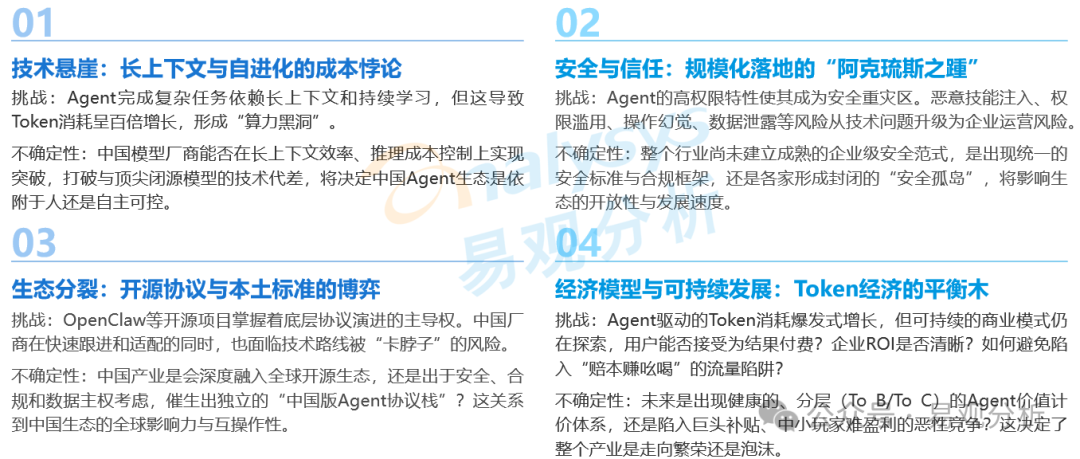
Figure 1: Fourfold Challenges in China's Agent Ecosystem
**First Challenge: The Technological Cliff - The 'Cost Paradox' of Long Contexts and Self-Evolution**
**Challenge Essence**: The long-context processing and continuous learning capabilities Agents rely on to complete complex tasks are creating a terrifying 'computational black hole,' potentially devouring all efficiency gains. OpenClaw's 'Age of Action' hinges on Agents' ability to understand complex instructions, decompose multi-step tasks, and execute them via tools. But this capability comes at a staggering cost. The report notes, 'Token consumption for a single complex task may be tens or even hundreds of times higher than for a dialogue.' When Agents process a 50-page contract, analyze a year's sales data, or continuously learn user preferences, their context length and computational resource demands grow exponentially.
**Specific Dilemmas**:
1. **Long-Context Dependency vs. Efficiency Bottlenecks**: While domestic models boast cost advantages, their inference efficiency, accuracy, and cost control in handling ultra-long contexts lag behind top-tier closed-source models (e.g., GPT-4 Turbo 128K). As task complexity rises, this gap widens, forcing trade-offs between effectiveness and cost.
2. **The 'Bottomless Pit' of Self-Evolution and Continuous Learning**: Ideal Agents should learn and optimize continuously on the job. But this requires perpetually incorporating new interaction data into training or fine-tuning loops, creating an endless 'data-training-inference' consumption spiral. For most enterprises, whether this sustained investment yields clear ROI remains uncertain.
3. **Inference Compute as the New 'Strategic Resource'**: The report emphasizes that Agents' 24/7 operation makes inference demand, not training, the dominant force in compute consumption. This could strain GPU supply and raise prices, eroding domestic models' cost advantages.
**Uncertainty Question**: Can Chinese model vendors breakthrough in long-context efficiency and inference cost control to eliminate technological gaps? Or will computational inefficiencies force China's Agent ecosystem to rely on overseas closed-source models for 'fuel' in high-end tasks, undermining autonomy?
**Second Challenge: Security & Trust - The 'Achilles' Heel' of Scalable Deployment**
**Challenge Essence**: Agents' 'high-privilege execution' transforms them from 'chat partners' into digital employees holding 'system keys,' escalating security risks from technical issues to enterprise operational and legal liabilities. OpenClaw's 'lightweight plugin' model lets Agents directly operate core enterprise systems—their greatest value but also a fatal flaw. The report identifies five gaps enterprises must overcome, four of which are security-related: fuzzy security isolation, permission overreach, audit deficiencies, and supply chain (skill) poisoning. Risks are moving from theory to reality:
1. **Permission Abuse and Boundary Penetration**: To facilitate execution, enterprises often grant Agents excessive permissions (e.g., database read/write, system administration). A malicious prompt or vulnerable Agent could instantly delete critical data, alter financial records, or initiate illegal transfers. Without effective sandboxing, a single Agent overreach could penetrate entire corporate networks.
2. **Supply Chain Attacks via the 'Skill Black Market'**: Active 'skill markets' like ClawHub reflect ecosystem vitality but also create security blind spots. Hackers can disguise malicious code as practical 'Financial Report Analysis Skills' or 'Competitor Monitoring Skills.' Once installed, enterprises invite spies into their core systems, risking data leaks and backdoors.
3. **Operational 'Hallucinations' and Liability Vacuum**: Agents may perform unpredictable 'hallucinatory' operations, causing business accidents. Without tamper-proof, full-process audit logs, it's impossible to trace whether the fault lies with the Agent, prompt wording, or underlying model flaws, creating liability vacuums and compliance risks.
4. **Lack of Enterprise-Grade Security Paradigms**: While security vendors and cloud platforms offer solutions, the industry lacks unified, mature enterprise-grade Agent security standards, compliance frameworks, and best practices. Vendor-specific solutions may create fragmented 'security silos,' increasing management complexity.
**Uncertainty Question**: Can industry-recognized security standards and trust systems be established quickly to clear psychological and institutional barriers for large-scale enterprise adoption? Or will repeated security incidents trigger heavy-handed regulation and erode market confidence, stalling growth?
**Third Challenge: Ecosystem Fragmentation - The 'Route Struggle' Between Open-Source Protocols and Local Standards**
**Challenge Essence**: Will China's Agent ecosystem deeply integrate with global open-source technology or pursue independence for security and sovereignty? This choice will determine China's voice and influence in the global Agent revolution. OpenClaw's success owes much to its open-source nature and designs like the **Model Context Protocol (MCP)**, which serve as a 'lingua franca' for global developers. Chinese vendors quickly followed with localized variants like QClaw and ArkClaw. But seeds of fragmentation have been sown:
1. **Technological Dependence and 'Chokepoint' Risks**: Core frameworks and protocols remain controlled by overseas open-source communities. If international relations or open-source licenses shift (e.g., restricting commercial use), China's highly OpenClaw-dependent ecosystem could face 'supply cuts.'
2. **Local Compliance Drives 'Special Edition' Protocols**: Mandatory Chinese regulations like Cybersecurity Level 2.0 and data export safety reviews clash with global open-source protocols' original intent. Localized protocols like ACPX (China Private Cloud Standard) emerge as a result, potentially creating two distinct protocol stacks long-term.
3. **Potential Loss of Ecosystem Interoperability**: If China adopts independent protocols, it may satisfy short-term compliance and security needs but risk decoupling from the global mainstream ecosystem. This would prevent Chinese Agents from seamlessly using global innovative skills and hinder Chinese skills from going global, creating an 'ecosystem island.'
**Uncertainty Question**: Can China's industry, academia, and regulators collaborate on a wise approach—deeply participating in and contributing to global open-source ecosystems to gain influence while building security-controllable 'compliance enhancement layers' in critical sectors (e.g., government, finance) instead of reinventing the wheel? This tests China's balance between technological globalization and national security.
**Fourth Challenge: Economic Models - The 'Sustainability Dilemma' of Token Consumption and Commercial Returns**
**Challenge Essence**: Agents drive explosive Token demand, but clear, sustainable business models remain elusive. The industry risks falling into a 'loss-leader' trap, becoming unsustainable. OpenClaw shifts AI value from 'generation' to 'execution,' but who pays for 'execution results'? How? Current prosperity is largely driven by giant subsidies and speculative capital, not healthy commercial loops.
**Uncertainty Question**: Will a tiered, healthy valuation system emerge (e.g., simple tasks billed by Token, complex tasks split by outcomes, enterprise services packaged with security governance)? Or will giants monopolize markets through subsidies, squeezing out smaller players in a vicious cycle? This determines whether the Agent industry becomes a 'rainforest ecosystem' nourishing diverse species or a 'capital bonfire' leaving ashes.
In conclusion, the window opened by OpenClaw is precious, and China's Agent industry has shown real vitality in application innovation, ecosystem integration, and cost control. However, true greatness lies not in catching the wind but in navigating cycles. Hidden concerns beneath prosperity are not grounds for pessimism but calls for clarity. Whether China's Agent industry can transform uncertainties into competitive strengths will determine its enduring vitality in reshaping global productivity.
Analysys has released *Reconstruction and Rise: China's Agent Industry Ecosystem in the OpenClaw Era*. If you follow the Agent industry, please engage with Analysys promptly.
-
Ofilm Teams Up with ADSensE to Propel Large-Scale Deployment of All-Solid-State LiDAR Powered by ADS6311 Chip!
-
![]()
Loss of 2.5 Billion Yet Facing Strong Demand for Shares? Another Battle for Control of Lianchuang Electronics
-
![]()
Huawei’s Enjoy Series Flies Off the Shelves, Prompting Xiaomi to Double Down on Budget Smartphones
-
![]()
Beijing Hyundai's Top Executive Criticizes Industry Disorder: Certain Brands Treat Customers as Beta Testers
-
![]()
The domestic mobile phone market has declined for five consecutive quarters! Huawei defies the trend with significant growth: maintains its top market share
-
Annual Revenue Surpasses 3 Billion: An Automotive Trim 'Little Giant' Makes Its Debut on the Beijing Stock Exchange
-
![]()
The Space Force Wants to Spend $30 Billion on Rocket Launches: Is Trump Doubling Down, and Is SpaceX the Big Winner?
-
![]()
Going Crazy! One out of Every Three Plug-in Hybrids Sold in Europe is a Chinese Vehicle