When Passenger Cars Outweigh Light Trucks, Should New Energy Vehicles Continue to Grow 'Bulkier'?
 05/29 2026
 454
454
During the era of fuel-powered vehicles, global automakers largely adhered to a common belief: the lighter the vehicle, the better. For every 100 kg reduction in weight, fuel consumption per 100 km decreased by 0.3 to 0.5 liters. Lighter vehicles not only handled more agilely and had shorter braking distances but also generated less energy during collisions. Engineers invested heavily, utilizing materials from aluminum alloys to carbon fiber, all with the singular aim of reducing vehicle weight.
Now, the tides have turned.
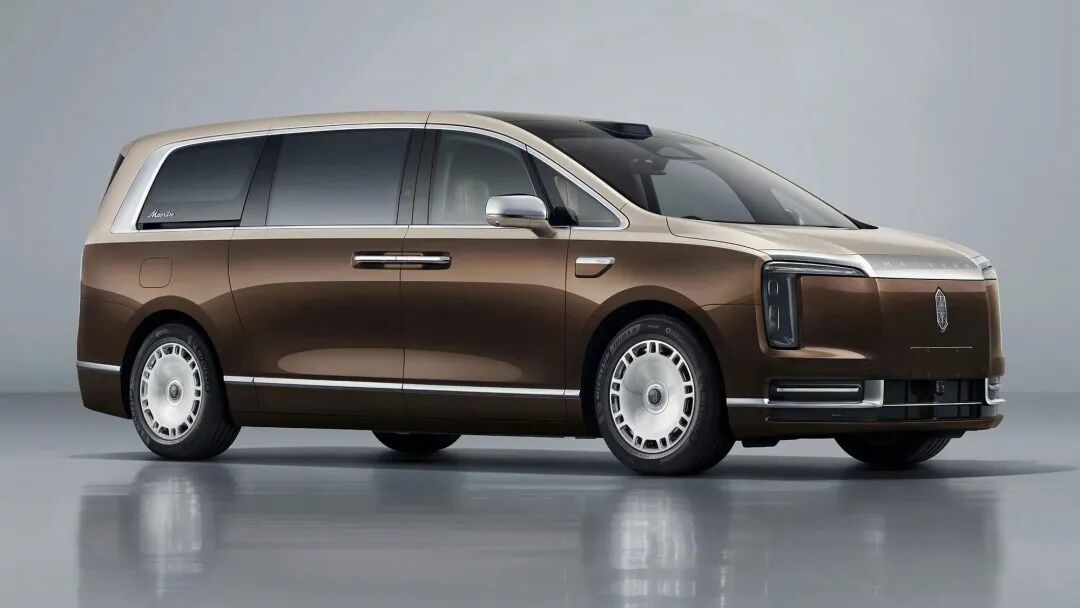
Recently, the first MPV from Hongmeng Zhixing's Zunjie brand—the Zunjie V800—made its appearance in the MIIT's declaration catalog. It boasts dimensions of 5495mm × 2006mm × 1850mm and a total mass of up to 3800 kg, with a curb weight range of 3120-3190 kg. What does this signify? With seven adults on board, this vehicle approaches the 4-ton mark, surpassing the weight of some light trucks available in the market.
And the Zunjie MPV is not an isolated case in today's automotive industry. Mercedes-Benz's new energy MPV—the VLE—has a curb weight of approximately 2900-3200 kg and a maximum permitted gross weight of 3700 kg, placing it in a similar weight category as the Zunjie MPV.

The Rate of Weight Gain in New Energy Vehicles Far Outpaces That of Fuel-Powered Cars
Data released over the years by the MIIT and the China Passenger Car Association reveals that the average curb weight of new passenger cars in China reached 1704 kg in 2024, up from 1312 kg in 2012—an increase of nearly 400 kg for an average family car in just 12 years. More notably, the rate of weight gain has accelerated further in the past two years.
Focusing on new energy models, the trend is even more pronounced. According to the 2025 Annual Assessment Report on the Technology Roadmap for Energy-Saving and New Energy Vehicles released by the Society of Automotive Engineers of China, the average curb weight of domestically produced pure electric passenger cars in 2024 was 1865 kg, about 350 kg heavier than their fuel-powered counterparts of the same class.

At the 2026 Beijing Auto Show, the NIO ES9 weighed nearly 2915 kg, the XPENG GX extended-range version approached 2890 kg, the Li Auto L9 Livis reached 2835 kg, and the Denza D9 with a 115 kWh battery weighed a hefty 3015 kg. These weight figures, once exclusive to trucks, seem to be becoming the norm for mainstream passenger cars.
A typical family pure electric vehicle carries a battery pack weighing 500-700 kg alone, equivalent to the curb weight of a micro fuel-powered car.
Three Major Causes and Industry Practices Contribute to 'Overweight' Vehicles
Why are new energy vehicles getting heavier? Three main factors are at play: First, consumer demand for large SUVs has driven industry-wide expansion of vehicle sizes; second, new energy automakers are adding battery capacity to pursue longer range; and third, the accumulation of luxury features like 'refrigerators, TVs, and sofas' has become a trend.
A 100 kWh battery pack weighs 500-600 kg; a set of ultra-luxury seats with heating, cooling, and massage functions adds dozens of kilograms more than standard seats; and eleven or twelve airbags replace the one or two of the past.
Industry experts point out: The continuous rise in vehicle weight is not a badge of progress for the automotive industry but rather a product of disorderly competition, running counter to the original goals of energy conservation, emissions reduction, and environmental protection.
From a market perspective, replacement demand now accounts for about 50%, with consumers more willing to choose larger vehicles due to upgrade desires, the birth of a second child, or status considerations. Automakers, in turn, prefer to promote higher-priced large vehicles for greater profits.
A research and development engineer from a mainstream automaker revealed another industry practice: 'Lightweighting requires significant R&D investment, and technologies like carbon fiber and all-aluminum bodies have high technical thresholds and costs. In contrast, enlarging batteries and vehicles is the simplest, most direct way to 'solve' range anxiety and market anxiety.' This statement also points to the problem from another angle.
The Costs of 'Oversized and Overweight' Vehicles Are Already Evident
Thus, a peculiar paradox has emerged: During the fuel-powered vehicle era, automakers went to great lengths to reduce weight, lower fuel consumption, and decrease emissions; in the new energy era, automakers are doing the opposite—waving the banner of 'green travel' while making vehicles heavier and more power-hungry.
The costs of this 'weight gain' are moving from concern to reality.
First to surface is the energy consumption issue. For every 10% increase in vehicle weight, energy consumption rises by 6% to 8%. An MPV weighing nearly 4 tons will inevitably have shocking energy consumption per 100 km. This means that adding batteries to pursue range only further increases energy consumption due to the added weight, creating a classic 'weight spiral' dilemma.
In fact, this is precisely the 'weight spiral' publicly criticized by NIO CEO William Li: Increasing battery size to boost pure electric range—the added battery weight forces body reinforcement—the increased vehicle weight raises energy consumption—and to maintain range, batteries are enlarged again.
More concerning are the safety issues. Many consumers mistakenly believe that heavier vehicles are more crash-resistant and safer, but this is a serious misconception. The core of automotive safety never relies on weight but on scientific body structure design, high-strength lightweight materials, and the precise intervention of active safety systems.
Heavier vehicles have greater inertia during emergency braking, significantly extending braking distances and making it harder to stop in time during sudden incidents. After a collision, an overly heavy body can obstruct energy transfer, potentially increasing the impact on occupants and causing greater harm to the collision object, especially pedestrians.
Parking difficulties are also not to be overlooked. An MPV nearly 5.5 meters long is already a technical challenge to park in a standard 2.4-meter-wide, 5.1-meter-long space. In reality, many older residential areas and even commercial parking lots have actual space widths of only about 2.15 meters and lengths under 4.5 meters.
Increasingly heavy vehicles not only pose greater safety challenges but also cause more severe road damage. Studies show that a 3-ton vehicle causes about 8 times more road damage than a 1.5-ton vehicle (axle load and road damage follow a fourth-power relationship). When tens of thousands of overweight new energy vehicles hit the roads, road maintenance cycles will be significantly shortened, and maintenance costs will multiply. Many countries already levy taxes based on vehicle weight to address this issue, and similar proposals have emerged in China.
New National Standards and Tax Reforms Are Already 'On the Way'
In response to this escalating 'weight gain competition,' regulatory authorities have begun to take action.
Starting January 1, 2026, the national mandatory standard Energy Consumption Limits for Electric Vehicles—Part 1: Passenger Cars will be officially implemented, directly linking the energy consumption limit per 100 km to curb weight and tightening the standard by about 11% overall. Relevant regulatory departments have also begun discussing a reform of the automobile taxation system based on vehicle weight. The decoupling of new energy vehicle consumption taxes from body weight and size may soon become history.
Industry insiders reveal that the policy intent is clear: to form positive regulation through the tax system and curb automakers' blind pursuit of increased weight in competition. This means the approach of 'the heavier, the better' in vehicle manufacturing will soon face substantive policy constraints.
We do not intend to deny consumers' reasonable demands for spaciousness and long range, nor do we deny the product strength of large new energy models like the Zunjie V800. However, it must be pointed out that when 'bigger is nobler' becomes the industry's default competitive direction, and every automaker races to see who can make bigger cars, heavier cars, and more luxurious features, this industry is straying from its original purpose.
The new energy industry was born to promote energy conservation, emissions reduction, and sustainable development. If we move in the opposite direction for 'face and grandeur,' the term 'new energy' will clearly lose its meaning!
-
![]()
Embrace Freedom, Live Boldly! Great Wall Motor’s Menglong PLUS Launches in the Greater Bay Area, Unlocking Enhanced Lifestyles with One Vehicle
-
![]()
The Agent hasn't arrived yet, but Ascend has already paved the way from hardware to software.
-
![]()
In 71 years, He sold products to 100 million people
-
![]()
First-hand Practical Test! Opus 4.8 Vs ChatGPT 5.5 Vs Kimi 2.6: Which is the Most Usable?
-
![]()
Fourfold Uncertainty Challenges Facing China's Agent Industry - Interpretation of the 'Report' (Part Six)
-
Crazy Anthropic
-
![]()
CNPC’s Kunlun Model Advances with 152 Implemented Scenarios, Showcasing Proactive AI
-
![]()
Revenue Increases, But Profits Don't: Pinduoduo's Anxiety Amidst Billion-Dollar Brand Building