We’re Still 300 Kilometers Short of the 'All-Electric Era'
 06/04 2026
 407
407
Lead-in
Introduction
Lithium iron phosphate batteries are too cumbersome, ternary lithium batteries are too costly, and solid-state batteries remain a distant prospect.
Has the 'all-electric era' dawned? This seemingly simple question is surprisingly challenging to answer.
In fact, the term 'all-electric era' only gained popularity as a buzzword following the U.S.-Iran conflict. The timeline for traditional automakers' transition from internal combustion engines (ICE) to new energy vehicles (NEVs) was abruptly hastened.
Brands specializing in pure electric vehicles, such as NIO, Xiaomi, and Tesla, now find themselves presented with new growth opportunities. The 'windfall' and benefits of a second industry transformation have arrived.
However, a sober analysis reveals that the all-electric era has not yet fully materialized. From the perspectives of market penetration and battery range limitations, ICE vehicles still exhibit strong resilience.
One might say that even if we've located the 'Temple' from Joy of Life and knocked on the door of the 'all-electric era,' we haven't truly stepped inside. Therefore, we're likely still 300–400 kilometers (in range) away from the all-electric era.
01 Ownership: The True Benchmark
The past two months have witnessed explosive growth in pure electric vehicle sales globally. From a marketing standpoint, the hype is pervasive, but a closer examination reveals a different reality.
For instance, in the European market, 723,704 battery electric vehicles (BEVs) were registered in the first quarter of 2026, with BEVs accounting for 20.6% of the market share. Meanwhile, the market share of gasoline vehicles in Europe has declined from 28.7% a year ago to 22.5%. This is a factual observation.
However, it seems premature to declare Europe's entry into the all-electric era. Minor trends do not necessarily signify a full-scale transition.
From the perspective of vehicle ownership in Europe, data from the European Automobile Manufacturers' Association (ACEA) and Eurostat indicates that as of 2024, the total vehicle ownership in Europe (including EU countries, the UK, and EFTA nations) was approximately 340 million.
This encompasses around 297 million passenger vehicles and 45 million commercial vehicles. Among passenger vehicles, BEV ownership in the EU was approximately 5.87 million, representing about 1.7% of total EU vehicle ownership (based on the EU's passenger vehicle ownership of approximately 297 million).
If we consider the broader definition of Europe (including the UK, Norway, Switzerland, etc.), the proportion of BEVs is slightly higher than EU data but still below 2% overall.
This data pertains to 2024. Even with projected growth in BEV ownership in 2025, it can only be said that BEVs are still in a rapid development phase in Europe.
Furthermore, as a true indicator, the transition to pure electric vehicles among ultra-luxury brands at the pinnacle of the automotive pyramid has yet to find a perfect solution. The recently released Ferrari LUCE, which faced severe criticism, serves as a cautionary tale.
Additionally, foreign automakers' electrification strategies have generally encountered setbacks, leading to collective route adjustments. For instance, Lotus Cars abandoned its pure electric route and reverted to engine development. Volvo's early comprehensive electrification plan yielded disappointing results despite substantial investment.
If the overseas market is facing such challenges, has the domestic market reached the 'all-electric era'? The answer appears to be no.
According to statistics released by the Ministry of Public Security on January 26, 2026, as of the end of 2025, the total number of new energy vehicles (NEVs) in China reached 43.97 million, accounting for 12.01% of the total vehicle population.
Among these, the number of pure electric vehicles was 30.22 million, translating to a BEV ownership proportion of approximately 8.26% (i.e., 30.22 million ÷ total ownership of 366 million).
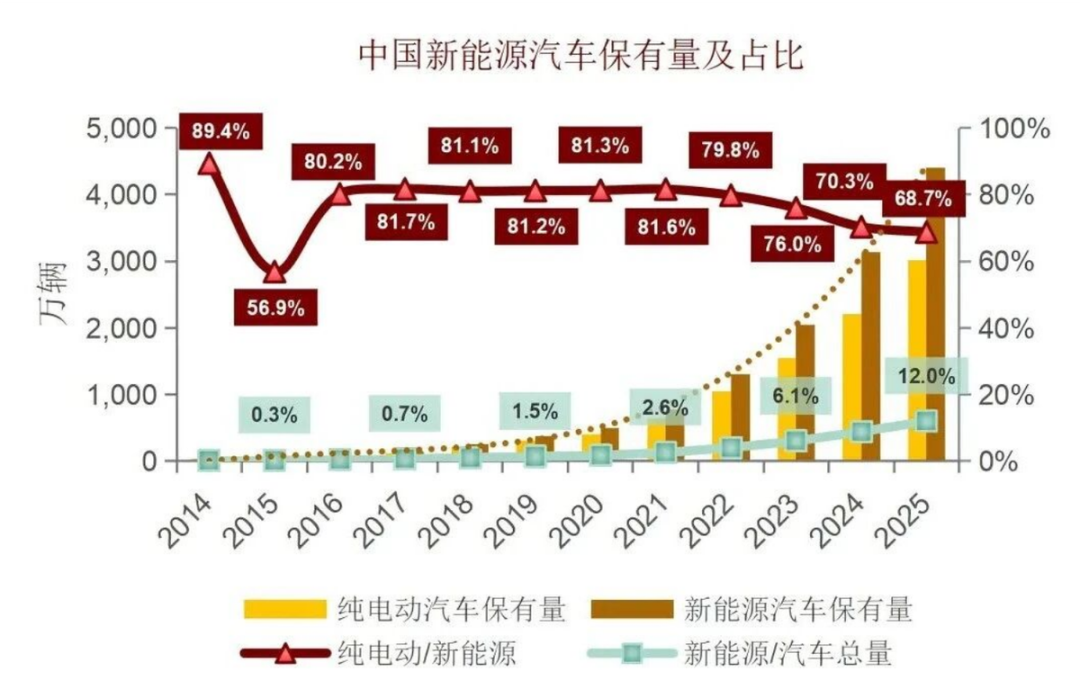
Of course, this data reflects the stock situation at the end of 2025. With the rapid development of the NEV market, the proportion of BEV ownership continues to rise.
So, when can we say the 'all-electric era' has arrived? At the very least, it should surpass the golden ratio of 38.2%.
Moreover, in the long run, the existing advantages of BEVs are subject to uncertainty.
For example, there is the risk of gradually fading policy dividends. We know that NEVs currently enjoy multiple supportive policies. However, the market's immediate negative reaction to the reduction of purchase tax incentives earlier this year was evident for all to see.
Additionally, to support the development of the new energy sector, the state has provided subsidies for many years, and BEVs have not paid road maintenance fees. This has created a significant 'tax exemption black hole.'
However, there are now strong calls for NEVs to pay road maintenance fees, with rumors suggesting a 300 billion yuan shortfall in national road maintenance funding. Once implemented, it remains uncertain whether BEVs will remain as popular.
Of course, as a 'new pillar industry,' imposing road maintenance fees on NEVs raises concerns. Collecting too little would be ineffective, while collecting too much would create hesitations. This is not the focus of this article, so we'll set it aside for now.
Therefore, when the market penetration rate of NEVs reaches a high level of 60–70%, supportive subsidies will likely be withdrawn, and NEVs will gradually achieve tax parity with ICE vehicles. At that point, the cost advantages of purchasing and using electric vehicles will significantly diminish, and ICE vehicles may experience a resurgence.
Furthermore, there are significant differences in energy structures between China and other countries. China is rich in various resources and has low electricity costs, supporting the development of domestic NEVs. However, most countries worldwide face higher costs and inadequate structures for acquiring electricity, making it impossible to replicate China's pure electric development model.
Thus, achieving the vision of a 'global all-electric era' is unlikely in the short term.
02 No Suitable Batteries Yet
In reality, one of the two most significant pain points for pure electric vehicle consumers, though less discussed in recent years, is range anxiety.
After all, for BEVs to truly replace ICE vehicles, their range must reach at least 1,000 kilometers to eliminate range anxiety. Currently, the mainstream BEV range is around 700 kilometers.
However, just as we're 300 kilometers away from eliminating range anxiety and entering the 'all-electric era,' battery bottlenecks have emerged.
From a battery perspective, achieving an equivalent 1,000-kilometer range would result in vehicle weights exceeding 3 tons, with the battery itself weighing over 1 ton, as highlighted by CATL during its Tech Day event on April 21.
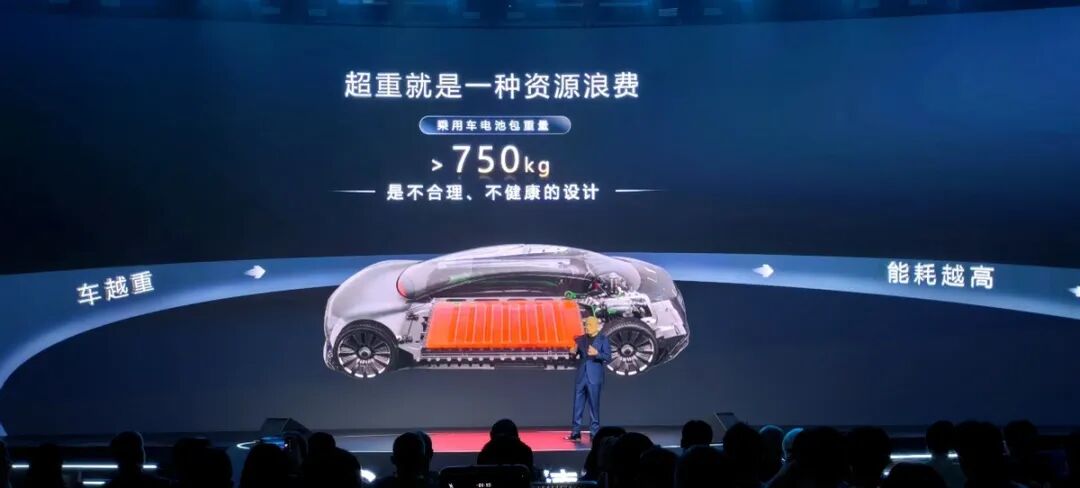
Excessive vehicle weight introduces numerous issues. For example, a recent anecdote mentioned several automakers' 'boxy' NEVs failing to climb steep off-road slopes during testing. One well-known company's vehicle repeatedly failed to make the ascent.
The reason? With the same power output, the large lithium iron phosphate battery increased the vehicle's weight by 300–400 kilograms, ultimately leading to failure.
Consider the NIO ES9, released on May 27. According to the MIIT's new vehicle declaration catalog, the highest-spec ES9 has a curb weight (empty vehicle weight) of 2.915 tons.
At nearly three tons, this already far exceeds the notorious 'two-and-a-half-ton' light trucks from the ICE era.
It's not just NIO. This year's BYD Tang EV high-spec version weighs 2.97 tons, while the Denza D9's 115 kWh version weighs 3.015 tons. Others are no different.
Compared to domestic ICE vehicles, which typically weigh between 1.3 and 1.8 tons, their electric counterparts are at least 300–500 kilograms heavier. According to MIIT data, the average weight of passenger vehicles in China has climbed from 1.312 tons to 1.704 tons over the past 12 years, a net increase of nearly 400 kilograms.
This has been a recent trend, with domestic NEVs becoming increasingly heavy, with some models surpassing the three-ton mark.
Although lightweighting power batteries has been a technical focus for NEVs over the past decade, with innovations ranging from CTP to CTC structural integration, material substitutions, semi-solid/solid-state battery iterations, and anode/battery casing weight reductions, no stone has been left unturned.
However, despite these efforts, range extensions still ultimately rely on increased weight.
The primary reason is that the energy density of lithium iron phosphate batteries has reached its ceiling, with no significant breakthroughs possible. Ternary lithium batteries, while offering higher energy density and lighter weight, suffer from safety instability and are only used in models priced above 250,000 yuan, limiting their penetration rate.
The much-hyped solid-state batteries, plagued by technical issues such as solid-solid interface impedance, lithium dendrites, and solid electrolyte materials, are not only expensive but also face delays in mass production, with estimates suggesting they won't be available until 2030–2035.
Thus, the current 'village hope' rests on solid-liquid batteries (semi-solid-state batteries). However, their uncertainty remains, with technical progress suggesting it will take at least 1–2 years for widespread adoption. So, can the 'all-electric era' arrive so soon?
Another issue is that excessively large and heavy batteries lead to various problems.
For example, increasingly heavy NEVs place significant pressure on road infrastructure maintenance.
Road engineering features the famous 'fourth-power law,' where doubling the axle load increases pavement damage by 16 times, a classic conclusion from the 1960s AASHO road experiments in the United States.
Japan and the United States have already considered implementing 'weight taxes.' For instance, Japan passed legislation in May requiring private buyers of electric vehicles under 2 tons, between 2–2.5 tons, and over 2.5 tons to pay annual fees of 6,500 yen, 19,900 yen, and 24,000 yen, respectively.
With NEV ownership rates of just 5.5% in Japan and 2% in the United States, these countries are already considering the increased road maintenance costs associated with NEVs.
As the world's largest producer and consumer of NEVs, China, with 43.97 million NEVs (2026 data not yet available), must certainly consider this factor.
However, the core issue is that as transportation systems approach their 'breaking point,' unrestricted growth of NEVs cannot continue. The tax exemption advantages of BEVs will gradually disappear and eventually reach zero.
Additionally, excessive vehicle weight shortens component lifespans, including tires, which experience accelerated wear.
As the saying goes, 'fat people wear out shoes, heavy vehicles wear out tires.' Increased vehicle weight necessitates tire upgrades, while the braking system also faces heightened pressure, requiring upgrades. These increasingly large and imposing BEVs are not budget-friendly for consumers, becoming more expensive to maintain.
The fact that electric vehicles are heavier than ICE vehicles reflects temporary physical limitations in battery technology optimization. However, imposing a 'weight limit' on NEVs could stifle range improvements, effectively abandoning the policy goal of large-scale replacement of ICE vehicles with NEVs.
Therefore, regarding the 'unsolvable' dilemma of rapid new energy industry expansion, the illusion of the 'all-electric era,' much like AI, requires correction. Moreover, industrial development follows cyclical patterns, and the automotive industry will not move in a straight line toward pure electrification. Amidst this complexity, calmness and composure are essential.
Editor-in-Charge: Li Sijia Editor: He Zengrong

THE END


-
![]()
Masayoshi Son's 'Revenge': From Defeat to Deification via AI, Regaining Asia's Richest Title After a Decade
-
![]()
Doubao is About to Start Charging: Let's Talk About My True Feelings
-
![]()
Kuaishou’s Q1 Report: The Strategic Imperative of Spinning Off Kling
-
This field has reached a new high
-
![]()
May Sales Review: Top 5 Independent Chinese Automakers Shine; BYD Holds Lead, Chery Expands Globally
-
![]()
The Godfather of AI Launches a Startup: Silicon Valley Places Bets on the 'Next-Gen AI Paradigm'
-
![]()
We’re Still 300 Kilometers Short of the 'All-Electric Era'
-
![]()
Why Is CATL Included on DeepSeek's Major Investor List?