800V vs. 48V: Which Reigns Supreme? Online Clash Between Executives Intensifies Debate Over Li Auto and NIO's Suspension Systems | MIRROR Pro
 06/08 2026
 576
576
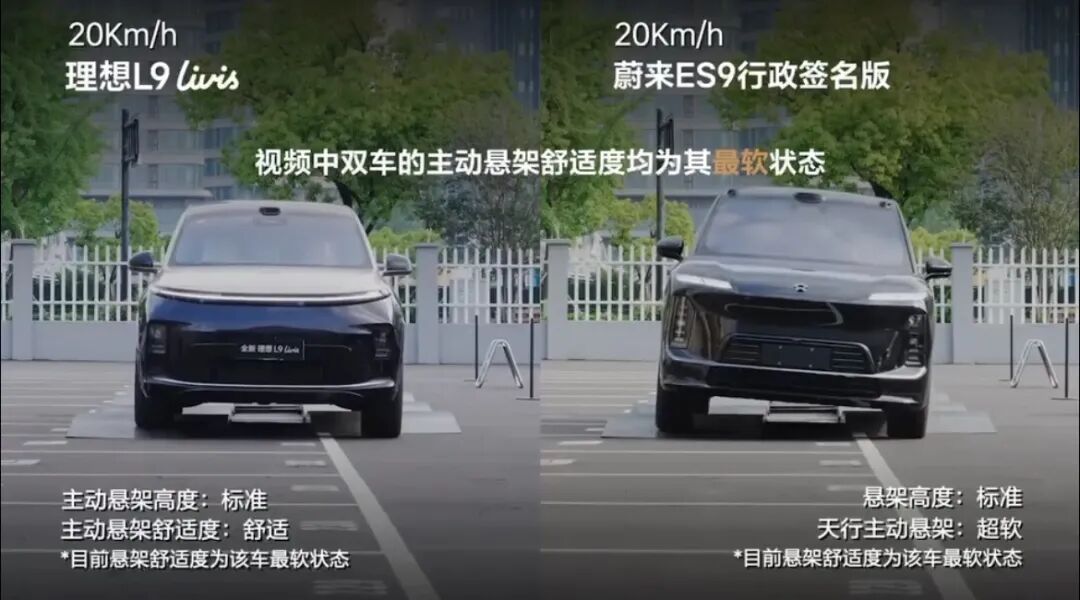
After more than two weeks of heated debate over suspension systems, executives from Li Auto and NIO took their dispute to the online arena. On the morning of June 5, Li Auto posted a video on its official mini-app, demonstrating the performance of two vehicles equipped with active suspensions—the Li L9 Livs and the NIO ES9 Executive Signature Edition—as they navigated a wavy road under varying modes.
The video revealed that, at a speed of 20 km/h, regardless of whether the suspension was set to its firmest or softest comfort setting, the L9 Livs exhibited significantly superior body stability compared to the ES9. The L9 maintained a steady posture, while the ES9 experienced more pronounced oscillations. Although the video was swiftly removed after its release, its content had already spread, igniting widespread discussions.
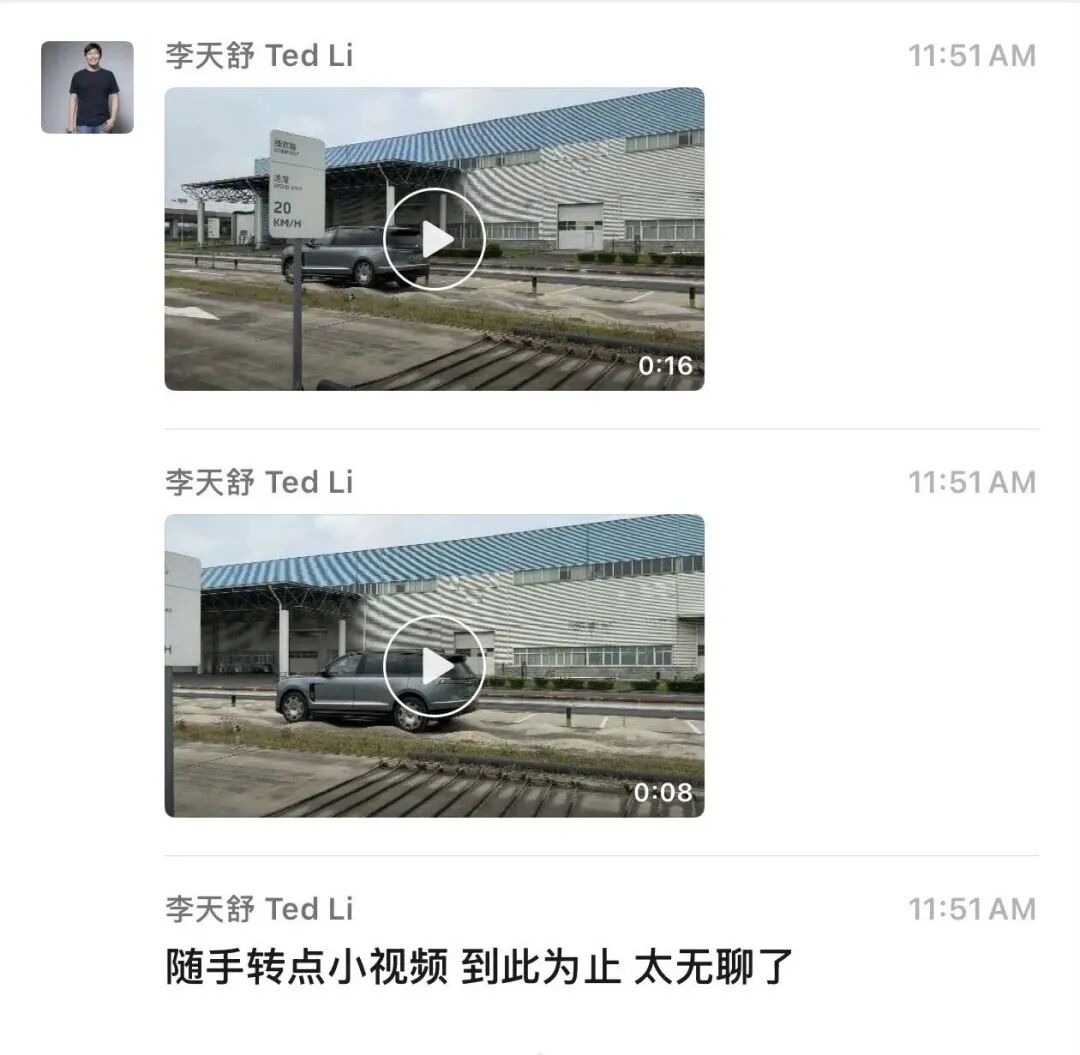
Around noon on the same day, Li Tianshu, the head of NIO's product line, shared a video in a group chat, showcasing the ES9's performance on the wavy road. While the video did not specify the speed or suspension settings during the test, the ES9 appeared remarkably stable. “Just sharing a short video for fun. That's it, too boring,” Li Tianshu remarked.
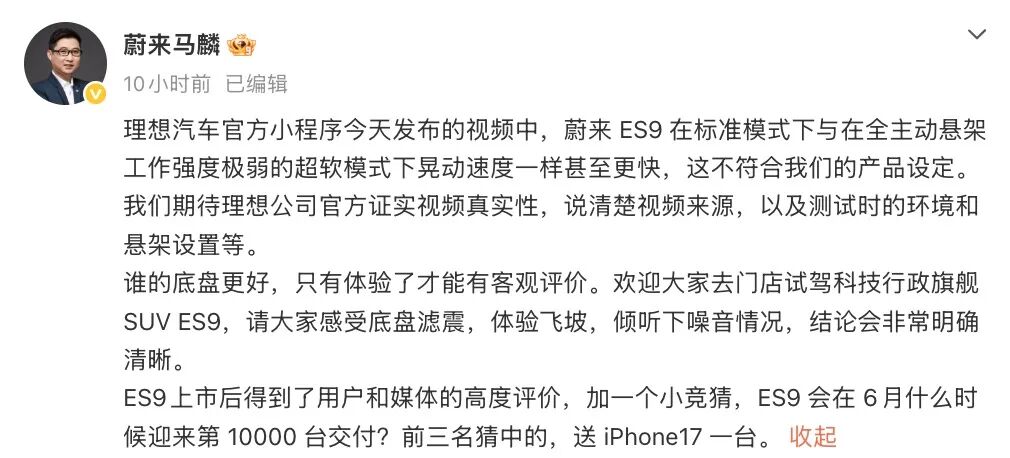
At approximately 1:00 PM, Ma Lin, NIO's Vice President, publicly challenged Li Auto. “The oscillation speed of the NIO ES9 in standard mode is the same or even faster than in its ultra-soft mode, where active suspension operation is minimal. This performance does not align with our product settings,” Ma Lin asserted. He urged Li Auto to verify the authenticity of the video, clarify its source, and provide details about the testing environment and suspension settings.
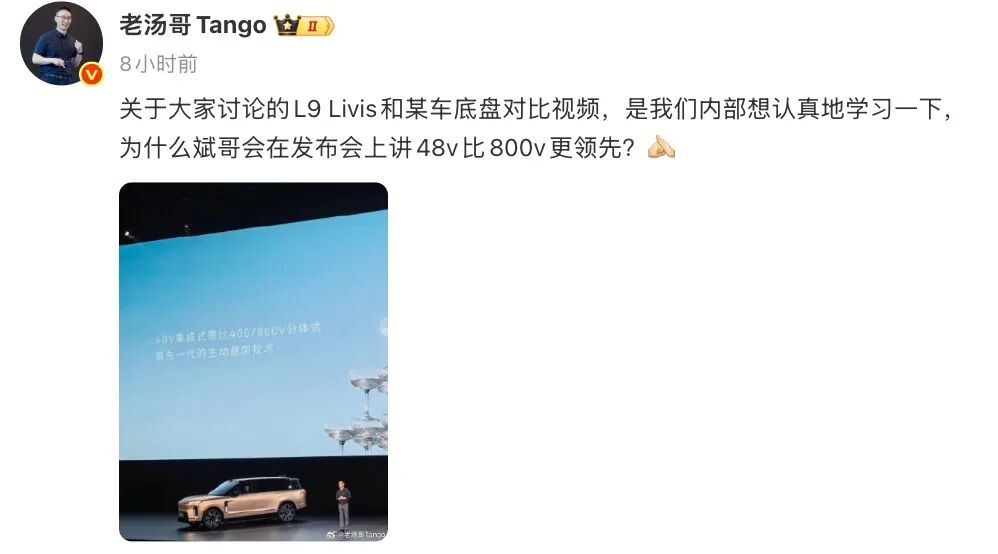
Shortly thereafter, around 3:00 PM, Tang Jing, the head of Li Auto's product line, responded with a post. He explained, “Regarding the video comparing the chassis of the L9 Livs with another model, which has sparked external discussion, we aimed to understand why Bin [Li Bin] mentioned during the launch event that 48V is more advanced than 800V.” His post included an image from NIO's launch event, where Li Bin, NIO's Chairman, stated, “The 48V integrated solution is a generation ahead of the 400V and 800V split solutions for active suspension technology.”
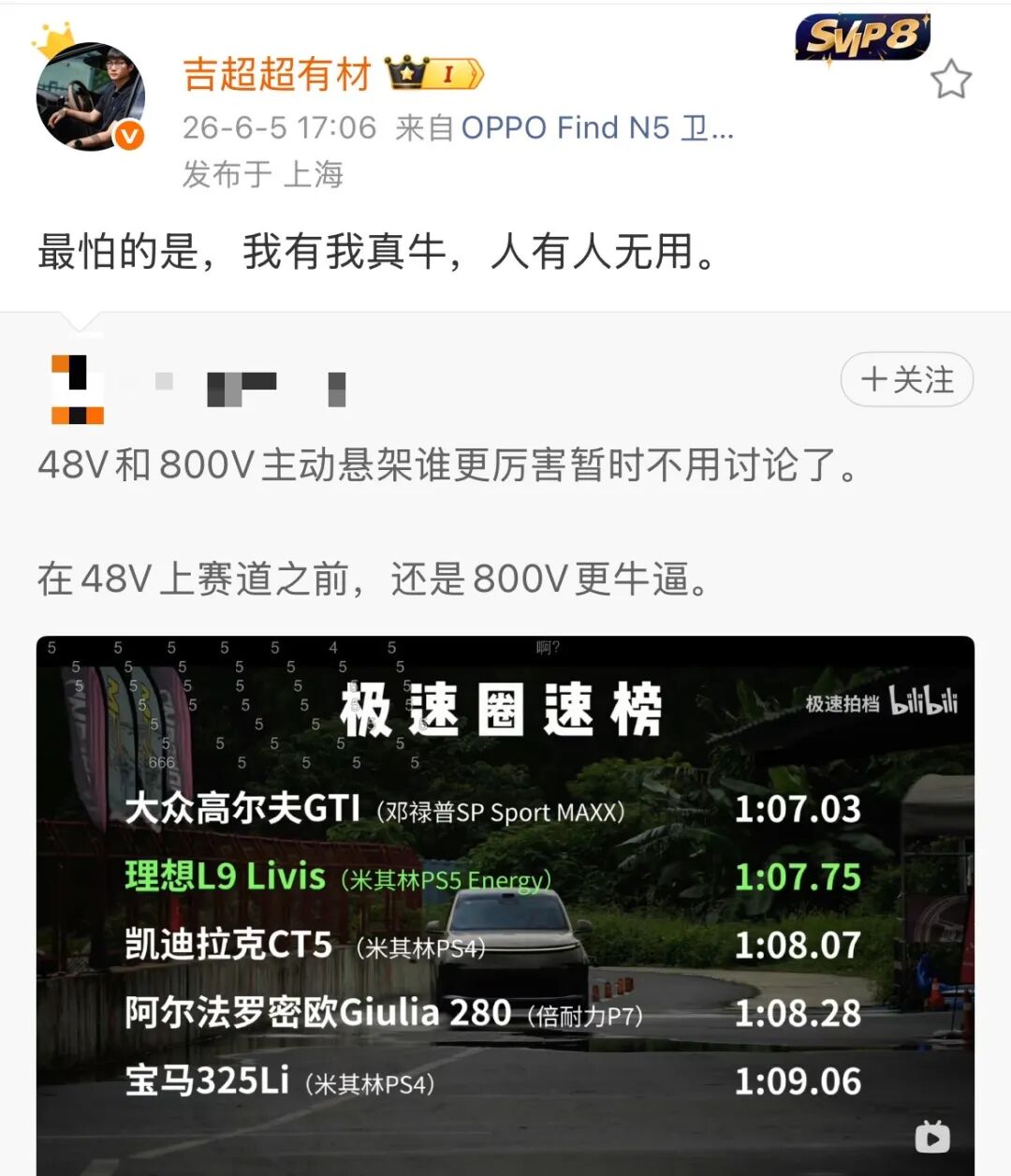
Subsequently, Ji Chao, Li Auto's body materials leader, forwarded a test of the L9 Livs' top lap speed conducted by a self-media outlet, accompanied by the comment, “The scariest thing is when I have something genuinely good, while others have nothing useful.” Ji Chao's response was notably confrontational.
The L9 Livs and ES9 are the flagship models launched this year by Li Auto and NIO, respectively, with their latest technology—fully active suspensions—being a core selling point. Prior to this, NIO and Li Auto had already been engaged in a debate over this issue for half a month.
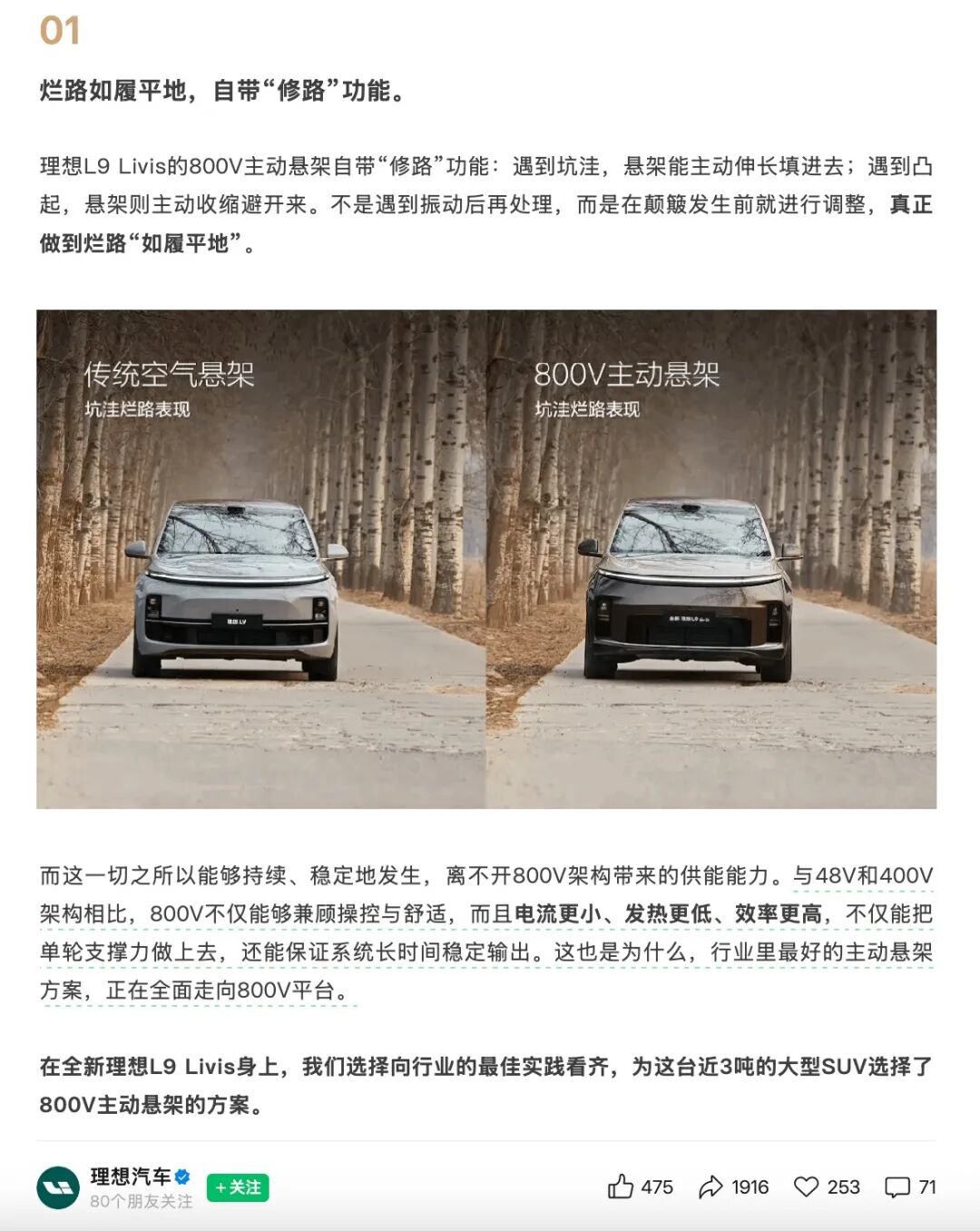
Publicly available information traces the origin of the conflict to an article published by Li Auto on April 29. Titled “Understanding the 800V Active Suspension of the All-New Li L9 Livs in One Read,” the article stated that compared to 48V and 400V architectures, the 800V system not only balances handling and comfort but also features lower current, reduced heat generation, and higher efficiency. It can deliver strong single-wheel support while ensuring long-term stable system output. “This is why the industry's best active suspension solutions are moving toward the 800V platform,” Li Auto claimed.
Shortly after, on May 12, NIO published an article titled “Farewell to 'Prefabricated Dishes': NIO Gains Full Autonomy in Chassis Development with the ES9.” NIO recounted its exploration journey in chassis technology, referencing the “rotating chef” phenomenon—where, for a long time, most automakers relied on suppliers for complete chassis tuning solutions. Automakers would only outline general requirements, and suppliers would provide a mature solution, treating every car the same way, like a standard dish, adding water if too salty or salt if too bland. “If you always eat prefabricated dishes, you'll never know how vinegar is brewed or what a two-second difference in cooking temperature means,” said Wang Feng, head of NIO's Vehicle Dynamics and Chassis Engineering Department.
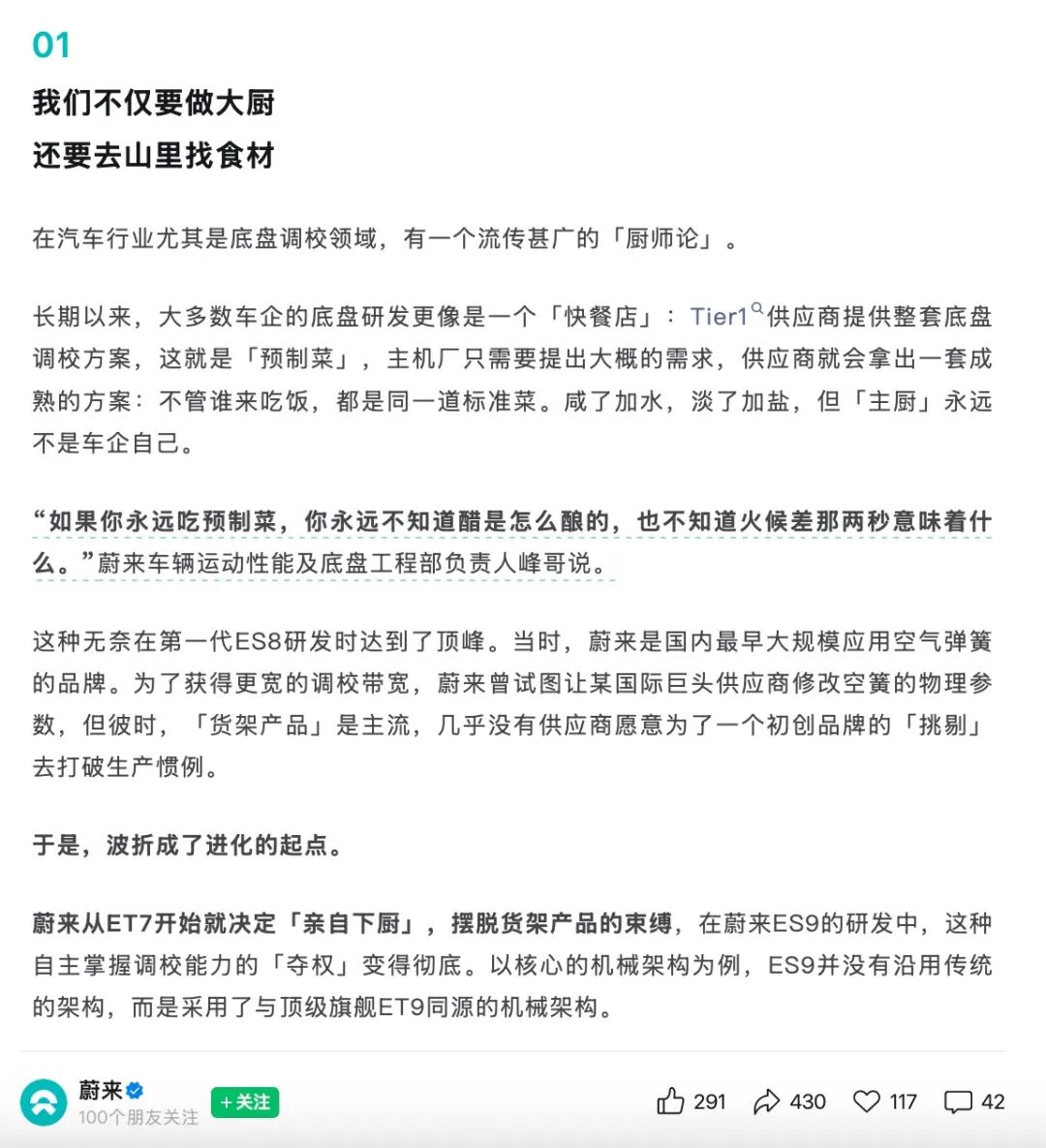
Although NIO did not directly name Li Auto or the 800V active suspension, this was widely seen as a counterattack.
During the ES9's launch event on May 27, Li Bin, NIO's Chairman, was even more direct in his criticism. At the event, Li Bin stated, “The 48V integrated active suspension equipped in the ES9 is a generation ahead of the 400V and 800V split solutions.” In response, Tang Jing replied on the evening of May 27, “We will continue to serve our users well and not argue over whether something is a generation or two years ahead.”
On May 31, DCD Auto conducted a video comparison test of the suspensions of the L9 Livs and ES9. According to the test video, the L9 Livs' active suspension performed better in emergency lane changes and single-wheel lifting, while the ES9's 48V active suspension provided greater stability on continuous long-wave bumpy roads. However, the test sparked significant controversy over fairness due to differences in the suspension testing modes and calibration orientations of the two vehicles.
Active suspension has recently become a hot topic in the industry. After Li Auto showcased single-wheel lifting for tire changes at the Beijing Auto Show, brands like AITO, Geely, and Fangchengbao also demonstrated this feature, even going as far as showcasing three-wheel driving. These demonstrations primarily focused on showcasing active suspension capabilities and did not constitute a debate. The current dispute between NIO and Li Auto, however, revolves around their chosen technical routes for 800V and 48V active suspensions.
The 800V active suspension is a split solution that utilizes an 800V high-voltage platform for the entire vehicle, combined with a split hydraulic pump station for the body. The electric drive actuator (high-voltage motor/power module) and shock absorber of the active suspension are separate components. Driven directly by the vehicle's 800V high-voltage platform, a high-power hydraulic pump provides centralized output, which is then distributed to the four-wheel actuators via high-voltage pipelines, delivering extremely high power output and lifting force to all four wheels. The advantages of this solution lie in its strong force and support, enabling high-intensity maneuvers such as “body dancing” and single-wheel in-place lifting, as well as extreme body control during high-speed cornering and rapid acceleration/deceleration. However, its drawbacks include the elasticity of the hydraulic pipelines, which results in slightly slower response to high-frequency, small-amplitude bumps. Additionally, it has lower integration, occupies more space, and offers poor layout flexibility.
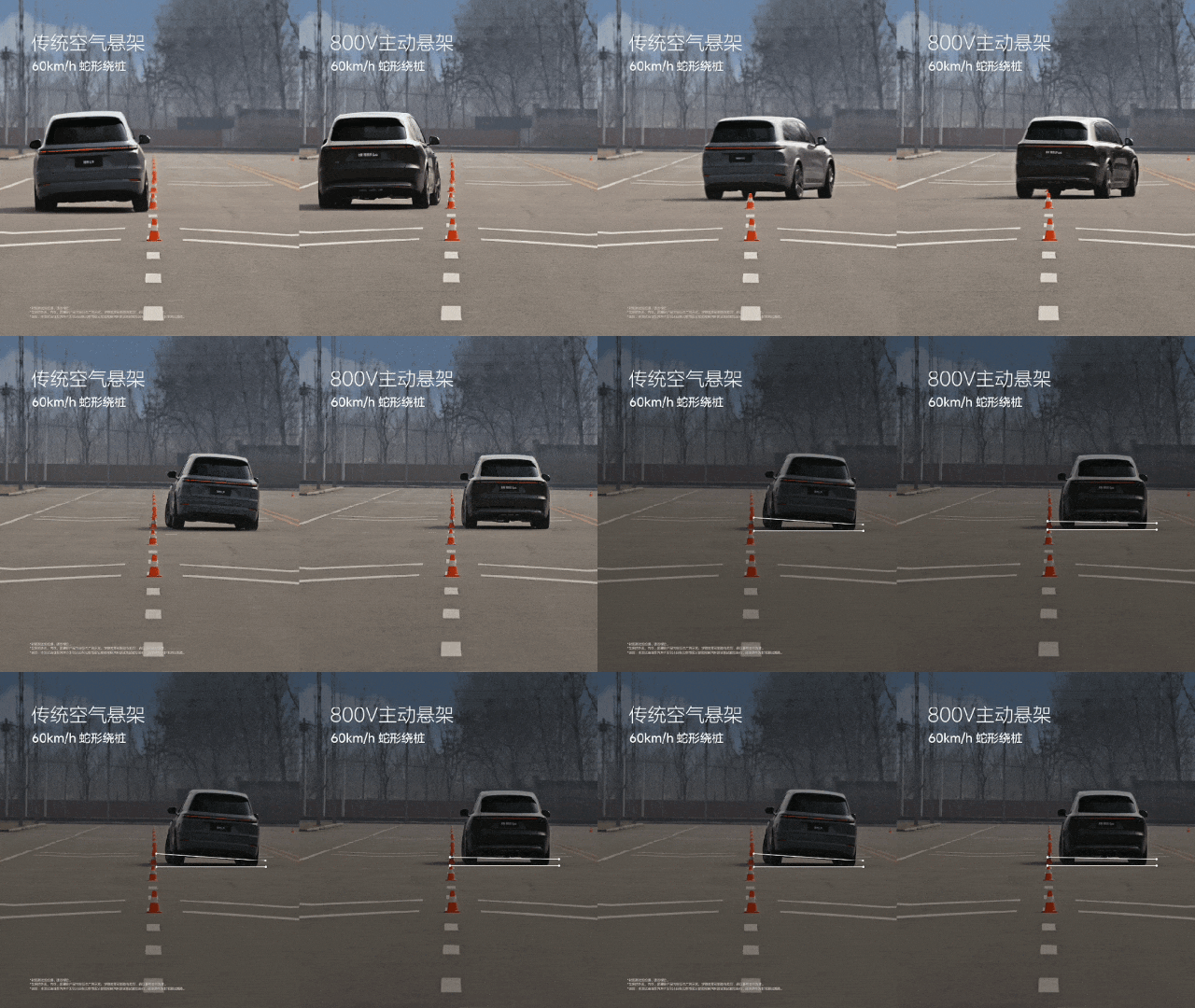
In contrast, the 48V solution is an integrated approach where the motor, hydraulic pump, and shock absorber are highly integrated into an independent module at thousands each wheel, enabling torque adjustments of times per second. The system is controlled by an independent 48V low-voltage electrical architecture, decoupling wheel and body motion. Its advantages include fast response and high precision, with a maximum adjustment frequency of up to 1000 times per second, making it extremely sensitive and capable of finely filtering high-frequency, small-amplitude bumps like manhole covers and seams. However, its drawback is that, due to the 48V voltage limitation, its support force under extreme handling or heavy loads is inferior to that of the 800V solution.
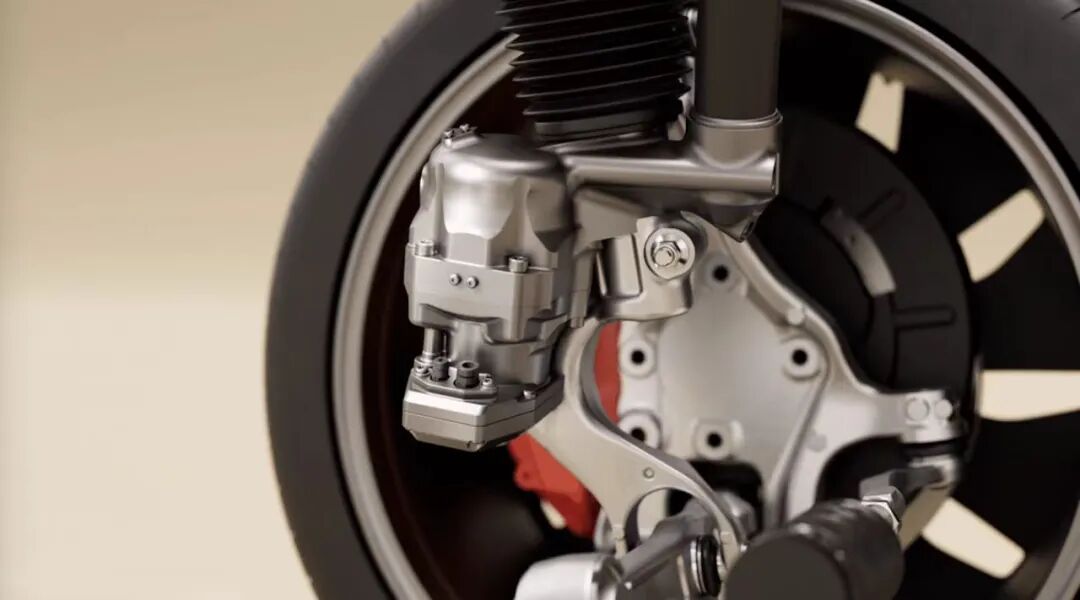
From a technical perspective, the 800V solution is more suitable for pursuing sporty handling and body stability under extreme driving conditions, while the 48V active suspension is better suited for delivering ultimate comfort during daily urban commuting. Many industry insiders believe that there is no absolute “leadership” between the two routes; they simply represent different choices based on each brand's product philosophy and applicable scenarios.
In industry practice, in addition to brands like Li Auto and NIO, which have firmly committed to a single route, Porsche has adopted a dual-track strategy, simultaneously advancing both 800V split and 48V integrated active suspension technologies. However, as of now, Porsche has only achieved mass production of the 800V split PAR active suspension, while its 48V integrated fully active suspension, developed in collaboration with ClearMotion, has not yet entered mass production.
In fact, disagreements over technical routes are not necessarily a bad thing; instead, they are a driving force for the industry to remain vibrant and continuously innovate. Such debates are common in the industry. For example, in the 1990s, Citroën and German automakers engaged in decades-long disputes over suspension systems. Rather than getting stuck in a black-and-white debate over superiority, it is more productive to recognize the broader possibilities brought about by different technical paths. Compared to the traditional chassis trade-off between “sportiness and comfort,” the arrival of the Li L9 Livs and NIO ES9 indeed represents the highest level of mass-produced active suspension technology today.
-
![]()
73-Day Rapid Listing: Where Does Unitree's Wang Xingxing's 'Sense of Urgency' Come From?
-
![]()
AI Project Mindverse, Backed by Meituan, Faces Data Inflation Allegations Over Its Macaron Product
-
![]()
3000-word In-Depth Analysis | What Makes Physical AI So Magnetic? It Has Captivated Masayoshi Son, Jensen Huang, and Justin Sun All at Once
-
What Does LoRaWAN Plan to Do in the Next Three Years?
-
![]()
Can WeChat ‘Win Over the Bride’ from Doubao?
-
![]()
Transformation, Boarding, and Buying Tickets: Catching the Last Bus with a Leap
-
The Backside Knife Skills of vivo S60 and OPPO Reno16
-
![]()
Breaking News | Core Chip Team Member Unexpectedly Changes Jobs! OpenAI Transforms into Anthropic's Talent Hub, with Over 15 Ex-OpenAI Core Members Now Holding Key Roles at Anthropic