Second-Hand Car Prices Plummet: Are Gasoline Vehicles on the Verge of Collapse?
 06/08 2026
 460
460
Amid fierce competition from new entrants in the domestic automotive market, an even more ruthless, covert battle is underway: the clash between new energy vehicles (NEVs) and gasoline-powered vehicles. Recently, several gasoline-vehicle-related topics have trended on social media, with the "collapse in second-hand gasoline vehicle prices" taking the top spot. 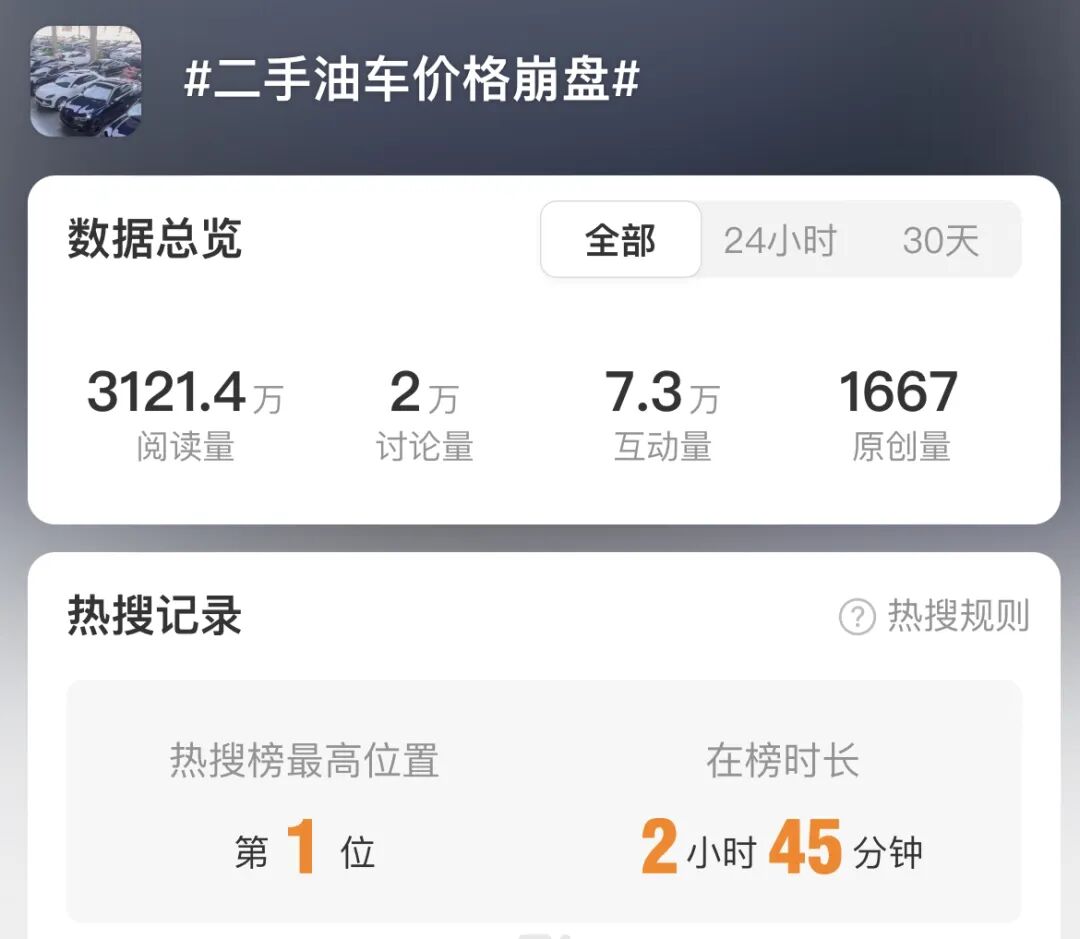
While some of this trending topic may be fueled by second-hand car dealers' schemes to buy low and sell high, the reality is that the second-hand prices of gasoline vehicles have indeed taken a nosedive.
Data reveals that in May alone, some used gasoline-powered vehicles saw a staggering price drop of nearly 10%, with certain models plummeting by 30,000 yuan in a single month. Models originally priced at 300,000 yuan are now typically selling for just 200,000 yuan.
Moreover, media reports indicate that a Hangzhou-based car dealership, which previously sold thirty to forty vehicles a month, experienced an 80% year-on-year sales volume decline in May, with "selling 10 vehicles resulting in a loss on 8".

Some car dealers have also noted that the second-hand prices of gasoline vehicles have dropped sharply this year, without any apparent reason or warning, and the extent of the drop is abnormal. The price decrease in one month is equivalent to the previous year's entire price drop, with a monthly decline of nearly 10%, and a 300,000-yuan car dropping by 20,000 to 30,000 yuan in a month.
The residual value rate system for luxury brands and mainstream joint-venture vehicles is undergoing a drastic reconstruction, with the three-year residual value rate of mainstream joint-venture gasoline vehicles dropping from 70% to below 50%.
Facing the aggressive onslaught of NEVs, new car prices in the gasoline vehicle market are also plummeting. A related topic recently trended on social media, revealing a brutal scene in the new car market for gasoline vehicles: "32 gasoline vehicle models have reduced prices this year."

This data comes not from some unofficial source or unprofessional statistics, but from Cui Dongshu, Secretary-General of the China Passenger Car Association.
Data shows that from January to May 2026, a total of 32 conventional gasoline vehicle models have reduced prices, an increase of 13 models compared to the same period last year.
In addition to the increase in models, the magnitude of the price reductions is even more alarming. In May this year, the average price of new conventional gasoline vehicle models that reduced prices was 166,000 yuan, with an average price reduction of 25,000 yuan, reaching a price reduction rate of 14.9%.
In this round of price reductions, luxury vehicles have seen promotional efforts reach a mid-to-high level of 25.2%.
Apart from these two trending topics, the topic of Honda, once the undisputed market leader, experiencing a year-on-year sales volume halving in China for two consecutive months also trended simultaneously. 
Data shows that Honda China's sales volume in May was 28,300 vehicles, a year-on-year decline approaching 50%; in April, Honda China's sales volume was 22,600 vehicles, also a year-on-year decline close to 50%.
Cumulative sales volume from January to May 2026: 173,344 vehicles, a year-on-year decline of 32.47%. Even once-revered models like the Accord and CR-V have seen their sales volumes halved in the past two months.
Furthermore, in the 2025 fiscal year (ending March 2026), Honda recorded a net loss of 423.9 billion yen (approximately 18.2 billion yuan), with its losses in the Chinese market (due to reduced sales, price wars, asset impairment, and idle production capacity) amounting to approximately 8-10 billion yuan, accounting for 27%-55% of its global losses.
Additionally, Toyota's sales volume is also not optimistic, with approximately 106,500 vehicles sold in April 2026, a year-on-year decline of 25.4%, and further declining to 102,300 vehicles in May, with the year-on-year decline expanding to 31.7%. 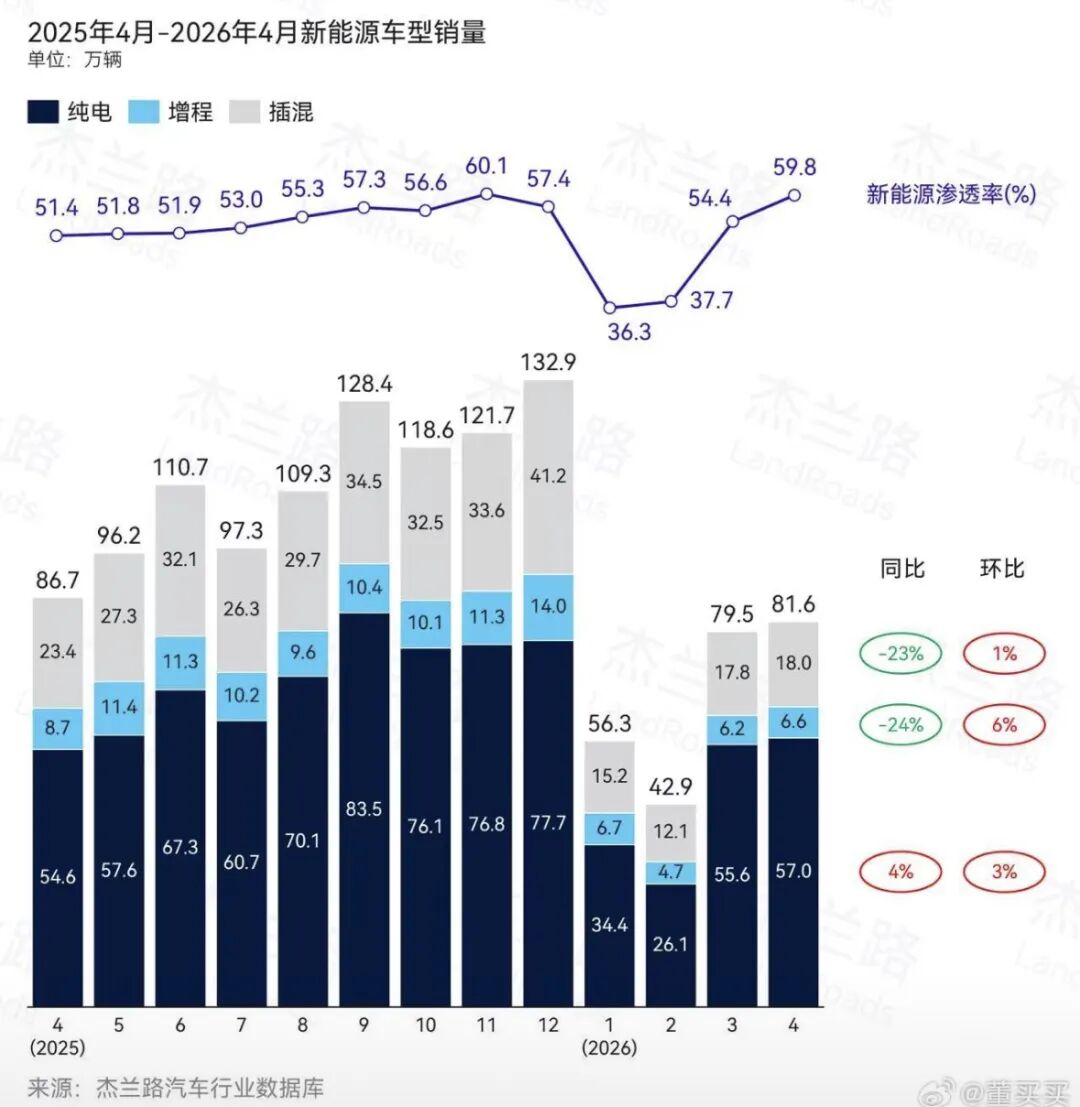
On the other hand, while gasoline-powered vehicles are wallowing in despair, the NEV market is thriving. Data shows that in April 2026, the retail penetration rate of NEV passenger vehicles in China broke through the 60% mark for the first time, reaching 61.4%, and further climbing to approximately 63% in May, marking NEVs as the absolute mainstream in the market.
Meanwhile, the topic of NEV price increases has also unexpectedly trended on social media—multiple NEV models have increased in price! 
Data reveals that recently, over 15 NEV companies have suddenly collectively raised their prices or covertly tightened purchase incentives.
Behind this round of price increases, on one hand, NEVs are gradually gaining the upper hand in the Chinese automotive market. On the other hand, it signifies that the competition in the Chinese automotive market has shifted from extensive "price competition" to "value competition" centered on technology and services.
Of course, more importantly, the war between NEVs and gasoline-powered vehicles is set to become even more brutal in the future...
-
![]()
73-Day Rapid Listing: Where Does Unitree's Wang Xingxing's 'Sense of Urgency' Come From?
-
![]()
AI Project Mindverse, Backed by Meituan, Faces Data Inflation Allegations Over Its Macaron Product
-
![]()
3000-word In-Depth Analysis | What Makes Physical AI So Magnetic? It Has Captivated Masayoshi Son, Jensen Huang, and Justin Sun All at Once
-
What Does LoRaWAN Plan to Do in the Next Three Years?
-
![]()
Can WeChat ‘Win Over the Bride’ from Doubao?
-
![]()
Transformation, Boarding, and Buying Tickets: Catching the Last Bus with a Leap
-
The Backside Knife Skills of vivo S60 and OPPO Reno16
-
![]()
Breaking News | Core Chip Team Member Unexpectedly Changes Jobs! OpenAI Transforms into Anthropic's Talent Hub, with Over 15 Ex-OpenAI Core Members Now Holding Key Roles at Anthropic