Auto Retailer Rankings: January-May 2026 - Geely Leads, BYD Follows
 06/11 2026
 540
540
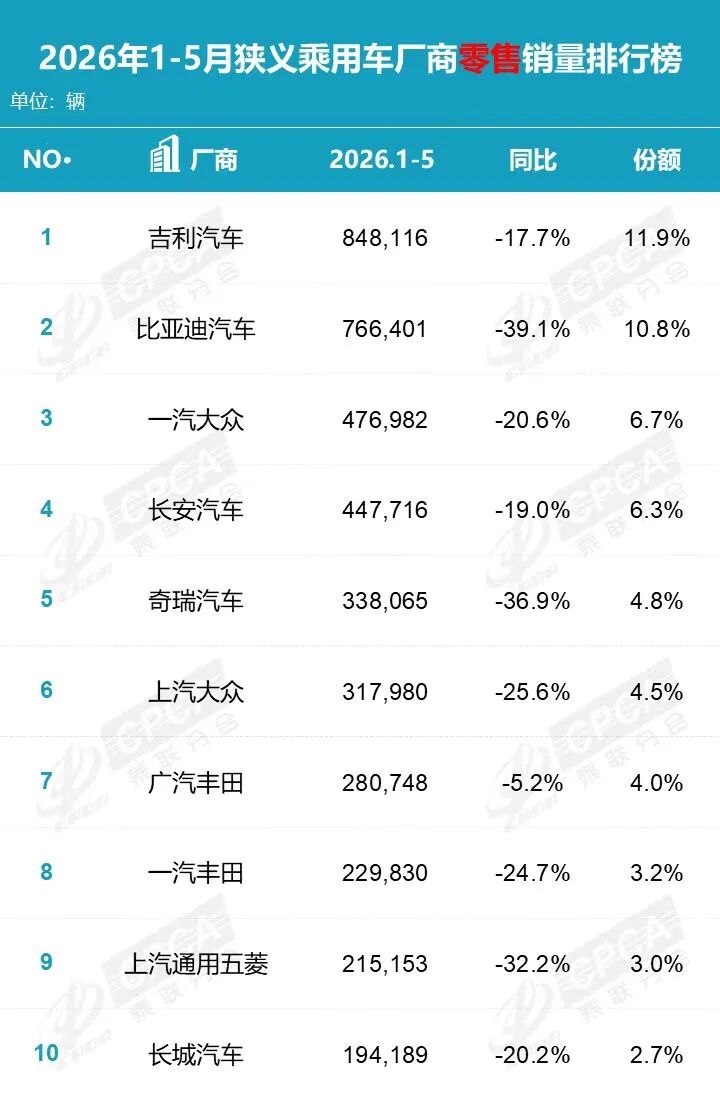
On June 9th, the auto retailer rankings for the period from January to May 2026 were unveiled, with Geely Auto maintaining its top position and BYD Auto securing a close second place. A notable divergence exists between joint-venture and independent automakers. Below, we present the detailed retail sales figures and market performance of the top ten automakers:
1st Place: Geely Auto
From January to May 2026, Geely Auto achieved a cumulative retail sales volume of 848,116 units, marking a 17.7% year-on-year decrease. With a market share of 11.9%, it claimed the top spot in the domestic auto retail rankings. Geely stands out as the sole automaker in the top ten to surpass 800,000 cumulative retail sales, showcasing a robust market foundation and a formidable competitive edge at the pinnacle, despite the overall industry downturn.
2nd Place: BYD Auto
During the same timeframe, BYD Auto recorded cumulative retail sales of 766,401 units, experiencing a significant 39.1% year-on-year decline. Its market share stood at 10.8%, placing it second on the list. As a former leader in independent auto sales, BYD witnessed a steep year-on-year drop among the top ten automakers, with its previous market growth advantages gradually diminishing and facing substantial sales pressure.
3rd Place: FAW-Volkswagen
From January to May, FAW-Volkswagen achieved cumulative retail sales of 476,982 units, down 20.6% year-on-year, with a market share of 6.7%. It maintained its lead among joint-venture automakers. Amidst strong positioning by independent automakers and overall industry weakness, FAW-Volkswagen still holds the top spot among joint-venture brands, acting as a core benchmark for German joint-venture brands.
4th Place: Changan Auto
Changan Auto recorded cumulative retail sales of 447,716 units, down 19.0% year-on-year, with a market share of 6.3%. It ranked fourth in the industry and fourth among independent automakers. As a leading independent automaker, Changan Auto's decline was moderate within the industry, with relatively stable overall sales performance.
5th Place: Chery Auto
Chery Auto achieved cumulative retail sales of 338,065 units, experiencing a significant 36.9% year-on-year drop, with a market share of 4.8%. It ranked fifth in the industry and fifth among independent automakers. Its decline was second only to BYD among the top ten automakers, making it one of the brands with the most significant sales decline among leading independent automakers, facing substantial market pressure.
6th Place: SAIC Volkswagen
From January to May, SAIC Volkswagen recorded cumulative retail sales of 317,980 units, down 25.6% year-on-year, with a market share of 4.5%. It ranked sixth on the list. Compared to FAW-Volkswagen, SAIC Volkswagen experienced a larger decline, with a clear differentiation between the two German Volkswagen brands, and overall market enthusiasm declining.
7th Place: GAC Toyota
GAC Toyota achieved cumulative retail sales of 280,748 units, down only 5.2% year-on-year, with a market share of 4.0%. It ranked seventh on the list. GAC Toyota is the brand with the smallest year-on-year decline among the top ten automakers, demonstrating exceptional resilience and market stability amidst the overall industry downturn, with its Japanese hybrid product lineup effectively safeguarding its core market foundation.
8th Place: FAW Toyota
From January to May, FAW Toyota recorded cumulative retail sales of 229,830 units, down 24.7% year-on-year, with a market share of 3.2%. It ranked eighth on the list. Compared to GAC Toyota, FAW Toyota's sales decline was significantly larger, with a clear differentiation in market performance between the two Japanese Toyota brands.
9th Place: SAIC-GM-Wuling
SAIC-GM-Wuling achieved cumulative retail sales of 215,153 units, down 32.2% year-on-year, with a market share of 3.0%. It ranked ninth on the list. The brand's overall sales decline was substantial, with weak demand for low-end passenger vehicles significantly impacting its performance.
10th Place: Great Wall Motors
From January to May, Great Wall Motors recorded cumulative retail sales of 194,189 units, down 20.2% year-on-year, with a market share of 2.7%. It ranked tenth on the list and at the bottom among leading independent automakers. Its sales decline was moderate within the industry, with a slight contraction in overall market share.
Key Market Observations
Firstly, the overall industry is cooling down, with persistent weak terminal consumption.
The domestic auto retail market experienced an overall downturn from January to May 2026, with all ten major automakers on the list showing year-on-year sales declines, and none achieving positive growth. This fully confirms the current market reality of weak terminal consumer demand and overall industry pressure.
Secondly, the independent auto sector is undergoing a major reshuffle, with a reconfiguration of the top rankings.
The competitive landscape among independent automakers has undergone significant changes. Geely Auto successfully topped the industry rankings with stable sales performance, becoming the biggest winner. Meanwhile, BYD, which previously held the top sales spot, experienced a rapid decline in growth dividends and a significant drop in sales, greatly reducing its leading advantage and completing a reconfiguration of the top tier among independent automakers. At the same time, traditional leading independent brands like Chery and Great Wall Motors all experienced significant declines to varying degrees, intensifying overall competitive pressure among independent brands.
Thirdly, joint-venture brands are polarizing, with Japanese brands showing far greater resilience than German ones.
The joint-venture camp is experiencing significant differentiation. German brands are generally lagging, with both FAW-Volkswagen and SAIC Volkswagen experiencing sales declines of over 20%, and their market competitiveness continuously declining. Japanese brands, on the other hand, have maintained their market foundation with the advantage of hybrid models, especially GAC Toyota, which leads the top ten with only a 5.2% decline, demonstrating strong market risk resistance and serving as a core support for the joint-venture camp.
-
![]()
Why Do All Cars Look Alike These Days?
-
Don't Just Focus on Financing Amounts—Look at the 'Order Truth' Behind the Commercialization of Embodied AI
-
![]()
Are Traditional Fuel Cars Really Losing Their Market?
-
![]()
Comprehensive PPT Guide to Understanding CAAM Production and Sales Data: Auto Production and Sales Declines Narrow Again in May; New Energy Vehicle Market Share and Auto Exports Reach New Monthly High
-
![]()
Chinese Cars Seize Overseas Markets: The Advent of a Winner-Takes-All Era
-
![]()
Will WeChat Start Charging Fees?
-
![]()
Cross-border 'Golden Window' in 2026: Chinese Products Sweep Across Southeast Asia
-
![]()
BIWIN Storage, Betting 20 Billion on the Future with Hundreds of Billions in Market Cap