10 Volkswagen Models Face 'Tire Cracking' Complaints; Tests Show Tires Meet National Standards, Volkswagen Says Detailed Causes Require In-Store Checks
 06/12 2026
 339
339
Ten Volkswagen models have become the center of a controversy due to complaints about 'tire cracking.' The test results of the tire samples sent for inspection show that they meet national standards, and the cracks do not compromise the basic driving safety of the tires.
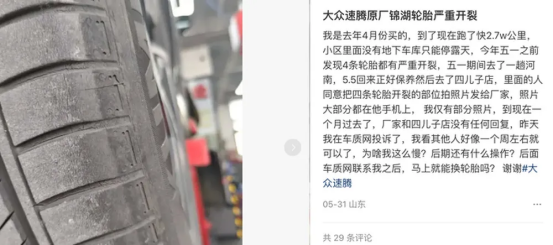
Recently, according to New Huang He, a Volkswagen Sagitar owner in Shandong posted a complaint on social media. The owner reported that the original factory-fitted tires exhibited significant surface cracking after just one year of use and 27,000 kilometers driven. Despite reporting the issue to the 4S dealership a month ago, the owner has yet to receive a clear resolution.
Publicly available information reveals that the Volkswagen Sagitar is an A+ class compact sedan produced by FAW-Volkswagen. It is known for its German manufacturing standards and quality, catering to family travel needs and the driving pleasure sought by young customers.
Regarding the tire cracking issue, the official customer service of FAW-Volkswagen informed the New Knowledge Research Institute that they are not yet fully aware of the situation. They explained that numerous factors can contribute to tire cracking, including bumps, sudden braking, uneven vehicle load, and tire pressure. To determine the specific cause of the tire cracks, an in-store inspection is necessary.
As for after-sales service for tire cracking, FAW-Volkswagen customer service stated that the normal tire warranty period is six months or 10,000 kilometers (whichever comes first, based on the car's mileage). If a quality issue is identified during the warranty period and meets the specified criteria, a claim can be filed.
In response to the same tire cracking issue, SAIC Volkswagen's official customer service told the New Knowledge Research Institute that all SAIC Volkswagen models currently use summer tires. When driven in low winter temperatures, these tires are prone to developing superficial surface cracks. However, these cracks typically diminish as the temperature rises and friction decreases. Many users may mistakenly perceive these cracks as a tire quality issue, but in reality, they do not affect the basic properties of the tires or pose a risk to driving safety.
If after-sales service is required, SAIC Volkswagen customer service also stated that warranty coverage applies within six months or 10,000 kilometers.
Such cases are not isolated incidents. According to passenger car complaint data released by CheZhi.com for May 2026, among the top 30 models ranked by complaint volume that month, 10 were from brands under the Volkswagen Group, including FAW-Volkswagen, SAIC Volkswagen, and FAW-Audi.
Among these, the Passat ranked second overall with 198 complaints, while models such as the Sagitar, Tayron, Magotan, Bora, Tiguan L, Tharu, Lavida, T-ROC Explore Song, and Audi A4L also made the list.
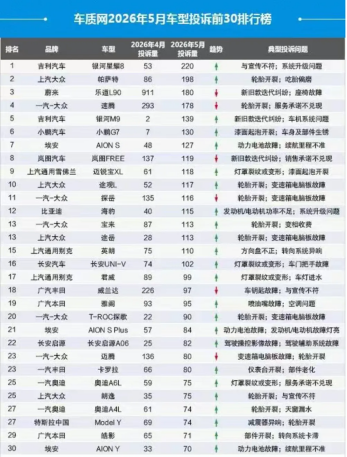
Analyzing the overall situation, in March of this year, only five models—the Sagitar, Magotan, Tayron, Bora, and Audi A4L—were among the top 30 on CheZhi.com's complaint list due to tire cracking. Complaints continued to rise in April, with the Sagitar receiving 293 complaints and ranking second, the Passat making its debut on the list, and models such as the Tayron and Magotan each surpassing 100 complaints. By May, the issue had further escalated, with models like the Tiguan L, Tharu, and Lavida also featuring prominently in the complaints.
From five models in March to six in April, and then to ten in May, the same issue persisted across multiple brands and model platforms within a single quarter.
In response to the growing number of complaints, CheZhi.com released a special inspection report on May 30. The report revealed that the testing agency selected six sample tires from faulty tires provided by owners. All samples were from Hankook and Kumho brands, with manufacturing dates within the past four years and mileage ranging from approximately 30,000 to 36,000 kilometers, showing significant surface cracks.
The testing was conducted by the Qingdao Product Quality Supervision and Inspection Research Institute, adhering to the GB/T4502-2023 national standard. It included endurance performance, low-pressure performance, and high-speed performance tests. After a cumulative 34-hour endurance test, a 90-minute low-pressure test, and an extreme speed test of up to 270 kilometers per hour, none of the samples exhibited structural issues such as delamination, bulging, rupture, or air leakage, and the original cracks did not further expand.
Experts from the testing center at the Beijing Rubber Industry Research and Design Institute stated that the quality of the tires inspected in this case meets national standard requirements. The cracks primarily appeared in the surface rubber and did not damage the internal load-bearing structure of the tire, thus not affecting normal service life or basic driving safety.
-
![]()
Insta360 Leads Global Market, Yet Profit Signals Remain Subdued
-
Marketing and Transaction Growth: Entering the Age of the Agent
-
![]()
Dongfeng’s Solid-State Batteries Set for Mass Production and Vehicle Integration in H2 2026
-
Marketing and Transaction Growth: Entering the Age of Agent
-
![]()
Stock Prices Hit Rock Bottom & Regulatory Interviews Raise Dual Alarms in Auto Industry
-
![]()
Can the Hongqi G919 Surmount the Challenge Posed by the Mengshi 917?
-
![]()
AI Gaokao Evaluations Plagued by Chaos: Full Marks Awarded for Incomplete Questions
-
![]()
For Two Straight Months, No BBA Model Has Exceeded 10,000 Monthly Sales in the Chinese Market