Chang'an and BAIC Enter into a ‘Partnership Without Formal Ties’ Alliance, Charting a New Course for Collaborative Vehicle Manufacturing Among Chinese Automakers
 06/22 2026
 513
513
By AUTO Core Ball
Over the past three years, the Chinese automotive industry has developed a significant reliance on Huawei’s technological advancements.
Whenever the topic of “collaborative vehicle manufacturing” arises, Huawei’s HiCar or HI mode is often the first thing that comes to mind. From Seres’s remarkable resurgence to the eager participation of Chery, BAIC, and JAC, it’s clear that the paradigm where “tech companies define the intelligence and automakers handle the manufacturing” has become the industry’s de facto standard, largely due to its proven market success.
However, just as everyone thought the path was set in stone, two major players with annual sales in the millions sought to carve out a different route to success.
On June 13, BAIC Group and Chang'an Automobile signed a seemingly routine strategic cooperation agreement in Beijing. Just five days later, Chang'an unveiled more groundbreaking details at its Investor Relations Day: The two sides will jointly develop new vehicles and construct an intelligent driving platform, with the depth of cooperation reaching “the highest level short of a corporate merger.”
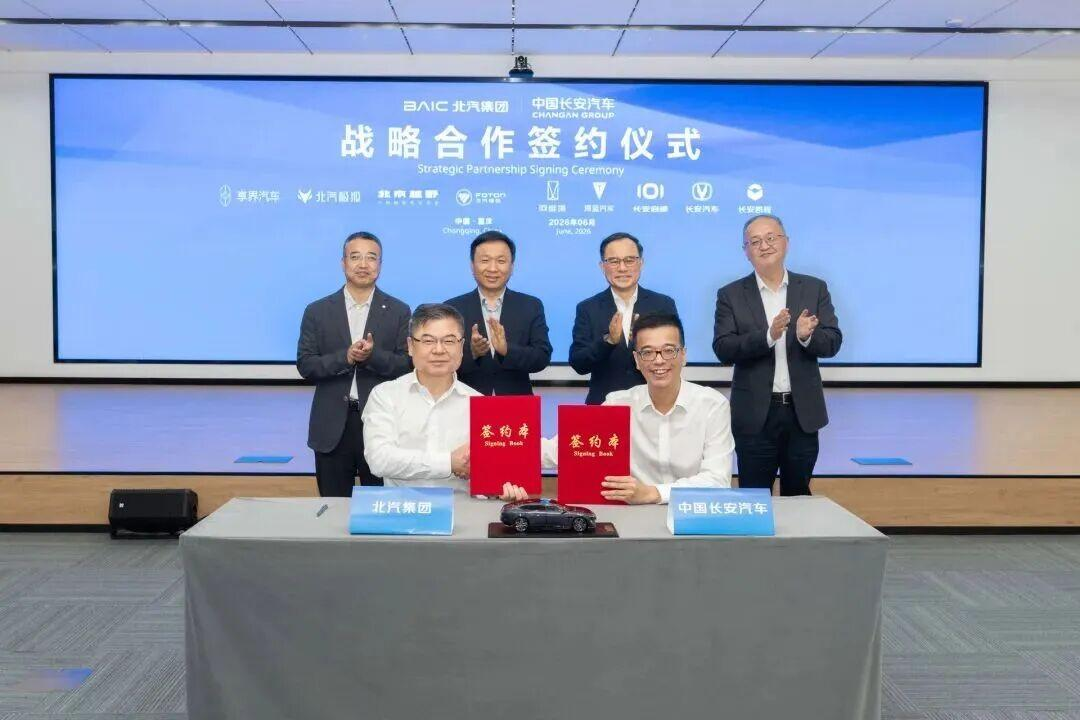
This agreement, which involves no equity swaps or asset mergers, addressed a question the industry had never seriously pondered: What new possibilities could arise if two equally powerful automotive giants collaborated without seeking to merge or empower one another?
Post-Changfeng Restructuring Failure: State-Owned Enterprises Learn a Valuable Lesson
Four months ago, the automotive community was still mourning the collapse of the ‘Changfeng restructuring’.
In February 2025, Chang'an and Dongfeng, two major central state-owned enterprises, initiated merger talks, an event once seen as a landmark for the integration of China’s automotive ‘national team’. Everyone was doing the math: A combined annual sales volume of nearly 5 million units would instantly catapult the merged entity past BYD to become China’s largest automaker.
But this seemingly perfect equation ultimately faltered due to practical execution challenges.
Market overlap was too high, distribution channels were too entangled, management systems were incompatible, and negotiations over power and responsibility allocation failed. Traditional ‘forced marriage’ equity mergers, which essentially use administrative means to solve market problems, often result in 1+1 < 2. While scale increased, responsiveness slowed, and internal friction costs rose.
Chang'an took four months to realize a crucial truth: Strong-strong alliances don’t necessarily require physical consolidation.
So, they turned to BAIC. This time, they completely abandoned the obsession with ‘getting married’ and opted for a more pragmatic ‘living together’ approach.
Without equity swaps or asset mergers, both sides maintained independent legal status and complete brand systems, not even needing to relocate their headquarters. However, in the most costly and time-consuming areas—R&D, procurement, manufacturing, and overseas expansion—they chose to trust each other.
This ‘non-equity, asset-light synergy’ model may sound like a fallback option, but it represents a breakthrough path finally discovered by China’s state-owned automakers after countless failed attempts.
Survival Pressures Drive Innovation in Collaboration
To understand the Chang'an-BAIC collaboration, one must first recognize the harsh realities of China’s automotive industry in 2026—this is no longer about earning more or less, but about survival itself.
Industry-wide profit margins plummeted to a staggering 3.2% in the first quarter, with the average net profit per vehicle barely exceeding 10,000 RMB.
What does that mean? The profit from selling one car isn’t enough to buy the latest iPhone.
Against this backdrop, Chang'an and BAIC face their own survival pressures. When profit margins are razor-thin, any unnecessary redundant investment becomes suicidal.
Chang'an has already taken the lead in cutting costs: Over the next five years, its model lineup will shrink from 63 to 36, a 43% reduction, aiming to create six major models each selling over 300,000 units annually. This means many products already in development or even finalized will be ruthlessly scrapped. BAIC is likely to become the recipient of these canceled models—one of the core logics behind their ‘joint new vehicle development’.
Joint procurement offers the most straightforward benefits. Two million-unit-scale enterprises negotiating together with suppliers, whether for power batteries or automotive-grade chips, doubles their bargaining power. Every penny saved goes straight to the bottom line.
Capacity sharing is even more practical. No automaker dares claim its production capacity is always fully utilized—underutilization during off-peaks and shortages during peaks are industry-wide issues. By adjusting production rhythms in welding, painting, and final assembly, they can achieve tens of thousands of units in flexible capacity without investing billions in new factories.
Of course, what truly elevates this collaboration is the ‘north-south convergence’ in intelligent driving, with depth far exceeding initial expectations.
Few know that currently, only two automakers in China have obtained the Ministry of Industry and Information Technology’s L3 autonomous driving production approval—Chang'an and BAIC. Chang'an’s Deepal SL03 has spent three years navigating Chongqing’s hilly terrain, mastering urban congestion scenarios; BAIC’s Arcfox Alpha S has logged millions of kilometers on Beijing’s highways, boasting a hardware advantage with three LiDAR sensors.
One excels in ‘urban street fighting,’ the other in ‘highway blitzes.’ Previously, both invested billions to collect data the other already possessed. Now, they’re not just sharing data but building a unified intelligent driving platform.
At its Investor Relations Day, Chang'an disclosed details of its self-developed ‘Tianshu Pilot’ intelligent driving system for the first time: The Pro version comes standard with LiDAR, identifying obstacles 2 seconds before human eyes in low-light conditions; the Max version, trained on over 20 million high-quality human driving data points, handles complex commuting scenarios with ease; the Ultra version incorporates a VLM visual-language large model, enabling interactive assisted driving.
Collaboration with BAIC gives Chang'an an opportunity to turn ‘Tianshu Pilot’ into another ‘Qiankun Intelligent Driving.’ Huawei successfully pivoted from ‘whole-vehicle cooperation’ to ‘technology supplier’ through Qiankun Intelligent Driving; Chang'an hopes to explore a path for exporting its intelligent driving technology through deep binding with BAIC. This means Chang'an’s intelligent driving system may not only equip its own vehicles but also become standard for other state-owned automakers.
This is Chang'an’s true ambition—to drive Huawei-style innovation across the industry through direct automaker collaboration, offering a viable alternative force.
Big Automaker Collaborations Follow Objective Laws, Even Huawei Can’t Defy Them
The significance of the Chang'an-BAIC alliance lies not in what they’re collaborating on but in proving to the industry that the Huawei model isn’t the only answer.
Over the past three years, Huawei has indeed proven the ‘tech giant empowers traditional automaker’ path. But this path has an unavoidable premise: The roles of the partners are inherently unequal.
Huawei holds the core power to define products, while automakers primarily handle manufacturing and supply chains. This model serves as a lifeline for smaller automakers lagging in the intelligent era. However, for million-unit-scale leading automakers, there’s always an insurmountable red line.
No true automotive giant wants to play a supporting role (despite verbal commitments to ‘mutually respectful cooperation’).
This is why when Huawei’s cooperation deepened with major automakers like GAC and SAIC, the original ‘components/Hi/Harmony Intelligent Mobility’ three-tier approach became insufficient. Huawei’s Qiankun Intelligent Driving collaboration with GAC is no longer simple technology output but a deep symbiotic model of joint investment, development, and shared benefits.
You’ll notice this model shares the same essence as Chang'an-BAIC’s asset-light synergy.

The dignity of big automakers may seem intangible, but more importantly, they operate under objective development laws.
They possess complete R&D, supply chain, and brand systems and don’t need others to teach them how to build cars. What they lack isn’t technology itself but the scale effect to amortize R&D costs. When a single enterprise’s investment can no longer support intelligent-era R&D expenses, equitable cooperation, complementary strengths, and cost-sharing become inevitable choices.
Thus, China’s automotive industry cooperation landscape has clearly split into two routes:
1. The Huawei Route: Tech giants empower smaller automakers, suitable for players lagging in intelligent transformation.
2. The Chang'an-BAIC Route: Leading automakers form equitable alliances, suitable for giants with core capabilities but needing cost-sharing (including collaborations like Huawei’s Qiankun Intelligent Driving with GAC).
Neither route is superior; they simply suit different players. What’s certain is that China’s automotive market won’t be dominated by a single player in the future.
Chemical Reactions Without Altering Property Rights
Of course, Chang'an-BAIC’s asset-light synergy model isn’t without concerns. As cooperation deepens, the real tests are just beginning.
This collaboration spans far beyond initial expectations, covering logistics synergy, overseas market sharing, joint layout in emerging industries (Robotaxi, unmanned delivery), and green carbon cooperation. Among these, vehicle and platform synergy, joint new vehicle development, and building an intelligent driving platform are the three toughest challenges.
Differences in decision-making processes, assessment mechanisms, and corporate cultures between central and local state-owned enterprises are objective realities. How to establish efficient collaborative execution mechanisms? How to allocate benefits? Define responsibilities? The current agreement remains framework-level. More importantly, securing market-recognized products is the key to determining this alliance’s success.
Even so, this collaboration deserves a place in the case library of state-owned enterprise reform methodologies.
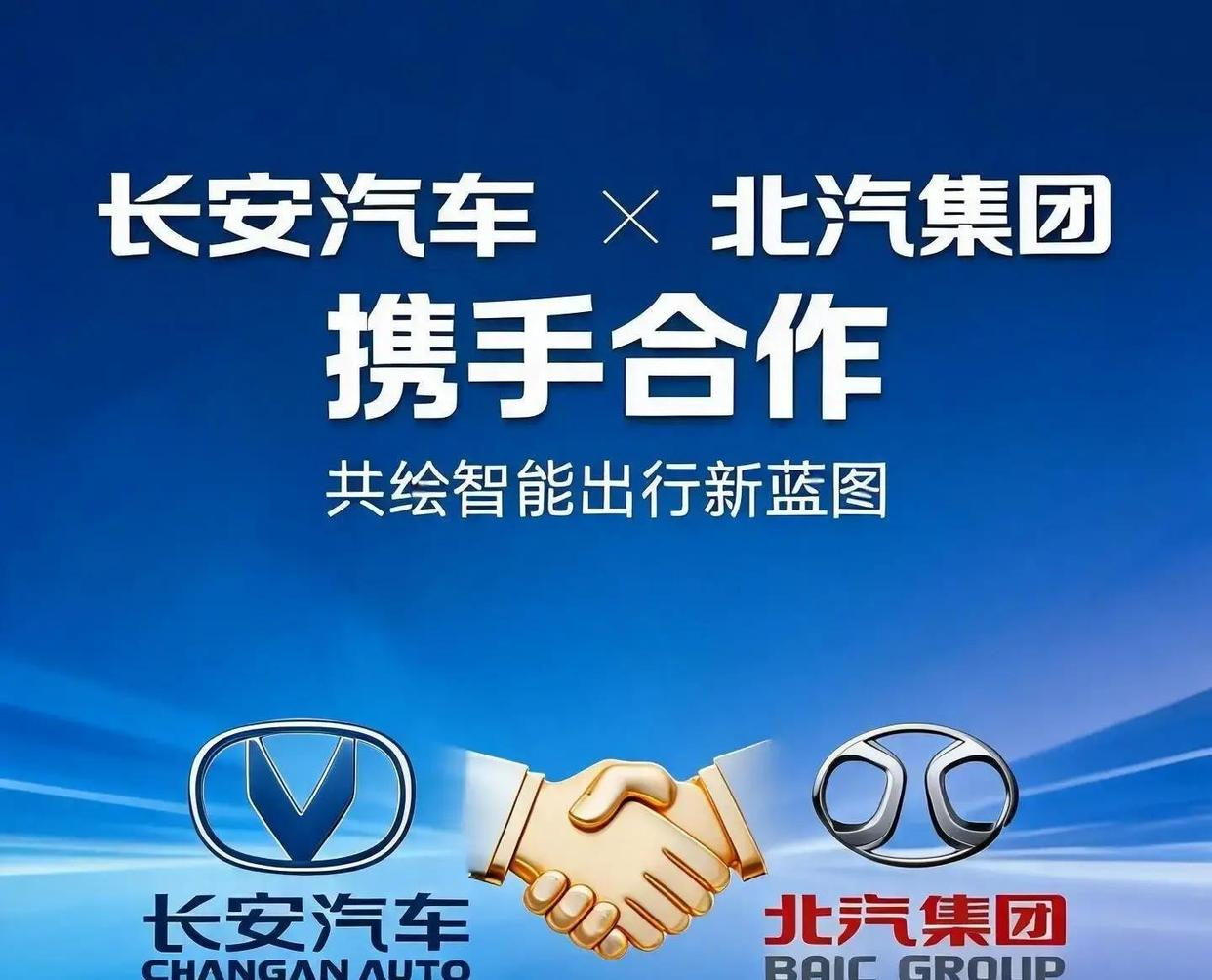
For decades, the default approach to state-owned enterprise reform has been ‘merge to grow,’ assuming scale solves all problems. But countless practices prove that simple scale superposition often leads to greater management challenges. The failure of Chang'an-Dongfeng’s ‘Changfeng restructuring’ is the best proof that this path has reached its limits.
Chang'an and BAIC’s attempt has opened a new path for collaboration among state-owned automakers. Without altering property rights or restructuring organizational systems, they achieve deep integration in key value chain areas like R&D, procurement, manufacturing, and overseas expansion. This flexible structure—‘advancing together in synergy, retreating to operate independently’—preserves market competition vitality while unlocking systemic dividends from scaled collaboration.
It answers a long-unsolved question in state-owned enterprise reform: How to achieve optimal resource allocation and efficient capability complementarity without touching institutional barriers.
Epilogue
Years later, when we look back at the summer of 2026, we may realize that Chang'an and BAIC’s handshake marked a turning point for China’s automotive industry.
Before this, the industry logic was ‘winner takes all,’ with everyone striving to grow and eliminate competitors. After this, the logic shifted to ‘competitive cooperation and symbiosis,’ where even the strongest players need partners.
The Huawei model taught Chinese automakers what intelligent vehicles are, while the Chang'an-BAIC model taught them what a mature industrial ecosystem looks like. This central-local collaborative experiment born in Beijing has now waded into deep waters. Its success or failure will not only determine the fates of Chang'an and BAIC but also illuminate a new path for the entire Chinese automotive industry’s future.
*All images in this article are sourced from the internet.
Focusing on intelligent vehicles to empower critical decisions.
-
![]()
Insta360’s Post-Lockup Period Begins: Employees Suspected of Selling Shares, Institutions Biding Their Time—Is a Major Storm on the Horizon?
-
![]()
Are Houses Getting 'ID Cards' Now? In the Future, House Decorating, Renting, and Buying Will All Be Possible with a Simple Scan!
-
![]()
Where Should the Senior Citizens in County Towns Go?
-
![]()
【OFweek Weike Cup】Santec Officially Enters for the 2026 Optical Industry Annual Innovation Product Award
-
![]()
Anhui’s Taihu County Establishes a Project with an Impressive Annual Production Capacity of 850 Million Square Meters of Optical Film, Along with Supporting Rollers!
-
![]()
The AI Unicorn Valued at 960 Billion is Raising Funds Again
-
![]()
Unveiling the Strategy: The RMB 11.5 Million Deal of MLOptics
-
![]()
Qingtian Lease Hits 7 Billion Valuation in Six Months, Coexistence of Robot Leasing Bubble and Reality