Volkswagen Starts Operating at a Production Capacity of 9 Million Vehicles
 06/22 2026
 549
549
At this year's shareholder meeting, Volkswagen laid its cards on the table.
In 2025, it sold approximately 9 million vehicles, generating €322 billion in revenue and €8.9 billion in operating profit, with a profit margin of just 2.8%. Special items and U.S. tariffs impacted earnings by nearly €9 billion.
Vehicles are still selling, but profits are no longer as easy to come by.
This is why Volkswagen CEO Blume emphasized workforce and production capacity reductions the most at the shareholder meeting, with new vehicle launches taking a backseat. 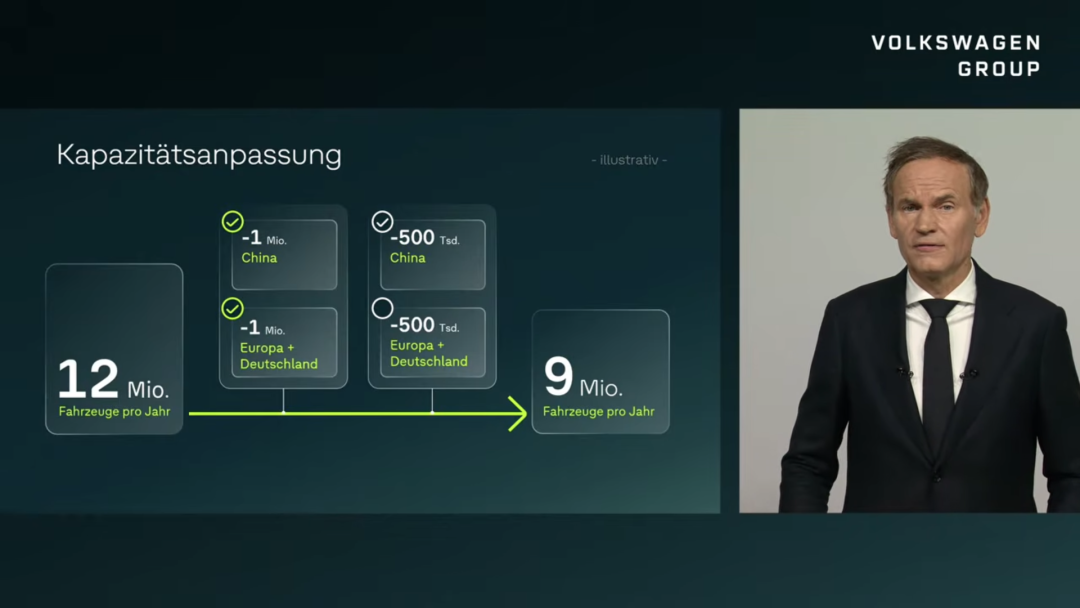
Our starting point was a global production capacity based on an annual 12 million vehicles planned prior to the pandemic and a planning founded on much more optimistic assumptions at the time. Today we believe a figure in the order of 9 million is more realistic and this is the average achieved over the past 5 years.
Our starting point was a global production capacity based on an annual 12 million vehicles planned before the pandemic, along with planning founded on much more optimistic assumptions at the time. Today, we believe a figure around 9 million vehicles is more realistic, which also aligns with the average output over the past five years.
Volkswagen Group's 66th Shareholder Meeting: CEO Blume's Speech Highlights
The 12-Million-Vehicle Capacity Can No Longer Be Sustained
Before the pandemic, Volkswagen Group configured its factories for an annual global production of 12 million vehicles. Looking back now, this capacity was overestimated.
Over the past five years, Volkswagen's average sales have been around 9 million vehicles, second only to Toyota's 10 million-unit level. This leaves a 3-million-unit gap between its capacity and actual sales, meaning a significant portion of its factories, equipment, and workforce remained underutilized, yet still incurred costs.
Volkswagen no longer assumes sales will eventually return to 12 million units. Blume has set a new benchmark of 9 million units. The priority is to streamline the company to this scale before focusing on profits. Over the past two years, Volkswagen has already cut approximately 2 million units of capacity in Europe and China, with six vehicle assembly plants ceasing operations.
The latest production plan for Osnabrück reveals operations will continue until next year, with no further plans announced afterward. How to proceed is still under discussion. And this is not the end.
According to information from the shareholder meeting, Volkswagen Group plans to further reduce capacity by 500,000 units in China, with similar-scale adjustments expected in Europe and Germany.
China: Launching New Models While Cutting Capacity and Exploring Exports
By the end of 2027, Volkswagen plans to introduce around 30 new models in China. Simultaneously, it aims to reduce production capacity by 500,000 units. Viewed together, the logic is straightforward.
Volkswagen intends to use fewer factories and production lines to accommodate its upcoming batch of battery electric, plug-in hybrid, and extended-range electric vehicles. If existing production lines have low utilization rates or prohibitively high conversion costs, retaining them would only continue to dilute profits.
Volkswagen also disclosed two key figures for China: a 30% reduction in vehicle development cycles and up to a 50% decrease in material costs. While R&D and procurement are already saving money, production must follow suit; otherwise, the savings would be offset by idle factory costs.
As for which entities will implement the 500,000-unit reduction—whether it's FAW-Volkswagen, SAIC Volkswagen, or Volkswagen Anhui, or whether it involves factory closures, production line suspensions, reduced shifts, or repurposing old lines for new energy vehicles—no answers have been provided yet.
At this stage, only the total reduction volume is confirmed, not the specific factory list. However, a turning point for the Chinese market is that Volkswagen plans to export capacity from China to Southeast Asia, Australia, India, the Middle East, Africa, or South America. 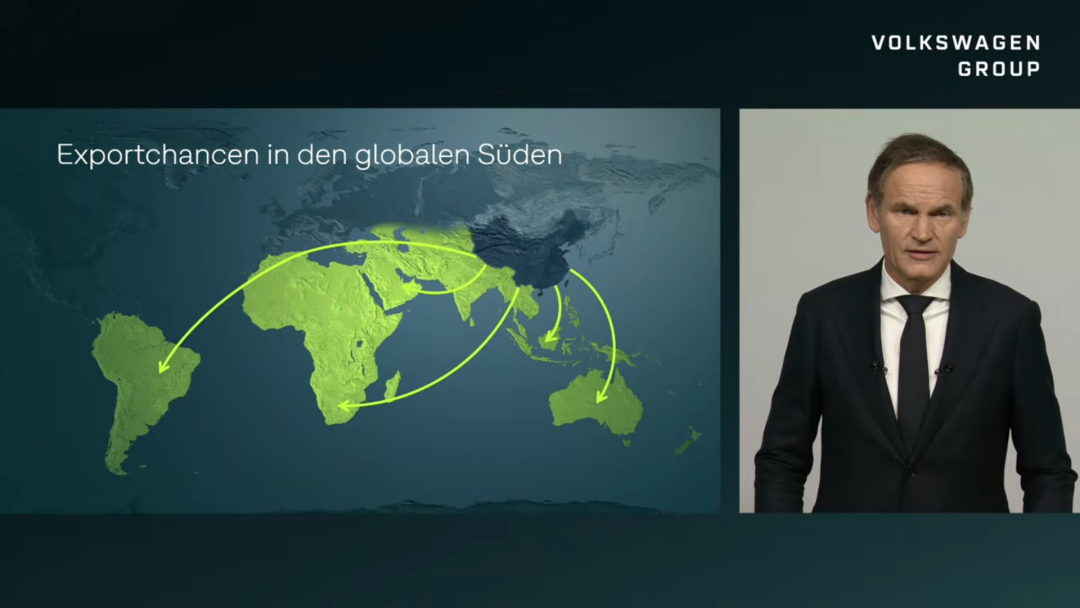
And at the same time, we have created new prospects with our Chinese models.
In other words, export opportunities in the global south and market segments that were previously not accessible due to the structure of our costs and our product offerings such as Southeast Asia, Australia, India, the Middle East, Africa or South America.
"Meanwhile, our Chinese business model has also created new commercial prospects. In other words, this opens up export opportunities in the 'Global South' and market segments previously inaccessible due to our cost structures and product offerings, such as Southeast Asia, Australia, India, the Middle East, Africa, or South America."
Volkswagen Group's 66th Shareholder Meeting: CEO Blume's Speech Highlights
Germany to Lose 50,000 Jobs
The workforce adjustments are more straightforward.
Volkswagen, Audi, Porsche, and CARIAD plan to reduce approximately 50,000 jobs in Germany by 2030.
Focusing solely on Volkswagen AG, including Sachsen and Osnabrück, 19,000 positions will be cut by the end of 2026.
Over 28,000 separation agreements have already been signed as part of the 2030 workforce adjustment plan. These measures are already reflecting in cost reductions. In 2025, Volkswagen's German factories reduced costs by over 20%. Wage and workforce measures have delivered sustained cost savings of approximately €1 billion.
By 2030, Volkswagen aims to achieve annual net savings of €6 billion in personnel-related costs. In 2025, the group's operating profit was €8.9 billion, meaning the €6 billion target represents two-thirds of that figure. Of course, savings targets cannot be directly equated with new profit gains, as some will be offset by tariffs, price wars, and transformation investments.
However, this comparison underscores that Volkswagen is now targeting its cost base. The priority is to make selling 9 million vehicles more profitable. Volkswagen has set a 2030 profit margin target of 8%-10%, up from just 2.8% in 2025.
Sales volumes may not recover, and price wars won't end on their own. All Volkswagen can do is reduce its workforce and factory footprint—originally sized for 12 million units—to a sustainable level for 9 million units.
Key figures to remember from this round of adjustments: 50,000 job reductions in Germany; 2 million units of capacity cut in Europe and China over the past two years; an additional 500,000-unit reduction in China; and €6 billion in annual net personnel cost savings by 2030. The success of Volkswagen Group's measures will hinge on whether these figures translate into improved profitability in future financial statements.
The automotive industry appears to be entering an era where 'the West may dim, but the East shines bright.'
*Unauthorized reproduction or excerpting is strictly prohibited.-
-
![]()
Industry Insights | Electronic Fabric Prices Double, Fueled by AI Demand as a ‘Critical Resource’
-
![]()
Surging by 2000%, Market Value Breaks Through Trillion Yuan! Behind the Glory of AI 'Leader'
-
![]()
Tianfu Communication Shortlisted for 2026 Optics Industry Outstanding Component Supplier Award
-
![]()
【OFweek Weike Cup】Fair Optics Submits Application for 2026 Optical Industry High-Growth Enterprise Award
-
![]()
【OFweek Weike Cup】Fair Optics Officially Nominated for 2026 Outstanding Contribution Award in Optical Industry Application Solutions
-
![]()
The Competitive Landscape of Financial AI Agents in the 'Long Tail' Market: FinTech Subsidiaries, Financial Leasing, Consumer Finance, AMCs, and Other Players Making Quiet Strides
-
![]()
【OFweek Weike Cup】Fair Optical Officially Enters for the 2026 Optical Industry Annual Innovation Product Award
-
![]()
【OFweek Weike Cup】Wuhan Changjin Photonics Nominated for 2026 Optics Industry Outstanding Component Supplier