Fresh Air in Healthy Cabins Starts with a CO2 Sensor
 06/29 2026
 533
533
The arms race in automotive intelligent cabins has reached pixel-level precision: competing for larger screens, higher-quality sound systems, and more comfortable seating. Yet, the "air we breathe" has been overlooked—in this third space where we spend two hours or more daily, is the air truly fresh and safe?
CO2: An Invisible Safety Hazard
In a tightly sealed cabin, CO2 levels rise silently. Unlike PM2.5, which creates visible haze, or unpleasant odors that are immediately detectable by the nose, CO2 is colorless, odorless, and non-irritating, making it undetectable by any of the senses. Its presence is only felt through its effects: dizziness, drowsiness, and slower reactions, which only manifest once concentrations have already surpassed safe thresholds. Therefore, real-time CO2 monitoring is essential for maintaining fresh air in the cabin and ensuring timely ventilation.

International standards from the WHO and ASHRAE, as well as China's Indoor Air Quality Standard (GB/T 18883), set a clear safety threshold of 1000ppm for CO2 concentrations in enclosed spaces. Higher concentrations pose increasingly severe risks. Authorities have set 5000ppm as the 8-hour work exposure limit; exceeding this threshold can cause difficulty breathing and disorientation, directly threatening driving safety.
CO2 Levels Rise Faster Than You Think
Normal atmospheric and bodily CO2 concentrations pose no health risks. However, automotive cabins are highly sealed; with windows closed and the internal circulation on, the cabin becomes nearly airtight. Occupants continuously exhale CO2, and without fresh air replacement, waste gases accumulate—causing cabin CO2 levels to quickly surpass safe thresholds. This gradually impairs the driver's nervous system and judgment, with the rate of increase accelerating with more occupants and longer durations.
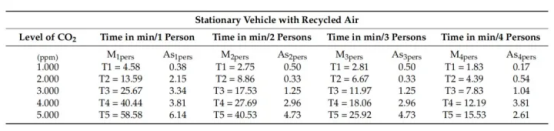
Real-world test data from the MDPI journal Sustainability shows that in stationary vehicles with the air conditioning on internal circulation mode, cabin CO2 concentrations rise significantly: reaching 5000ppm (the OSHA 8-hour exposure limit) in as little as 56 minutes for a single occupant and just 13 minutes for four occupants.

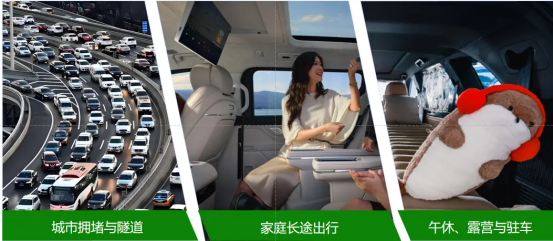
Typical Scenarios of High CO2 Concentrations
⒈Urban Congestion and Tunnels
When vehicles are stuck in traffic or passing through tunnels, internal circulation blocks external pollutants but also traps CO2, which rises with occupant respiration.
⒉Family Road Trips
During family trips, cabin CO2 levels rise much faster, especially since children and the elderly have a more urgent need for fresh air. The system must consider more than just external pollution. Data shows that with four occupants, CO2 levels can reach 1500ppm in just 7 minutes on internal circulation.
⒊Lunch Breaks, Camping, and Parking
New energy vehicles allow cabins to serve as temporary resting spaces. The longer the dwell time (duration of stay), the more attention must be paid to the safety risks of rising CO2 levels.
Automotive-Grade CO2 Sensors: From Passive Endurance to Active Management
Without CO2 sensors, automotive HVAC systems operate in "blind adjustment" mode, estimating fresh air needs based on preset values. However, these estimates rarely hold true in real-world driving scenarios: the Air conditioning load (air conditioning load) and CO2 rise and fresh air needs differ greatly between a full car of children heading to school and a solo driver returning home after an all-night shift.
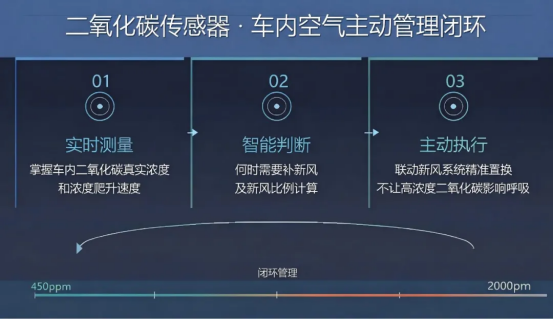
The application of automotive CO2 sensors enables a closed-loop system for active management: real-time measurement → tracking actual cabin CO2 levels and rise rates; intelligent judgment → determining when fresh air is needed and in what proportion; active execution → precisely controlling the fresh air system to prevent high CO2 levels from affecting passenger air quality.
Cubic Sensor and Instrument Co., Ltd.: Making Cabins Truly "Breathable"
Cubic's automotive-grade CO2 sensors provide real-time monitoring of cabin CO2 levels, automatically issuing alerts when thresholds are exceeded and precisely controlling the fresh air system for air replacement. The product line supports single/dual light sources, fan-based, and multi-module integrated solutions, building a healthy air barrier for the cabin.
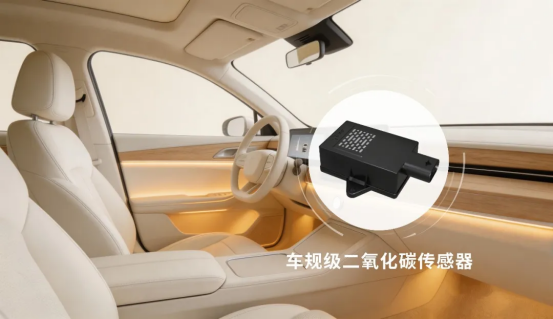
▲Supports automatic matrix measurement and full-temperature range calibration, meeting automotive-grade requirements for high precision and long-term stability, with no maintenance needed throughout the lifecycle.
▲Features fast response times, no cross-interference, controlled costs, and long service life, building a healthy air barrier for the cabin.
Future in-cabin air management will shift from simple "internal/external circulation" buttons to multi-dimensional fresh air ratio control: PM2.5 and AQS sensors assess whether external air is suitable for entry, CO2 levels indicate whether fresh air inside the cabin is insufficient, and the automotive HVAC system makes comprehensive decisions on circulation ratios, airflow volumes, and filtration strategies.
For automotive cabins, CO2 sensors are not just an added luxury but a crucial piece in the puzzle of transitioning from functional stacking to a closed-loop experience for healthy and intelligent cabins.
-
![]()
Kunlunxin’s IPO: Baidu’s Strategic Move to Forge Alliances
-
![]()
AI Gives Volcano Engine a Chance to 'Change the Table'
-
![]()
AI Gives Volcano Engine a Chance to 'Change the Table'
-
![]()
A Smart Parking IPO Emerges in Xiamen with a 204% Surge on the First Day of Listing
-
![]()
Alibaba Exits Gaming Industry: A Strategic Move Forward?
-
![]()
New Car Model Faces Unprecedented Negative Campaign; Leapmotor Navigates Through Challenges Amid Profitability Concerns
-
![]()
Overnight Vanishing Act: 1.8 Trillion Gone! Silicon Giants Are Splurging While Carbon-Based Consumers Are Priced Out
-
![]()
2026 China GEO Industry Application Scenario Maturity and Supplier Selection Analysis Report (Part 1)