AI Gives Volcano Engine a Chance to 'Change the Table'
 06/30 2026
 405
405

AI has given Volcano Engine a chance to change the table, but winning still follows the old rules.
Editor | Meng Wen
"In the past two years, everyone competed on who could sell Tokens cheaper. Now, it's about who can go deeper."
Generative AI has overturned the decade-long table of traditional cloud providers, allowing Volcano Engine, which entered the market six years later, to leap to the top in terms of large-scale model invocation on public clouds by leveraging C-end traffic and extremely low prices.
However, as the industry's narrative shifts from 'Token worship' to 'production-level implementation,' Volcano suddenly finds that the heavy barriers related to assets, services, and trust, which were once bypassed by traffic, can no longer be avoided.
After reaping the dividends of the AI era, Volcano Engine has no choice but to enter a longer and more cumbersome business.

AI Reshuffles the Deck: Volcano Engine 'Joins the Table'
When Volcano Engine officially launched for commercial use in 2020, its goal was to become the 'fourth cloud' alongside Alibaba Cloud, Tencent Cloud, and Huawei Cloud. However, few in the industry believed it could succeed at the time.
It's not that ByteDance lacks technical capabilities, but rather that the moat of the traditional IaaS market has been built over decades.
Migrating a medium-sized enterprise's core business to the cloud takes an average of 6 to 18 months, with sunk costs ranging from millions to tens of millions of yuan. A survey of over 300 global enterprise IT leaders revealed that 57% of companies spent more than $1 million (approximately 7 million yuan) on migration, with an average project cost of $1.75 million (approximately 12 million yuan).
Under such strong stickiness, the market has long formed an unbreakable Matthew effect: IDC data from the second half of 2022 showed that Alibaba Cloud, Huawei Cloud, China Telecom Cloud, and Tencent Cloud accounted for over 70% of the public cloud market share, with Volcano Engine and other small and medium-sized vendors grouped under 'others.'
ByteDance's be good at (expertise in) C-end traffic strategies proved ineffective here, as the hundreds of millions of users on Douyin and Toutiao could not assist B-end clients in cloud migration.
The turning point came with the outbreak of generative AI triggered by ChatGPT at the end of 2022, which created a brand-new market segment—GenAI IaaS—with no historical market share precipitate (accumulation).
The core of traditional IaaS is CPU general-purpose computing power, competing on data center scale, network coverage, and cost control of general-purpose servers. However, the core of GenAI IaaS is GPU intelligent computing clusters, competing on the scheduling capability of tens of thousands of GPUs, the transmission efficiency of RDMA networks, and the stability of large-scale model training—capabilities that no cloud provider had fully accumulated in advance.
AI large-scale models are like a brand-new table for all players, allowing everyone to restart from the same line.
While other vendors were still digesting traditional general-purpose computing inventory and hesitating to heavily invest in GPUs, Volcano Engine went against the market trend and large-scale (massively) procured computing resources, directly securing training orders from the first batch of large-scale model startups such as Zhipu AI, Yuezhi Ailian, Minimax, and 01.AI. This propelled it to become the cloud provider with the highest share in the GenAI IaaS field.
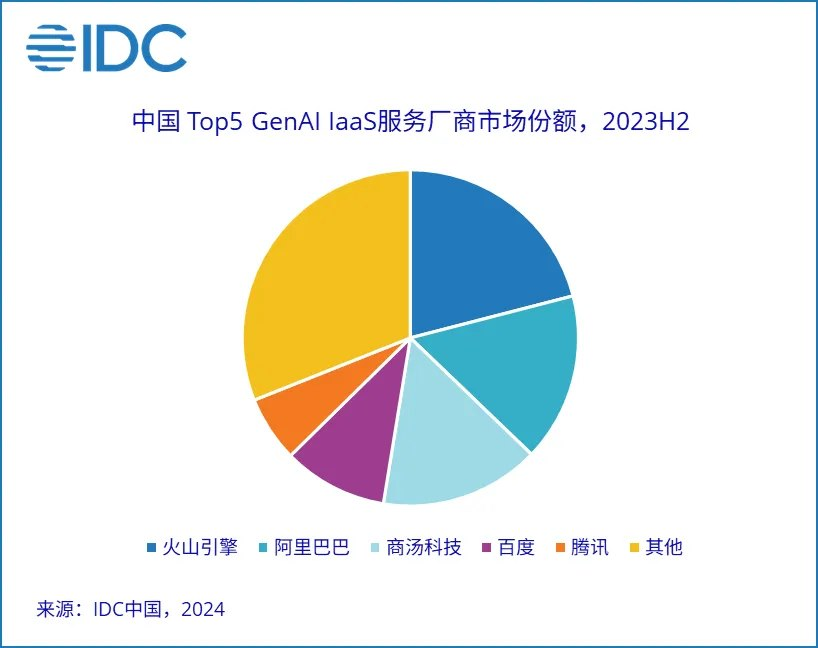
If breaking through in the intelligent computing layer was about seizing the timing of the computing power structure shift, leading in the MaaS layer was Volcano's first true realization of translating its C-end genes into B-end leverage.
The large-scale model industry has a natural flywheel effect: more users → more dialogue data generated → better model iteration → attracting more users. Traditional cloud providers' MaaS businesses rely on gradual accumulation of B-end clients, making the flywheel turn very slowly.
However, Volcano Engine is backed by Doubao, a national-level C-end application with over 100 million daily active users, acting as a natural traffic accelerator for its MaaS business.
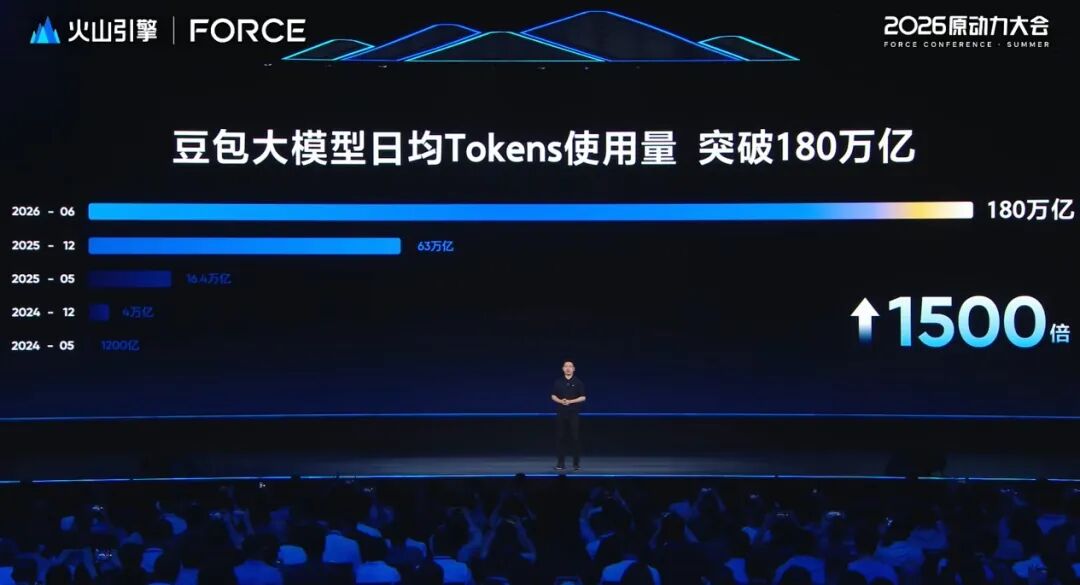
In May 2024, Volcano Engine initiated a price war, reducing the enterprise pricing of its main Doubao model to 99.3% lower than the industry average, directly bringing large-scale model APIs into the 'cent era.' Combined with its C-end user base, the invocation volume of Doubao's large-scale model Tokens soared.
As of the FORCE conference, its daily average Token invocation volume had surpassed 180 trillion, growing over 1,500 times compared to two years ago. Based on public cloud large-scale model invocation share, Volcano Engine ranked first in China with a 49.5% share.
Many believe Volcano's top invocation volume is inflated by Doubao's C-end traffic. In reality, as an internal ByteDance business, the Token consumption generated by Doubao's C-end does not count toward Volcano Engine's publicly reported enterprise service invocation statistics. Volcano's nearly 50% share in public cloud MaaS comes from model capabilities and extreme cost advantages, not from C-end traffic diversion.
Moreover, in the AI large-scale model era, a strong model itself serves as a 'new entry point' for the cloud. ByteDance's self-developed Doubao series models—including the Seedance series, which unlocks commercial video production scenarios, and Doubao 2.1 Pro, which achieves production-level Coding and Agent capabilities—are the strongest customer acquisition tools: clients who want top-tier multimodal generation capabilities and code models that can directly enter R&D workflows will prioritize Volcano Engine. Meanwhile, clients' real-world scenario data feeds back into model iteration, forming a positive flywheel of 'strong model → customer inflow → scenario refinement → stronger model capabilities → more customer inflow.'
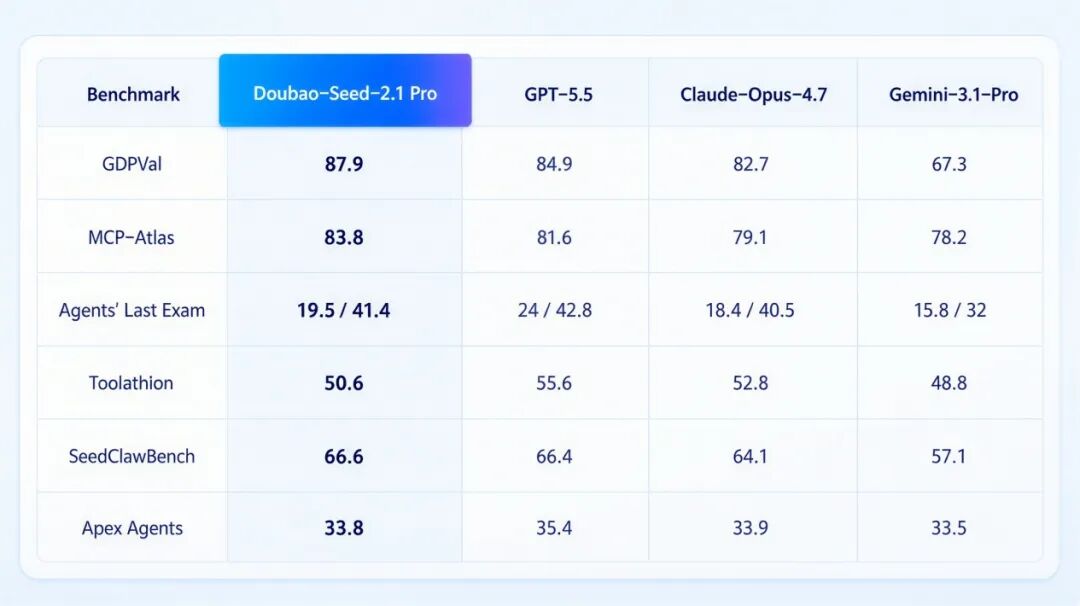
This aligns with Tan Dai's judgment at the conference that 'models can stably enter enterprise production workflows after crossing the production quality threshold': when model capabilities are strong enough to stably support enterprises' core production processes, customer switching costs rise rapidly, forming user stickiness no less than the barriers built by traditional cloud-era migration costs.
However, it must be acknowledged that this flywheel currently mainly covers internet clients, developer groups, and public cloud API scenarios. By 'selling Tokens + strong models,' Volcano Engine has indeed achieved a overtake on a curve (overtaking on a curve) in the MaaS track and driven overall public cloud market share pursuit.
But the 'first place' has been controversial from birth due to differing statistical caliber (methods) and client structures.
Based on public cloud API invocation volume, Volcano Engine is undeniably first. However, when calculating overall AI cloud revenue, Omdia data shows Alibaba Cloud remains first with a 35.8% share, with revenue exceeding the sum of the second to fourth places.
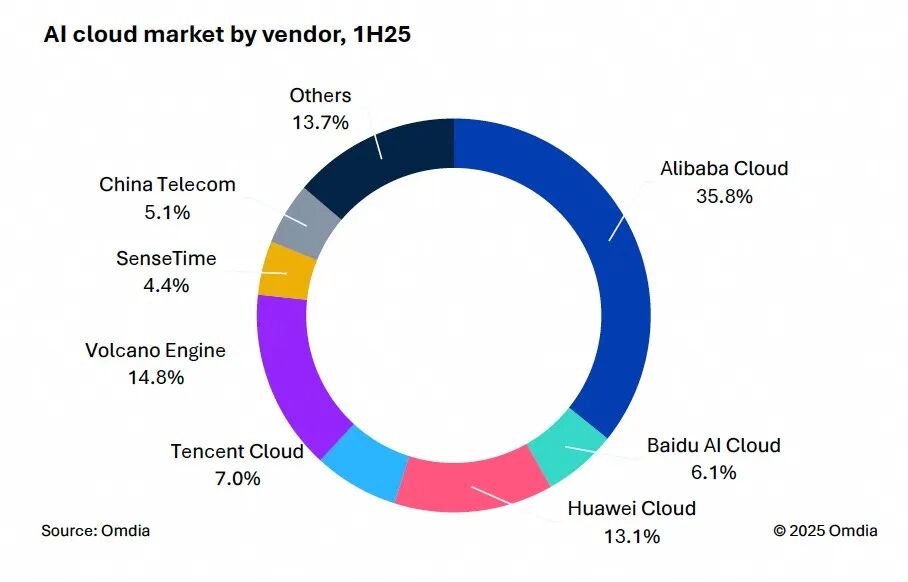
A more critical difference lies in client structure. Currently, the domestic MaaS market still relies on public cloud API invocations as its main revenue source, but high-value production scenarios such as financial risk control, autonomous driving simulation, government data governance, and industrial large-scale model deployment mostly adopt private deployment or dedicated cloud models, with single-customer ARPU values tens or even hundreds of times higher than public cloud APIs. This market has long been the stronghold of Alibaba Cloud, Huawei Cloud, and Tencent Cloud.
AI has given Volcano Engine a chance to overtake on a new track, pulling it from 'others' in the traditional cloud market to the center of the table.

From Token Competition to Delivery Competition
The cloud market's direction has changed this year.
If the keywords for 2023-2024 were 'land grabbing,' comparing who had more models, lower prices, and higher invocation volumes, the keyword for the second half of 2025 has become 'production implementation.'
Enterprise clients no longer pay for 'cheap Tokens' but instead calculate real costs: Can large-scale models solve my actual problems? Will data leak? Can they integrate with my existing systems? Who will take responsibility if issues arise?
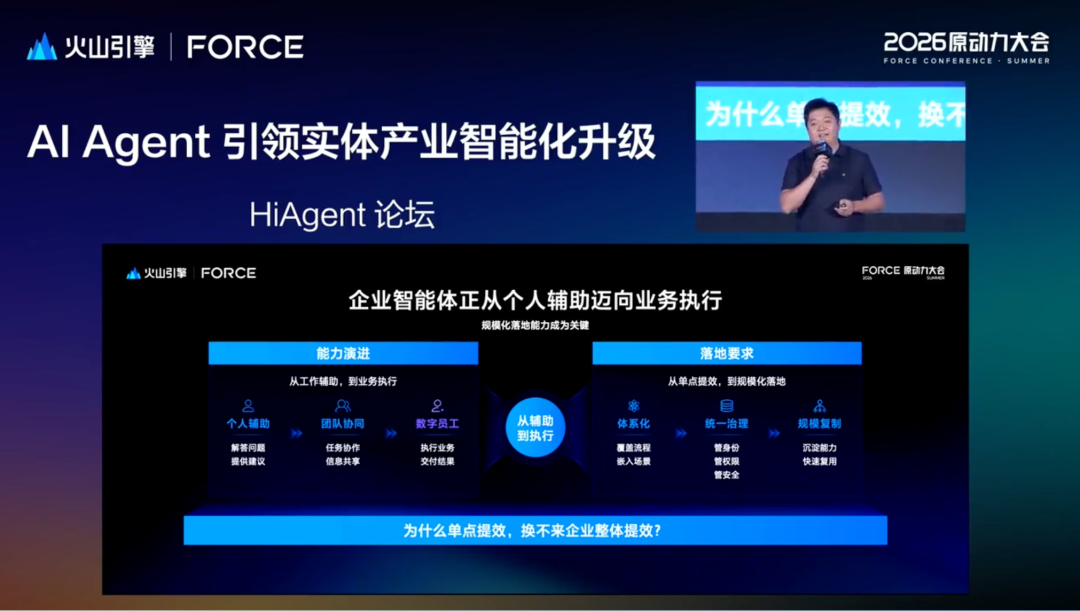
At this industry turning point, Volcano Engine held the FORCE conference. The signal throughout the event was clear: no longer competing on 'who is cheaper,' but actively addressing the capabilities needed for core production scenarios to fill gaps.
The reassurance came from a strategic organizational adjustment. At the conference, ByteDance CEO Liang Rubo stated: Climbing the AI peak is ByteDance's top priority, and Volcano Engine's MaaS business has been upgraded to a group-level foundational business with long-term and firm investment.
In the cloud industry, upgrading a business from 'business line level' to 'group foundational business' is the highest-weight strategic signal, meaning MaaS is no longer just a department within Volcano Engine but the 'water, electricity, and coal' for all of ByteDance: group-level computing power procurement, talent allocation, and capital investment will fully tilt , and even internal AI demands from Douyin, Toutiao, Feishu, and other businesses will prioritize Volcano Engine for practice.
When Huawei Cloud upgraded its EI Enterprise Intelligence to a group core business in 2017, it secured first place in the government cloud market within three years. When Alibaba Cloud upgraded to the Alibaba Cloud Intelligence Business Group in November 2018, led by Group CTO Zhang Jianfeng, it maintained its long-term first-place share in China's public cloud market. Volcano Engine's adjustment similarly opens the green light for long-term heavy investment.
Next comes filling the gap in 'enterprise-level capabilities.' Following Volcano Engine President Tan Dai's judgment that 'models must cross the production quality threshold to support enterprise business,' Volcano reconstructed a three-layer AI cloud-native service architecture: the MaaS layer launched Ark CLI to lower access barriers, the Agent layer upgraded AgentKit and HiAgent 3.0, and introduced the enterprise workbench ArkClaw.
The most critical part is the AI Trust system built at the security layer, addressing government and enterprise data compliance pain points through confidential computing, intelligent security operations, and full-link auditing. It even jointly launched an AI confidential computing zone with China Mobile, directly targeting the core requirement of 'data not leaving the domain' for central SOEs.
After the introduction of the Data Security Law and the Regulations on the Security Protection of Critical Information Infrastructure, 'data not leaving the domain and full-link auditability' are rigid requirements in key sectors like government, finance, and energy. Previously, Volcano lacked a systematic trusted computing capability, making it difficult to even enter the supplier qualifications for many central SOEs, let alone secure core orders.
This collaboration with China Mobile found the right 'guide': operators are the most trusted entry point in the government and central SOE cloud markets. Huawei Cloud and Alibaba Cloud expanded into the government and enterprise markets by first partnering with operators. Volcano's proactive 'operator binding' is also paving the way for entering high-value government and enterprise markets.
Beyond enterprise capabilities, Volcano has also begun addressing doubts about its business model. At the conference, Doubao officially launched a tiered subscription system: Basic at 68 yuan/month, Enhanced at 200 yuan/month, and Professional at 500 yuan/month, with core functions like daily chat and basic Q&A permanently free, while charging for advanced features like long document processing, AI office, and high-definition generation based on usage quotas.
Previously, industry doubts about Doubao's monetization persisted. LatePost reported that Doubao's daily revenue was previously less than 1 million yuan, mostly from e-commerce referral commissions, while its B-end API actively initiated a price war, and the massive Token invocation volume came with Continuously high (persistently high) computing costs, leading to concerns that 'more traffic means greater losses.'
The significance of this paid tiering goes beyond earning C-end user membership fees. Morgan Stanley's estimates on domestic large-scale model monetization show that long-term continuous subscription payment rates for C-end large-scale models range from 0.3%-3%, with a neutral expectation of around 1% for top products. Tencent Research Institute surveys also indicate that if including single-function payments and temporary top-ups, the overall payment rate among domestic AI users is about 9.8%.
Based on QuestMobile's publicly reported 345 million monthly active Doubao users, even achieving a stable 1% subscription rate could generate hundreds of millions in stable annual cash flow, directly funding B-end R&D and price wars without relying solely on first-tier market financing or traditional business support from the group, as other large-scale model vendors do.
This is the first time a leading domestic large-scale model vendor has directly connected C-end payment systems with B-end MaaS businesses. Once the payment model proves successful, Volcano will become one of the few vendors in the industry capable of sustaining B-end R&D and price wars through stable C-end cash flow, effectively submitting a letter of intent for the MaaS business's commercial sustainability.
Meanwhile, the criteria by which Volcano measures business success have also started to change. At this conference, the organizers did not repeatedly emphasize being 'No. 1 in average daily Token calls.' Instead, they highlighted 'over 200 enterprise customers with annual cumulative Token consumption exceeding one trillion, doubling in six months' as a core metric. They specifically mentioned that 90% of the world's top mobile phone manufacturers, 100% of mainstream automotive companies, and over 80% of systemically important banks have already integrated Volcano Ark.
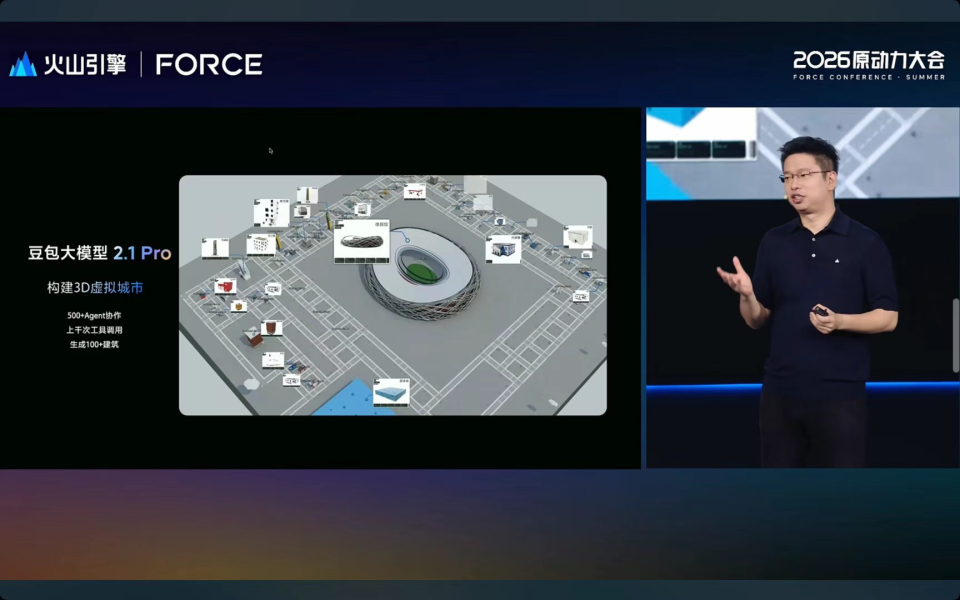
According to the general implementation framework proposed by the Ministry of Industry and Information Technology's 'Guidelines for Promoting Enterprise Cloud Adoption,' enterprise cloud usage typically goes through three stages: 'single-point testing - partial deployment - core system migration.' When AI capabilities are only used for scattered efficiency-enhancing scenarios like chatting and content generation, customers face almost no migration costs. However, when AI penetrates into an enterprise's core production processes, system coupling significantly increases, and customer retention rates also rise notably.
This customer retention metric carries more weight than mere call volume numbers, indicating that Volcano has at least moved beyond the 'customer trial' stage.
All these changes ultimately reflect on growth targets. Volcano Engine's internal revenue target for its MaaS business in 2026 has been raised to the ten-billion level, representing several times growth compared to 2025. Tan Dai confirmed in an interview that revenue targets have indeed been raised this year, with a consistent pursuit of 'profitable scale.'
Volcano Engine is no longer satisfied with being a platform leading in Token call volume but aims to become an AI cloud company capable of sustained profitability and stable delivery.

Volcano Engine Embraces the 'Tough Business'
Looking back at Volcano Engine's growth trajectory, it becomes clear that 'starting from upper-layer scenarios and gradually building down capabilities' has been its consistent approach since inception.
Unlike Alibaba Cloud, Huawei Cloud, and Tencent Cloud, which 'first laid out IaaS data centers, then developed PaaS platforms, and finally created SaaS applications,' Volcano Engine originated as a cloud computing team serving ByteDance internally. When it officially commercialized in 2020, it first launched SaaS-layer products like Feishu, intelligent recommendations, and video cloud. It wasn't until September 2021 that it formally released IaaS foundational services such as computing, storage, and networking, following a path of 'securing scenarios first, then building the foundation.'
Early on, it entered through video cloud SaaS, gradually migrating entire business chains of small and medium-sized clients like Dongqiudi to its proprietary IaaS platform, validating this 'light entry, heavy retention' logic. Now, it aims to replicate this logic across the entire AI cloud market, facing challenges orders of magnitude greater.
To determine whether Volcano's current moves represent mere external narratives or genuine strategic implementation, one need only observe whether each action continues to revolve around the traffic logic of 'lowering barriers for new customer acquisition and expanding call volume' or genuinely moves toward the 'tough business' of 'embedding into core processes and building industry trust.'
Cloud service barriers thicken layer by layer, but in real competition, it resembles an ever-deepening dive. The tool layer has the lowest barriers—anyone can do it. The middle application layer requires deep industry know-how. At the core lies trust, built through years of customer accumulation.
The outermost layer is tool capabilities. Products like Ark CLI essentially industrialize model calls into standard instructions, lowering development barriers, scaling developer numbers, and increasing Token consumption. This leans more toward 'expanding traffic' than building barriers, as both leading cloud providers and MaaS platforms can offer similar capabilities, competing on efficiency and price with low developer switching costs.
Moving inward is the enterprise process layer. HiAgent 3.0 and the ArkClaw Enterprise Edition workstation begin integrating into genuine business processes: contract review, production workflows, and digital employee orchestration. The core here isn't model capability but system integration capability: whether it can connect with OA and ERP systems, adapt to industry regulations, and operate stably in production environments.
This 'delivery capability' offers no shortcuts—it requires industry-by-industry refinement and customized client adaptations, demanding substantial frontline service teams and industry experience accumulation. Tan Dai mentioned in an exclusive interview that Volcano has now established FDE (Frontier Deployment Engineer) teams covering key industries like automotive, finance, manufacturing, and healthcare to collaborate with clients on scenario implementation.
This marks a departure from the 'selling Tokens and interfaces' light model, embracing the traditional cloud provider's 'heavy service, heavy delivery' path.
The deepest and toughest challenge is trust. The AI Trust system's collaboration with China Mobile targets critical sectors like government, finance, and energy. Data security, compliance, and stability represent impenetrable barriers—the same moats Alibaba Cloud and Huawei Cloud spent nearly a decade building through landmark projects.
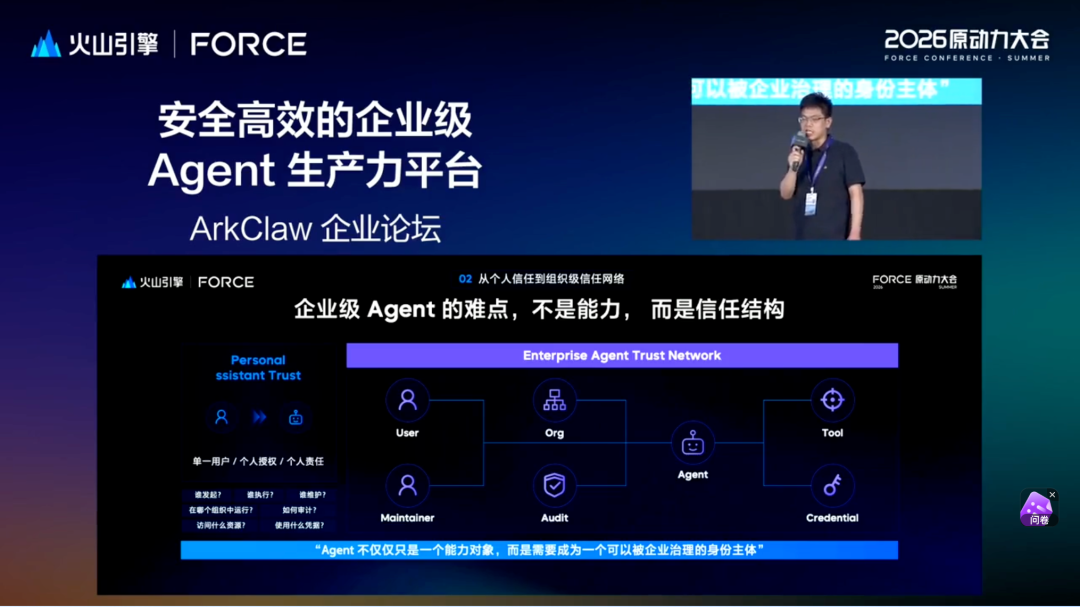
Volcano's establishment of a full-chain trusted computing system and joint AI confidential computing zone with China Mobile directly addresses state-owned enterprises' core requirement of 'keeping data within domains.' However, it must be acknowledged that trust in such markets never comes from mere product launches or cooperation signings: from supplier qualification shortlisting to the first pilot project implementation and then large-scale core system procurement, the process often spans years, involving countless security tests and stability validations.
Only by navigating this path can Volcano Engine truly secure admission to the mainstream cloud market.

Conclusion
After more than a decade in China's cloud market, no provider has ever won solely through 'low pricing.'
AWS began by selling computing power for an online bookstore and waited a decade to become the global cloud market leader. Alibaba Cloud started from Alibaba's own e-commerce systems, invested for ten years, and endured countless pitfalls before securing its top position. Huawei Cloud leveraged three decades of to B customer relationships to break into the first tier within five years.
All cloud providers that ultimately survive and thrive must undergo the process of 'calculating the accounts thoroughly.' You might penetrate trial scenarios with extreme pricing, but to become a mainstream player, you must help clients fully account for adaptation costs and risk costs, ensuring they feel secure and cost-effective when placing core businesses with you.
AI presents Volcano Engine with a once-in-a-century opportunity to change the game, but while the table may change, the rules for winning remain: 'price to penetrate costs, service to underwrite risks.'

Editor: Muren Proofreader: Zhang Wenxin Production: Rui Zong
▼
Welcome to follow the video channel #Dr. Qi's Insights#
-
![]()
Luxury Lineup, Highly Anticipated! The Pioneer of Physical AI Gears Up for Hong Kong Stock Exchange Debut!
-
![]()
Mercedes-Benz Withholds Year-End Bonuses for 90,000 Staff: Germany's Industry 4.0 Aspirations in Tatters
-
![]()
Can the Hong Kong Stock Market Pay for World Models? Dissecting Momenta's Prospectus
-
![]()
Set for Secondary Listing in Hong Kong with Market Cap Exceeding 500 Billion: How Luxshare Precision Regains Investor Trust?
-
![]()
Approaching its Secondary Listing in Hong Kong with a Market Cap Exceeding 500 Billion: How Has Luxshare Precision Regained Investor Trust?
-
![]()
Real Insights from New Energy Vehicle Owners in China’s Top 30 Cities by Ownership
-
![]()
Real Thoughts of New Energy Vehicle Owners in Top 30 Cities by Car Ownership
-
![]()
Truth Revealed: Memory Prices Soar, Apple Profits Surge, Yet Memory Makers Bear the Blame