Iterative Communication in Automotive Electronics: ADI's Innovative AB, GMSL, and EB Solutions
 07/14 2026
 493
493
Authored by Zhineng Zhixin
At Electronica China in Munich, Shanghai, ADI provided a comprehensive overview of its automotive product lineup, encompassing in-cabin audio, video SerDes, and edge Ethernet solutions. Focusing on A²B, GMSL, E²B, and zonal architecture, we can delve into an in-depth discussion.
MCU-free designs are poised to revolutionize the future of integrated automotive electronics.
Part 1: A²B 2.0: A Fourfold Leap in Audio Bus Technology 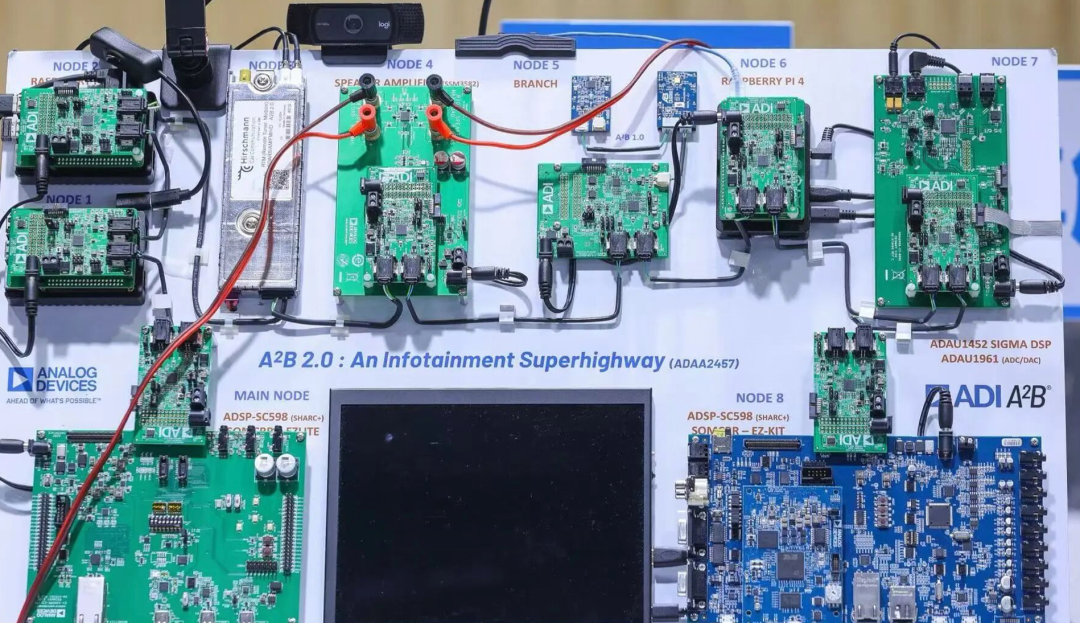
In intelligent cockpits, audio systems are gaining prominence, with an increasing number of microphones and speakers being integrated, along with features such as Active Noise Cancellation (ANC) and Road Noise Cancellation (RNC) being implemented sequentially. Traditional bus technologies are struggling to keep pace.
ADI's A²B 2.0 represents a significant upgrade, transitioning from 50 Mbps half-duplex in version 1.0 to 100 Mbps full-duplex, with equal upstream and downstream bandwidth, marking an overall fourfold increase. The number of audio channels has expanded from 32 to 119.
A single RNC node consumes three channels. With four RNCs, microphones, and speakers, the previous 32-channel limit is quickly reached. The sampling rate has also been enhanced from 44.1 kHz to 96 kHz, elevating audio quality.
A²B 2.0 introduces 10BASE-T1S Ethernet tunneling. In the future, when a device within the Zonal architecture requires an Ethernet connection for upgrades, there will be no need for a separate Ethernet cable; it can be achieved through the A²B bus. Within the 100 Mbps bandwidth, 10 Mbps is allocated for Ethernet, utilizing the same UTP unshielded twisted pair cable without requiring connector changes. For automakers, this simplifies system-level design.
It also maintains bridging capability with version 1.0. By placing both 2.0 and 1.0 chips on a board, legacy earphone peripherals can connect via 1.0, while new nodes utilize 2.0, facilitating a smooth transition without a complete overhaul. It supports a maximum length of 80 meters, with 25 meters between sub-nodes in a daisy-chain topology. Deterministic and low latency are its key strengths.
Version 2.0 offers cleaner EMC and EMI performance compared to 1.0, simplifying peripheral circuits and better controlling system design costs for Tier-1 suppliers and OEMs. Some compare it to AVB; while both are audio buses, they cater to different scenarios. A²B focuses more on low-latency and deterministic latency transmission, and the two have coexisted in vehicles for years.
The necessity of A²B 2.0 is evident. The communication bandwidth was insufficient, with ANC and RNC quickly consuming the 50 Mbps. The 32 audio channels were inadequate, as one RNC occupies three channels, four RNCs account for 12 channels, and adding microphones and speakers rapidly exhausts capacity. The sampling rate needed to increase from 44.1 kHz to 96 kHz, which version 1.0 couldn't accommodate. These factors signaled to automakers that an upgrade was imperative.
A single physical line can now carry different types of data, akin to a highway with a 100 Mbps lane and an 80 Mbps lane operating independently.
Of course, A²B 2.0's applications extend beyond automobiles; noise reduction in homes, conference rooms, and even robots can be achieved by extending the daisy-chain without the need for repeaters.
Part 2: GMSL3: The Moat of Deterministic Latency in Video SerDes
For video transmission, ADI offers GMSL3. The previous generation provided 6G bandwidth, while this generation delivers 12G.
At the exhibition, four 12-megapixel cameras simulated the A-pillar, B-pillar, rear, and front of the vehicle, with the surrounding view converging on a central computing platform and displayed on two 4K screens. The familiar requirements of high bandwidth, stability, and deterministic low latency are crucial here.
However, GMSL's true competitive advantage lies in its deterministic and low latency and high reliability, with point-to-point transmission being more stable than going through a switch.
For surround view applications, 3 to 5 megapixels are generally sufficient. ADAS end-to-end large models don't rely on high pixel counts but rather on frame rates. Frame rate determines temporal resolution, so reducing pixels and increasing frame rates still necessitates bandwidth in the tens of gigabits. Algorithms, computing power, and model orchestration will see more DSPs in vehicles, with radar algorithms and data processing relying on their real-time capabilities.
Automobiles differ from consumer electronics. Consumer-grade devices strive for finesse, while ADAS serves the computing center with upper limits on demand, unlike the human eye's limitless capacity. That's why 8-megapixel cameras have remained the standard in vehicles for so long—not due to technical limitations but because higher resolutions aren't necessary.
GMSL is also integrating Ethernet capabilities. GMSLE carries GMSL data over Ethernet, responding to industry calls for "video in the backbone network." However, ADI doesn't view GMSL and Ethernet as competitors; various buses will coexist in vehicles for a long time. Four cameras can be aggregated into one stream, resolved by a single new GMSL3 deserializer instead of two MAX96792s.
Some discuss fiber-optic Ethernet, but its physical medium is more sensitive, and its noise immunity and environmental stability are still uncertain. The industry is still exploring, without a unified direction. In the short term, mature SerDes technologies like GMSL will remain the mainstay in vehicles, with usage still growing.
The OpenGMSL Alliance has placed GMSL protocols under third-party leadership, allowing members to access GMSL3 content. ADI, which both develops solutions and opens protocols, may seem contradictory, but its goal is to expand the ecosystem, ensuring interconnectivity with its host-side products regardless of customer choice.
Part 3: E²B: Edge Ethernet, the Protagonist Without MCUs 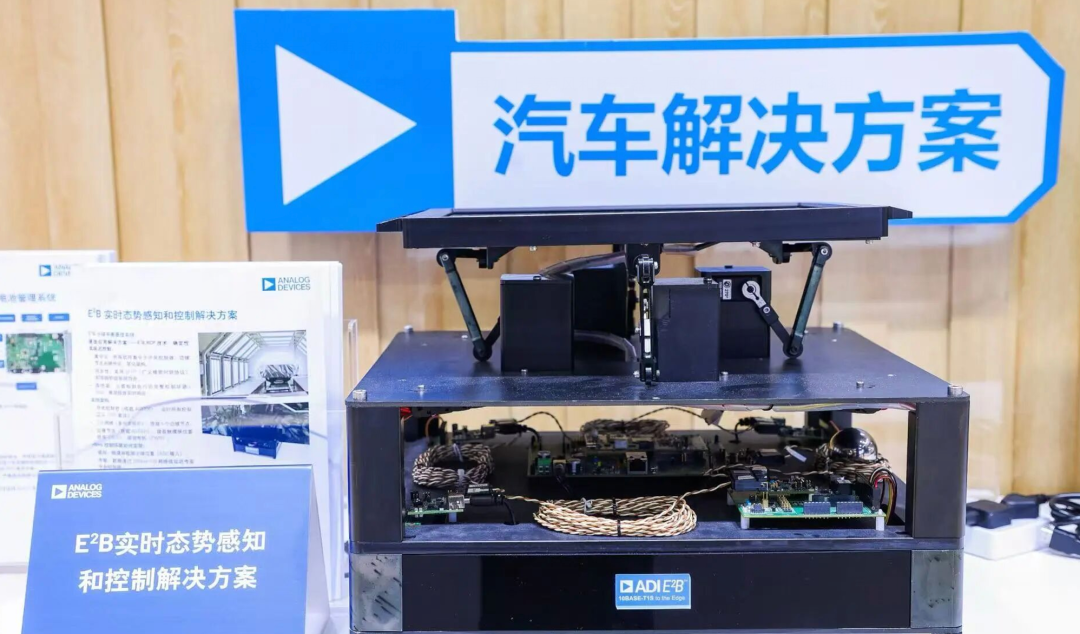
The product that truly stood out at this conference was E²B. E²B, or Ethernet Edge BUS, is a bus technology that connects Ethernet to edge nodes via an interface chip. Its greatest significance lies in enabling remote MCU-less and centralized software deployment. Targeting RCP (Remote Control Protocol), E²B is the first to achieve mass production and will be compatible with RCP in the future.
The balancing ball demo effectively illustrates this concept. A central computing center connects four sub-nodes via a single E²B, with each node's ADC handling pressure sensing and motor control. When the ball tilts, sensors collect data, transmit it to the center via E²B, and after processing, the center sends commands back to four controllers to adjust the plane. The key lies in gPTP synchronization (1588 within TSN), ensuring all four motors move simultaneously. The entire closed-loop transmission takes less than 5 milliseconds. Without E²B synchronization, the balancing algorithm would fail.
What gives the MCU-less approach its vitality? Three words: centralized software.
Remote nodes become hardware-based, with software centralized on the ZCU (Zonal Control Unit). Previously, sub-endpoints required their own software, necessitating collaboration with Tier-1 suppliers, OTA updates, and some couldn't even support OTA. Now, with hardware-based nodes, upgrading edge node functions only requires modifying the regional control, making all sub-endpoint OTA updates possible.
For domain controllers, adding too many MCUs with I/Os is burdensome, complicating package design. E²B takes over this role. Its first mass-produced project is an ambient lighting system for an OEM. Vehicle lighting, seats, windows, by-wire chassis, and steering are all within its purview.
The next generation will add ASIL B functional safety, with two B redundancies upgraded to D, potentially entering body control. Robotic dexterous hands also use it, as each degree of freedom requires control, involving numerous motors.
Remote nodes shed software and MCUs, centralizing functions.
BMS can also leverage this trend. The 48V BMS chip ADBMS6948 supports 16 cells in series, with an analog front-end up to 80V, ±2.7mV voltage accuracy, ASIL C, and seamless integration with E²B. It transmits data packets directly in 10M Ethernet format to the ZCU, eliminating the need for an MCU.
A single chip handles total package voltage and current detection and temperature sensing, replacing the previous setup of a total package chip plus a modular BMS.
Higher integration leads to cost advantages at the system level.
These are tangible benefits. Thermal management can also be integrated. Any MCU-based temperature control application can utilize E²B. Combining 48V BMS with E²B shifts BMS operations to the ZCU. MCU-less designs aren't universal.
By-wire chassis requires functional safety, so E²B must wait for the next generation with ASIL B. Active suspension currently relies on MCUs. However, for vehicle lighting, seats, ambient lighting, and windows, integration via RCP or E²B is just a matter of time.
The global standard for RCP, developed by the Open Alliance TC18 working group, is still refining details. ADI isn't a member but contributes to the protocol without open-sourcing it. Leveraging its early mass production, ADI can quickly integrate once the standard is finalized.
Summary
ADI is positioning itself at the forefront of communication layers and the trend towards MCU-less designs. A²B handles audio, GMSL manages video, and E²B oversees edge nodes, forming a comprehensive communication backbone for zonal architectures.
-
![]()
HK$340 Billion Wiped Out in 4 Months, Founder Takes 'No Salary' Pledge: What’s Ailing MiniMax?
-
It's Time to Tally the ROI for Tokens
-
![]()
WPS, with 678 Million Users, Seeks Equilibrium Between Revenue Growth and User Experience
-
![]()
Seres, Once a Profit Leader, Shifts from Gains to Losses in H1: It’s Not Entirely Huawei’s Fault | MIRROR Pro
-
![]()
Why Google Remains 'Others' After 16 Years in the Smartphone Business
-
![]()
The Theory of Distillation Threat
-
![]()
Iterative Communication in Automotive Electronics: ADI's Innovative AB, GMSL, and EB Solutions
-
![]()
Despite AITO’s Explosive Sales, Why is Seres Still Struggling Financially?