Early Riser, Late Arrival: Where Is Toyota Stumbling in Its Electrification Journey?
 08/10 2026
 551
551
Within Toyota, it's not that the path forward is unclear; rather, at the Japanese headquarters, resistance to change has consistently outweighed the drive for transformation.
Recently, Toyota officially announced the cancellation of the mass production plans for the Lexus BEV sedan LF-ZC, drawing widespread attention across the industry. The vehicle, which made its debut at the 2023 Tokyo Mobility Show, was touted as Lexus's 'next-generation BEV model,' boasting steer-by-wire technology, the Arene OS operating system, and AI capabilities. Originally scheduled for production by the end of 2026 and later postponed to mid-2027, it ultimately failed to reach the mass production stage.
In response, Toyota cited 'changes in global market demand and structural optimization adjustments to the group's vehicle development system,' emphasizing that this represented merely a scaling back of planning for certain models and did not signify Lexus abandoning BEVs.
However, those who have closely followed Toyota's moves are well aware that this explanation is nothing new. As early as December 2021, Toyota unveiled 16 BEV concept models in a single strategic announcement. These models spanned nearly all categories, including sedans, sports cars, SUVs, and pickups, creating quite a stir. Akio Toyoda, then-president, took the stage and declared resolutely, 'Toyota will launch 30 BEV models by 2030, with an annual sales target of 3.5 million units.'
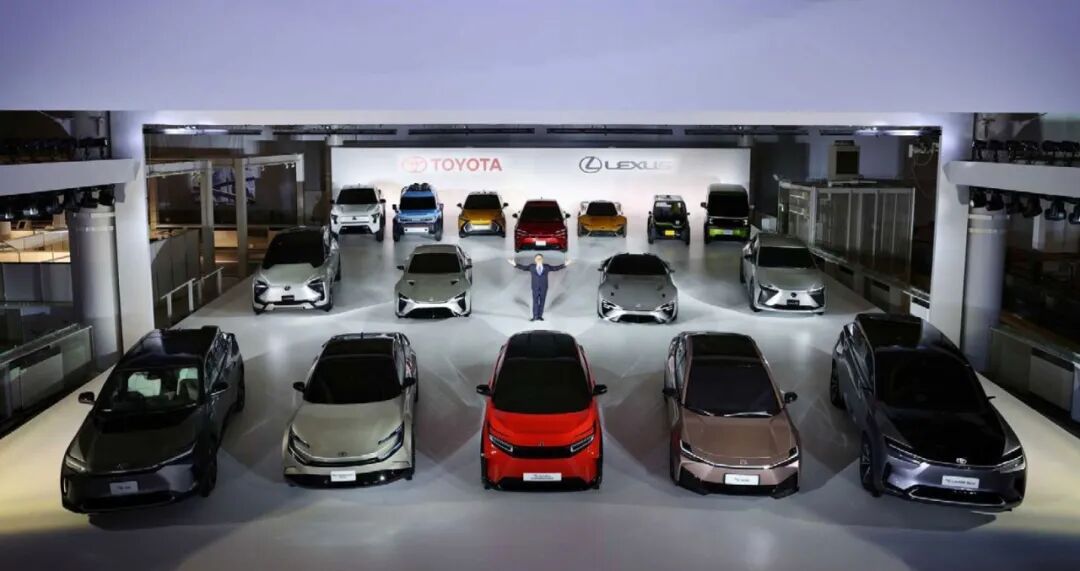
Yet, the grand vision failed to materialize. Just a year after the announcement, foreign media reported that Toyota had suspended mass production plans for two core models: the BEV Crown and the BEV FJ Cruiser. Today, looking back at the once-impressive lineup of BEV concept models, only a few—such as the bZ4X, bZ3, bZ5, and Lexus RZ—have made it to mass production, while the rest remain stalled. With the official termination of LF-ZC's development, most of Toyota's planned electrification models have faltered.
Why is this happening?
In fact, frequent project launches, mid-course adjustments, and hasty shelving have become the norm for Toyota's BEV business. This may be linked to the persistent indecision at its decision-making level.
During Akio Toyoda's tenure as Toyota's president, he long adhered to a 'multi-path carbon neutrality' approach, arguing that BEVs were just one option among many, and that hybrids, hydrogen energy, and fuel-cell vehicles could also pave the way to carbon neutrality. He publicly stated, 'The more electric vehicles we make, the worse carbon dioxide emissions will become,' and 'If Japan fully shifts to electric vehicles, the surge in summer electricity demand will lead to supply shortages.' He even explicitly declared in 2024 that BEVs would never account for more than 30% of Toyota's global sales.
These remarks may sound like excuses, but within Toyota's corporate culture, they represent a very real internal force.
The reason is straightforward. Hybrids represent a competitive advantage that Toyota has spent nearly 30 years building, with over 27 million vehicles sold. Hydrogen energy is a bet Toyota has placed for 20 years, still incurring losses today. Abandoning hybrids to advance electrification would mean tearing down its strongest wall while admitting that the hydrogen energy path of the past 20 years was a mistake.
For any company, this would be a massive self-negation. And most companies lack the courage to undertake such a negation.
Although Akio Toyoda stepped down as president in 2023 and retreated behind the scenes, his influence within the company did not wane. At the 2025 Shanghai Auto Show, Toyota announced that it would transfer R&D decision-making power for the Chinese market to China, but hesitation at the Japanese headquarters regarding the global BEV strategy never truly ceased.
This creates a fatal problem: without unified leadership will, strategies cannot be fully executed. On one hand, the market and the Chinese team are desperately pushing for electrification; on the other hand, decision-makers at the Japanese headquarters remain cautious about BEVs. When these two forces coexist, the result is that strategies are set but cannot be smoothly implemented; projects are launched but can still be canceled.
When the top leadership's attitude toward BEVs is 'it's okay to pursue it, but no need to go all in,' the teams below naturally won't go 'all in' either. The widespread failure of the 16 concept models in 2021 stems from this very issue.
Secondly, profit structure constraints play a significant role. Toyota is one of the world's top automotive giants, selling tens of millions of vehicles annually, with its most profitable businesses remaining fuel-cell vehicles and hybrids. Today, BEVs not only fail to contribute profits to Toyota but continue to incur losses.
Every step forward in electrification means using profits from fuel-cell vehicles to fill the investment gap for BEVs. Under this structure, if any BEV model lacks a clear path to profitability, adjustment becomes the most 'rational' choice.
The third reason may be even more pragmatic: alone, Toyota cannot yet build competitive BEVs. Specifically, BEVs require a new battery supply chain, software-defined vehicle capabilities, and rapid product iteration. Toyota's entire system—lean production, long development cycles, and deep supplier integration—is optimized for fuel-cell vehicles and hybrids. A fuel-cell vehicle typically takes 4-5 years from project launch to mass production, while new entrants have compressed this cycle to 18-24 months. When self-development costs are too high and external collaborations risk losing bargaining power, canceling projects becomes the easiest option.
Toyota has not shied away from self-development attempts. Its solid-state battery R&D has been ongoing for years, but mass production timelines keep being pushed back, with no clear node yet. On the software front, while Arene OS has been installed in 26 Toyota RAV4 models, its overall operational convenience and software ecosystem still lag significantly behind Huawei's HarmonyOS and Xiaomi's HyperOS. Hardware can be purchased, but software ecosystems require time and a user base—exactly what Toyota lacks most.
Toyota's dilemma is not unique. Honda and Nissan face similar challenges. In the first quarter of 2026, Japanese automakers' collective revenues declined, and losses widened. The core reasons are twofold: first, their market share in China is being rapidly eroded, with domestic brands capturing a significant portion of the new energy vehicle (NEV) market, while Japanese automakers' shares continue to shrink; second, electrification investments continue to incur losses, with returns nowhere in sight. Profits from fuel-cell vehicles are being eaten away by losses from BEV businesses—when the entire Japanese automotive industry is 'giving up halfway' on electrification, it is not just a strategic misstep by individual companies but a systemic lag for the entire sector in this competitive arena.
Toyota in China: A Different Story
Interestingly, Toyota's electrification progress in the Chinese market has been remarkably swift, unlike its pace elsewhere.
Currently, Toyota has launched four BEV models in China: the bZ3 and bZ5 from FAW Toyota, and the Platinum Wisdom 3X (Bózhì 3X) and Platinum Wisdom 7 (Bózhì 7) from GAC Toyota. These vehicles share a common trait: none were built entirely by Toyota from scratch.
The bZ3 and bZ5 use BYD's three-electric system (battery, motor, and controller), while the Platinum Wisdom 3X and Platinum Wisdom 7 utilize GAC's NEV platform. Moreover, these models are equipped with RoboSense's LiDAR and Momenta's intelligent driving system, with the Platinum Wisdom 7 even featuring Huawei's HarmonyOS cockpit and Xiaomi's CarIoT ecosystem. According to incomplete statistics, over 100 Chinese suppliers are involved in the core component supply for these models. Toyota's contributions lie more in branding, quality control, and manufacturing systems.
More notably, Toyota has transferred R&D decision-making power for the Chinese market from its Japanese headquarters to China, establishing an independent R&D system and a Chief Engineer system for China. In 2023, Toyota renamed its R&D center in China as the 'Toyota Intelligent Electric Vehicle R&D Center (China),' enabling engineers from FAW Toyota, GAC Toyota, and BYD Toyota to collaborate seamlessly across organizational barriers.
In other words, Toyota in China is taking a 'borrowing a boat to go to sea' approach—leveraging Chinese technology, supply chains, and speed, slapping on a Toyota badge, and selling to global consumers.
From a short-term perspective, this approach has proven effective. After its launch, the Platinum Wisdom 3X once exceeded 5,000 monthly sales, establishing a foothold in the 150,000-yuan BEV SUV market. The bZ3 also saw decent shipments in the ride-hailing market. While Toyota's BEV sales in China are far behind BYD's, they are no longer negligible.
However, this path carries hidden risks. As Toyota's NEVs co-developed in China become increasingly 'un-Toyota-like,' a more pressing question arises: if consumers one day discover that the 'Toyota' vehicle's three-electric system is BYD's, the cockpit is Huawei's, and the intelligent driving system is Momenta's, how much value will the Toyota badge retain?
On social media, some owners already joke, 'Isn't this just a BYD with a Toyota badge?' When the core sources of product competitiveness all come from partners, Toyota's brand premium will continue to dilute. A deeper risk is that under this model, Toyota is losing definition rights over its NEV products.
By 2025, China's NEV penetration rate has surpassed 50%. By 2026, this figure is accelerating. The window of opportunity for Toyota is closing at a visible pace. At this moment, the question Toyota truly needs to answer is no longer 'whether to do BEVs' but—when BEVs truly become mainstream, will Toyota still be Toyota?

Image: Sourced from the Internet
Article: Auto Review
Layout: Auto Review
-
New Business Models in the Era of AI Agents: A2A
-
![]()
Kejinming's IPO: Diminished Fundraising, Slashed Working Capital Project, Sluggish Growth of Core Products, and a Cooling North American Market
-
![]()
Tencent Secures a Crucial Victory in AI Office Arena, While Baidu Continues to Struggle
-
![]()
DeepSeek Raises Prices, Alibaba Takes a Cut: Will Major Clients Stay or Leave?
-
![]()
After Persistent Declines, Is This Joint Venture Automaker Considering an Exit? Here’s the Official Word
-
![]()
DeepSeek Raises Prices, Alibaba Takes a Cut: Will Big Clients Pay Up or Walk Away?
-
![]()
SAIC-GM Shows Confidence in Joint Venture Model: What Lies Ahead?
-
![]()
Early Riser, Late Arrival: Where Is Toyota Stumbling in Its Electrification Journey?