Chery and VOYAH in Heated Debate: A Flood of New Car Models Hits the Auto Industry—3.6 Launches Per Day. Are Some Brands Cutting Corners on "Rushed Vehicles"?
 08/14 2026
 455
455
Say no to "rushed vehicles," but embrace "efficient vehicles."
The controversy over "rushed vehicles" is far from over.
Recently, Li Xueyong, Vice President of Chery, addressed concerns about the company's perceived slow pace in vehicle development. He explained that while the four-year development cycle for the Fengyun T7 may seem unconventional, automobiles are not fast-moving consumer goods; they are intricately linked to the safety of millions of families. Therefore, R&D, validation, and global user co-creation processes must not be rushed.
In contrast, Lu Fang, Chairman of VOYAH, argued that a short development time does not necessarily mean a "rushed vehicle." Time, he emphasized, is not the sole criterion for quality. If a vehicle undergoes every required test in accordance with regulations and industry standards, even within a short R&D cycle, it should be considered an "efficient vehicle." Shortening development times reflects advancements in tools and methodologies.
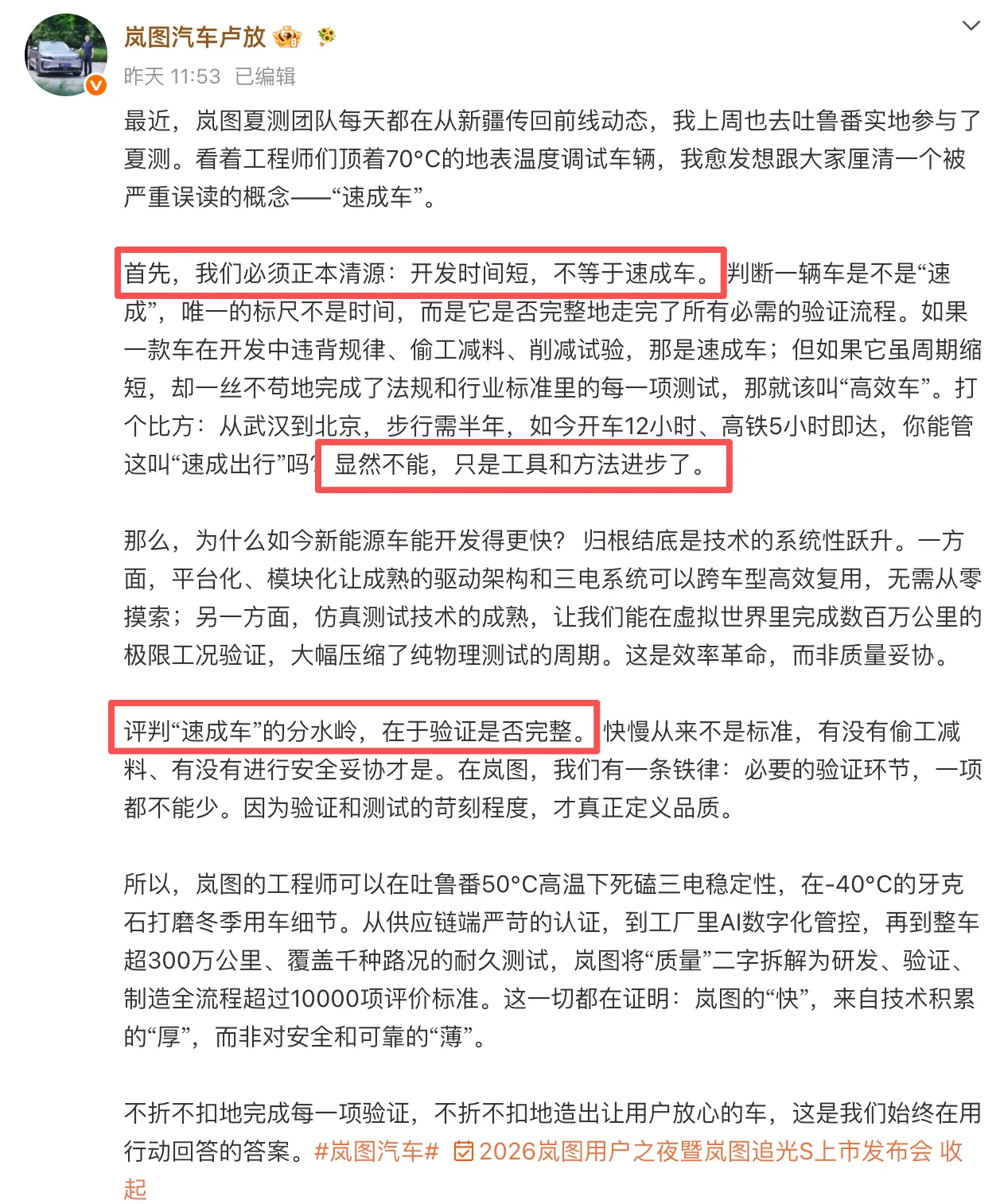
(Image source: Weibo screenshot)
Among international automakers, Nissan has acknowledged that by adopting development models from Chinese automakers, it has significantly reduced its new vehicle development cycles.
With "efficiency improvements" being a near-universal topic and goal in the industry, the issue may not lie with short development times per se, but rather with the quality of "rushed vehicles."
Last month, He Zhiqi, Executive Vice President of BYD, revealed that 542 new vehicle models were launched in China from January to May this year, averaging 3.6 per day.
At the 2026 China Auto Forum, Li Fenggang, General Manager of Beijing Hyundai, publicly cautioned that some automakers, in their haste to bring products to market, are skipping crucial validation stages such as Design Verification (DV) and Production Validation (PV). This practice, he warned, turns consumers into road testers and treats vehicles as if they were fast-moving consumer goods, leading to inconsistent manufacturing and frequent malfunctions.
Recent quality issues reported by several domestic automakers, resulting in the recall of tens of thousands to hundreds of thousands of vehicles, have heightened consumer concerns about the quality of "rushed vehicles."
(Image source: Doubao AI-generated)
In response, some automakers have begun highlighting their R&D cycles and road test mileage as selling points. For example, in March 2025, Li Auto announced that the i8 had undergone durability and performance validation across two winters and two summers in 300 Chinese cities, accumulating over 8 million kilometers in test mileage.
This year in July, Hu Zhengnan, CTO of Xiaomi Auto, stated that from the first Pengcheng test vehicle hitting the road in October 2024 to June 30 of this year, 566 test vehicles were deployed, accumulating 4.28 million kilometers in travel distance, covering 31 provincial-level administrative regions and 194 prefecture-level cities nationwide. From the Xiaomi SU7 to Pengcheng, a total of 35.51 million kilometers were driven.
These automakers aim to demonstrate to consumers that their products have undergone meticulous refinement and rigorous testing, ensuring reliable quality through extensive road test mileage and development cycles.
Automakers opt for the "flood of new models" strategy for two primary reasons: First, the new energy vehicle sector is still in a period of rapid technological advancement, with frequent iterations in three-electric systems (battery, motor, controller), AI, and intelligent driving technologies, coupled with evolving consumer demands. Automakers must frequently launch new products or upgrade existing models to meet these needs.
(Image source: Doubao AI-generated)
Second, industry competition is intensifying. Beyond established giants, new entrants like NIO, XPeng, Li Auto, Leapmotor, Hongmeng Intelligent Driving, and Xiaomi are entering the market. Automakers must continuously generate buzz to maintain brand relevance.
During the era of internal combustion engine vehicles, lengthy whole-vehicle development cycles were primarily due to the need for all-new development of numerous components, building vehicle architectures from scratch, and relying heavily on physical prototypes for testing.
In the new energy era, platform-based modular architectures have become the industry standard. A single architecture can spawn multiple models, with reuse of mature components in chassis, three-electric systems, and electronic architectures, eliminating the need for complete from-scratch development for every new vehicle.
Regarding validation, AI simulation testing and digital twin technologies have become key to shortening new vehicle development cycles. Thus, a vehicle's quality cannot be judged solely by development time; what matters is whether automakers conscientiously complete relevant quality tests.
When sharing insights from learning from Chinese automakers, Nissan mentioned that by massively introducing AI modeling tests, digital twins, and VR virtual simulation technologies, it has shifted many testing phases to virtual spaces, reducing the need for excessive physical prototypes. The accompanying automated testing systems even support unattended nighttime testing.
Lu Fang also stated that VOYAH can complete millions of kilometers of extreme-condition testing in virtual environments, significantly compressing pure physical testing cycles.
The virtual testing tools used by automakers integrate digital twin-based CAE simulation technologies.
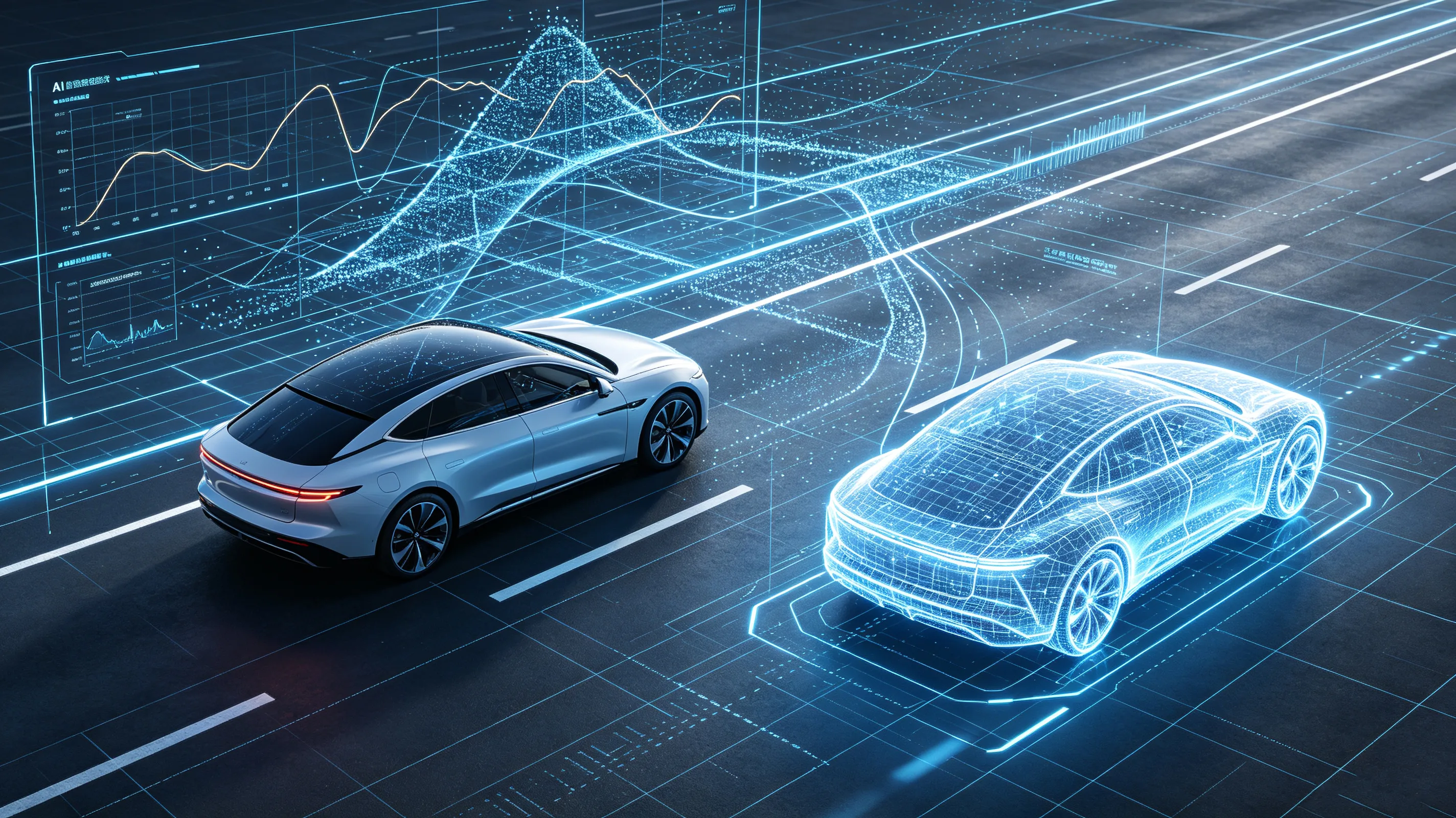
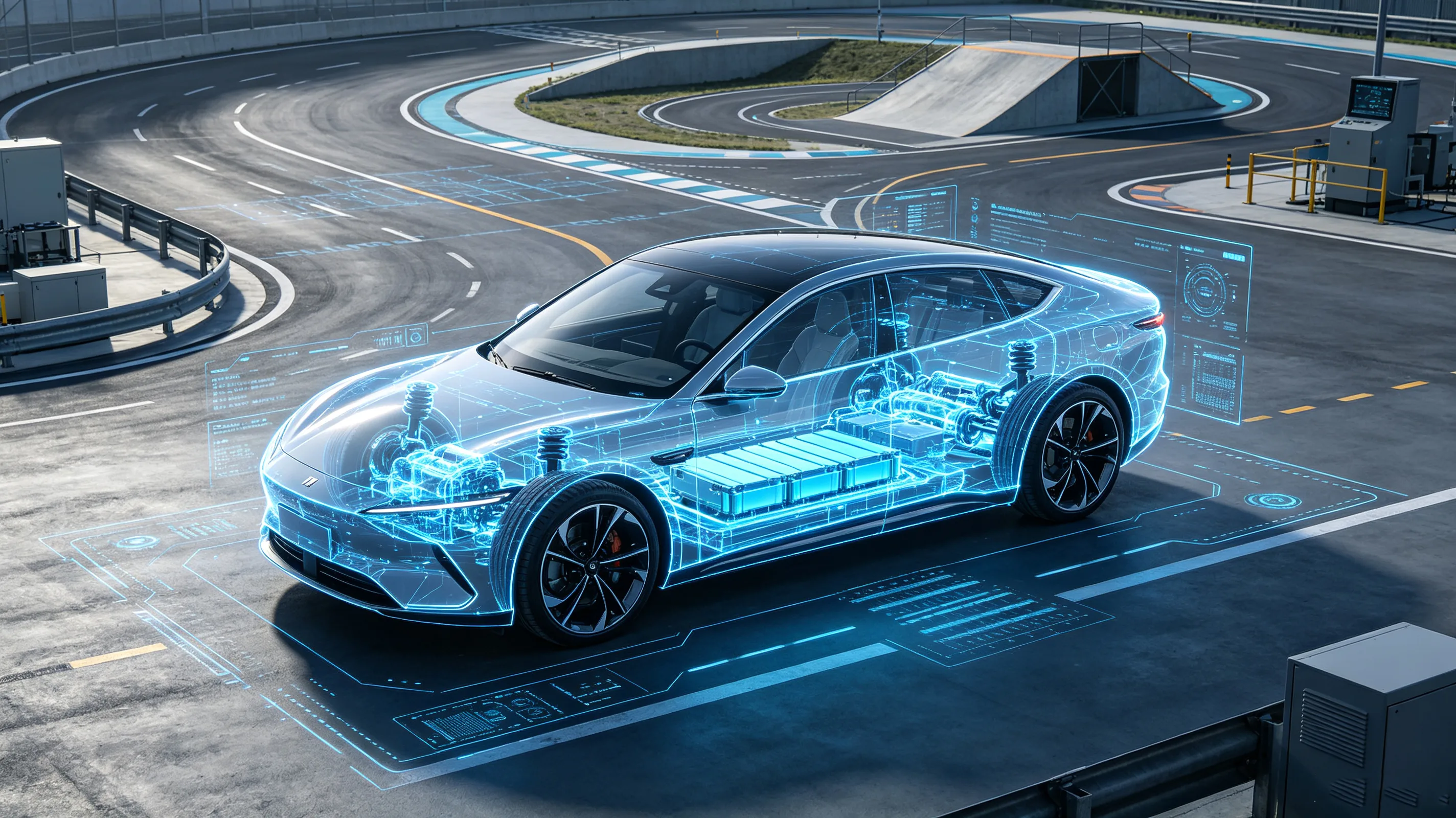
Digital twin technology creates a 1:1 high-fidelity virtual mirror of a real physical vehicle, real road, or test track as its sole corresponding entity, with real-time bidirectional data synchronization via sensors and road testing equipment. It embeds CAE simulation and AI algorithms at the core, adding real-time data links, virtual-physical interaction, and closed-loop feedback—going beyond mere simulation.
(Image source: Doubao AI-generated)
Real-vehicle road data can be synchronized in real-time to virtual twin roads, enabling infinite replay of rare AEB (Autonomous Emergency Braking) failures or chassis distortion noises observed during road tests for hardware-in-the-loop (HIL/VIL) calibration. The twin model can also synchronize chassis stress, battery temperature, and suspension fatigue loads in real-time, predicting component fatigue failure points and optimizing chassis structures in advance.
In this virtual world, tests that once required dozens of physical vehicles can now be achieved by producing just a few vehicles to build a 1:1 high-fidelity virtual mirror, enabling infinite repeat testing and significantly shortening model R&D time and test vehicle production costs.
Digital twins have reconstructed traditional automotive testing models, drastically shortening R&D cycles and reducing testing costs—becoming a critical technology for intelligent R&D, technological democratization, and global competitiveness among automakers.
However, Dianchetong (ID: dianchetong233) reminds us that no matter how precise simulation models are, digital twins and AI simulation tests can never fully replace real-world road testing.
Nonlinear deformation of materials, component manufacturing tolerances, long-term aging and wear, sensor lens contamination, dust, and glare-induced noise—these real-world complexities can only be approximated infinitely by virtual models, not replicated at 100%.
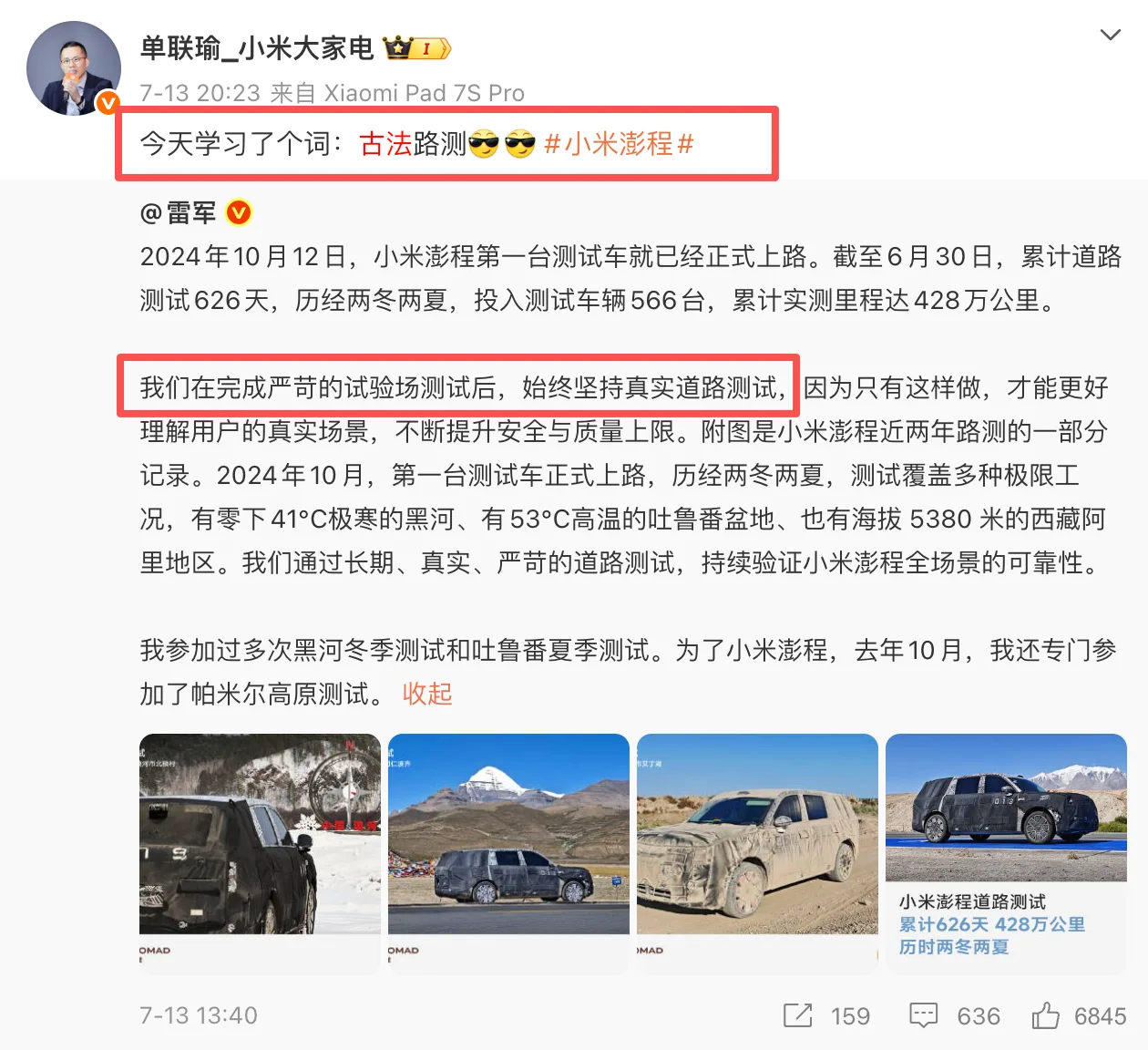
Xiaomi CEO Lei Jun stated directly on Weibo that Xiaomi always adheres to real-world road testing because only this approach allows a better understanding of genuine user scenarios, continuously improving safety and quality limits. Shan Lianyu, General Manager of Xiaomi's Large Appliance Division, referred to Xiaomi's testing approach as "ancient-method road testing" and, when asked by netizens if this indicated "insufficient technology," replied, "It means no shortcuts."
(Image source: Weibo screenshot)
When automakers use digital twins and AI simulation as tools to pre-screen product issues while retaining a complete real-vehicle validation process, these technologies greatly enhance product maturity.
If companies use simulation as an excuse to reduce real-vehicle testing, concealing gaps in physical validation with virtual mileage, new technologies risk becoming a cover for "rushed vehicles."
As consumers, we can trust the auxiliary value of virtual testing but must not blindly believe in it.
Short new vehicle development times are an objective trend in the software-defined automotive era, driven by platform-based architectures and digital tools—an industry transformation. They cannot be simply equated with "rushed vehicles." Automakers' adoption of digital twins, AI simulation, and other technologies is a rational choice to cope with rapid model iterations and fierce market competition in the new energy era.
No matter how powerful virtual simulation capabilities become, whole-vehicle durability, extreme-environment reliability, and component batch consistency still rely on real-world road testing.
Leading automakers, while using extensive virtual simulations, retain complete "three highs" (high-temperature, high-altitude, high-cold) tests. Simulation screens out most issues, while real-vehicle tests provide final confirmation. Real-world road test data is fed back to optimize digital twin models, forming a closed loop of virtual-physical calibration—not replacing physical validation with virtual testing.
(Image source: Doubao AI-generated)
Regulators have recognized the risks of "rushed vehicles," with two mandatory standards set to take effect in 2027.
The first is the "Road Motor Vehicle Production Enterprises and Product Access Review Requirements." Starting January 1, 2027, all newly launched vehicles must complete specified mileage reliability road tests: no less than 15,000 kilometers for pure electric vehicles and 30,000 kilometers for fuel and hybrid vehicles. Recently, the National Technical Committee for Automotive Standardization publicly sought opinions on aligning new energy and fuel vehicle standards, proposing a unified mandatory road test mileage of 30,000 kilometers.
The second is GB 44721—2026 "Intelligent Connected Vehicles—Autonomous Driving System Safety Requirements," effective July 1, 2027. It mandates that L3 and L4 autonomous vehicles undergo simulation, venue (track), and road tests—none can be omitted. It prohibits using mass-produced vehicle owners as free test subjects, setting a compulsory entry threshold for intelligent driving products.
The ultimate goal of the automotive industry has never been about speed—neither faster nor slower—but about ensuring product quality and passenger safety while increasing technological iteration frequency. By embracing the efficiency revolution brought by digital R&D while upholding safety baselines in the physical world, the industry can achieve high-quality development.
Chery, VOYAH, Xiaomi, Lei Jun, new energy vehicles
Source: Leikeji
Images in this article are from the 123RF licensed image library. Source: Leikeji
-
![]()
Top Domestic Computing Power Supplier Exceeds Net Profit Forecasts for First Half of the Year
-
![]()
Wanwei Advanced Materials Plans to Raise 2.3 Billion Yuan through Private Placement to Boost PVA Optical Film Production!
-
![]()
Tencent Launches WeChat AI + WorkBuddy: A Strategic Long-Term Play
-
![]()
Tencent's Grand Move: Leveraging WeChat AI+WorkBuddy
-
![]()
AR Optical Film Sees 110% Surge! Rijiu Optoelectronics’ Q2 Net Profit Rockets 135% QoQ
-
![]()
Global Panel Giant Finds No Buyers
-
![]()
OpenAI Shuts Down Atlas: Who Has the AI-Powered Browser Yielded To?
-
Stay Alert! Avoid Over-Reliance on AI Chats—It Can’t Address Core Issues