Li Shufu 'Steps Down,' Handing Over Reins to 30-Year Geely Veteran An Conghui
 08/20 2026
 435
435
Produced by Leida Finance | Text by Zhou Hui | Edited by Meng Shuai
With the departure of founder Li Shufu, Geely Auto has officially entered the 'era of professional management.'
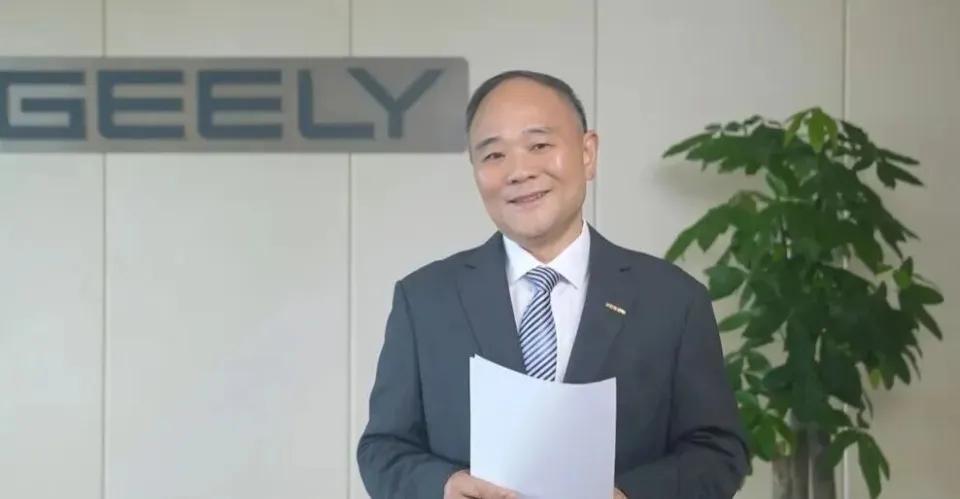
On August 17, Geely Auto announced that Li Shufu had resigned as Chairman of the Board, with seasoned executive An Conghui taking his place.
Following his resignation, Li Shufu will continue to serve as Chairman of Zhejiang Geely Holding Group and has been appointed Lifetime Honorary Chairman of Geely Auto.
On the same day, Geely Auto also unveiled a series of new personnel appointments. Gui Shengyue replaced Li Donghui as Vice Chairman of the Board, while Gan Jiayue succeeded Gui Shengyue as CEO.
Also on August 17, Geely Auto released a 'solid but unspectacular' interim financial report. In the first half of the year, the company achieved revenue of RMB 173.6 billion, up 15% year-on-year, with net profit attributable to the parent company at RMB 9.091 billion, down 2% year-on-year.
However, after excluding the net loss attributable to the parent company after tax from foreign exchange gains and losses and the impairment loss of non-financial assets, Geely Auto's core net profit attributable to the parent company rose to RMB 9.684 billion, up 46% year-on-year.
Notably, with the conclusion of the 'Li Shufu era,' Geely Auto is poised for new transformations under the leadership of its new management team.
According to Gan Jiayue, Geely Auto will discontinue the development of traditional fuel vehicles in the future, with all fuel models transitioning to i-HEV Intelligent Hybrid Technology.
In terms of global expansion, Geely Auto is displaying heightened 'ambition.' The company not only raised its full-year overseas sales target to 920,000 units but also formulated a more ambitious '123456 Strategy.'
Bidding Farewell to the 'Li Shufu Era': Major Leadership Reshuffle at Geely Auto
On August 17, Hong Kong-listed Geely Auto announced that Li Shufu had resigned as Chairman of the Board and Executive Director to dedicate more time to other business pursuits and align with the company's succession plan.
Public records indicate that Li Shufu was born in 1963 in Taizhou, Zhejiang Province. After graduating from high school, Li Shufu embarked on an entrepreneurial journey, operating businesses such as a photo studio, refrigerator factory, and motorcycle factory.
In 1997, Li Shufu officially entered the automotive industry, famously stating, 'Cars are not that remarkable; they're just four wheels, two sofas, and an iron shell.'
In 2001, Geely obtained the 'license to produce' passenger vehicles from the state, becoming China's first privately-owned automaker. Under Li Shufu's leadership, Geely Auto experienced continuous growth and expansion.
According to Tianyancha, Geely Auto was listed on the Hong Kong Stock Exchange in May 2005 and has since evolved into an automotive giant with a market capitalization of nearly HK$200 billion.
In recognition of Li Shufu's outstanding contributions to Geely Auto's development over the years, the Board of Directors appointed him as Lifetime Honorary Chairman of the company.
After stepping down from his previous roles, Li Shufu will continue to serve as Chairman of Zhejiang Geely Holding Group and, as the company's major and controlling shareholder, will fully support Geely Auto's long-term development.
Following Li Shufu's resignation, An Conghui, a seasoned executive with 30 years of experience at Geely, was appointed as the new Chairman of the Board of Geely Auto.
The Board of Directors of Geely Auto stated that An Conghui's appointment as Chairman is part of an orderly succession plan, consistent with the company's previously disclosed long-term succession strategy.
In the Board's view, An Conghui's extensive experience within the controlling shareholder group and his in-depth understanding of the company's business operations and strategic direction will enhance strategic synergies, strengthen cooperation with the controlling shareholder, and promote the company's sustainable growth and long-term development.
Simultaneously, this leadership transition will further strengthen strategic synergies between the Group and the controlling shareholder and facilitate the continuous sharing of the controlling shareholder group's industry expertise, strategic resources, management experience, and business cooperation opportunities.
In addition to the aforementioned changes, Geely Auto also disclosed a series of new personnel appointments: Li Donghui resigned as Vice Chairman of the Board and will continue to serve as an Executive Director.
Gui Shengyue succeeded Li Donghui as Vice Chairman of the Board and will continue to serve as an Executive Director; Gan Jiayue replaced Gui Shengyue as CEO, responsible for the company's daily operations and driving the implementation of long-term strategic goals. All appointments took effect on August 18, 2026.
Regarding this large-scale personnel adjustment, Gui Shengyue said, 'This marks Geely Auto's transition from the entrepreneurial and development phases driven by the 'founder' to a mature phase driven by 'systems and teams.' The enterprise is shifting from relying on individual charisma and authority to relying on organizational systems and talent pipelines, indicating more transparent corporate governance, more professional decision-making, and more scientific management. For internal talent, it also signals the breaking of glass ceilings.'
Li Shufu stated, 'An Conghui is an outstanding professional talent cultivated within the Geely system. I am fully confident in Geely Auto's performance under An Conghui's leadership as Chairman of the Board.'
Revenue Hits New High in First Half, Net Profit Attributable to Parent Company Sees Slight Decline
While announcing the leadership change, Geely Auto also disclosed its performance for the first half of 2026 to the public.
Regarding this financial report, Gui Shengyue, who is about to step down as CEO, said bluntly, 'This is a solid financial report, but not a spectacular one.'
According to Geely Auto's 2026 interim performance presentation materials, total sales volume reached 1.423 million units in the first half of the year, up 1% year-on-year, setting a new historical high.
By brand, in the first half of 2026, Zeekr's total sales volume reached 178,000 units, up 97% year-on-year, with brand contribution revenue surging 103% from RMB 27.14 billion in the same period last year to RMB 55 billion, demonstrating significant progress in premiumization.
During the same period, Lynk & Co's sales volume was 144,000 units, with new energy vehicle sales at 94,000 units, up 9% year-on-year, accounting for 65% of total sales.
Galaxy's sales volume in the first half of the year was 520,000 units, ranking second among all brands in China's new energy passenger vehicle market.
Additionally, China Star sold a total of 581,000 vehicles in the first half of the year, with its domestic market share increasing by 1.7 percentage points year-on-year to 10.4%.
At the same time, Geely Auto performed outstandingly overseas: It exported 474,000 vehicles in the first half of the year, up 158% year-on-year. Among them, new energy vehicle exports reached 277,000 units, surging 585% year-on-year.
Thanks to the significant results of its premiumization and globalization strategies, Geely Auto's total revenue and average revenue per unit reached new historical highs.
In the first half of the year, Geely Auto achieved total revenue of RMB 173.6 billion, up 15% year-on-year; the average sales revenue per unit reached RMB 112,000, up 16% from RMB 96,000 in the same period last year.
However, dragged down by a net loss attributable to the parent company after tax of RMB 550 million from foreign exchange gains and losses and an impairment loss of RMB 45 million from non-financial assets, Geely Auto's net profit attributable to the parent company in the first half of the year declined by 2% year-on-year to RMB 9.091 billion.
After excluding the impact of the aforementioned factors, Geely Auto's core net profit attributable to the parent company in the first half of the year was RMB 9.684 billion, up 46% year-on-year.
In addition, the increase in the company's gross profit margin further reflects the rise in Geely Auto's profitability. In the first half of the year, Geely Auto achieved a total gross profit of RMB 31.2 billion, up 26% year-on-year; the gross profit margin increased from 16.4% in the first half of 2025 to 17.9%.
In terms of expenses, in the first half of the year, Geely Auto's distribution and sales expenses were RMB 9.826 billion, up 16.27% year-on-year; administrative expenses were RMB 2.93 billion, up slightly by 0.53% year-on-year; R&D expenses increased by 25.5% year-on-year to RMB 9.199 billion.
Data from Tonghuashun iFinD showed that as of the end of the first half of the year, Geely Auto's total assets were RMB 300.853 billion; its cash reserves were as high as RMB 69.556 billion, up 2% from the end of 2025.
During the same period, the company's total liabilities reached RMB 204.982 billion. Based on this calculation, Geely Auto's asset-liability ratio as of the end of the first half of the year was 68.13%, up 0.37 percentage points from the end of 2025.
Farewell to Traditional Fuel Vehicles, Accelerating Global Expansion
Although not 'spectacular,' Gui Shengyue also said, 'This is a financial report that can be sustained in the long term and has significant room for improvement.' As for how to improve, clues may be found at Geely Auto's interim performance briefing.
At the briefing, An Conghui, who is about to take over as Chairman of the Board of Geely Auto, stated that the overseas market will be transformed into an important growth driver for Geely, accelerating overseas expansion while increasing domestic market share, with the long-term strategy of achieving two-thirds of sales from overseas markets.
Based on the export sales volume growth rate of up to 158% year-on-year in the first half of the year, Geely Auto's management raised the full-year overseas sales target from the previous 640,000 units to 920,000 units and plans to further reach a million-level overseas sales target.
Gan Jiayue, who is about to take over as CEO, also disclosed Geely's '123456 Strategy' for the overseas market for the first time when answering analysts' questions: to build a unified overseas Geely system consisting of the tech-luxury brand Zeekr, the sporty trend brand Lynk & Co, and the mainstream family car brand Geely.
Specifically by region, the goal is to build a 600,000-unit European market, a 500,000-unit ASEAN market, a 400,000-unit Latin American and African market, a 300,000-unit Eastern European market, and a 200,000-unit Middle East and South Asian market, totaling a long-term overseas sales blueprint of 2 million units.
While continuing to ramp up its overseas business, Geely Auto will also adjust its internal product lineup. Gan Jiayue revealed that Geely will cease developing traditional fuel vehicles in the future, with all fuel models fully transitioning to i-HEV Intelligent Hybrid Technology.
It is reported that this technology is based on AI intelligence and is equipped with a 60C high-rate battery, a 230 kW high-power electric drive, and an engine with a thermal efficiency of 48.41%. Its fuel consumption is 12% lower than that of the world's most fuel-efficient Japanese hybrid benchmark model, and its zero-to-100 km/h acceleration is more than 1 second faster.
Gan Jiayue stated that the new technology will be applied to multiple models launched in the second half of the year, such as the Xingyue L Plus, Xingrui L Plus, and Boyue L, aiming to achieve the goal of building a million-level China Star series.
In response to the soul-searching questions of 'product cannibalization among brands' and 'lack of blockbuster models,' Geely Auto's solution is to reduce the number of products and broaden product categories.
Gan Jiayue revealed that from last year to this year, Geely has reduced its product lineup by more than 20% internally. In the second half of the year, the Galaxy brand will launch the Zhanjian 700 and Galaxy TT, entering the off-road and pure electric vehicle segments, respectively.
An Conghui also admitted, 'We lack strength in the mid-tier segment. We have Zeekr at the top and Xingyuan at the bottom, but our mid-tier products are indeed insufficient.'
An Conghui stated that the management team has recognized this issue and is making adjustments. Once blockbuster mid-tier products emerge, Geely Auto's gross profit margin, selling price, and profits will further improve.
With the conclusion of the 'Li Shufu era,' what kind of development will Geely Auto undergo next? Leida Finance will continue to monitor the situation.
-
![]()
2026 Chengdu Auto Show Preview: Emerging Forces, Top Five Chinese Brands in Showdown, Joint Ventures Speed Up Localization Efforts
-
Has Xiaomi Weathered Its Toughest Phase as Single-Quarter Revenue Again Tops 100 Billion Yuan?
-
![]()
14.6 Billion Yuan in Asset Impairment Losses: What’s Ailing Geely Holding Group, and How Will Li Shufu Navigate the Crisis?
-
![]()
Baidu’s WorkBuddy: Beyond Task Completion, Toward Trusted Automation
-
![]()
Bu Yizhou from Junyuan Capital: The Allure of Commercial Space Investment Transcends Mere Rocket Recovery Success
-
![]()
Avita Seeks Independence from Huawei
-
![]()
Li Shufu 'Steps Down,' Handing Over Reins to 30-Year Geely Veteran An Conghui
-
HONOR Incorporates 'DJI-Inspired' Tech into Smartphones: Hype Surpasses Actual Sales