Cubic Sensors and Instruments Air Quality Sensor Module: Focusing on PM2.5 for Comprehensive Cabin Air Monitoring
 08/27 2026
 395
395
The automotive cabin environment is experiencing a significant transformation in terms of value perception. Over the past ten years, Original Equipment Manufacturers (OEMs) have poured substantial resources into enhancing interactions within the cabin—think expansive touchscreens, voice control, gesture recognition, Head-Up Displays (HUDs), integrating every conceivable feature. However, as interaction experiences start to resemble one another, where does the next competitive edge in cabin innovation lie?
The answer can be found in a more fundamental, yet often overlooked, aspect: air quality sensing.
Under the blazing summer sun, with windows tightly shut and the cabin in recirculation mode, PM2.5 levels can soar to several times those found outside. During extended drives, CO2 concentrations build up, leaving passengers feeling lethargic. In heavy traffic, exhaust fumes can infiltrate the cabin unnoticed. These scenarios are daily occurrences, yet most cabins remain unaware of them. The absence of effective air quality sensing ultimately compromises the health and well-being of the occupants.
PM2.5: The Key Indicator in Automotive Air Quality Sensing
Among all metrics used to assess cabin air quality, PM2.5 stands out as the most frequently monitored and directly perceived by users. It serves as the primary basis for decisions regarding air conditioning recirculation and purification activation.
What truly defines the quality of the air sensing experience is the interplay of three critical factors: the ability to accurately distinguish between low PM2.5 concentrations, such as 35μg/m3 and 50μg/m3; the rapid response time to switch to recirculation mode when exhaust fumes are detected; and the ability to operate unobtrusively within the cabin with minimal noise. These parameters collectively address a fundamental question: Is the sensor providing precise measurements or merely rough estimates?
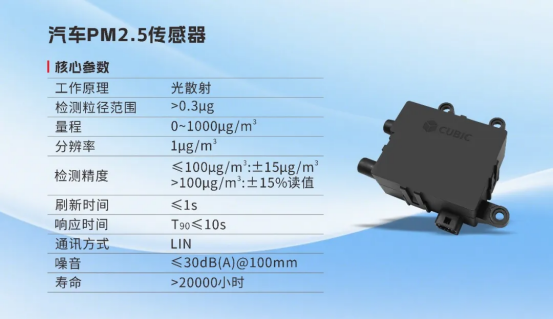
Cubic Sensors and Instruments has honed its expertise in Automatic Particle Identification (API) and sheath gas protection structures, transitioning from industrial dust monitoring to automotive-grade solutions. The value of API lies in its cross-dust-source consistency: it delivers measurements that closely align with those of standard instruments across various scenarios. This reliability is not merely the result of "precision" calibration under specific conditions but is genuinely validated through extensive testing in industrial dust, atmospheric monitoring, cleanrooms, and automotive cabins.
According to Yole Intelligence's "Gas and Particle Sensors 2024" report, Cubic holds the top position in the global market share for PM sensors. However, the true significance lies not in the ranking itself but in the scale of installations—the vast amount of real-world vehicle data continuously feeds back into the API algorithm iterations, with accuracy enhancements derived from actual road conditions rather than laboratory simulations.
Cubic Sensors and Instruments: A Holistic Approach to Air Quality Sensing
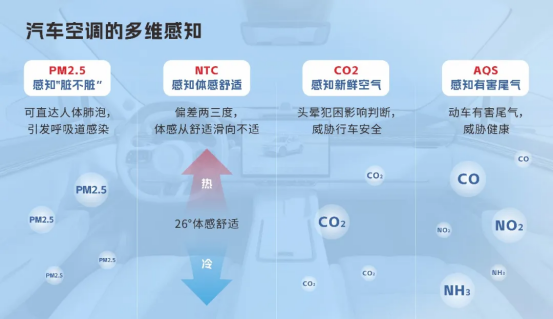
An exceptional PM2.5 sensor can determine whether the air is polluted. However, effective air conditioning management requires a more comprehensive approach.
A mere two-to-three-degree deviation in outlet air temperature can shift the cabin environment from comfortable to uncomfortable—NTC sensors must accurately gauge whether the temperature is appropriate. When CO2 levels surpass 1000ppm, occupant attention spans decline—CO2 sensors must promptly decide when to initiate ventilation. In traffic, when exhaust fumes start to seep in—AQS sensors must swiftly determine when to switch to recirculation mode.
If each of these dimensions necessitates a separate sensor for procurement, assembly, and calibration, the Bill of Materials (BOM) costs, production line stations, incoming inspections, and EMC testing would multiply significantly. Cubic's solution is not to simply stack sensors but to build a comprehensive system around PM2.5.
▲PM2.5+NTC: The AIS-3307 integrates NTC temperature sensing into the same optical and algorithm system without compromising precision.
▲PM2.5+CO2: The AIS-3700 offers high integration, enabling real-time synchronous monitoring and alerts for both CO2 excess and dust pollution.
▲PM2.5+AQS: The AIS-3600 monitors external harmful gases, triggering recirculation before they can enter the cabin.
▲And more: Additional integration options are available on the same platform...
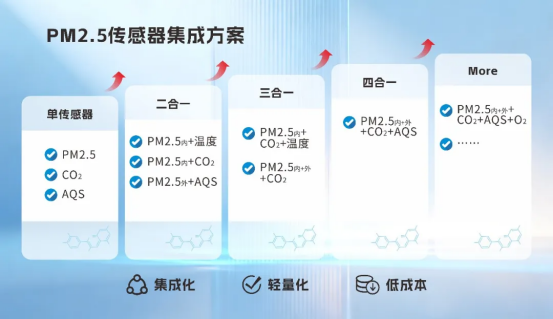
The continued preference by global mainstream automakers for Cubic's in-vehicle sensor solutions underscores their technical reliability and engineering adaptability. From standalone products to integrated combinations, from basic functionality to enhanced user experience, Cubic's flexible technical architecture enables models across different tiers to achieve differentiated cabin air management—making comfort a standard feature of every journey.
-
![]()
Cubic Sensors and Instruments Air Quality Sensor Module: Focusing on PM2.5 for Comprehensive Cabin Air Monitoring
-
![]()
Optical Components and Assemblies Surge 45.75% Year-on-Year! Yongxin Optics Reports 564 Million Yuan in First-Half Revenue
-
![]()
Sunny Optical’s Semi-Annual Report: Mobile Phone Profits Slide by RMB 280 Million, Robotics Business Surges to Mitigate Losses
-
![]()
Performance Examination of Hong Kong Stocks: From Pop Mart to Newborn Town and Kingsoft Cloud, Market Preferences May Be Shifting
-
![]()
ARR in August Surges Past $800 Million, MiniMax's Darkest Hour May Be Over
-
![]()
Major Changes in the Mobile Phone Industry: From 'Small Profits and High Sales Volume' to 'High-Priced Game of One Phone per Person'
-
![]()
Even Sues XGIMI in U.S. Court: $1.2 Million ‘AI Glasses’ Crowdfunding Campaign Abruptly Stops!
-
![]()
The world's third largest mobile operating system was born in China! Installed on over 1.3 billion devices