ARR in August Surges Past $800 Million, MiniMax's Darkest Hour May Be Over
 08/27 2026
 542
542
From 'Building Apps' to 'Selling Intelligence': MiniMax's B-End Engine Ignites
Produced by | Meigang Investigation
When evaluating a model company, the investigator is accustomed to looking at two report cards. One answers how smart the model is, and the other answers whether this intelligence can actually be sold.
The first report card tends to be lively, with benchmarks, rankings, and parameters being refreshed every few weeks. The second is much quieter, focusing only on Tokens, revenue, and gross profit.
On August 26, after the market closed, MiniMax released its first semi-annual report since going public.
After reviewing the financial report, the investigator's first impression is that MiniMax's darkest hour may have passed. These results are sufficient to dispel market pessimism: this is a unique company with both strong technical and commercial capabilities, as well as expertise in both multimodal and large language models.
Despite intense competition, the AI market is still in its early stages. During the earnings call, MiniMax addressed market questions about its technical approach. Many asked why the company was pursuing multimodal capabilities, as the future will not rely solely on large language models. When scenarios begin to intersect, MiniMax's unique value will become apparent.
Such scenarios have already started to emerge in scientific research, a market more than ten times larger than coding. The investigator's sense from this financial report is that MiniMax's better days may be approaching soon. While it's unclear how much longer it will take, at least the tough times have passed.

MiniMax's Growth Curve Suddenly Steepens, Surpassing Last Year's Full-Year Performance in Six Months
Let's first highlight several key figures.
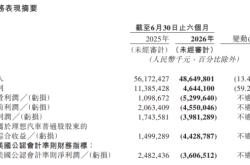
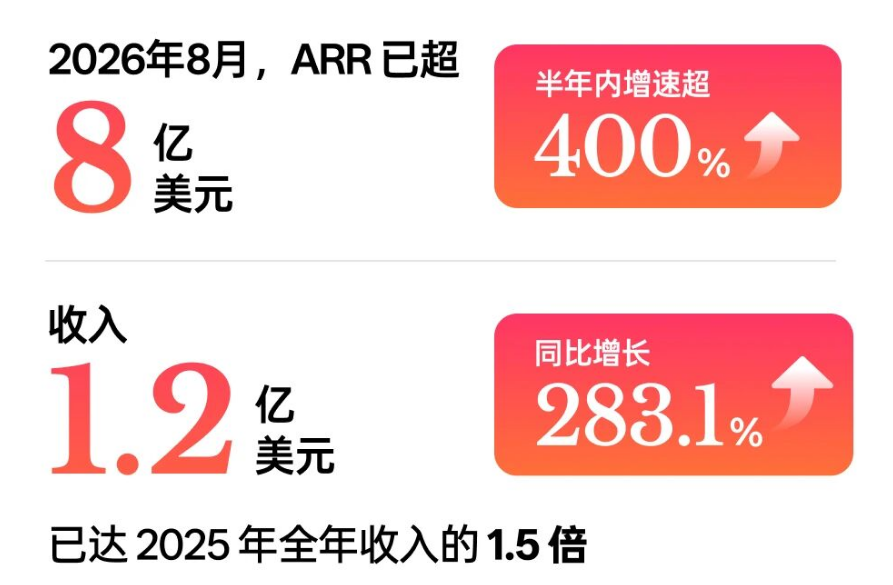
MiniMax's full-year revenue for 2025 was $79 million. This year, it achieved approximately 1.5 times that amount in just six months.
When viewed over a longer timeframe, the growth curve becomes even more striking.
Revenue in the second quarter increased by 81.8% sequentially from the first quarter; Token consumption in July reached 20 times that of January; ARR was $150 million in February, exceeded $300 million in May, and further rose to $800 million in August.
In six months, ARR expanded to 5.33 times its original level.
Thus, $117 million represents revenue already confirmed in the financial report, while the $800 million ARR more closely reflects MiniMax's current business operating speed. The market is seeing a report card as of the end of June, but the company has already advanced to August.

From 'Building Apps' to 'Selling Intelligence': MiniMax's B-End Engine Ignites
In the past, when the market mentioned MiniMax, the first reaction was usually to consumer products like Conch AI and Talkie. This impression is not surprising. In the first half of 2025, AI-native products contributed 69.7% of the company's revenue, while open platforms and enterprise services accounted for only 30.3%.
But a year later, the situation had completely reversed.
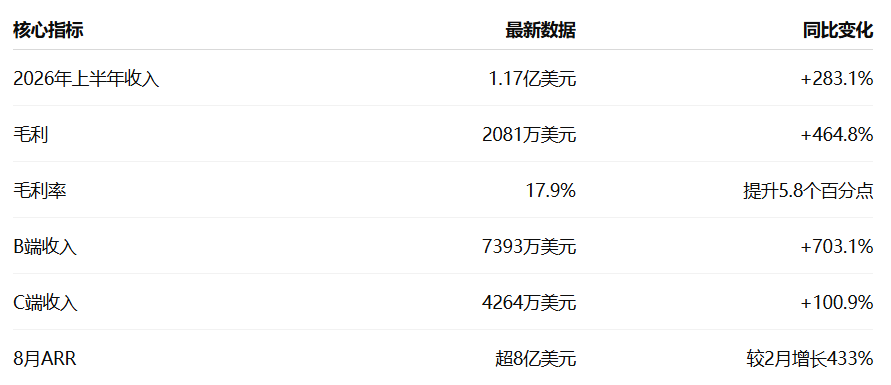
In the first half of 2026, MiniMax's revenue from open platforms and other AI enterprise services reached $73.93 million, a 703.1% year-over-year increase, accounting for 63.4% of total revenue. By August, the B-end's share of overall ARR had further risen to 80%.
The C-end has not been left behind. Revenue from AI-native products in the first half reached $42.64 million, a 100.9% year-over-year increase. The rapid rise in the B-end's proportion is not because the C-end is stagnating, but because the B-end itself has grown more than sevenfold.
During the earnings call, management further broke down this growth.
Currently, MiniMax has surpassed 2 million enterprise clients and developers, ten times the number at the end of last year. While new clients have contributed, existing clients have also continued to expand their usage. With the M3 series maintaining the same price as the M2 series while improving model capabilities, clients have begun unlocking more usage scenarios, leading to increased Token consumption per client.

There's a detail here that I find particularly noteworthy.
In the past, it was mostly 'humans asking AI questions.' Now, more and more demands are being broken down by Agents into multi-round model requests, tool invocations, and sub-Agent tasks. While users may only issue a single command on the surface, dozens or even more model interactions may be triggered behind the scenes.
This explains a seemingly exaggerated statistic: while the number of enterprise clients and developers has grown tenfold, Token consumption has increased twentyfold in six months.
Growth is not just about more clients—it's also about each client using the platform more deeply.
Thus, MiniMax's commercial identity is also changing. In the past, it resembled more of an AI application company with self-developed models. Now, it is increasingly approaching a global AI platform with both foundational models, open platforms, and end-user products.

Gross Profit Surges 465%: MiniMax Aims to Cut Inference Costs by Another Two-Thirds
While a 283.1% revenue increase is impressive, I'm even more interested in the 464.8% growth in gross profit.
In the first half, MiniMax's gross profit reached $20.81 million, with the gross margin improving from 12.1% to 17.9%, a 5.8 percentage point increase. Meanwhile, sales and distribution expenses decreased by 17.9% year-over-year.
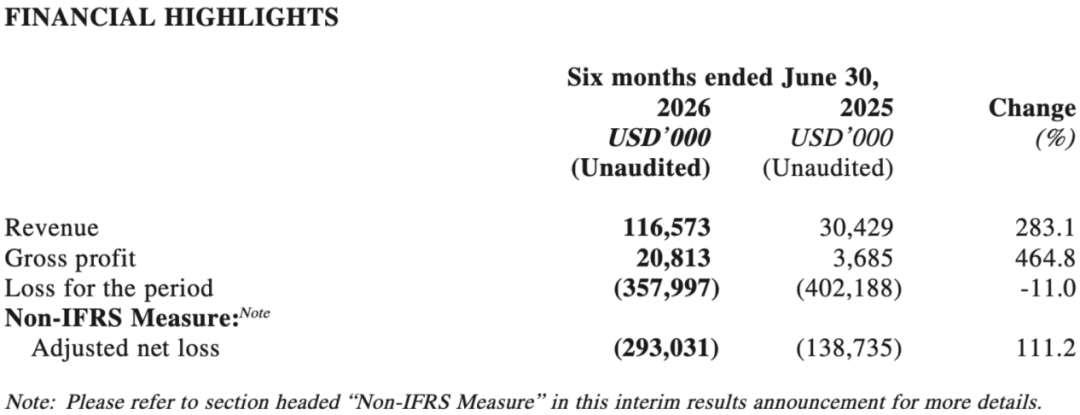
With revenue nearly quadrupling and sales expenses declining, this indicates that a growing portion of the new revenue comes from model capabilities, developer adoption, and organic usage, rather than relying on heavy sales investment.
The fact that gross profit growth outpaces revenue growth suggests that as infrastructure efficiency improves, the gross profit retained per dollar of revenue is increasing.
Management provided a more specific explanation for this.
Over the past two months, MiniMax's text model has tripled its unit computing throughput. The M3.1, currently under development, aims to reduce inference costs to about one-third of what they were when M3 was first launched.
This goal is not achieved through a single optimization but through joint improvements in the model, inference system, and infrastructure.
MiniMax's proposed MSA 2.0 architecture will further reduce the storage capacity required for KV Cache, improving cache hit rates and Batch Size. At the maximum parameter scale, the company expects computing efficiency to improve about threefold compared to the first-generation architecture, with even greater efficiency advantages for longer tasks and more complex contexts.
This also explains a phrase management has repeatedly emphasized:
"Minimize the Inference Cost, Maximize the Intelligence."
Lower inference costs connect to commercialization on one end: clients can afford to use more, allowing Token scale to continue expanding. On the other end, it connects to model R&D: synthetic data, reinforcement learning Rollout, and evaluation all require significant inference, so higher efficiency means more post-training can be accomplished with the same computing power.
Management puts it bluntly: inference is both a process of supplying intelligence externally and producing the next generation of intelligence internally.
The company's Effective Training Time Ratio (ETTR) has reached 97%, and there is still at least a threefold improvement potential in post-training scale per unit of capital efficiency. Management expects gross margins to continue improving in the second half of the year and to rise further next year.
In the first half, MiniMax's R&D investment reached $297 million, a 138.8% year-over-year increase, but significantly lower than revenue growth; net loss under IFRS narrowed by 11% year-over-year. After completing a HK$16 billion private placement in July, the company's cash reserves exceeded $3 billion, providing a stronger financial foundation for continued training of large models.

H3 Open Source Ignites Multimodal: MiniMax Finds Another High-Value Entry Point
Coding is currently the clearest direction for model commercialization, with multimodal productivity potentially being the next.
In just over three weeks since H3's open-source release, it has been downloaded more than 24 million times, spawning over 300 publicly available derivative models, making it one of the most downloaded models globally in 2026. Management revealed that official service usage of H3 has also exploded since its launch.
Its value extends beyond video generation.
H3 attempts to truly integrate language models with visual generation, enabling the model to understand context, reference materials, and user intent before participating in camera control, subject consistency, sound synchronization, and continuous revisions.

Video models are thus evolving from 'generating a clip' to encompassing complete workflows in advertising, e-commerce, gaming, design, and film and television. Models are not just responsible for generation but also for understanding, revising, and ultimately delivering finished work.
MiniMax's decision to open-source H3 also follows a clear commercial logic.
Open-sourcing lowers the adoption barrier for developers and enterprises, allowing the model to integrate more quickly into cloud platforms, development tools, and enterprise workflows. Meanwhile, large-scale commercial revenue will ultimately still come from efficient inference, stable services, API calls, and enterprise delivery.
Next, the company will advance M3.1, M3 Pro, and H3.1. M3 Pro's parameter scale is expected to increase to about 3T, with expanded reinforcement learning and long-task training.
What MiniMax is competing for is no longer just a ranking on a model leaderboard but the long-term competition in model iteration speed and unit computing power output.

Market Cap at HK$105.8 Billion: Is the Market Racing Ahead, or Still Underestimating?
As of the August 26 close, MiniMax's market cap was approximately HK$105.8 billion.
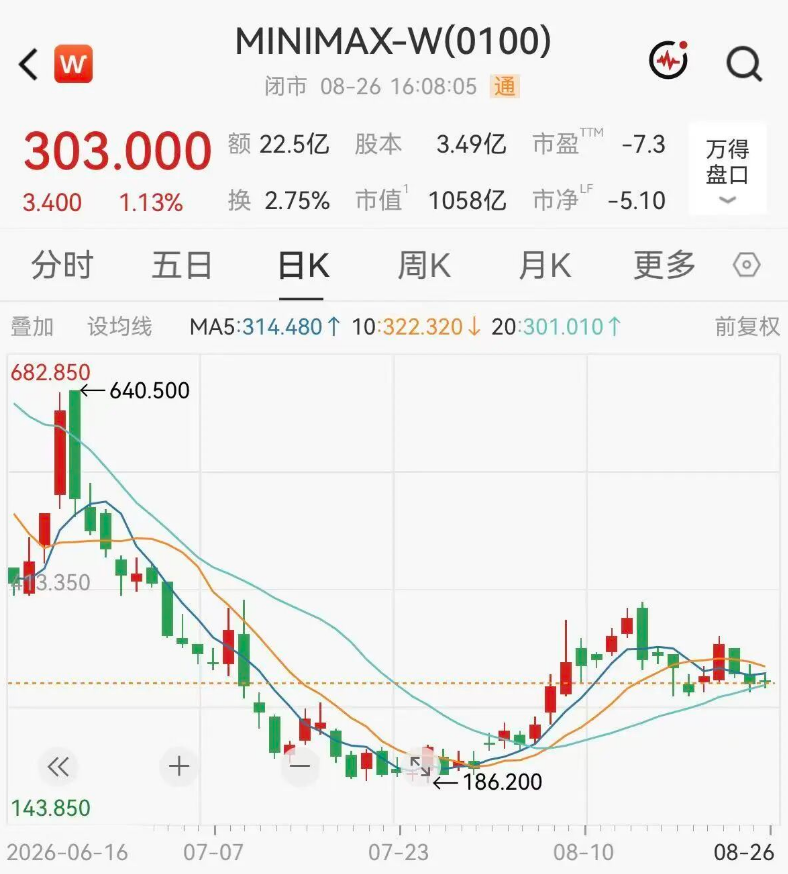
If we simply annualize the first half's revenue, the company's PS ratio is about 58x; if calculated based on August's $800 million ARR, the P/ARR ratio is about 17x.
The two methods differ by more than threefold, with the issue lying in the denominator.
Static P/S calculates based on already confirmed revenue, while P/ARR reflects the latest operating speed as of August. What the market is truly trading on now is how quickly the $800 million ARR can convert into reported revenue.
A rough calculation based on the August 26 market cap and public operating rate puts Zhipu's P/ARR at about 61x; Anthropic, based on its latest private valuation and revenue operating rate, is about 15x. Given differences in statistical methods among the three companies, these figures are only suitable for observing general positioning.
Placing MiniMax among global leading model companies, its valuation is now close to Anthropic's range.
Thus, whether the valuation can continue to be absorbed depends mainly on three factors going forward:
First, how quickly the $800 million ARR can convert into revenue;
Second, whether M3.1 can achieve its goal of reducing inference costs to one-third;
Third, after the B-end accounts for 80%, whether it can continue to sustain growth.

How to view this matter?
The core narrative of MiniMax's interim report can be summed up in one sentence: Chinese large model companies are not only capable of technological innovation but also of commercialization. Moreover, the pace of commercialization is faster than most people anticipate.
The most eye-catching surface-level data includes a 283.1% increase in revenue and a 464.8% growth in gross profit.
However, I believe that what truly warrants a market revaluation are three interlocking sets of changes: the number of enterprise clients and developers has surged to 2 million, Token usage has grown 20-fold in half a year, and ARR has risen to 5.33 times its previous level in six months.
More clients, deeper usage, and lower unit costs form the complete chain of acceleration for a model company's commercialization.
Therefore, after the release of the financial report, when re-evaluating MiniMax, focusing solely on model rankings is no longer sufficient.
What deserves closer attention next is how much revenue the $800 million ARR can deliver, how far M3.1 can reduce costs, and how much further the 17.9% gross margin can climb.
If the targets outlined in the conference call are gradually achieved, the 283% growth may merely be the starting line before MiniMax truly accelerates.

Disclaimer: This article is based on the public company attributes of the listed company. Meigang Tanan strives to ensure the objectivity and fairness of the content and viewpoints presented in the article but does not guarantee its accuracy, completeness, or timeliness. The information or opinions expressed in this article do not constitute any investment advice, and Meigang Tanan assumes no responsibility for any actions taken based on the use of this article.
-
![]()
ARR in August Surges Past $800 Million, MiniMax's Darkest Hour May Be Over
-
![]()
Major Changes in the Mobile Phone Industry: From 'Small Profits and High Sales Volume' to 'High-Priced Game of One Phone per Person'
-
![]()
Even Sues XGIMI in U.S. Court: $1.2 Million ‘AI Glasses’ Crowdfunding Campaign Abruptly Stops!
-
![]()
The world's third largest mobile operating system was born in China! Installed on over 1.3 billion devices
-
![]()
Chinese Home Appliance Giants Face Collective Awkward Phase | WaveTide
-
![]()
Is 18 Months Truly Adequate for a Vehicle to Go from Design to Market?
-
![]()
Li Auto Reports Q2 Net Loss of 1.7 Billion Yuan
-
![]()
Zhao Changjiang: ZHIJIE RX Stands Unrivaled