The Hundred-Glasses Battle Kicks Off: Will the Entry of Giants Trigger a Smartphone-like Oligopoly?
 02/02 2026
 817
817
By Haishan
Source: Bowang Finance
With the smartphone market saturated, where will the numerous players in the industry head next?
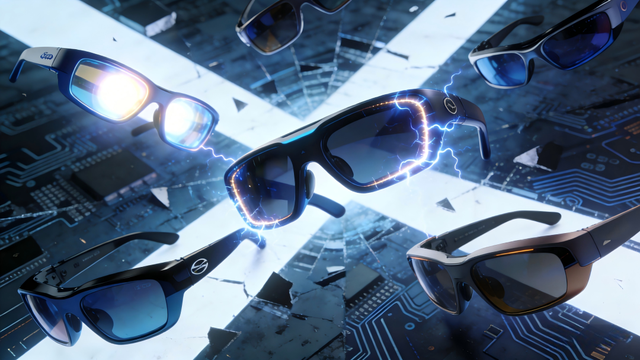
As the smartphone market growth decelerates and the industry stabilizes, smart glasses, propelled by technological advancements and expanded use cases, have emerged as a rare sector experiencing explosive growth in consumer electronics. Players from various sectors, including internet giants, smartphone manufacturers, automakers, and ecosystem companies, are all rushing in.
Now, this 'Hundred-Glasses Battle' has not only disrupted the traditional dominance of optical companies but also propelled the industry through a rapid transformation from hype-driven to demand-driven growth in just two years.
However, behind the excitement, the industry is displaying typical characteristics of consumer electronics: a cluster of players leading to premature functional convergence, with the looming threat of homogenized competition.
Powered by large models, 5G, and optical technologies, smart glasses are advancing towards a new era characterized by high aesthetics, lightweight design, and deep AI integration. Yet, amid intensifying competition, market shakeouts, and diverging development paths, they face critical choices. Will they repeat the smartphone oligopoly or carve out new paths through ecological integration and scenario innovation?
In fact, this enduring battle over technology, branding, and user needs has become one of the most noteworthy focal points in the tech industry.
01
Cross-Sector Players Flood In, Leading to Premature Functional Convergence?
Since the end of the golden growth phase for smartphones, smart glasses have been one of the few subsectors experiencing explosive growth. The more a sector's supply and demand amplify, the more aggressively players will enter the market. According to incomplete statistics, there are dozens of domestic players in the smart glasses sector, with the industry scale growing rapidly.
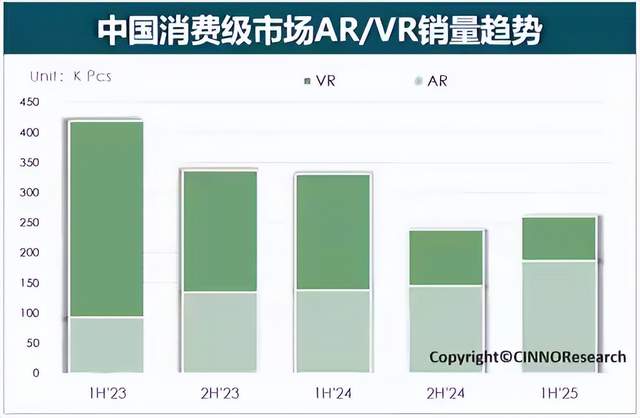
However, unlike the automotive industry, which is still largely dominated by traditional OEMs, the leading forces in the smart glasses industry are not traditional optical giants like Chiba Glasses, Thornbird Glasses, or even Zeiss. Instead, internet giants, smartphone manufacturers, automakers, and other ecosystem companies have taken the lead.
Currently, besides familiar names like Quark, INMO, Thunderbird, Rokid, and Xiaomi, giants like Alibaba, Li Auto, and Huawei have also entered the fray. Once considered a 'niche toy,' smart glasses have now become a coveted prize pursued by capital and fiercely contested by companies, with the player lineup continuously expanding and industry boundaries blurring.
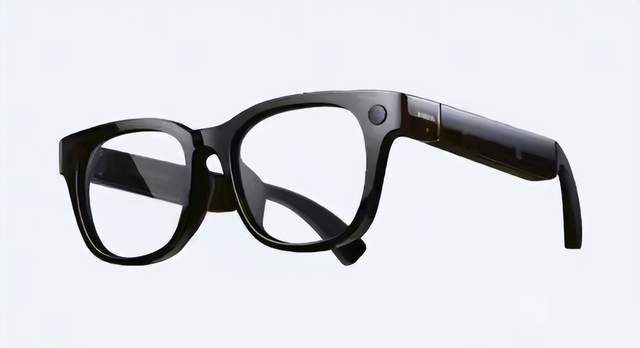
On the surface, these companies use smart glasses as a link to firmly bind users to their ecosystems, forming closed-loop barriers with their core businesses and shaping what the outside world calls 'new entry points.' However, attributing the influx of giants solely to new interaction or connection entry points oversimplifies the matter.
On one hand, the domestic market is still far from shipping at the ten-million scale. Even if the average unit price of smart glasses reaches 2,000 yuan (about 280 USD), the pie of profits to be shared is not large. On the other hand, the iteration speed of large models has been shortened to just a few months. Feishu's 'Doubao' and DingTalk's 'Tongyi Qianwen' are continuously investing in multimodal fields. Smart glasses are essentially a key scenario for companies to race to validate their model capabilities.
This means that the hotter the sector, the more cross-sector players enter, and the faster homogenization arrives—a typical pattern in the consumer electronics industry.
02
Will Intense Competition Become the Next Theme?
As any industry transitions from a blue ocean to maturity, both insiders and outsiders worry about whether it will descend into intense competition. The brutal price wars and verbal battles in the past new energy industry are prime examples.
Judging by the product evolution trends of smart glasses, the next focus will be on high aesthetics, lightweight design, and practicality, deeply integrating with AI technology to enter a co-definition era. The Ideal Livis AI glasses use Swiss EMS medical-grade TR90 material, weighing as low as 36 grams, with adjustable titanium alloy nose pads that fit Asian nose structures. The Quark AI glasses S1 series features a dual-optical machine binocular display solution with a brightness of 4,000 nits, solving display issues under outdoor strong light. Thunderbird Innovation focuses on shooting technology to enhance the imaging capabilities of AI glasses.
Behind almost all these trends is a signal that the early industry is shifting from hype to user demand, no longer pursuing gimmicky complex functions. Some manufacturers are beginning to focus instead on wearing comfort and practicality in high-frequency scenarios.
This implies that, unlike mature industries, intense competition in smart glasses may not manifest in price wars or overcapacity. After all, the current industry average price hovers around 1,500 yuan (about 210 USD), with some mainstream AI models priced between 1,800-3,800 yuan (about 250-530 USD), with much smaller fluctuations than the smartphone industry at the same stage.
This is because the industry is still in its growth phase, with high-margin spaces not yet formed and market demand still rapidly expanding. iMedia Research predicts that China's smart glasses sales will reach 41.533 million units by 2029, with vast growth potential preventing temporary overcapacity.
We judge that future intense competition will center on functional experience, with deep integration of large models raising user demands for interaction smoothness and scenario adaptability. For example, the Ideal Livis's 300ms wake-up speed and Quark AI glasses' multi-scenario ecological linkage represent competitions in different directions.
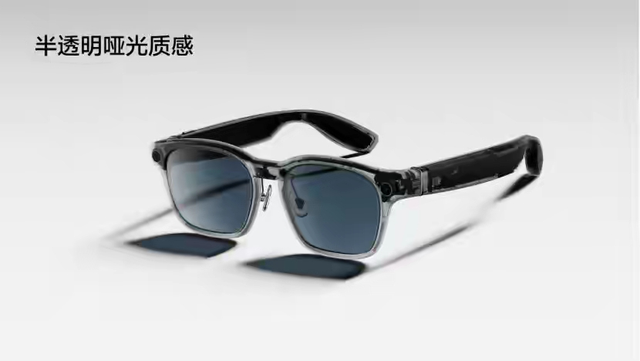
Objectively, this intense competition is not vicious competition; rather, it is a necessary path for the industry to screen quality players. In other words, only products that truly solve user pain points will survive.
Once product functional competition intensifies, it will accelerate industry shakeouts. We believe this is a highly probable next step for the smart glasses industry.
As for who will take the lead in the subsequent shakeout and gain initiative beyond Mate, brand strength may be a crucial test factor.
This conclusion is not unfounded. According to an iResearch report, over 70% of consumers consider brand elements when purchasing smart glasses, a trend also reflected in market data. Leading manufacturers, leveraging brand accumulation and channel advantages, may be better positioned to capture more market share.
For new entrants, relying solely on functional stacking is no longer sufficient to break through. Without sustainable brand recognition, it is often difficult to gain a foothold in fierce competition. After all, functions can be imitated, but brand trust requires time to build—a common law in all consumer electronics sectors.
03
Towards a Bubble or Following the Smartphone Path?
Once smart glasses transition from the current phase of cultivating market awareness and user habits to rapidly forming scale, establishing brand recognition, and nurturing scenario stickiness, two pressing questions arise for all players: Will the industry head towards a bubble or follow the smartphone path?
We believe that the bubble in the global and domestic smart glasses market is actually limited, with most companies still in the process of continuously increasing their bets. Take Meta as an example: in early January 2026, it laid off about 1,000 Reality Labs employees, gradually shifting one of its R&D focuses to AI smart glasses. Thunderbird Innovation also recently raised 1 billion yuan (about 140 million USD) in funding. These indicate that the smart glasses sector represents rational investment by various parties, far calmer than the frenzy in the robotics market with over 10 billion yuan (about 1.4 billion USD) in financing and a wealth of new investment enterprises across the upstream and downstream of the industrial chain.
Overall, the industry's bubble component is limited: industry growth is solidly supported by demand, with China's 700 million nearsighted population forming a vast user base. Enterprise digital transformation also drives B-end applications. Technologically, the maturity of large models, 5G, and optics provides substantial support for industry development. Bubbles may accelerate industry shakeouts but will not alter the long-term upward trend.
As for whether it will repeat the smartphone industry's path, this is highly likely.
Reviewing the development paths of smart hardware industries like smartphones, similar patterns emerge.
In terms of market structure, both may shift from a diverse landscape to oligopoly. Currently, the domestic smartphone market is increasingly dominated by oligopolies, roughly forming a market structure led by 'Hua, Mi, V' (Huawei, Xiaomi, Vivo).
Looking back, from explosive growth to homogenized competition, the smart glasses industry has traversed in just two years what other industries took years to achieve. It may repeat some of the smartphone industry's pitfalls, such as increased market concentration and functional convergence, but it will also forge its own path, opening new spaces in ecological integration and scenario applications.
For consumers, industry intense competition means better products and more reasonable prices; for companies, it is an enduring battle testing technological, branding, and ecological capabilities. When the hype fades, the players that remain will inevitably be those who adhere to user needs and build core barriers.
As for whether smart glasses will ultimately become the next super terminal surpassing smartphones, there is still no answer.
-
On the Eve of Its IPO, Avatr Finds Itself Embroiled in a 'Farce of Controversy and Belittlement'
-
![]()
Yutong Optics' Japanese Subsidiary Unveiled in Tokyo, Shifting Strategic Focus to Technology-Driven Growth
-
![]()
Half-Year Revenue Outstrips Last Year’s Total! Zhongrun Optics Forecasts 80.2% H1 Revenue Growth
-
![]()
Why Does AI Competition Start with Computing Power?
-
![]()
Apple AI Finally Makes Its Debut in China, Yet iPhone's 'AI Autonomy' Faces Uncertainty
-
![]()
Apple AI and QianWen Make Up Lessons: Alibaba Has Its Own 'Doubao Phone'
-
![]()
QianWen Joins Apple, Signal for Large Models to ‘Fade into the Background’
-
![]()
The ‘Anchor’ Strategy of Google Hidden Behind the Bleeding Financial Report