Popular Science Essay | The Pull of Light: Exploring Micro-Nano Scale Ultra-Long-Range Optical Pulling Manipulation Technology
 03/03 2026
 591
591
The Pull of Light: Exploring Micro-Nano Scale Ultra-Long-Range Optical Pulling Manipulation Technology
——On a delicate nanofiber, a tiny droplet is moving upward against gravity under the influence of optical pulling force, performing a fascinating dance of light-matter interaction. This is no longer a scene from science fiction but a real phenomenon in cutting-edge optical laboratories. In 1619, astronomer Johannes Kepler observed comets and noticed that their tails always pointed away from the Sun, leading him to speculate that sunlight might produce some kind of thrust (Figure 1). He proposed a bold hypothesis: light might possess radiation pressure capable of moving matter in the universe [1]. This groundbreaking idea initiated humanity's exploration of light pressure, but few at the time could have imagined that light could not only push objects but also pull them. 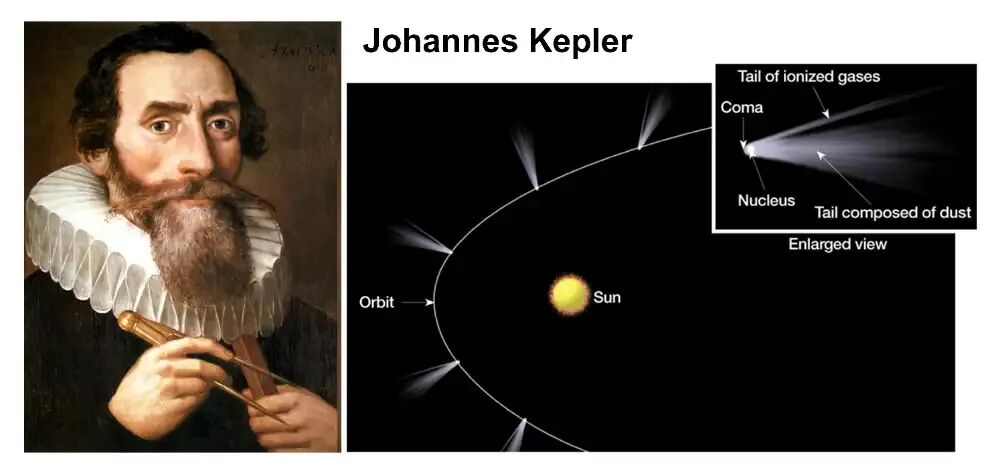
Figure 1 The origin of Kepler's hypothesis on light pressure [1]
01 A Counterintuitive Discovery: Optical Pulling Force
For nearly four centuries after Kepler proposed the concept of light pressure, the scientific community generally believed that light could only push objects along its propagation direction. This understanding was based on a simple logic—photons carry momentum, and when they strike an object, they transfer momentum to it, generating thrust. However, the beauty of scientific exploration lies in constantly challenging conventional wisdom. In 1973, Arthur Ashkin and colleagues at Bell Labs observed a puzzling phenomenon in their experiments. When they directed a laser beam onto the surface of a liquid, instead of being pressed down as expected, the liquid surface bulged upward—as if pulled by an invisible force (Figure 2) [2]. This counterintuitive observation demonstrated for the first time that light could not only push objects but also pull them backward. Ashkin, as is well known, later won the 2018 Nobel Prize in Physics for his work on optical tweezers and their applications in biological systems, and his early research laid the foundation for exploring optical pulling forces. 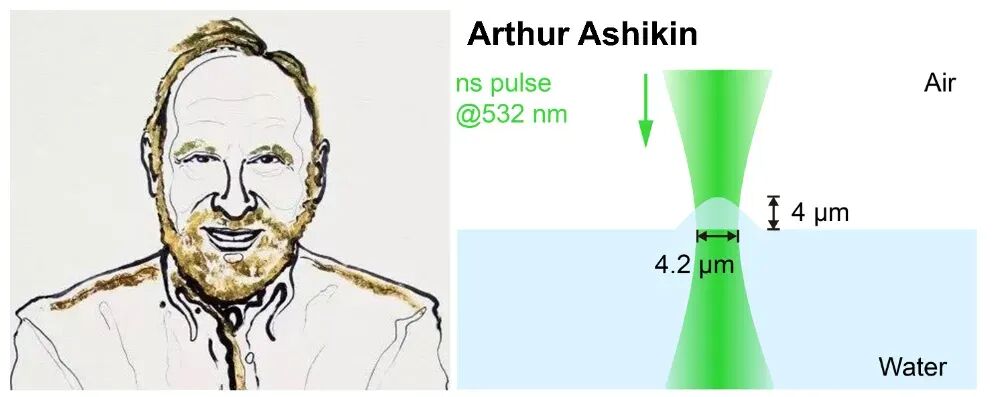
Figure 2 Ashkin's first experimental observation of optical pulling force [2]
Over the past two decades, with the development of nanotechnology and photonics, researchers have proposed and demonstrated various methods to generate pulling forces using light. By employing structured beams, specially designed micro-nano structures, or inhomogeneous background media, they can control photon momentum transfer in light-matter interactions, amplifying the forward momentum of light after it passes through an object and thereby exerting an optical pulling force (Figure 3) [3]. However, these methods are often limited by optical diffraction effects. Similar to how a flashlight beam diverges as it propagates over distance, the transmission field of a single beam struggles to maintain its original shape and intensity over long distances, making it unable to continuously provide the optical momentum required for generating an optical pulling force. In optical pulling manipulation, this means that the pulling force can only be maintained over extremely short distances—the longest previously reported effective distance was merely 0.2 mm [4], posing a challenge for long-range single-beam optical pulling manipulation. 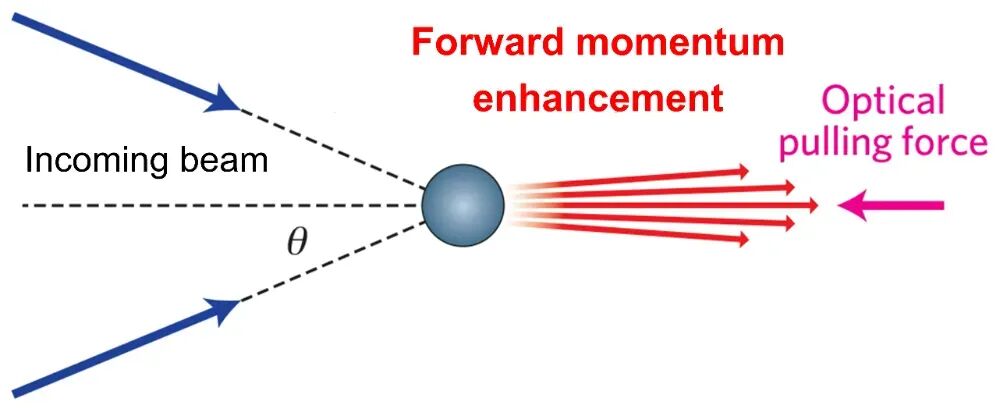
Figure 3 Optical pulling force generated based on forward optical momentum amplification [3]
02 Breaking the Limit: Single-Beam Long-Range Optical Pulling Force Achieved Through Nanofiber-Based Optical Momentum Control
To address the technical challenges of generating long-range optical pulling forces, a team led by Professors Guo Xin and Tong Limin from Zhejiang University recently proposed a microdroplet optical force manipulation structure based on ultrathin nanofibers. By controlling the photon momentum of the transmission field in nanofibers, they achieved ultra-long-range optical pulling forces. What is a nanofiber? It is a waveguide structure with a diameter close to or smaller than the vacuum wavelength of the transmitted light, typically ranging from a few tens to a few hundred nanometers (about one-hundredth the diameter of a human hair). Nanofibers are usually fabricated by high-temperature stretching of standard optical fibers (Figure 4a, b). Taking a typical silica nanofiber as an example, it features a subwavelength diameter, atomic-level surface smoothness, and a large refractive index contrast between the core and cladding. When light propagates along it, a significant portion of its energy exists in the form of an evanescent field (Figure 4c) [5, 6], meaning the light is confined to a low-loss transmission in the space near its surface. This can be regarded as a long-range non-diffracting Bessel beam, promising for long-range optical manipulation. 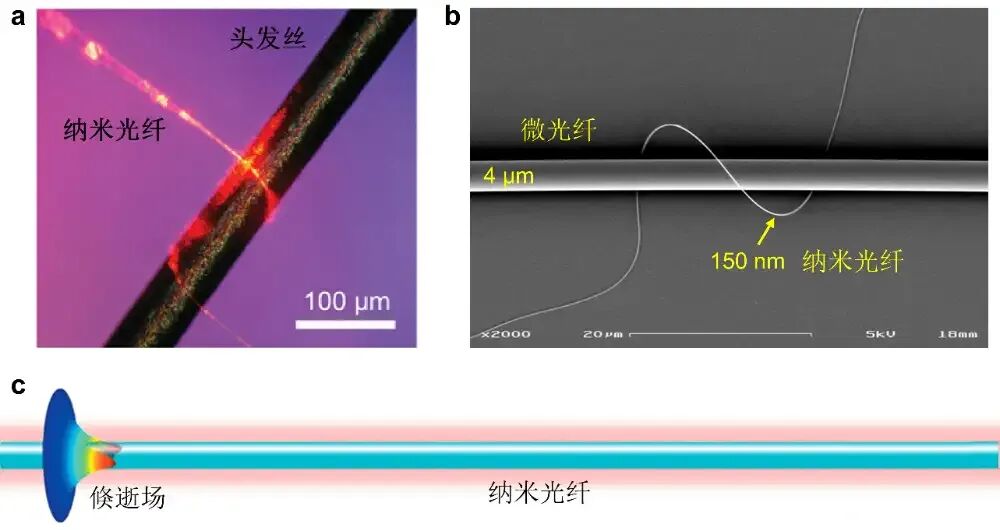
Figure 4 (a) Optical microscope and (b) electron microscope images of nanofibers; (c) transmission field distribution of nanofibers [5, 6]
How can light both push and pull? The underlying physical mechanism lies in the exchange of photon momentum. When the transmission field of a nanofiber passes through a microdroplet, the axial optical force acting on the microdroplet depends on the photon momentum exchange between the media (nanofiber and air) and the microdroplet. For photon momentum exchange across multiple medium interfaces, the photon momentum manifests in the form of Minkowski momentum, meaning its magnitude is proportional to the refractive index of the medium it occupies. Taking a silica nanofiber with a diameter D = 400 nm as an example: when the input light wavelength λ0 = 980 nm, the transmission field is primarily distributed within the high-refractive-index core, with an effective mode field diameter much smaller than the microdroplet size. After the light field passes through the microdroplet, the number of photons entering the low-refractive-index air increases, equivalent to a reduction in the forward field momentum (Figure 5a, b). According to the law of momentum conservation, the optical force acting on the microdroplet manifests as a thrust along the fiber's axial direction. When the input light wavelength λ0 = 1550 nm, the energy of the transmission field is mainly distributed in the air outside the core, with an effective mode field diameter comparable to the microdroplet size. After passing through the microdroplet, the number of photons entering the high-refractive-index core increases, equivalent to an increase in the forward field momentum, thereby generating an optical pulling force on the microdroplet based on momentum conservation (Figure 5c, d). Theoretical calculations indicate that for silica nanofibers, when the ratio of fiber diameter to input light wavelength D/λ0 < 1/3, the optical force acting on the microdroplet manifests as a pulling force; when D/λ0 > 1/3, it manifests as a pushing force. 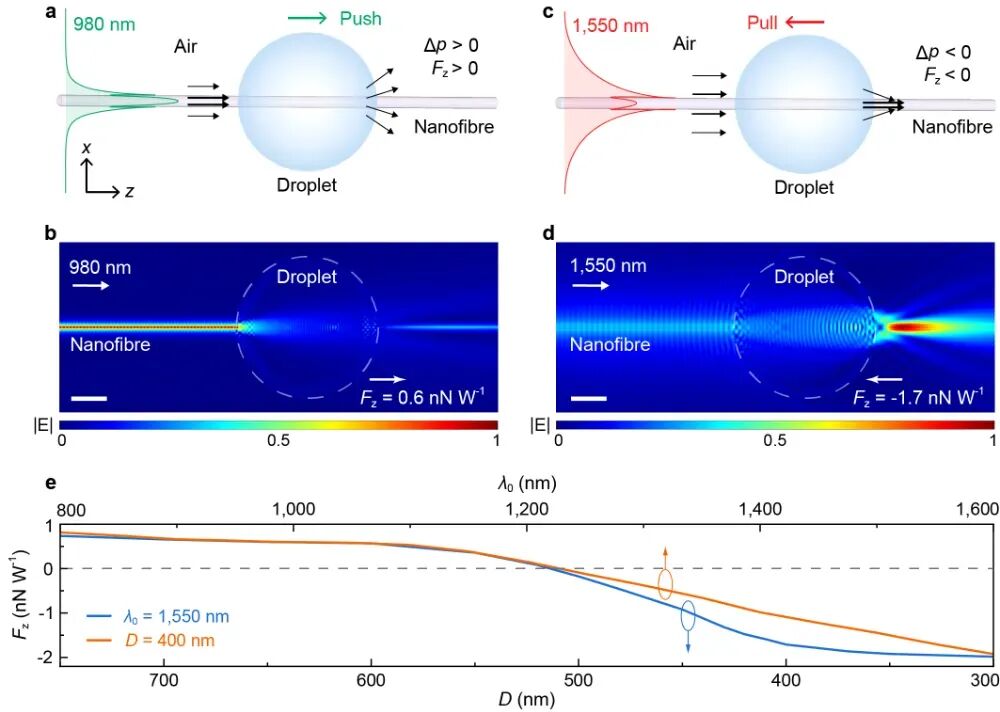
Figure 5 Optical momentum exchange mechanism in the nanofiber-microdroplet optical force manipulation structure [7]
Based on the aforementioned optical momentum exchange mechanism, the research team used micro-nano manipulation techniques to precisely transfer a silicone oil microdroplet (diameter 20 μm) onto a silica nanofiber (diameter 370 nm), constructing a fully fiber-based nanofiber-microdroplet optical force manipulation system. The cleverness of this system lies in its simplicity—it requires no complex optical components or precise laser alignment. By merely changing the wavelength of the input light into the nanofiber, flexible switching between optical pushing and pulling modes can be achieved (see Video 1), significantly enhancing the flexibility and degrees of freedom in single-beam particle manipulation. Video 1 Switching between optical pushing and pulling modes Using microdroplets as carriers also enables optical pulling manipulation of solid particles doped inside them (see Video 2), broadening the range of objects that can be manipulated. Imagine this: on an extremely thin "optical track," a microdroplet, driven by the optical force of a single beam, can move forward or be pulled backward, ultimately transporting its internal particles to a designated location. Video 2 Particle transport based on nanofiber-microdroplet systems 03 Ultra-Long-Range Optical Pulling Manipulation Thanks to the nanofiber's ultra-low transmission loss, large proportion of evanescent field, and other transmission characteristics, its transmission field can be regarded as an ultra-long-range non-diffracting Bessel beam. This special transmission field can maintain stable photon momentum exchange over long distances, significantly increasing the effective range of the optical pulling force. To verify this theoretical concept, the research team used a high-precision nanofiber fabrication system to produce an ultra-long, ultrathin, low-loss nanofiber with a diameter of 325 nm and a length of 40 cm, constructing a microdroplet ultra-long-range optical pulling system. Under continuous optical pulling force at a wavelength of 1552 nm, a microdroplet with a diameter of 45 μm attached to one end of the nanofiber moved along the nanofiber for a distance of up to 40 cm (see Video 3), achieving a three-order-of-magnitude improvement compared to previously reported single-beam optical pulling distances. This is equivalent to, in the microscopic world, the nanofiber's transmission field laying a reverse optical track for the microdroplet, enabling it to complete a macroscopic-scale journey. Video 3 Ultra-long-range optical pulling force 04 Defying Gravity: Vertical Optical Pulling Force This ultra-long-range optical pulling force can also be extended vertically to lift microdroplets upward, providing more degrees of freedom for optical manipulation. Driven by a vertically downward-input continuous light at a wavelength of 1552 nm, through the coordinated effects of optical force, microdroplet gravity, and viscous drag, the microdroplet can be controlled to move upward, downward, or hover (see Video 4). This scenario resembles a "tug-of-war" in the microscopic world: on one side is gravity trying to pull the microdroplet downward, and on the other is the optical pulling force trying to lift it upward. Video 4 Vertical optical pulling force 05 Summary and Outlook: The Future of Optical Pulling Manipulation Looking back on this four-century-long scientific exploration, from Kepler's skyward gaze and his hypothesis about light pressure, to Ashkin's observation of liquid surface bulging, and now to the development of ultra-long-range optical pulling manipulation technology, humanity's understanding of the power of light continues to deepen. This study utilized Minkowski photon momentum control in the transmission field of a nanofiber-microdroplet system to achieve ultra-long-range optical pulling manipulation of microscopic objects, with an effective distance of up to 40 cm, far exceeding previously reported single-beam optical pulling distances. The core breakthrough lies in their clever use of the nanofiber as a unique "optical track" to confine light to low-loss transmission in the space near its surface, circumventing the diffraction problem that has plagued long-range optical pulling manipulation for years. This nanofiber-guided optical pulling manipulation requires no free-space beam alignment; by changing the wavelength and power of the transmitted light, the direction of motion and speed of microdroplet manipulation can be flexibly adjusted. Additionally, the light propagation direction in the nanofiber can be altered by bending it, adding more spatial degrees of freedom for microdroplet manipulation. Overall, this research not only provides a new perspective for understanding optical momentum control in optical force manipulation but also proposes a novel approach for achieving single-beam long-range optical pulling. It holds potential applications in fields such as nanophotonics, optomechanics, biophotonics, and optofluidics. From Kepler's speculation about comet tails to now harnessing light flows and manipulating objects in the laboratory, the story of scientific research once again tells us that bold ideas born of curiosity will eventually transcend time and space, unleashing world-changing power at technological inflection points. Light, the most familiar presence in the universe, still harbors infinite unknowns waiting for us to explore and harness.
References [1] Kepler J. De Cometis Libelli Tres [M]. Avgvstae Vindelicorvm, 1619. [2] Ashkin A, Dziedzic J M. Radiation pressure on a free liquid surface [J]. Physical Review Letters, 1973, 30(4): 139-142. [3] Sáenz J J. Laser tractor beams [J]. Nature Photonics, 2011, 5(9): 514-515. [4] Kajorndejnukul V, Ding W Q, Sukhov S et al. Linear momentum increase and negative optical forces at dielectric interface [J]. Nature Photonics, 2013, 7(10): 787-790. [5] Tong L, Lou J, Ye Z et al. Self-modulated taper drawing of silica nanowires [J]. Nanotechnology, 2005, 16(9): 1445-1448. [6] Tong L M, Zi F, Guo X et al. Optical microfibers and nanofibers: a tutorial [J]. Optics Communications, 2012, 285(23): 4641-4647. [7] Zhang J B, Liu K, Wang P et al. Ultra-long-range optical pulling with an optical nanofibre [J]. Nature Communications, 2025, 16(1): 7424.
-
![]()
Over 50% of Revenue Hinges on Yutong Optics! This Optical Equipment Manufacturer is Charging Towards an IPO
-
![]()
YOCO Optics Finalizes Industrial and Commercial Registration Update Post 160 Million Yuan Investment in Jiangfeng Biology, Securing 20% Stake to Emerge as Second-Largest Shareholder!
-
![]()
Google Market Value Plummets by $1.5 Trillion Overnight Following the Loss of Two Key Figures
-
![]()
Put an End to the EV 'Weight Gain Race'! Can Your Car Still Be Driven Under the New National Standards?
-
![]()
In 2026, 'AI Upstarts' Collectively Bet on World Models
-
![]()
【OFweek Weike Cup】Phoenix Optics Officially Participates in the 2026 Optical Industry Annual Innovation Product Award
-
![]()
Ford Ditches Mach-E: Will Its Billion-Dollar Electrification Drive Have to Start All Over Again?
-
![]()
【OFweek Weike Cup】Shuangli Hepu Officially Participates in the 2026 High-Growth Enterprise Award in the Optical Industry