Research on the Industrial Logic Behind the Surge of Chinese Action Camera Brands in Japan and GoPro's Decline: How the UGC+AIGC Creative Wave is Reshaping the Market
 07/14 2026
 497
497
In early July 2026, Chinese action camera brands DJI Osmo Pocket 4 and Insta360 Luna Ultra made their debut in Tokyo's Akihabara district, sparking a frenzy among offline consumers who queued overnight to make purchases. Social media platforms were ablaze with related content, amassing over 10 million views in a single day, marking a truly remarkable phenomenon.
Just two months prior, in May, GoPro, once the undisputed leader in the action camera market, announced the initiation of a strategic review process, hinting at a potential sale or merger of the company.
RUNTO's comprehensive analysis of these two pivotal industry events reveals the following insights: ① The shift in market share is fundamentally driven by evolving creative demands, prompting an industry reshuffle. The global community of content creators is experiencing rapid expansion, with the democratization of User-Generated Content (UGC) and the advent of Artificial Intelligence Generated Content (AIGC) editing technologies reshaping the demand dynamics for portable imaging devices. The exponential growth of UGC creators serves as the primary growth engine, while integrated AIGC hardware-software capabilities emerge as the key determinants of success.
② Chinese brands are transitioning from mere hardware manufacturers to architects of the creative ecosystem, with competition now centered on comprehensive ecosystems that seamlessly adapt end-side AIGC to UGC scenarios. Manufacturers that can cater to the everyday recording needs of the general public and lower the barriers to content creation will continue to gain market share and establish technological barriers. Conversely, traditional companies that remain entrenched in niche markets and lag in AI-driven creative ecosystems will witness a steady decline in their market shares.
Hence, these two events are not isolated incidents but rather the inevitable outcome of the convergence of three critical factors: the transformation of the creative ecosystem, differentiation in AI capabilities for integrated hardware and software, and the iterative evolution of product categories.
RUNTO will leverage retail market monitoring data, global creator economy quantitative data, market competition transformation, and the core logic of integrated hardware-software capabilities to conduct an in-depth analysis of the medium- to long-term development trends underpinning this industry reshuffle.
1. Global Market Data Performance: Chinese Brands Dominate the Market Following Significant Shifts
According to RUNTO data, from January to April 2026, in the Japanese action camera retail market, DJI and Insta360 collectively captured approximately 85% of the market share, while GoPro and other budget-friendly niche brands vied for the remaining less than 15%. Traditional Japanese digital camera brands were virtually absent from this market segment.
In fact, these two Chinese brands also dominate the Chinese action camera market with exceptionally high market shares. From January to May, DJI held a 60.5% share of the sales market, while Insta360 accounted for 26.1%, with their combined sales share reaching an astonishing 86.6%.
Globally, GoPro once commanded a 75% market share. However, according to RUNTO data, in the first quarter of 2026, its share in the global pan-action camera market has plummeted to just around 10%. In terms of capital market performance, GoPro reached a peak market capitalization of $13 billion upon its IPO in 2014, but by 2026, its market value had dwindled to a mere $130 million, representing a 99% decline from its peak and reducing it to a micro-cap penny stock. Additionally, the company has reported consistent quarterly losses over the past three years.
2. Underlying Driver: The Explosive Growth of the Global UGC Creator Economy
According to RUNTO research, the global community of content creators is projected to surpass 250 million individuals by 2026, with a three-year Compound Annual Growth Rate (CAGR) of 86% from 2023 to 2026. Consequently, the global content creator economy is expected to exceed $300 billion in scale, with annual viewership growth rates for four major vertical content categories—short-form video Vlogs, outdoor cycling, travel documentaries, and extreme sports—all surpassing 30%. This directly fuels sustained demand for hardware such as action cameras and pocket gimbal cameras.
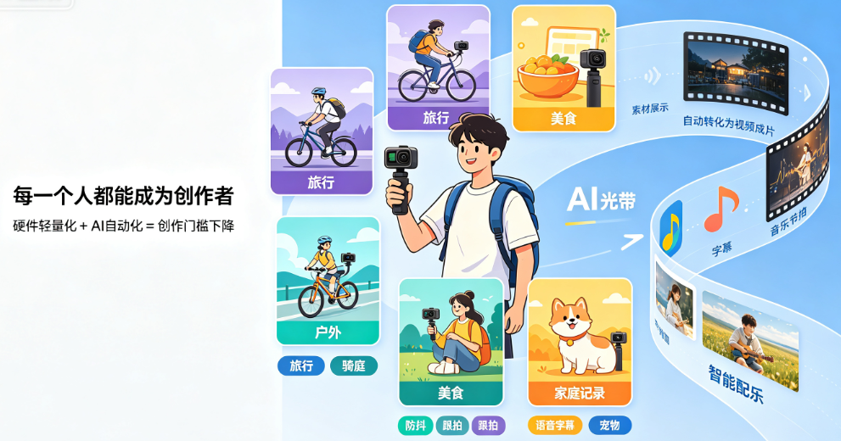
Amidst this wave, the action camera industry is undergoing a paradigm shift, transitioning from a "niche tool for professional extreme sports enthusiasts" to a daily UGC recording device for the general public.
According to RUNTO's survey of Chinese consumers, over 70% of ordinary content creators abandon secondary distribution of their footage due to the high barriers associated with traditional video editing. Consequently, lightweight and simplified AIGC automatic video generation has emerged as a critical decision-making factor for users when purchasing products.
3. UGC+AIGC Dual-Wheel Drive Reconstructs Competition Standards for Action Camera Devices
RUNTO's qualitative assessment predicts that competition in the action camera industry has transcended mere hardware specifications, evolving into a dual-core competition between hardware shooting capabilities and end-side AIGC creative ecosystems.
Chinese leaders DJI and Insta360 have adopted strategies that deeply integrate AIGC capabilities into their hardware and software, incorporating features such as AI highlight recognition, automatic camera movement cropping, panoramic intelligent correction, and one-click matching of background music and subtitles. This enables full-chain automation from "shooting, footage screening, to finished video export." Additionally, they customize exclusive AI models for high-frequency UGC scenarios like cycling, skiing, traveling, and home Vlogs, significantly reducing post-production costs for ordinary creators and perfectly meeting the needs of massive long-tail UGC users.
In contrast, GoPro's product shortcomings lie in its relatively lagging AI capability iteration. Its Quik editing tool requires a paid subscription to unlock basic video generation functions, and its end-side local AI computing power is insufficient, limiting it to recognizing simple motion shots and failing to adapt to everyday Vlog creation for the general public.
4. Core Logic Behind the Surge of Chinese Brands and the Decline of the Industry Pioneer
Regarding the surge in sales of Chinese brands in the Japanese market, RUNTO identifies four key factors: ① A lack of local Japanese portable gimbal/panoramic camera products. ② DJI and Insta360's products break the stereotype that action cameras are only suitable for outdoor extreme sports, offering full-scenario adaptability for UGC by the general public. ③ Their differentiated advantages in end-side AIGC, such as built-in localized AI video generation functions, directly address the core pain points of Japanese short-form video creators. ④ Chinese brands offer significant cost-effectiveness and ecosystem advantages, pricing their products approximately 30% lower than GoPro's for equivalent imaging specifications. Coupled with a well-established ecosystem of third-party accessories, this perfectly aligns with the affordable creation needs of Japanese mass creators.
These four factors have driven a narrative reversal in the industry: Over a decade ago, Chinese consumers flocked to Japan to purchase Japanese imaging devices. Today, domestically produced smart imaging devices have reversed the trend, occupying the local market in the birthplace of cameras and leveraging AIGC creation experience advantages to build strong brand momentum.
Regarding GoPro's global decline, RUNTO analyzes the underlying internal causes as follows: ① In terms of product iteration rhythm, it updates only one generation of its HERO flagship series annually, resulting in slow functional updates and prolonged stagnation in capabilities. ② In terms of product positioning, it has long clung to niche extreme sports scenarios like skydiving, surfing, and skiing, missing out on the UGC boom for the general public. In contrast, DJI and Insta360 cater to both professional players and ordinary UGC users, unlocking a multi-billion-dollar incremental market. ③ Its AIGC ecosystem construction is severely lagging, with a strategic mismatch to the AIGC creation cycle. GoPro's paid subscription model for creative functions contradicts UGC user needs, and its insufficient investment in end-side local AI computing power creates a stark technological gap compared to Chinese devices' zero-barrier one-click video generation. ④ The pricing and accessory premiums of its flagship models erode its competitiveness in the mass market, leading to customer diversion. ⑤ Beyond the competitive pressure from Chinese leaders, the continuous upgrade of smartphone imaging capabilities poses a threat. High-end smartphones now come equipped with wide-angle lenses and basic electronic image stabilization, exerting downward pressure on the low-end entry-level device market.
GoPro's Main Product Line for Sales in 2026
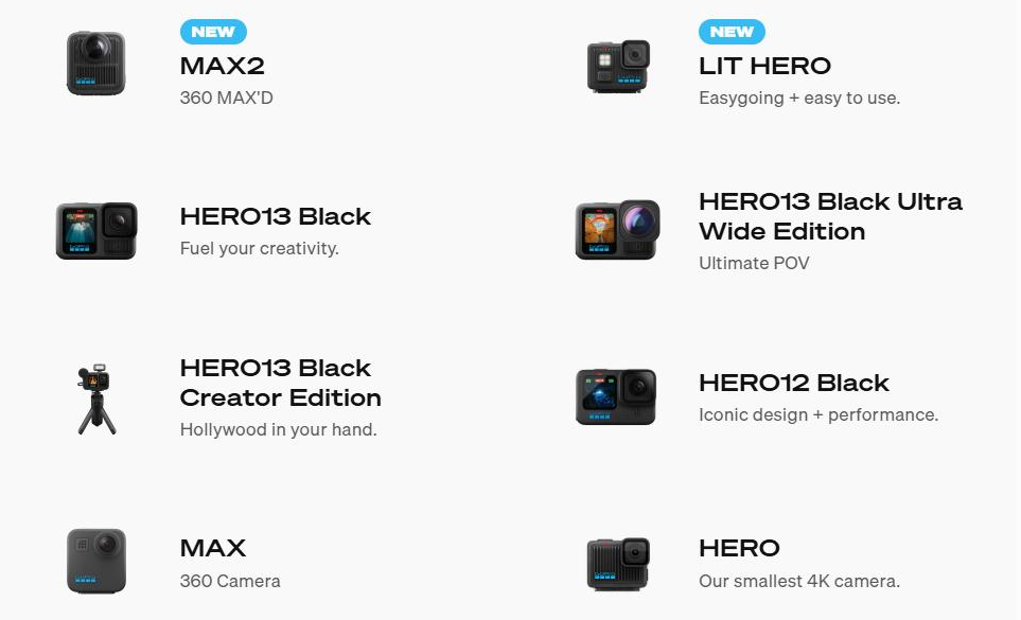
Source: Corporate official websites and the internet
5. Three Major Trends for Medium- to Long-Term Industry Development
RUNTO concludes that the global action camera industry will primarily evolve in three directions:
(1) Deep Integration of AIGC Hardware Becomes the Norm: The long-term growth potential of portable imaging devices will inevitably be tied to the continuous evolution of the UGC content creation ecosystem for the general public. All devices will come standard with local AI computing power, and features like automatic video editing, intelligent camera movement, and footage semantic recognition will become basic functionalities. Business models that bundle essential AIGC functions like basic one-click editing and highlight recognition with paid subscriptions will gradually be phased out by the mass market. Instead, a tiered payment model featuring free basic AI video generation + value-added cloud services and advanced special effects will become the industry mainstream.
(2) Category Boundaries Continue to Blur: Traditional action cameras, panoramic cameras, and pocket gimbal cameras will increasingly interpenetrate, uniformly serving full-scenario UGC content production and continuously converging towards the mass consumer market. However, professional extreme industrial-grade action cameras will remain a distinct niche segment.
(3) Market Matthew Effect Intensifies: The market shares of the top two players with self-developed imaging algorithms, self-developed end-side large models, and global channels will continue to solidify. For all industry participants, detaching from creator needs and underestimating the importance of integrated AIGC hardware-software layout will result in a continuous loss of market influence. Ultimately, the market space for small and medium-sized brands and overseas legacy manufacturers lacking AI creation capabilities will be continuously compressed. Furthermore, beyond traditional action camera manufacturers, machine vision and smart home hardware manufacturers are also accelerating their cross-border布局 (layout) in creator shooting hardware (e.g., Shenmou V1 VlogCAM, Akiitu Pin by Aiketu).
-
![]()
AI Enters Second Half: Buy the 'Cloud,' Not the 'Chip'?
-
![]()
Breaking the Monopoly! Trillion-Parameter Large Model Adopts Domestic Chips, Marking a Key Step Towards 'De-NVIDIA-ization' in AI Computing Power
-
![]()
Performance Drops Sharply, Seres Alerts 280,000 Shareholders
-
Behind the AI Boom: US Rakes in $314 Billion, South Korea $223 Billion, While China Lags at $26 Billion?
-
![]()
Volkswagen's 'Drastic Measures' to Cut Half of Its Models: Will China's Three Joint Ventures Be Affected?
-
![]()
It's already crowded in car manufacturing, yet Chunnan insists on joining in.
-
Confirmed: Fossil Fuel Vehicle Ban! Hainan Unveils New '15th Five-Year Plan', Weakening Passenger Vehicle Sector and Initiating Petroleum Asset Depreciation
-
![]()
Research on the Underlying Industrial Logic of the Booming Sales of Chinese Action Camera Brands in Japan and the Decline of GoPro: The UGC+AIGC Creation Wave Reshapes the Market Landscape