The Value of Qingdao Summit Continues to Rise with More High-Level Attendance
 06/17 2026
 502
502
The value of the Qingdao Summit of Leaders of Multinational Corporations continues to rise.
On the morning of June 16th, the opening ceremony of the 7th Qingdao Summit of Leaders of Multinational Corporations was held, with Vice President Han Zheng attending and delivering a speech.
Seven years ago, on the morning of October 19th, 2019, the inaugural Qingdao Summit of Leaders of Multinational Corporations opened at the Qingdao International Conference Center. President Xi Jinping sent a congratulatory letter to the summit, and then Vice Premier Han Zheng, a member of the Standing Committee of the Political Bureau of the CPC Central Committee, attended the opening ceremony, read President Xi's letter, and delivered a speech.
In the intervening five editions, speeches were given by two Vice Premiers of the State Council, two Vice Chairpersons of the National People's Congress, and one State Councilor.
Amid an external environment marked by globalization backlash and intensified industrial chain restructuring, coupled with the beginning of the 15th Five-Year Plan period, increased national-level pilot programs for service industry opening-up, and the vigorous development of China's new quality productive forces, the national level clearly aims to leverage the Qingdao Summit of Leaders of Multinational Corporations to release more institutional opening-up dividends and encourage greater participation from multinational corporations in China's economic transformation and upgrading.
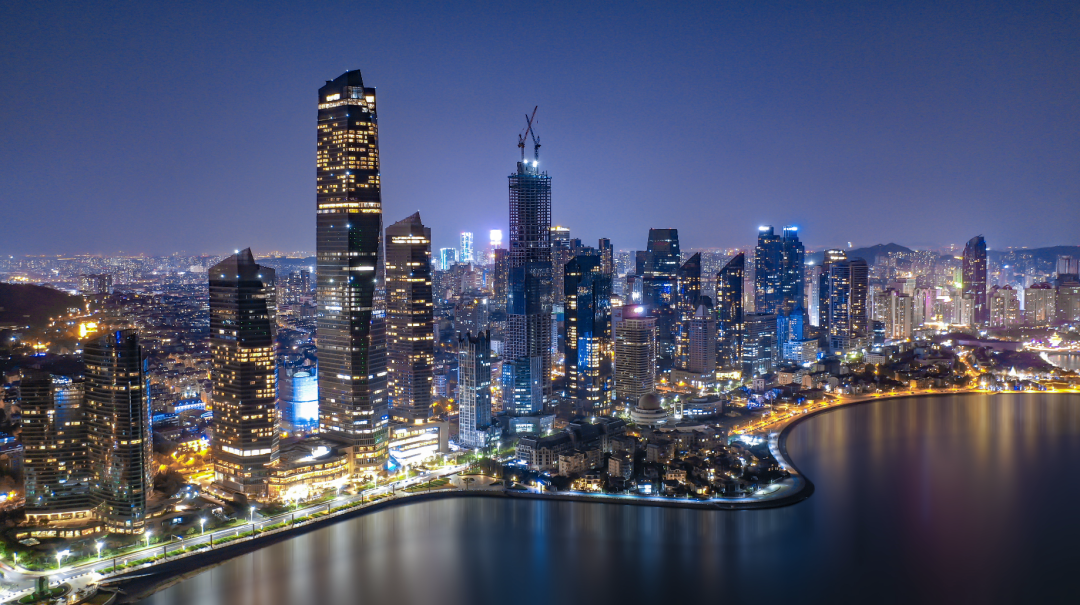
With 357 multinational corporations and over 700 guests gathering by Fushan Bay, representing 44 countries and regions, including 105 Fortune Global 500 companies, Qingdao once again became the "primary observation point" for multinational enterprises to understand China.
1
Examining the specific agenda, it is evident that innovative measures such as the inaugural Capital Investment Attraction Matchmaking Event between Central SOEs, State-Owned Enterprises, and Multinational Corporations (to deepen equity cooperation), the carefully added Closed-Door Meeting on Service Industry Expansion and Intellectual Property Rights Policies, and the first-ever National Enterprise Day (featuring the "Shandong-Turkey Exchange Day" on the occasion of the 55th anniversary of China-Turkey diplomatic relations) indicate that this year's Qingdao Summit of Leaders of Multinational Corporations is more akin to establishing a "platform for co-building rules for institutional opening-up," allowing more multinational corporations to participate in the development dividends of China's institutional opening-up.
For instance, the inaugural Capital Investment Attraction Matchmaking Event between Central SOEs, State-Owned Enterprises, and Multinational Corporations. This special session, held for the first time at this summit, focuses on promoting deepened equity cooperation, investment, and mergers and acquisitions between multinational corporations and Central SOEs and State-Owned Enterprises, supporting their technological cooperation, equity investments, and asset restructuring in Shandong, precisely matching financing and cooperation needs, and broadening channels for utilizing foreign capital. This is clearly a significant signal. Under the pressure of Sino-US competition and industrial chain restructuring, China is using deep capital integration to secure the long-term interests of multinational corporations. For Qingdao, local large state-owned enterprises such as Shandong Port Group, Tsingtao Brewery, and Hisense Group may adopt a more open stance to introduce multinational strategic investors in the future.
Another example is the sixth consecutive Closed-Door Meeting on Intellectual Property Rights Policies. Intellectual property protection is a core concern for European and American multinational corporations. This summit, for the first time, moved the interpretation of intellectual property rights policies to the main forum and provided precise responses to concerns collected from enterprises beforehand.
The signal released is that China must first establish a robust institutional infrastructure for intellectual property protection to transition from "technology import" to "technology co-creation." Whoever can first align with international high standards will secure the core R&D links of multinational corporations. The recent dense (intensive) layout (layout) of global multinational giants' R&D headquarters in Qingdao serves as evidence.
Meanwhile, artificial intelligence, low-altitude economy, and future industries have become core topics in the parallel forums of this summit. This highly resonates with China's accelerated advance (promotion) of comprehensive pilot programs for service industry expansion in April this year—among the 155 pilot tasks, "supporting the open development of telecommunication services and related digital industries" is placed at the forefront, and pilot contents such as lifting foreign equity restrictions in application stores, internet access, and other service businesses are key investment directions for multinational corporations.
2
As the host, Qingdao is naturally the biggest beneficiary.
To date, a cumulative total of 181 Fortune Global 500 companies have invested in 424 projects in Qingdao, all of which are "votes of confidence" cast by multinational corporations through their actions.
However, the spillover effects of the summit have long surpassed Qingdao alone. The previous six summits have cumulatively signed 632 key investment projects with a total investment of $75.73 billion, and 236 Fortune Global 500 companies have invested in and landed 947 foreign-invested projects in Shandong.
Based on past experience, more than ten cities, including Jinan, Yantai, Weifang, Weihai, Binzhou, Jining, Liaocheng, and Rizhao, have successfully implemented projects through the summit.
This summit continues the "province-wide coordinated investment attraction pattern" and promotes synchronized sub-venue promotions and separate signings across 16 cities through activities such as the "Sincere Shandong, Invest in Economic Development Zones" precision investment promotion symposium, the Shandong Provincial Development Zone Special Promotion Event, and policy briefings on industrial chain and supply chain international cooperation. Sichuan, participating as the guest of honor province, further promotes cross-regional industrial chain linkage and serves the overall national opening-up strategy.
It is reported that this summit has concentrate (concentratedly) signed 40 key cooperation projects, including 15 foreign-invested projects with a total investment of $1.42 billion; 15 modern service industry projects with a total investment of RMB 6.65 billion; and 10 foreign economic and trade projects with a cooperation amount of $1.31 billion. The sources of investors cover multiple countries and regions, including Hong Kong, China, South Korea, France, Singapore, the UK, Japan, Russia, Kazakhstan, and Mexico. The cooperation entities are primarily Fortune Global 500 companies and global industry leaders. The projects generally feature significant characteristics such as large investment scales, strong industrial chain driving capabilities, and outstanding comprehensive economic and social benefits.
3
During this summit, Qingdao hosted the International City Partner Dialogue, inviting representatives from multinational corporations such as Louis Dreyfus, AstraZeneca, ZF Friedrichshafen, Accenture, and Bekaert to exchange and discuss around the theme of "Collaborating in Technological Innovation and Deepening Open Cooperation" and conduct project signings, facilitating the implementation of a batch of two-way investment projects. Simultaneously, multiple events were held, including the Forum on Transnational Scientific and Technological Innovation Cooperation and Development, the Shandong Port Global Supply Chain Partner Conference, and the "Healthy Bay in China" Construction Scenario Matchmaking Event.
A crucial aspect here is precisely that Qingdao is driving the implementation of various initiatives through institutional opening-up.
For example, the Qingdao Science and Technology Innovation Corridor has become a key focus of the city's work, but technological innovation has consistently been a weakness in the city's efforts; in the construction of an international shipping center, there is a greater need for breakthroughs in high-end services surrounding port and shipping; and the construction of the "Healthy Bay in China" requires more tangible, high-quality projects for support.
The relevant topic settings at the summit surrounding Qingdao's work are clearly aimed at reinforcing these key initiatives.
For instance, as the northern gateway for opening-up and the only outlet to the sea in the Yellow River Basin, Qingdao needs to leverage its open advantages to attract more enterprises from within the province and along the Yellow River to establish go overseas (overseas) headquarters, supply chain headquarters, or R&D headquarters in Qingdao. The high-energy platform of the Qingdao Summit should serve as a window for Qingdao to showcase its "global resource allocation capabilities" to inland enterprises—not just providing docks and warehouses but offering a package of services including cross-border finance, international arbitration, overseas warehouse networking, and compliance consulting.
Another example is at the level of health and wellness and cultural tourism. The national level is vigorously promoting the modern service industry, and the Qingdao Summit brings not only investment demand in manufacturing but also a wealth of modern service industry resources related to healthcare, elderly care, health management, and cultural tourism technology. Qingdao is fully capable of transforming its "mountain and sea resources" into "health and wellness industry standards"—introducing international medical institutions, health and wellness operation headquarters, and health data platforms to deeply integrate coastal tourism with the modern service industry.
Furthermore, as the headquarters location for multinational corporations such as Haier and Hisense, Qingdao must not only fully leverage the advantages of headquarters enterprises to allocate resources globally but also attract more enterprises participating in the global industrial chain division of labor to set up operations in Qingdao, such as more irreplaceable specialized and innovative small giant enterprises in industries like new energy vehicles, artificial intelligence, and embodied intelligence. In this regard, Hisense has already built a global AI market-oriented industrial chain through its subsidiaries, including the optical communication enterprise Nazhen Technology, the smart energy enterprise Kelin Electric, and the compound semiconductor leader Qianzhao Optoelectronics, finding more imaginative growth space beyond the home appliance industry.
The 7th summit, for the first time, set up a Capital Investment Attraction Matchmaking Event between Central SOEs, State-Owned Enterprises, and Multinational Corporations and moved the interpretation of intellectual property rights policies to the scene. These signals all point in the same direction:
The future competition in opening-up will be a competition in institutional opening-up and factor allocation capabilities.
Qingdao is no longer satisfied with being a "good host" for the summit but aims to leverage the summit's momentum to create an institutional opening-up model for Qingdao, such as whether it can enable the supply chains of multinational corporations to take root here, whether it can gather go overseas (overseas) headquarters from the Yellow River Basin here, and whether it can export modern service standards for health and wellness from here.
Clearly, this is the true value of the Qingdao Summit of Leaders of Multinational Corporations to the city.
-
![]()
Net Profit Surges 13.65% Year-on-Year! Yutong Optics Reports RMB 1.782 Billion in H1 Revenue
-
![]()
Q2 Net Profit Slashes Losses by 80%! Has Costar Emerged from Its Darkest Hour?
-
AI Agents: The Paradigm Shift from 'Conversation' to 'Execution'
-
NVIDIA Takes Bold Strides to Lead in Both Hardware and Software Realms
-
![]()
It's Hard to Build Cars, Even Harder to Build Humans, and XPENG is Doing Both
-
![]()
Valuation Soars by $57 Billion: Three Entrepreneurs Born in the 1980s Forge an AI Unicorn Now Suddenly on the Market
-
![]()
How Can We Achieve the Goal of 100,000 Hydrogen Vehicles by 2030?
-
![]()
July Online Market for Consumer-Grade Sports Cameras: Robust Double-Digit Growth in Sales Volume and Value, Mid-Range Products Fuel Market Expansion