Shenzhen Computing Power Firm Soars to Daily Price Limit!
 09/22 2026
 402
402
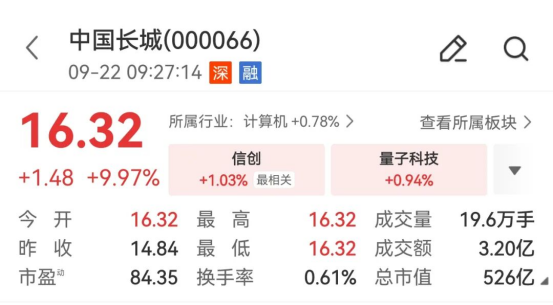
On the morning of September 22, the CPU concept sector emerged as the top performer. China Great Wall, Jiangsu Zhongguancun, and Hesheng New Materials all soared to their daily price limits, while Loongson Technology, Hygon Information, and NationalChip Technology opened more than 5% higher. In contrast, the Shanghai Composite Index experienced only a modest 0.35% gap-up.
This market movement was closely tied to the previous night's performance of U.S. stocks. On September 21 (U.S. Eastern Time), the Philadelphia Semiconductor Index surged by 4.29%, marking its best daily performance since August 4. ARM soared 17.16%, Intel jumped 12.14%, and AMD climbed 9.95%, closing at $615.52 and surpassing a market capitalization of $1 trillion for the first time. This milestone made AMD the fourth U.S. chip company to cross this threshold, following NVIDIA, Broadcom, and Micron. In comparison, NVIDIA only rose by 2.30%.
The surge in CPU computing power concept stocks was triggered by Meta's recent launch of its personal AI agent, Muse. Introduced in early September, the product quickly rose to the top of the U.S. App Store free chart within less than two weeks. According to Sensor Tower, cumulative downloads surpassed 2.5 million, with approximately 1.5 million on iOS and 1.1 million on Android.
Data from Wells Fargo revealed that on September 19 alone, there were 264,000 downloads in the U.S., with three consecutive days exceeding 200,000 downloads. Daily active users in the U.S. reached around 448,000 on that day. Apptopia's comparison was even more striking: 1.8 million downloads across the U.S. and Canada on iOS in the first 12 days, compared to ChatGPT's 1.3 million over the same period.
What truly shifted market sentiment was Muse's functionality. It assigns each user a dedicated cloud-based Linux virtual machine, with the agent running in the background to complete tasks such as form-filling, email organization, ordering, and ticketing—even when the app is closed. The reported specifications for a single instance are relatively modest: 2 virtual CPUs (vCPUs), 8GB of RAM, and 100GB of SSD storage. The real challenge, however, lies in scalability. If deployed to 100 million users, it would require 200 million vCPUs to remain active.
In traditional training clusters, the ratio of CPUs to GPUs typically ranges from 1:4 to 1:8, with CPUs primarily handling preprocessing and scheduling tasks.
However, the Agent scenario presents a completely different picture. Task scheduling, tool invocation, permission verification, code execution, and memory management are sequential, branch-heavy, and latency-sensitive processes—all of which rely heavily on the CPU. The industry now anticipates that the CPU-to-GPU ratio will approach 1:1, with even higher ratios possible in extreme scenarios. CPUs have thus transitioned from a supporting role for GPUs to a standalone business.
Demand expectations have risen just as supply has tightened. Intel's management has publicly stated that it can currently fulfill only about 50% of customer orders. CPU prices for PCs are set to increase by another 10% in early October, marking the third hike this year. Meanwhile, server CPU prices are expected to see a 15% increase in the fourth quarter.
Global capacity for upstream ABF substrates has been fully utilized, with a supply gap exceeding 50%. New capacity is not expected to arrive until 2029–2030. Recently, ABF substrate manufacturer Fastprint Technology has witnessed an upward trend, surging over 8% in early trading today.
The underlying rationale is that Agents require long-term retention of context and knowledge bases. If memory capacity and bandwidth are insufficient, reliance on DDR5 upgrades and CXL-connected pooled memory becomes necessary. Consequently, CPU demand is following this upward trajectory.
Notably, Alibaba's Cloud Town Conference, held in Hangzhou from September 22 to 24, showcased solutions like Agentic Cloud and AI Agent Sandbox, bringing the window for domestic CPU substitution into sharper focus.
The A-share market's reaction was faster—and more ambiguous—than in the U.S. Among today's three stocks that hit the daily price limit, only China Great Wall holds authentic CPU assets. It owns 28.03% of Phytium Information, making it Phytium's largest shareholder. In the first half of the year, revenue reached RMB 7.958 billion (a 25% year-over-year increase), with computing industry revenue accounting for RMB 6.792 billion (85%). Net profit attributable to shareholders was RMB 312 million (a 125.71% year-over-year increase), although after deducting non-recurring items, it remained in the red at RMB -316 million.
-
Is MiniMax on the Verge of Crafting a New Narrative?
-
Self-Driving Buses Enter a 'Golden Era'
-
Can’t Compete? 25 Automakers Unite to Lobby for a U.S. Ban on Chinese Car Imports
-
![]()
One Step a Day: OPPO and vivo Emerge as Two Leading Players in China's Tech Narrative
-
Taking Small Steps, OPPO and vivo Become Two Protagonists in China's Tech Narrative
-
![]()
Four Leading Brands Dominate the 2026 Automotive NPS Rankings
-
Selling an iPhone Duo Results in a 1,847 Yuan Tax in China, Whereas an iPhone 18 Pro Incurrs 1,157 Yuan in Tax
-
![]()
Toyota China Faces Its Most Challenging Transformation and Strategic Shift