Just the Facts, No Emotions—Has AI Actually Crashed or Not?
 11/09 2026
 531
Text and images by Sister Tang
On November 5, U.S. stocks suffered their largest single-day decline since April 2025. The Nasdaq Composite dropped 5.5%, the S&P 500 fell 4.4%, the Dow plunged 1,833 points, and the VIX—Wall Street's fear gauge—spiked from 16.6 the previous day to 28.2. Chip stocks bore the brunt of the selloff: the Philadelphia Semiconductor Index tumbled 12.3% in a single session, with AMD and Micron both down more than 17%, Nvidia off 9.3%, and its market value evaporating by nearly $450 billion in one day. The Nasdaq closed 11.9% below its October 6 high, slipping into technical correction territory.
Hong Kong stocks, by contrast, moved in the opposite direction. On the 5th, the Hang Seng Tech Index surged 5.55%—its biggest one-day gain since February 2025. Tencent climbed 7.17% and Alibaba rose 8.45%, while Lenovo, an AI server maker, fell 6.86%. Bloomberg reported that funds were rotating out of AI hardware stocks and into undervalued Chinese internet platforms; Tencent also unveiled a new large language model that same day. On the 6th, Hong Kong stocks pulled back in tandem with U.S. markets, with the Hang Seng Tech Index falling 1.95% and GDS and Zhipu both dropping more than 10%.
Over the first four trading days of the week, the Nasdaq fell 4.4% cumulatively, the S&P 500 lost 3.0%, and the Philadelphia Semiconductor Index plunged 15.7%. Notably, the Nasdaq and S&P 500's single-day declines on Thursday exceeded their entire weekly drops. There have been no shortage of interpretations over the past few days; rather than offer judgments first, I will lay out this week's events in chronological order.
On November 3, the midterm elections were held, and the Democrats won both the House and the Senate. According to projections by CNBC, CBS and other media outlets on the 5th, Democrats secured at least 250 of the 435 House seats and at least 54 of the 100 Senate seats. That night, Trump told The New York Times that he was willing to accept the results and that he could "probably work something out" with the Democrats. The same night, he posted an image of a red hat printed with "VETO" on social media. Overriding a presidential veto requires a two-thirds majority in both chambers—a threshold Democrats remain far from reaching.
The next day, November 4, the Dow rose 1,569 points—its best post-midterm performance in 44 years. Microsoft gained 6.7% and Amazon 6.1%.
Yet on that same day, CoreWeave, which specializes in renting out GPU computing power, fell 9.9%; power company Vistra dropped 14%; and Vertiv, a maker of data center power and cooling equipment, slid 13%. The market worried that once approvals in Texas slow down, operators like CoreWeave would be hit first—and only then the cloud giants that are their main customers.
This article, therefore, will contain few opinions or emotions—only the facts I believe need to be understood. Once you understand them, a judgment will naturally follow.
01 Why Data Centers Move Stock Prices
Data centers themselves were one of the key issues in this election.
According to ad monitoring agency AdImpact, campaign ads surrounding data centers in this midterm election cost $173 million—almost all of them criticizing data centers, with $140 million coming from the Democratic side. There were 41 local ballot measures related to data centers across 10 states, with voters either supporting restrictions or rejecting proposals to support development—the only exception being in Harwood, North Dakota.
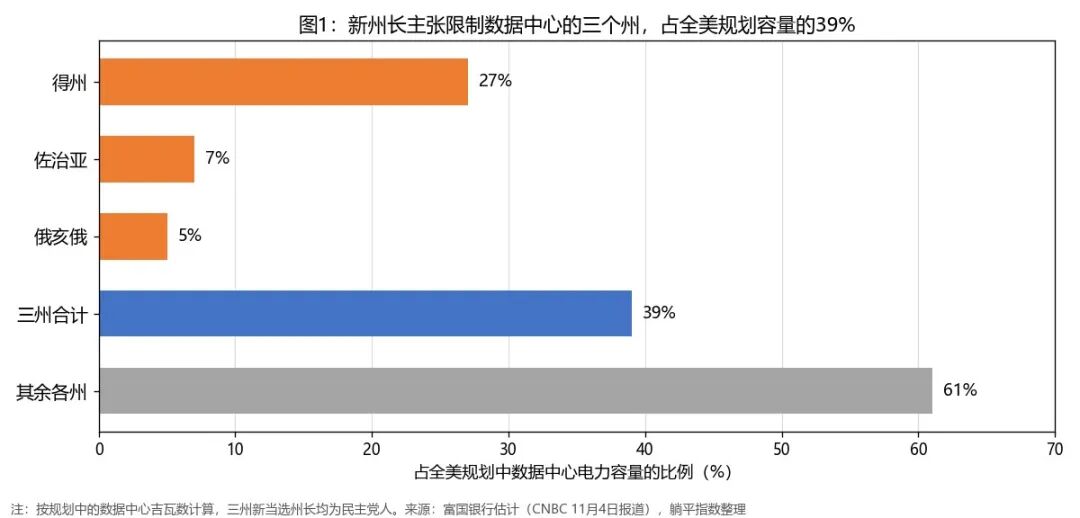
The new governors of Texas, Ohio and Georgia—three key data center states—are all Democrats, and all advocated pausing or restricting new data center construction during their campaigns.
These three states carry significant weight, together accounting for 39% of the planned data center power capacity in the United States. Among the large data center projects OpenAI announced this year, some are located in Georgia and Ohio. At the federal level, Senator Sanders and Representative Ocasio-Cortez proposed a bill in March of this year requiring a nationwide pause on new AI data center construction until national AI regulatory rules are introduced.
Institutionally, governors have more tools at their disposal than Congress. For Congress to impose restrictions on data centers, it must first legislate—and may also have to overcome a Trump veto. Governors, by contrast, can influence approvals, regulation and tax incentives at the state level, although some actions may require state legislature approval.
The market's attention is most concentrated on Texas, because Texas has the largest operating plus under-construction data center capacity in the United States.
Google announced in November last year that it would invest $40 billion in Texas by 2027. Amazon signed a 15-year lease last year with data center operator Cipher Digital worth about $5.5 billion for its campus in West Texas. The new governor, Gina Hinojosa, advocates pausing approval of all data center projects until the state legislature meets in January next year and passes laws protecting Texas residents; she also requires developers to bear the full cost of electricity and to cancel subsidies and tax incentives for data centers.
It is worth noting that Texas's cautious management—and even pause—on data center approvals actually began before this election, reflecting the general public opinion of ordinary Americans. Regardless of red or blue, no one in office can change this outcome.
According to CNBC, since this summer, voices opposing AI data centers have been growing rapidly in both party camps, with people worried that they damage the environment, drive up electricity bills and take away jobs. In August this year, Republican Governor Abbott halted approvals for new data centers to connect to the grid, requiring an audit of queued projects first; in September, he also had the state environmental agency pause issuing data center permits until the audit was completed.
The good news is that data center builders have begun responding to this public concern.
Two days after the election, OpenAI released a set of commitments, reiterating that it would fully bear the electricity costs of its own data centers; for data centers it owns and operates, it promised to seek community input, disclose construction plans publicly, and not sign confidentiality agreements with government officials. Meta, Microsoft, Google and Anthropic have also made similar commitments.
Meta President Dina Powell McCormick said at The Wall Street Journal's tech conference on the evening of the 4th that building data centers after the election would be "harder," and relayed what a winning governor told her: meet right after the inauguration because they do not want to lose this investment and these jobs to somewhere else.
02 A Slowdown Is Not a Crash
Before this year's midterm elections, the market had for a long time valued companies in a relatively aggressive way, pricing in 2027 and even 2028 growth expectations and order backlogs in advance; after the election, what the market needs to re-estimate is how fast the money for AI construction will be spent.
According to third-quarter reports, Amazon, Alphabet, Microsoft and Meta are expected to spend about $740 billion combined on capital expenditure this year, or up to $828 billion including SpaceX; Bank of America forecast before the third-quarter reports that next year could move toward $1.2 trillion.
The impact on next year versus the year after is different. Much of the computing power needed next year has already been contracted.
According to Anthropic's recently disclosed prospectus, most of its computing power is procured through multi-year contracts 12 to 18 months in advance; its computing power contract with SpaceX totals up to $120.5 billion, runs through 2029, and is expected to be fully delivered by December this year, after which it will be about $3.1 billion per month. Microsoft's computing power contract with Nebius signed last September was worth up to $19.4 billion over five years.
Semiconductor research firm SemiAnalysis said SpaceX already has 3.6 gigawatts of data centers under construction, with next year's target raised to about 13 gigawatts—roughly equivalent to all the data center capacity Google accumulated from 1999 to this year. But there are also signals in the opposite direction. On the morning of the 4th, OpenAI executives were already discussing whether to reset next year's data center capacity expectations because of the election results.
The bigger uncertainty is 2028. UBS analysts estimate that about 30% of the new data center capacity expected in the United States in 2028 could be affected by construction pauses. SpaceX also has new data centers in Texas, and another of its Texas campuses may be affected by the state environmental agency's suspension of permits. And 2028 growth is exactly the part that had already been priced into many companies' share prices.
That is also why the stocks that fell the most this week were companies supplying, building, generating power for and leasing computing power to AI construction.
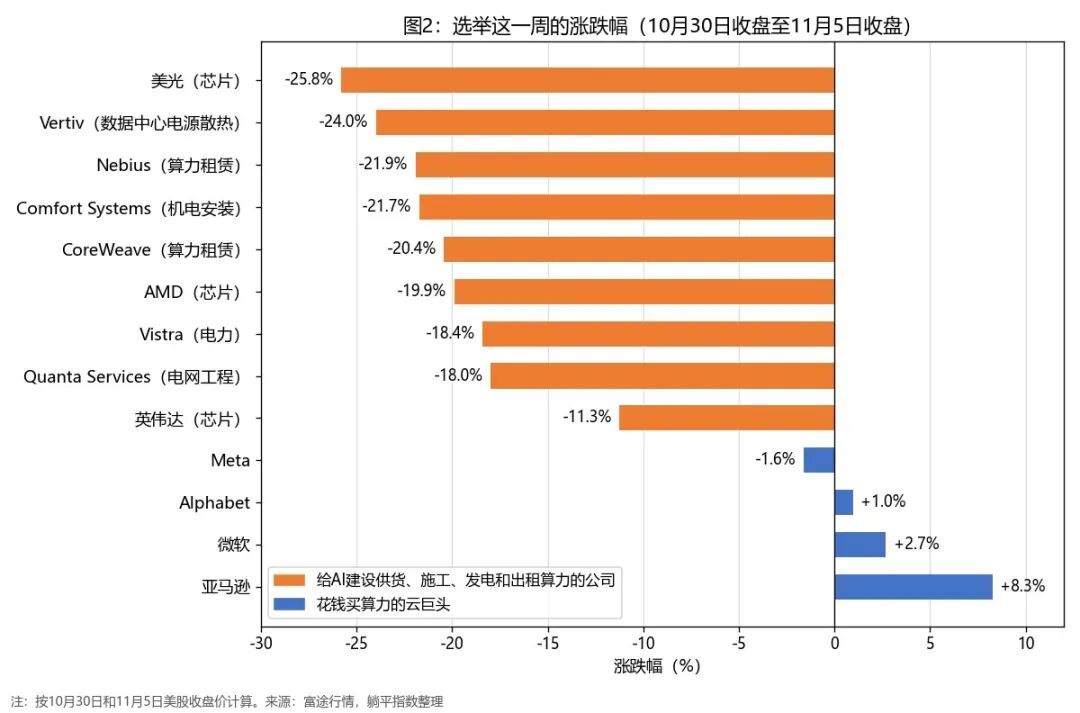
For the cloud giants spending the money, a slower buildout is not entirely a bad thing.
Meta's free cash flow turned negative in the most recent quarter, and Google and Amazon had already turned negative in earlier quarters. According to Bank of America estimates, the free cash flow gap for U.S. cloud giants plus computing power leasing companies like CoreWeave—eight companies in total—is $128 billion this year and will widen to $335 billion next year.
A Democratic victory may force cloud giants to slow capital expenditure and advance AI at a more cautious pace. From the perspective of long-term financial health, this is not a bad thing. Slower supply growth and resilient demand may push up utilization, support prices, and reduce the risk of overbuilding.
On the demand side, this quarter's data is not weak.
Several cloud giants have signed but not yet fulfilled long-term contracts worth $2.5 trillion. With computing power in short supply, tokens processed by large models are still growing rapidly. Google disclosed in the third quarter that its model API processes nearly 32 billion tokens per minute—more than four times the year-earlier figure.
Amazon said at its third-quarter earnings call that token processing volume on its large model platform Bedrock was nearly 17 times that of a year earlier. According to company financial reports, in the third quarter Amazon Cloud revenue grew 39%, Microsoft Azure grew 48%, and Google Cloud revenue more than doubled. Anthropic's prospectus shows that in the past 12 months it had more than 11,900 enterprise customers who spent more than $100,000 with it, compared with more than 950 a year earlier.
Next, there are several certain time points worth watching. The Texas grid's data center audit is expected to be completed in mid-December; the new Congress takes office in January next year; the Texas state legislature also meets in January; and Hinojosa takes office on January 19. So far, what can be seen are signs of a slower construction pace. Signs of weakening demand have not yet appeared in this quarter's data.
Statement: This article is for learning and exchange only and does not constitute investment advice.
Welcome to like, watch and repost. Your support is the driving force for our updates!
-
![]()
Valuation in the Hundreds of Billions, Revenue Just Over a Billion—Can Kling AI Carry Kuaishou's Second Growth Dream?
-
Alibaba Cloud Token Plan Boosts Quota by 70% Starting Today
-
![]()
Just the Facts, No Emotions—Has AI Actually Crashed or Not?
-
![]()
New Forces' Annual Targets in Jeopardy?
-
![]()
In 2026, Tencent Is Frantically Playing Catch-Up
-
![]()
Optical Brain-Computer Interface Paves the Way for Chip Integration! Huichuang Medical Makes Strategic Investment in Westlake Neuralicorn
-
![]()
First Three Quarters Non-Recurring Profit Jumps 116.94%! Why Is Wavelength Optoelectronics Betting Another 150 Million?
-
![]()
TV Distortion vs. Optical Distortion: How Exactly Do You Convert Between Them?