First Three Quarters Non-Recurring Profit Jumps 116.94%! Why Is Wavelength Optoelectronics Betting Another 150 Million?
 11/09 2026
 545
Recently, Wavelength Optoelectronics announced plans to invest up to 150 million yuan in a new "precision optical component technology breakthrough and industrialization project." The project involves upgrading and renovating existing factory buildings and purchasing precision optics production equipment, with a construction period of approximately 1.5 years.
This move should be assessed in light of the company's recent performance. In the first three quarters of 2026, Wavelength Optoelectronics reported revenue of 414 million yuan, up 19.94% year on year; net profit attributable to shareholders of 50.103 million yuan, up 94.47%; and non-recurring net profit attributable to shareholders of 43.7291 million yuan, up 116.94%.
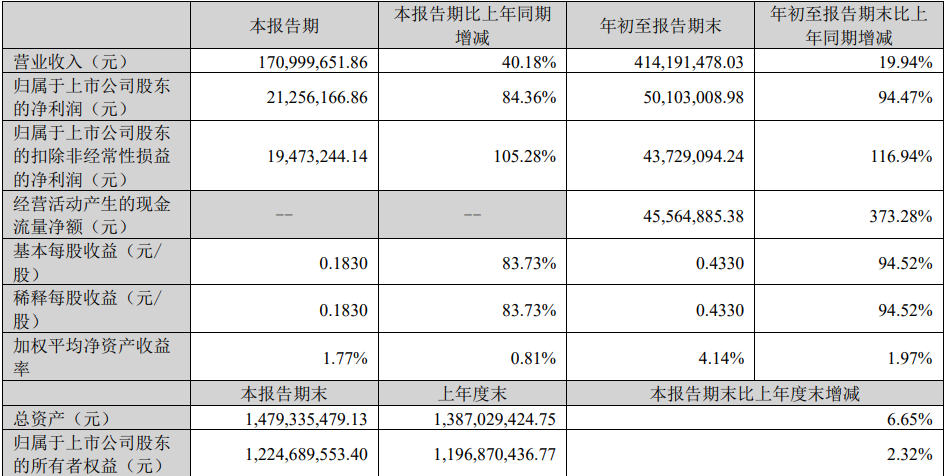
In Q3 2026 alone, revenue reached 171 million yuan, up 40.18% year on year; net profit attributable to shareholders was 21.2562 million yuan, up 84.36%; and non-recurring net profit was 19.4732 million yuan, up 105.28%. The consolidated gross margin stood at 35.98%, an increase of 4.71 percentage points from a year earlier.
The key lies in how the company explains the gross margin improvement. Its research notes state clearly that in Q3 2026, capital expenditure projects invested in earlier periods had largely been completed, and new equipment, production lines, and process routes had been fully debugged and matured, entering a capacity release phase in which the fixed-cost dilution effect began to emerge. At the same time, the share of high-precision, high-value-added products related to the semiconductor field increased, and the product transition period for the infrared optics business came to an end.
The significance of this statement is that it frames the current profit increase as the beginning of returns on the previous round of capital expenditure. As a result, the 150 million yuan dedicated line becomes the next round of targeted additional investment, launched just as a capital expenditure cycle has entered its return period and operating cash flow has improved markedly.
Against the baseline of the 2026 third-quarter report, the more specific constraint is "whether the momentum of the previous round of capacity release can be seamlessly carried over to the dedicated line." The company has just demonstrated that a round of capital expenditure can translate into a significant gross margin increase after about two years—itself positive validation of its capital expenditure discipline.
But precisely because it has only just entered the release period, when the 150 million yuan dedicated line forms capacity in 2027–2028, it will face an already elevated profit base. The marginal contribution the dedicated line itself must make has to be sufficient to continue pushing returns higher on a higher base, rather than merely offsetting newly added depreciation and debugging costs.
Another constraint comes from the capability threshold in the competitive landscape. The dedicated line targets a dedicated production line in precision optical processing and coating, with the goal of enriching the variety of high-precision products. This differs from the competitive position of the company's current PCB micro-machining lenses: the latter achieve import substitution within a relatively concentrated downstream equipment customer system, whereas the global supply of higher-end precision optical components is still dominated by a small number of international manufacturers.
Between supporting lenses and components and the high-value categories targeted by the dedicated line, there is a capability threshold. Therefore, "timing yet to be verified" cannot rest only on customer validation, factory audit pace, and process ramp-up; the competitive landscape must also be included in the tracking scope.
Overall, Wavelength Optoelectronics' 150 million yuan dedicated line remains, in direction, a reasonable bet on differentiating precision optics from general delivery toward extreme processes. But its position in the company's capital expenditure cycle has shifted from "front-loaded investment during the profit recovery period" to "a second additional investment at the inflection point of capacity release."
This shift in position reduces doubts at the level of "whether the company has the ability to bear it," but pushes the focus of the test to another, narrower threshold: whether the release efficiency just proven by the previous round of capital expenditure can be replicated at the higher capability threshold targeted by the dedicated line.
-
![]()
Valuation in the Hundreds of Billions, Revenue Just Over a Billion—Can Kling AI Carry Kuaishou's Second Growth Dream?
-
Alibaba Cloud Token Plan Boosts Quota by 70% Starting Today
-
![]()
Just the Facts, No Emotions—Has AI Actually Crashed or Not?
-
![]()
New Forces' Annual Targets in Jeopardy?
-
![]()
In 2026, Tencent Is Frantically Playing Catch-Up
-
![]()
Optical Brain-Computer Interface Paves the Way for Chip Integration! Huichuang Medical Makes Strategic Investment in Westlake Neuralicorn
-
![]()
First Three Quarters Non-Recurring Profit Jumps 116.94%! Why Is Wavelength Optoelectronics Betting Another 150 Million?
-
![]()
TV Distortion vs. Optical Distortion: How Exactly Do You Convert Between Them?