Valuation in the Hundreds of Billions, Revenue Just Over a Billion—Can Kling AI Carry Kuaishou's Second Growth Dream?
 11/09 2026
 436

Produced by|Paicai Original (ID: paicj314)
Over 120 billion yuan—a valuation now on par with its "parent" Kuaishou's market value. Yet its revenue is only a little over a billion.
Such a contrast is almost too bizarre to fathom.
Of course, it can also be rationalized—after all, capital market valuation logic isn't entirely about the revenue ledger; investors are betting more on a company's transformational promise and its positioning within the track.
But the awkward part is that this logic of valuations running ahead of revenue does not entirely rule out the possibility of failure. This "child rivaling the parent" valuation inversion has thrust Kling into the industry spotlight overnight. The impressive performance of capital piling in and revenue growth doubling cannot mask the real problems: difficult profitability, fierce track competition, and an imbalanced revenue structure.

In fact, behind these enormous expectation gaps, the market is essentially answering one core question: is the video large model that Kuaishou has bet heavily on a valuation bubble under the industry boom, or a core engine that can truly carry the group's future growth?
Either way, Kling is growing fast, but Kuaishou still needs to prove itself.
Reportedly Heading Toward an IPO—How Much Is Kling Worth?
According to outside reports, Kuaishou's Kling AI plans to list in Hong Kong as early as next year, and the company's valuation has exceeded 120 billion yuan.
Against the backdrop of the entire internet industry stepping up AI transformation, Kuaishou's intelligent layout—with the independent spin-off of the Kling business—is increasingly seeing substantial capitalization take shape.
Compared with the slow iteration pace of most companies' internal incubation, Kuaishou's operating rhythm for Kling is more aggressive and indeed more market-oriented.
As early as early July this year, Kuaishou officially completed the restructuring of its core business, completely stripping out all of Kling AI's technology, assets, and business links, and establishing an independent entity, Beijing Kling. This spin-off completely separated the AI large model business from the traditional short video business, clearing structural obstacles for independent financing, market-based pricing, and subsequent capitalization.
Relying on its independent entity status, Kling quickly launched a top-tier capital increase plan in the industry. The overall capital increase cap reached 20.447 billion yuan, equivalent to 3 billion US dollars, making it the largest single round of financing in the global video large model track.
Such a massive financing volume directly attracted leading industrial capital from both the technology and entertainment tracks. Alibaba Cloud, Baidu, Huace Film & TV, and Mango-affiliated institutions all participated, fully reflecting the industrial side's consensus on the implementation value of video AI.
The enthusiasm of capital piling in ultimately translated into a concrete valuation in a new round of equity changes at the end of August. On August 31, 2026, Kuaishou issued a Hong Kong stock announcement disclosing that the National Artificial Intelligence Industry Investment Fund and Zhengda Robot had officially become new shareholders. The market can precisely calculate Kling's true post-investment value through the officially disclosed capital contributions and shareholding ratios.

Among them, the National Artificial Intelligence Industry Investment Fund contributed 1.4 billion yuan, corresponding to a 1.14% stake; Zhengda Robot contributed about 131 million yuan, corresponding to a 0.11% stake. Compared with the secondary market conditions during the same period, as of the close on November 6, Kuaishou Technology's market value was about 124 billion Hong Kong dollars, and Kling's independent valuation was already infinitely close to the parent company's market value, forming a rare business counterattack pattern in the capital market.
Objectively speaking, Kling has indeed developed fast, and this has become the confidence behind its high valuation.
At the 2026 Kuaishou Guanghe Creator Conference, Cheng Yixiao publicly disclosed Kling's latest operating report card. From the quarterly data disclosed in the financial reports, the growth trajectory can be clearly seen: in the first quarter, Kling's revenue exceeded 650 million yuan, and in the second quarter it continued to rise, with revenue exceeding 850 million yuan, a year-on-year growth rate exceeding 200%. As of March this year, Kling's annualized revenue run rate had approached 500 million US dollars, and its commercialization pace far exceeded that of most AI large model companies at the same stage.
From the perspective of the entire industry, most video large models are still in the stage of technology refinement and scenario testing and have not yet formed large-scale revenue. By comparison, Kling's highlights do exist. The question is, how strong is it?
Kuaishou's Bet—How Strong Is It Really?
Unlike the broad technical layout of general large models, Kling has long focused on the vertical track of video generation. It has moved beyond the positioning of an ordinary entertainment-oriented AI creation tool and entered professional film and television industrialized production scenarios, completing a tiered leap in product capabilities.
Judging from the product progress officially disclosed, Kling has achieved native 4K video direct output, and its image precision, generation stability, and detail restoration all meet professional film and television production standards.
At the implementation case level, the self-produced AI short film "Paper Phone" exceeded 100 million views across the internet and was successfully shortlisted for the AIGC unit of the Beijing International Film Festival; it also participated in the production of the overseas Hollywood series "House of David," achieving collaborative finished content combining AI-generated materials with live-action footage and truly integrating AI technology into the traditional film and television industrial process.
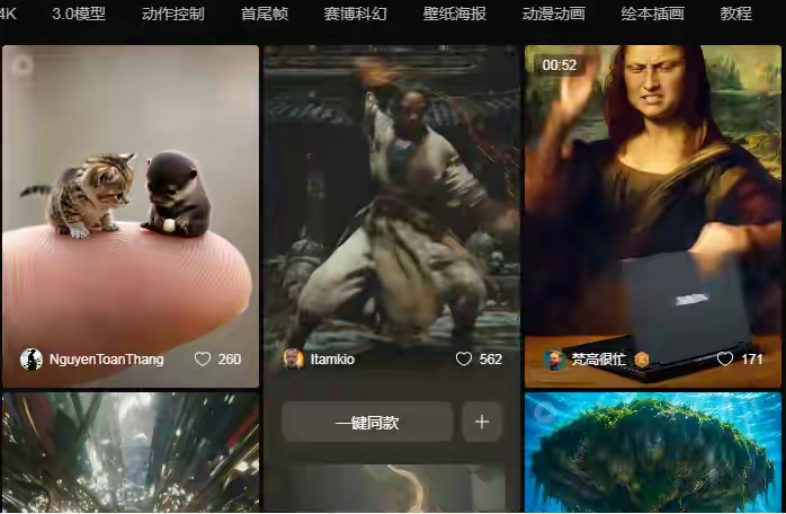
On the To C application side, Kuaishou, relying on the Kling model foundation, fully upgraded the Kuaiying editing tool and launched a full set of AIGC-assisted creation functions, covering the entire chain of services such as account positioning, intelligent editing, material optimization, and one-click video generation. This combination of "underlying large model + upper-layer application tools" serves both the platform's massive ordinary creators and the production needs of professional content institutions, forming a complete technology implementation ecosystem.

However, the technical refinement of vertical video large models requires extremely high computing power and R&D cost support, and the heavy-investment model has also brought the industry-wide problem of losses.
According to unaudited financial data disclosed by Kuaishou, Kling's after-tax net loss in 2024 was about 500 million yuan, and the loss expanded to 1.9 billion yuan in 2025. The rising loss scale is essentially due to rigid investment in technology iteration, computing cluster operation and maintenance, and R&D team expansion. Kuaishou has also clearly stated that it will continue to increase investment in AI technology R&D over the long term.
High investment has brought high growth, but to objectively evaluate Kling's business quality, one cannot look only at revenue growth; it is more necessary to deeply break down the revenue structure and see the business's true operating foundation and potential shortcomings.
Based on survey data from National Business Daily, Kling's revenue structure in the first quarter of 2026 had very distinctive characteristics. Overseas revenue accounted for nearly 80%, and API enterprise service revenue accounted for 60%, having replaced personal subscription services as the largest source of revenue. At the same time, the business is highly dependent on top clients, with super-large clients contributing more than 80% of revenue; among the top ten partner companies, eight are from overseas and two are domestic.
This business structure is a choice of the company's own market strategy and is blameless in itself. The favorable side is that it has enabled Kling to successfully avoid the red ocean competition for domestic C-end traffic and rapidly achieve revenue expansion through the overseas B2B market.
But an overly concentrated client and regional structure also creates an obvious structural imbalance in business growth, making revenue stability susceptible to fluctuations in a single market or a single client group.
More critically, competition in the video large model track has entered a white-hot stage, and external competitive pressure is continuously squeezing industry profits and growth space. At present, players such as ByteDance Seedance, Alibaba Happy Horse, and Shengshu Technology Vidu continue to increase their layouts, the industry's technology gap is constantly narrowing, and homogenization is intensifying.
To seize market share, there is no shortage of price and technology involution risks in the industry. Vidu launched an ultra-low-price commercialization plan, and MiniMax chose to open-source core model components. The era of extensive industry growth has completely ended.
In such a highly involuted industry environment, whether Kling's high growth can continue and whether its hundred-billion valuation can hold are worth observing.
Kling Is a Key Battle for Kuaishou
One important detail explaining why Kling can obtain resource tilt from the Kuaishou group with all its strength, as well as the capital market's ultra-high pricing, is that it is one of the few entirely new tracks for Kuaishou that can break through growth bottlenecks.
In recent years, Kuaishou's traditional main business has completely entered a stock competition cycle, and the growth ceiling has gradually emerged. In the first half of 2026, Kuaishou Group's overall revenue was 69.25 billion yuan, but the growth momentum of core businesses continued to weaken. Advertising revenue growth continued to decline, and second-quarter live streaming revenue fell 13.5% year on year; the profit side was also under pressure, with adjusted net profit for the period at 7.29 billion yuan, down 28.5% year on year. At the user level, the platform's daily active user scale has basically stagnated, and traditional short video, live streaming, and advertising businesses can hardly drive the group to achieve leapfrog growth anymore.
Against the backdrop of weak overall main business growth, Kling's year-on-year revenue growth of over 200% has become a relatively scarce growth highlight in Kuaishou's financial reports and an important lever for the group to break through the stock dilemma and layout a second growth curve.
However, judging from the real industry landscape, although Kling's growth is impressive, it still has an obvious gap with industry leaders in market share and user scale, and the pressure to break out in the track remains huge.
At the user level, in the first quarter of 2026, the monthly active users of the same-track Jimeng App reached 13.525 million, while Kling App's monthly active users were only 1.191 million. Even adding web and tool-side traffic, overall mobile monthly active users were only 7.8 million, leaving considerable room for improvement in C-end user mindshare penetration.
At the computing power and market share level, there is also a gap in industry tiers. Monitoring data from AI Price in May 2026 showed that ByteDance Seedance accounted for more than 80% of computing power consumption in the AI video generation market and held an absolute monopoly position in underlying calls, technology iteration, and data accumulation, while Kling's computing power market share was only 14%. A DataEye industry report showed that in 2026 the domestic AI video large model market exceeded 20 billion yuan, with Seedance holding a 69% market share and Kling ranking second in the industry with a 17% share. The top industry landscape is difficult to overturn in the short term.
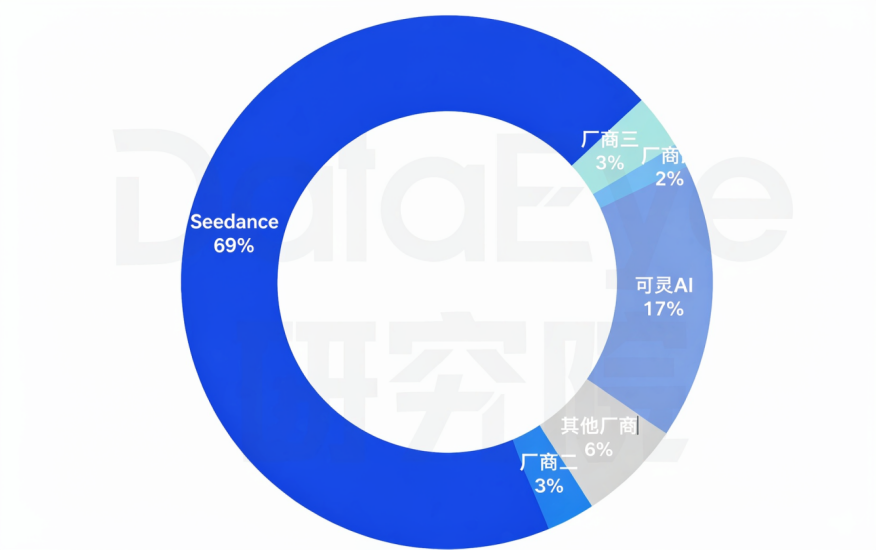
Given the current pressure of domestic market competition, a mature overseas commercialization layout has become Kling's key trump card for maintaining high growth and creating differentiated advantages, and it also matches its highly internationalized revenue structure.
Long-term tracking survey data from National Business Daily shows that Kling's overseas commercialization capability has continued to strengthen. Within one year, the proportions of overseas revenue and API enterprise service revenue have increased significantly. In 2025, the two figures were 60% and 30%, respectively, and in the first quarter of 2026 they had climbed to 80% and 60%. In the first five months of 2026, among the top ten clients contributing core API revenue, eight were from overseas markets, and the overseas B2B commercialization system has formed a stable and replicable implementation model.
Looking back, it must be acknowledged that overseas markets also do not offer easy growth space. Domestically, ByteDance Seedance is also deeply cultivating the overseas B2B track and directly competing with Kling for client resources; globally, overseas native AI platforms such as Google Veo, Runway, and Synthesia all have first-mover advantages in underlying models, application tools, and enterprise service scenarios, and global track competition remains at a high intensity.

From the overarching strategic perspective of the Kuaishou group, Kling represents a pivotal battle that will shape the company's future direction. The group's traditional core business has entered a phase of steady-state operation, and the AI video large-model track stands out as one of the few entirely new growth avenues where Kuaishou can simultaneously achieve technological differentiation, overseas scaling, and rapid revenue growth.
Admittedly, at this stage Kling boasts top-tier capital backing, doubled revenue growth, a mature overseas commercialization system, and technically validated execution capabilities. At the same time, it remains in a growth phase marked by insufficient revenue scale, fierce industry competition, and a notable gap with market leaders.
Betting on Kling is a critical battle for Kuaishou. Whether it can reach a larger-scale commercialization level—Kuaishou has yet to prove itself.
-
![]()
Valuation in the Hundreds of Billions, Revenue Just Over a Billion—Can Kling AI Carry Kuaishou's Second Growth Dream?
-
Alibaba Cloud Token Plan Boosts Quota by 70% Starting Today
-
![]()
Just the Facts, No Emotions—Has AI Actually Crashed or Not?
-
![]()
New Forces' Annual Targets in Jeopardy?
-
![]()
In 2026, Tencent Is Frantically Playing Catch-Up
-
![]()
Optical Brain-Computer Interface Paves the Way for Chip Integration! Huichuang Medical Makes Strategic Investment in Westlake Neuralicorn
-
![]()
First Three Quarters Non-Recurring Profit Jumps 116.94%! Why Is Wavelength Optoelectronics Betting Another 150 Million?
-
![]()
TV Distortion vs. Optical Distortion: How Exactly Do You Convert Between Them?