In 2026, Tencent Is Frantically Playing Catch-Up
 11/09 2026
 508

Tencent's AI path
Image source: Internet (contact us for removal if infringing); partly AI-generated
On May 13, 2026, Ma Huateng said something at the shareholders' meeting that was later clipped, shared, and dissected over and over: "A year ago I thought we had gotten on the boat, but later found the boat was leaking. Now I feel we've stood up on it, but still can't sit down—and I hope the boat can go a bit faster."
Most interpretations treat this as a founder's candor. But candor is only the surface.
The real question worth asking is: why did a company that for twenty years has "arrived late" to almost every track only discover, this time, that the hull itself had problems—after boarding?
The answers are all hidden in the posture of Tencent's catch-up. Lay out Tencent's series of moves from late 2025 through 2026—centralizing organizational power, resetting financial priorities, re-pouring the model foundation, switching entry-point logic, re-selecting the cloud commercialization path, and exposing the boundaries of its investment ecosystem—and you'll find they are not six parallel business stories, but different solutions to the same problem.
That problem is: how can an old ecosystem built on traffic, connections, and decentralization grow a new foundation characterized by computing power, models, and centralized scheduling—without being dragged down by the gravity of the old one?

A "Federal-System" Company Begins to Learn "Wartime Centralization"
To understand Tencent's catch-up, one must start with its organizational DNA.
Tencent's competitiveness over the past two decades was to a large extent built on a kind of "federal system." WeChat emerged from the email team, games broke out through internal horse racing, and business units long had independent budgets, technical judgments, and decision-making power. The group was more a coordinator than a commander.
This logic was almost unbeatable in the mobile internet era: the people closest to the market made the decisions, fast-running businesses were not dragged down by slow ones, and WeChat grew into a super app precisely because of this "special-zone-style" sense of boundaries.
But the underlying grammar of the AI war is completely different. Computing power must be centrally procured to lower costs, data must be centrally fed to train models, and the scheduling of training and inference must be unified to form synergy.
Google has spread Gemini into Search, Android, Workspace, and YouTube; Alibaba has re-centralized management of Tongyi; ByteDance uses Volcano Engine to uniformly undertake models and computing power...
They are all doing the same thing: pulling power back in.
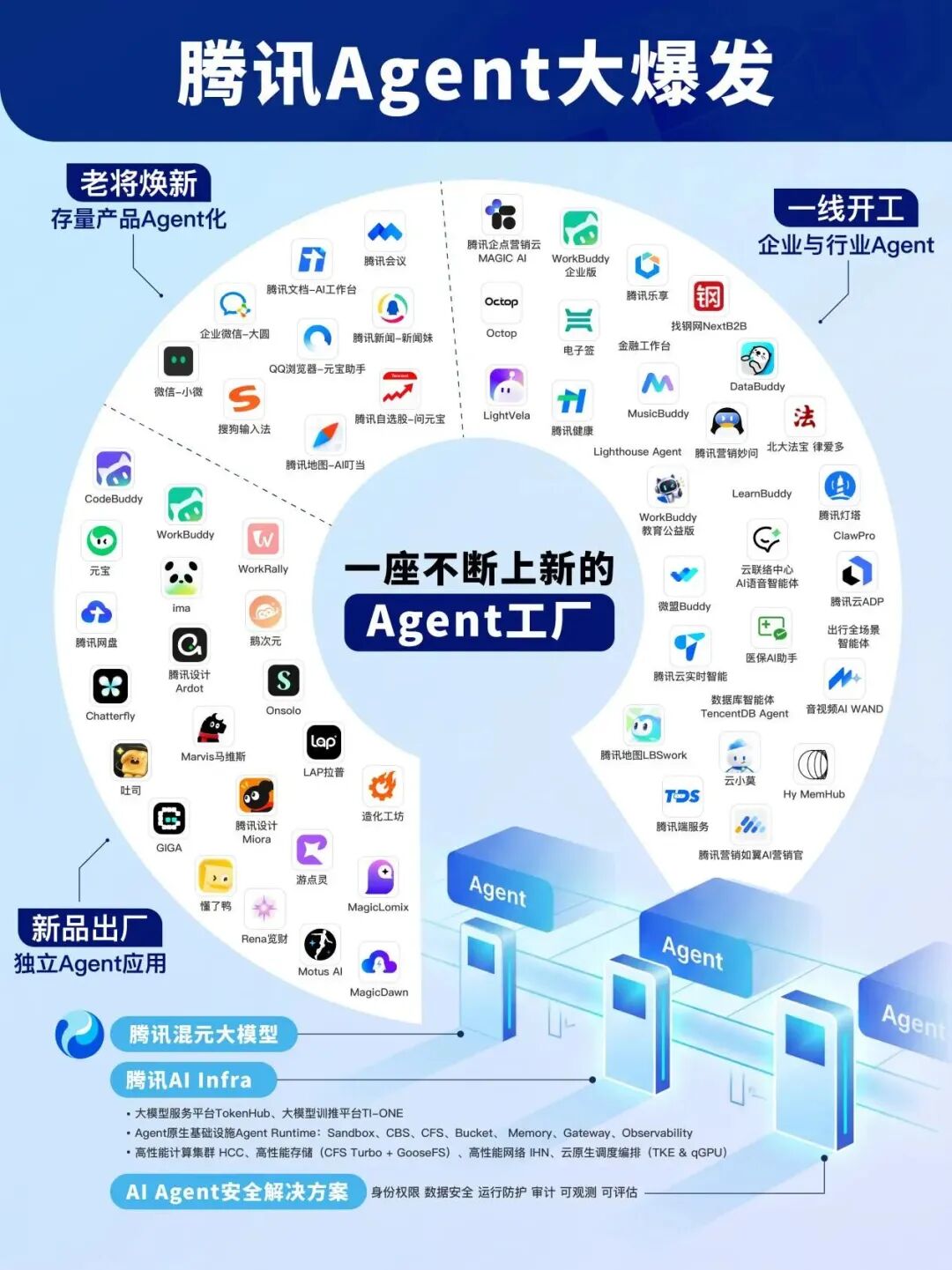
Tencent's real catch-up signal was the architecture upgrade in December 2025—namely, the establishment of the new AI Infra Department, AI Data Department, and Data Computing Platform Department, with Yao Shunyu serving as Chief AI Scientist and concurrently heading the AI Infra Department and the Large Language Model Department, reporting to President Liu Chiping.
By July 2026, the Multimodal Model Department and the Large Language Model Department were merged into the Foundation Model Department, uniformly managed by Yao Shunyu; in September, his authority was further expanded to oversee the Foundation Model Department, AI Infra Department, and AI Data Department, with Hunyuan's core chain—from R&D and computing power to data evaluation—held in one person's hands.
Three months later, the AI Lab, which had stood for a full ten years, was dissolved, and its personnel were merged into the Hunyuan system.
A 28-year-old, in less than a year, successively took charge of the three core chains of models, computing power, and data, reporting directly to the company's top leadership.
This level of authorization is extremely rare in Tencent's history. The signal it sends is far more specific than "valuing AI": Tencent is gathering AI resources that were previously scattered across multiple labs and multiple business groups into a combat chain that can be centrally commanded.
This is the first layer of the catch-up—and the hardest. Because the "federal system" is not just an organizational structure; it is a mindset.
Each business guards its own boundaries, data, and user experience, and naturally rejects new external businesses.
Ma Huateng said "the boat needs to go a bit faster." The real constraint may not be that some engine lacks power, but rather that the coordination cost between cabins is too high, and it is hard for the whole ship to draw water in one direction at the same time.

Buybacks Give Way to Computing Power, Profit Gives Way to Time
Once organizational power is centralized, the direction of money must change accordingly.
In the second quarter of 2026, Tencent's capital expenditure reached 52.8 billion yuan, up 176% year on year, and free cash flow was negative 13.8 billion yuan. For a company long known as a "cash cow," this is an extremely unusual figure.
Even more telling is the comparison with buybacks: in 2025 Tencent's buyback scale was close to 70 billion yuan, while by August 2026 the cumulative amount was about HK$29.1 billion, with a full-year estimate of HK$40 billion to HK$60 billion—nearly halved from 2024.
Liu Chiping's explanation was candid: if capital expenditure is increased, it can enhance rental capacity, build models, obtain more tokens, and achieve returns; the group will direct more funds toward capital expenditure, and therefore may reduce cash used for buybacks.
He even mentioned that prepayments and related orders paid several months ago can today sell computing power at more than 30% profit, but Tencent still chooses to prioritize using that computing power for training self-developed models and promoting self-developed applications.
The information content of this passage is much greater than it appears. It shows that Tencent's financial priorities have undergone a clear reset: in past years, funds flowed to buybacks, essentially signaling to the capital market that "there is no better use of funds than buybacks"; now funds flow to computing power, signaling that "the marginal return on AI infrastructure is higher than that on buybacks."
Use profit to buy time; use shareholder returns to buy strategic positioning.
In Q2 2026, the revenue, costs, and expenses of new AI products (Hunyuan, Yuanbao, CodeBuddy, WorkBuddy, Xiaowei, etc.) pulled the growth rate of non-IFRS operating profit down from 19% to 9%, with AI "eating" about 10 percentage points of profit growth.
This is not a number that can be digested through "optimization," but the result of an active choice.
The second layer of meaning of the catch-up is thus clear: Tencent is not using "spare money" to catch up; it is catching up through structural adjustments to its balance sheet and income statement.
The halving of buybacks and the turn to negative free cash flow are proof that this catch-up truly exists—and that its cost has already been factored into the financials.
With money and organization in place, the model is the first touchstone for testing the quality of the catch-up.
At the end of January 2026, Hunyuan launched an action internally called "rebuilding": pretraining, reinforcement learning, the data system, and the evaluation system were all torn down and rebuilt.
Yao Shunyu's own phrasing was to "define more real problems and improve data quality," which amounts to re-pouring the foundation.
The problems of inconsistent standards across different teams, scattered capabilities, and disconnection between models and products in the past were concentrated into one chain and solved anew.
The effect received staged verification on Hy4 in November. 770B parameters, about 2.6 times the previous generation Hy3; on the Intelligence Index v5 of independent evaluation agency Artificial Analysis, it scored 35, second only to Kimi K3.1 Pro's 46 among Chinese AI labs, and higher than all models with published weights listed by AA.
In the financial blind test officially provided by Tencent, 213 experts gave Hy4 a score of 3.04 on 579 real tasks, higher than DeepSeek-V4.1-Flash's 2.97 and Kimi and GLM's 2.68.
If you look only at these numbers, the catch-up seems to have delivered a decent answer sheet.
But the same AA scorecard contains a more glaring figure: Hy4's hallucination rate on knowledge benchmarks is as high as 89%, marked by AA as "high hallucination rate," compared with Kimi K3.1 Pro's 37%.
The Hunyuan team itself admits that Hy4 is "one of the strongest open-source models currently, but there is still a large gap between it and top closed-source models."
This is the true scale of the model catch-up. Tencent has pulled Hunyuan from "lagging behind" to "the front ranks of China's second tier," achieving competitive levels in specific scenarios such as coding and finance.
But competition in model capability is no longer at the "benchmark score" level. As AI moves from chatbot to agent, from "answering questions" to "executing tasks on behalf of users," hallucination rate is no longer a technical metric but a business trust metric.
A model with an 89% hallucination rate can be used to write copy and make summaries, but it is hard to put into an enterprise's core workflow with confidence, and even harder to entrust to a consumer-grade agent to "autonomously execute transactions."
Tencent has caught up on the lesson of "usable." But the lesson of "trustworthy" is the watershed that determines whether the model can truly become the foundation of cloud, agent, and ecosystem.

WeChat Begins to "Grow AI on Its Own"
Beyond models, the most unique battlefield in Tencent's catch-up is the entry point.
Over the past year, Tencent's logic for pushing AI was straightforward: make an independent Yuanbao and let WeChat funnel traffic to it.
Official account articles could be "summarized by Yuanbao," and AI capabilities in WeChat were opened to Yuanbao. WeChat handled traffic; Yuanbao handled AI.
But starting in the second half of 2026, this logic was quietly rewritten. On WeChat PC, the "Yuanbao Summary" at the top right of official account articles was gradually replaced by "Ask AI," and what took over inside was not Yuanbao but "Xiaowei," an AI agent grown inside WeChat, powered at the bottom by WeLM specially customized for WeChat scenarios rather than Hunyuan's general model.
Citi gave a high assessment in a September research report: Xiaowei is expected to become China's "ultimate consumer AI agent," because WeChat's relatively neutral platform positioning and established vertical partnerships provide a distribution and transaction moat that other players find hard to replicate.
Since June, Tencent has been testing Xiaowei's agent functions with selected business partners, with the direction being to autonomously execute more complex user flows and transaction actions within WeChat.
The significance of this is not "whether Yuanbao has been abandoned." Yuanbao remains Tencent's general AI product and competes head-on with Doubao and Qianwen.
The real change is at the logic level: Yuanbao is "app logic," where users need to open it and ask it questions; Xiaowei is "agent logic," which does not require users to open anything new—it is simply where users already are, invoking WeChat's relationship chain, mini programs, payments, and merchant network.
This is the smartest step in Tencent's entry-point catch-up—and also the hardest.
Smart because it did not fight ByteDance and Alibaba over ad spend and daily active users on the independent AI app battlefield, but instead stuffed AI into that container with 1.439 billion monthly active users that others cannot take away.
Hard because the "strength" of the WeChat ecosystem precisely constitutes the "lock" on AI-native logic.
An independent agent product needs extreme intent understanding and task closed-loop capability to make users willingly migrate.
But Xiaowei does not need users to migrate, because it is born at the destination.
This "distribution dividend" lets Xiaowei start extremely fast, but it may also mask a deeper problem: when the ceiling of the agent's capability is limited by the interface boundaries and scenario definitions of the WeChat ecosystem, can it still grow intelligence beyond that of a "WeChat internal assistant"?
What Citi calls "transaction commissions and advertising monetization" points to a path that is highly imaginative commercially but highly dependent on the old ecosystem product-wise.
Tencent's entry-point catch-up is not about "making another AI app," but about completing a switch in interaction logic inside its strongest ecosystem.
The switch has begun, but the endgame of the switch is not a product question; it is an ecosystem question.

"AI-ifying" Within Its Own Scenarios
Beyond the entry point, cloud is the part of Tencent's catch-up most easily misread.
If you look only at IaaS share, Tencent Cloud's position is not pretty. But the path Tencent Cloud has taken was never on the IaaS frontal battlefield. Tencent Cloud Vice President Yang Chen once said something repeatedly quoted: "Token is a low-quality business. The volume looks large, but stickiness is extremely poor. We have never thought Token is a good business."
While the industry was locked in cutthroat competition over GPU computing power and token prices, Tencent Cloud chose to press its chips on "AI+SaaS."
The revenue structure is the best footnote: about 40% IaaS, 40% PaaS, and more than 20% SaaS—with the SaaS proportion quite prominent among top cloud vendors.
Enterprise collaboration SaaS has been growing at roughly 40% annually, business enablement SaaS has posted double-digit or even higher growth, AI- and SaaS-related orders have doubled, and AI large-model products have expanded more than 50-fold in just two years.
In Q1 2026, Tencent Cloud's year-on-year revenue growth exceeded 40%, gross margin climbed above 35%, and AI-related high-margin services accounted for 25% to 30% of the mix. By 2025, Tencent Cloud had already turned profitable.
The essence of this playbook is to leverage what Tencent does best—SaaS products such as WeCom, Tencent Meeting, Docs, and e-signature that have already become embedded in the workflows of countless companies—to capture AI's incremental growth, rather than engaging in head-on combat on others' computing-power turf.
Tencent Meeting's evolution from a meeting tool into an efficiency platform integrating AI minutes, real-time translation, interview analysis, and HR system connectivity is a textbook example of "SaaS AI-ification."
But the ceiling of this path is equally clear. The MaaS market has already been staked out by Volcano Engine and Alibaba Cloud, and Tencent does not rank among the top five in call volume.
The logic of SaaS AI transformation holds only on one premise: that enterprises are willing to keep paying for "AI value-added embedded in workflows," rather than treating AI as a replaceable add-on feature.
What Tencent Cloud is making up for is the lesson of commercialization health, not scale. In a cloud market that is broadly loss-making, turning a loss into a profit is itself a signal—but whether that signal can become a barrier depends on whether the AI premium of SaaS can withstand the erosion of price competition.

Trading capital for time—but some lessons cannot be bought
The other line of Tencent's catch-up lies in investments outside the balance sheet.
Over the past few years, Tencent's AI moves have covered almost the entire industry chain: at the chip and computing-power layer, it has invested in Enflame Technology, Lightelligence, Yunbao Intelligence, and Infinigence AI; Tencent holds nearly 20% of Enflame and is also its largest customer, with Enflame's sales to Tencent accounting for over 77% in 2025.
At the large-model layer, it has backed Zhipu, MiniMax, Moonshot AI, Baichuan Intelligence, and StepFun among the "six AI tigers," and also participated in DeepSeek's first financing round; at the application layer, from AI marketing to collaborative office and creation platforms, it has made intensive bets.
According to media tallies, Tencent has all but "bought up half of China's AI industry."
Trading capital for time, for information, and for ecological position—this playbook was proven by Tencent in the mobile internet era.
But in the AI era, its limits have also been exposed with particular clarity.
Embodied intelligence is the most telling example. At WAIC, Tencent showcased a full-stack solution spanning the model layer, the platform layer, and the cloud foundation, consistently positioning itself as "building platforms and brains, not hardware."
Logically, it is very smooth: hardware is asset-heavy and low-margin, while once platforms and brains form an ecosystem, marginal costs decline and continuous revenue can be generated through the cloud.
But industrial reality has given the opposite answer. In 2026, nearly every leading humanoid robot company has moved toward self-developed brains.
Zhiyuan, whose Series B was led by Tencent itself, self-developed the Qiyuan large model GO-1 and the interactive large model WITA Omni, and one partner put it bluntly: "If a robot company does not build large models, it has no future."
Galbot self-developed the Galbot Brain, Galaxea open-sourced the G0 series foundation models, Unitree open-sourced VLA models, and even Tashi Zhiheng, which set a new financing record, has general embodied large models and real-world datasets as its core assets.
The deeper obstacle lies in data. Large language models can be trained on public internet text, but robot training data must be generated in the real physical world, with every frame coming from expensive real-machine operation or simulation synthesis.
At the current speed of data collection, it would take 120,000 years for embodied intelligence models to reach the intelligence level of large language models.
The data is in the hands of the robot companies that build the bodies and run the scenarios, not in the hands of platforms.
The lesson Tencent is making up for in embodied intelligence is logically valid: if robot companies ultimately need stronger "brains" and lower cloud costs, Tencent has supply value.
But whether the "platform dream" can hold does not depend on how fast Tencent catches up, but on whether the industry is willing to hand over its most core intelligence layer to a partner that does not make hardware.
Some lessons can buy time with capital, while others can only wait for the industry itself to reach that step.

Only by bringing together the lines of organization, finance, models, entry points, cloud, and investment can the true outline of Tencent's catch-up be complete.
It is not building a "Tencent of the AI era" from scratch.
What it is doing is embedding AI into things that already exist and that others cannot take away: the relationship chain of WeCom, the social and transaction closed loop of WeChat, SaaS workflows, and investment tentacles accumulated over more than a decade. Catching up is not about starting a new stove, but about enabling old assets to regain pricing power on a new foundation.
But this is also the deepest paradox of this catch-up. The old ecosystem gave Tencent its starting speed—and also gave it resistance in turning.
Whether Yao Shunyu's centralization of power can penetrate the inertia of the "federal system," whether the computing power obtained by halving buybacks can settle into the credibility of models rather than mere parameter scale, whether the Agent logic of Xiaowei will ultimately be defined by the boundaries of the WeChat ecosystem as a smarter assistant rather than a true intelligent agent, and how far the platform route of embodied intelligence can go in the industrial reality of "everyone developing their own brains"...
None of these questions can be automatically answered by continuing to "put in money."
Tencent's founder said he hopes the ship can go faster. But what determines whether this ship can sail steadily has never been the power of the engine, but whether the people on board are willing to open up their respective cabins and let the whole ship draw water in the same direction.
In the end, what Tencent is making up for is a question of organizational mindset; the product is secondary.
The answer to this question is still far from being written in 2026.
-
![]()
Valuation in the Hundreds of Billions, Revenue Just Over a Billion—Can Kling AI Carry Kuaishou's Second Growth Dream?
-
Alibaba Cloud Token Plan Boosts Quota by 70% Starting Today
-
![]()
Just the Facts, No Emotions—Has AI Actually Crashed or Not?
-
![]()
New Forces' Annual Targets in Jeopardy?
-
![]()
In 2026, Tencent Is Frantically Playing Catch-Up
-
![]()
Optical Brain-Computer Interface Paves the Way for Chip Integration! Huichuang Medical Makes Strategic Investment in Westlake Neuralicorn
-
![]()
First Three Quarters Non-Recurring Profit Jumps 116.94%! Why Is Wavelength Optoelectronics Betting Another 150 Million?
-
![]()
TV Distortion vs. Optical Distortion: How Exactly Do You Convert Between Them?