Who is Taking Away the Profits of Car Companies: Battery or Intelligent Driving?
 10/13 2026
 566
566
There's a Price to Pay for Cognitive Shortcuts
Authored by/ Chen Dengxin
Edited by/ Li Wenjie
Formatted by/ Annalee
Currently, the automotive industry stands at a crossroads of value chain reshaping.
Just half a month after going solo, Seres returned to the embrace of HiMode, forging a new five-year cooperation; around CATL, automakers' attitudes are ambivalent, with many unveiling Plan B...
Accompanying this are the ongoing discussions about "de-XX-ification" and "XX taking all the profits."
The question is, battery and intelligent driving have long been cost centers for automakers, so why has the sentiment suddenly amplified now? With only three companies maintaining a per-vehicle profit exceeding 5,000 yuan, why is it that the harder they try, the less profitable they become? Is the industry's ultimate destination a shift from zero-sum game to mutual prosperity?
Industry Differentiation: Some Reap Profits While Others Struggle
Currently, automakers are facing tough times.
Data from the China Passenger Car Association shows that domestic car retail sales have declined year-on-year for 12 consecutive months, with the September drop further widening to about 28%, marking the largest year-on-year decline since 2026.
Beyond sales pressure, cost pressures are also mounting.
Since 2026, upstream raw materials for car manufacturing, including lithium, copper, aluminum, rubber, plastics, and chips, have continuously risen in price, showing a trend of widespread increases. However, intensified terminal competition makes it difficult to pass on these cost increases, and even the average selling price of new energy vehicles has declined.
NIO founder Li Bin stated, "Prices can't be raised, and specifications no longer impress. The automotive industry has now entered the most brutal phase of the marathon's latter half and final. The entire industry's profits are under sustained pressure, with both sales and manufacturing profit margins at low levels."
As a result, automakers are more cost-sensitive than in previous years.
As a major cost component, power batteries naturally draw significant attention: Public data shows that in the first half of 2026, the combined net profit of eight listed power battery companies was approximately 50.8 billion yuan, while the combined net profit of 23 mainstream listed automakers was about 25.1 billion yuan.
This means that automakers, working tirelessly, only achieve half the profits of battery companies.
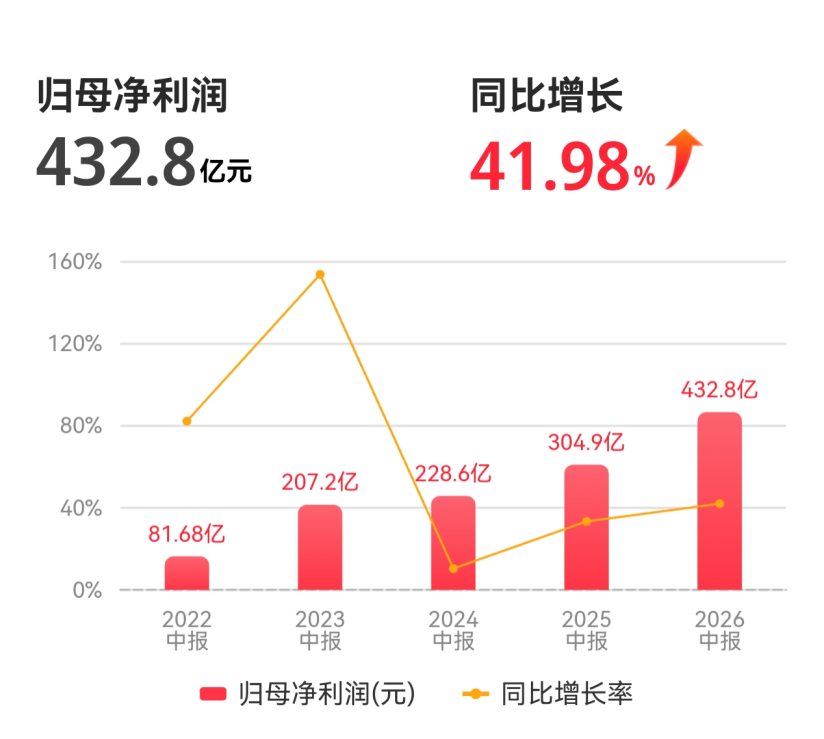
Among them, CATL's revenue in the first half of 2026 reached 276.917 billion yuan, up 54.80% year-on-year; net profit was 43.284 billion yuan, up 41.98% year-on-year. Its dominant position is clearly visible, naturally making it a target of criticism.
Source: Hithink RoyalFlush
Besides power batteries, intelligent driving is another cost center.
For example, Seres' rigid expenditures account for about 10% of the vehicle price to obtain services including intelligent driving and brand licensing, thus dragging down its performance and turning from profit to loss in the first half of 2026.
Another example, XPENG's service and other business revenue increased by 67.10% year-on-year in the first half of 2026, mainly due to providing intelligent driving-related services to Volkswagen, whose net profit decreased by 35.73% year-on-year over the same period.
It is evident that behind the noise is not dissatisfaction with XX battery or XX intelligent driving, but anxiety over profit decline, especially against the backdrop of widespread failure to meet sales targets, creating an urgent need for a breakthrough.
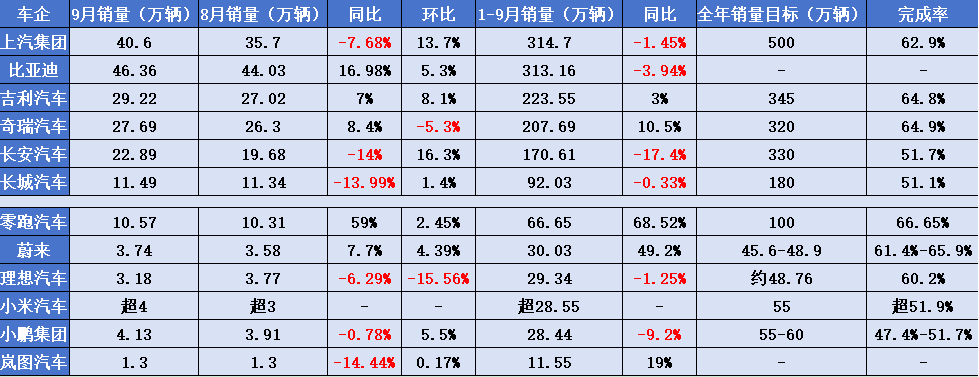
Looking back, in the first three quarters of 2026, the annual target completion rate of mainstream automakers ranged from 28% to 96%, with most between 50% and 70%. Achieving annual targets is no easy feat.
At this pace, Zeekr is relatively relaxed to meet its KPIs.
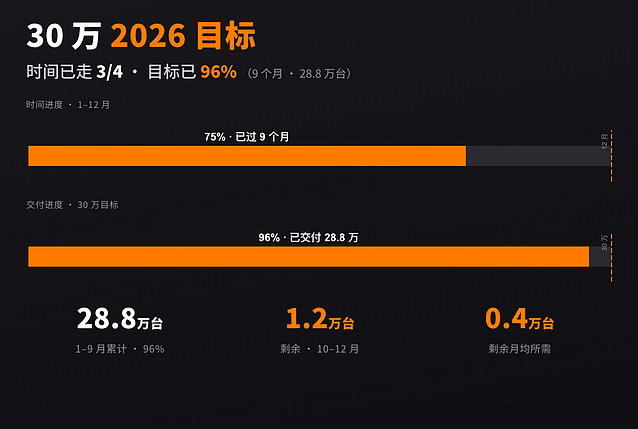
Zeekr's annual target is 300,000 units, with total sales of 288,400 units in the first three quarters of 2026. In the fourth quarter, it only needs to sell over 4,000 units per month on average to pass, which is almost certain.
Source: Zhineng Auto
Besides Zeekr, Leapmotor also holds promise.
Leapmotor's annual target is 1 million units, with total sales of 666,500 units in the first three quarters of 2026. In the fourth quarter, it only needs to sell over 111,200 units per month on average to meet the target.
"Bangning Studio" stated, "Targets are sometimes not meant to be achieved but to apply internal pressure and tell external stories. However, if the actual completion rate is too low, inflated annual targets can backfire on brand confidence. As the decisive fourth quarter begins, the sales pressure on automakers is visibly rising."
Rather Than a Zero-Sum Game, Why Not Aim for a Win-Win?
Nevertheless, automakers may find it difficult to gain dominance over the value chain in the short term for two reasons.
On one hand, consumer mindset is hard to change.
The "2026 Global New Energy Vehicle Consumer Research Report" shows that in purchasing decisions, the weights of batteries and intelligent driving are 13.8% and 8.7%, respectively, ranking first and second.
This means that consumer mindset has been successfully shaped.
Taking CATL as an example, 37.1% of Chinese consumers clearly state that they will abandon a model if it does not come equipped with CATL batteries.
It is evident that some consumers only recognize CATL.
In fact, to cater to consumers, the industry previously used CATL products for mid-to-high-end models and non-CATL products for low-end models, further solidifying consumer perceptions.
The same goes for Qiankun Intelligent Driving.
The "2026 P3 China Intelligent Driving Evaluation Report" shows that Qiankun Intelligent Driving ranked first for three consecutive years with ADS 2.0 in 2024, ADS 4.0 in 2025, and ADS V4 in 2026.
A market insider told Xinkedu, "For automakers, choosing CATL power batteries or Qiankun Intelligent Driving eliminates the need for explanation and takes a shortcut to a high-end perception."
On the other hand, high technical barriers.
It is widely known that profits in the automotive industry naturally flow to segments with high technical barriers. In the era of fuel vehicles, this segment was the "engine + transmission."
The "2025 China Automotive Cost Analysis Report" shows that the average manufacturing cost of a 100,000-yuan fuel vehicle is about 63,000 yuan, accounting for 63% of the retail price. Among them, the cost of "engine + transmission" accounts for 28%-32% of the total vehicle cost, about 18,000-20,000 yuan.
Companies that master "engine + transmission" have long occupied the high ground of industry profits.
From this perspective, it seems reasonable for new energy vehicles' "battery + intelligent driving" to resemble fuel vehicles' "engine + transmission" and achieve effortless success.
Because of this, automakers have their own ideas.
"21st Century Business Herald" stated, "The next phase of competition for China's new energy vehicles will not be about pulling others down but about safety, quality, technology, brand, and global trust. Only by returning to specialized division of labor, technological competition, and quality standards can leaders become stronger, more companies grow, and the industrial ecosystem become healthier."
Specifically, breaking the first-mover advantage of battery and intelligent driving companies is no easy task, with patent barriers being the primary challenge.
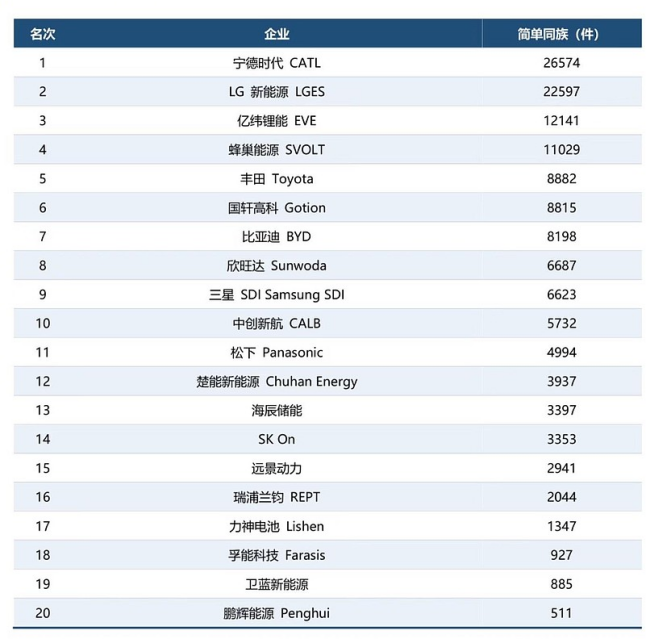
From October 2016 to September 2026, in the global ranking of total battery patents, CATL ranked first with 26,574 simple family patents, surpassing Japanese and Korean companies.
Source: PatSnap Global Patent Database
Simple family patents refer to the same core invention filed in different countries or regions, merged and counted as one, and are a key indicator for measuring a company's technological innovation.
It should be noted that battery companies favored by automakers, such as Sunwoda and Guoke Gaoxuan, still lag far behind CATL in terms of patent quantity.
Besides patent barriers, cost-effectiveness is another debatable aspect.
Currently, the new energy vehicle sector is becoming increasingly competitive. To gain a cost advantage, many companies are attempting to establish a controllable supply chain system through self-research, leading to redundant construction.
Jin Yuzhi, CEO of Yinwang Company, stated, "Faced with fierce competition, automakers first think of cost reduction, with self-research becoming a priority. However, if automakers invest billions or even tens of billions in self-researching intelligent driving systems, and many automakers' annual sales do not reach 1 million units, the cost per vehicle for software systems alone would be thousands of yuan. This system also requires continuous iteration, along with related investments in hardware, domain controllers, etc., making the self-research model not cost-effective for automakers."
Source: Red Star Capital Bureau
In other words, the relationship between automakers and suppliers is not a zero-sum game.
For automakers, there is no need to self-research all technologies. Instead, they can jointly optimize costs with suppliers through joint research and deep customization while creating differentiated product experiences. For suppliers, they also need to move towards an open ecosystem and deeply bind with automakers to continuously expand scale and iterate technology.
Li Xiang, founder of Li Auto, stated, "Apple's A-series chips, NVIDIA's and Qualcomm's flagship chips are mostly self-researched by manufacturers and manufactured by TSMC; Tesla's self-researched batteries are also produced in cooperation with CATL, LG, and Sunwoda. This model has not weakened TSMC, CATL, and Sunwoda but made them stronger."
Therefore, only when the new energy vehicle industry chain moves from independent operations to collaborative symbiosis can it truly escape the rat race of price wars.
-
![]()
Who is Taking Away the Profits of Car Companies: Battery or Intelligent Driving?
-
![]()
Tencent Successively Discontinues Two AI Agents
-
![]()
Has the Brake Pedal of JAC Motors Really Broken? The Market Will Teach Every Automaker with 'Fatal Flaws' a Lesson
-
![]()
Changsha’s Emerging Powerhouse in Computing: Cancels RMB 3 Billion Contract!
-
![]()
Production Capacity Can’t Keep Up with Orders! This Optical Enterprise Soars 449% on Debut
-
![]()
Q3 Report | Yuanjie Technology's Net Profit Expected to Surge Fivefold, Transitioning from 'Shortage Dividends' to 'Delivery Challenges'
-
![]()
The Computing Power Price War Hits Silicon Valley
-
![]()
The AI Office Sector is Forming a 'Three-Pillar' Landscape