Tencent Successively Discontinues Two AI Agents
 10/13 2026
 525
525
On October 8, Tencent Yuanqi's official website issued a "Notice on the Suspension of Services for the Yuanqi Platform." The notice was concise yet resolute. It announced that, due to business restructuring, the Yuanqi platform would cease operations on November 9, 2026. Prior to this, on October 29, the creation of new agents and the issuance of API keys would be halted. By November 9, application access, data read/write operations, API calls, and console usage would all be discontinued. Agents deployed to official accounts, service accounts, and WeChat customer service via Yuanqi would no longer respond to user interactions.
According to available information, Yuanqi was launched on May 17, 2024, at the Tencent Cloud Generative AI Industry Application Summit. Tencent positioned it as a one-stop platform for developing and deploying AI agents, enabling users without coding expertise to create AI assistants. It was subsequently upgraded to version 1.0 in August 2025.
It is reported that a segment of Yuanqi's user base comprises creators of official accounts who import historical articles into the platform's knowledge base. This allows agents to automate fan interactions in the background and subsequently publish responses to official accounts or WeChat customer service with a single click.
However, Tencent has granted these users a transitional period. Prior to November 9, users can independently export agent configurations, workflows, and conversation records. For the subsequent two months, they retain access to the console to retrieve backups. By January 9, 2027, all user data will be legally erased, except for records mandated by regulatory requirements for retention.
Tencent has recommended two alternatives for affected users: the Tencent Cloud Agent Development Platform (ADP) and the official account intelligent reply system.
This marks the second instance of Yuanqi scaling back its operations. In April of this year, Tencent announced that the creation portal for the older version of Yuanqi agents would cease functioning on May 6, citing that the "new version has already assumed relevant functionalities." Six months later, the entire new platform has also been discontinued.
Two weeks prior to Yuanqi's shutdown, another product ceased operations. In light of the deployment of AI agents in enterprise settings, an AI industry conference will be held in Shenzhen on October 23. How can enterprise-level AI agents be effectively implemented? Shenzhen holds the answers this golden October! Senior experts from leading companies such as Alibaba QianWen Office and Volcano Engine will be invited to share the latest advancements in AI agent deployment. Click on the link to register directly: https://forms.ofweek.com/Form/preview/form_id/2417?tgfrom=zxl
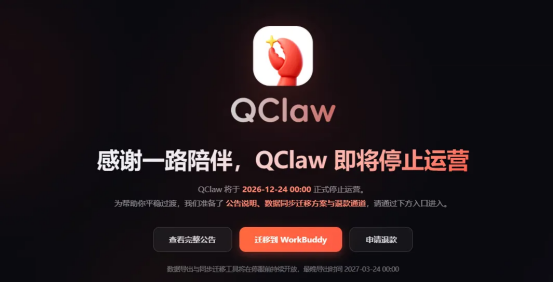
On September 24, Tencent QClaw announced its official cessation of operations at midnight on December 24, 2026. Commencing from the announcement date, new user registrations, purchases, and subscription service renewals will be discontinued.
QClaw, developed by the Tencent PC Manager team based on the open-source OpenClaw framework, was launched in March 2026. Its primary feature is remote computer control via WeChat. Users can issue instructions through WeChat on their mobile devices, and the computer-based assistant will execute tasks such as file organization, spreadsheet processing, and message replies.
According to China Daily, within 10 days of its Chinese version's launch, QClaw amassed over one million users, with "National Shrimp Farming" becoming a trending topic in the tech community at the time.
However, its popularity waned swiftly. The Paper, citing data from Feifan Industry Research, reported that in April of this year, QClaw's overseas version experienced a 99.19% month-on-month decline in user traffic. In July, Zhang Shuyu, the product lead, announced his resignation on social media on June 29. Also in July, Tencent issued an internal organizational adjustment notice, merging relevant businesses and part of the QClaw product team into Cloud Product Division Six, where WorkBuddy is situated.
At the time of its suspension, QClaw boasted 2.259 million monthly active users.
Two products within the same department followed divergent paths. QClaw users are being encouraged to migrate to WorkBuddy, with a reward of 1,000 points upon completion. WorkBuddy, Tencent's self-developed desktop workstation agent, recorded 20.97 million monthly visits on PC in June 2026, ranking first among domestic AI-native office agents, followed by ByteDance's TraeE with 12.79 million. Tencent's official statement to the media is to "further integrate resources to provide superior agent services to users."
Tencent is not alone in its retrenchment. In August, Alibaba consolidated QoderWork, MuleRun, and Wukong under the "QianWen Office" banner, entrusting the DingTalk team with their advancement. ByteDance integrated TRAE and Kouzi into the Doubao ecosystem at the end of August, launching "Doubao Work" for productivity scenarios. Baidu's GenFlow simultaneously adopted the Chinese name "Kuku AI." From June to July this year, Tencent Yuanbao, ByteDance Doubao, and Alibaba Tongyi Qianwen successively disabled or restricted their user-built agent functionalities.
The underlying reasons are straightforward. Agents capable of directly operating local computers or remaining on standby for extended durations incur significantly higher computational costs than conventional chat interfaces. Consequently, C-end users are hesitant to commit to long-term subscriptions for such services.
The trust barrier proves even more formidable. For products to autonomously execute tasks, they necessitate elevated system permissions, posing risks such as inadvertent document deletion or unauthorized access to spreadsheets and photos. CNR and Southern Metropolis Daily reported on these concerns during QClaw's peak popularity. Following the initial novelty, the habit of delegating tasks to AI failed to gain traction among most users.
Gartner's survey this year revealed that while 60% of organizations anticipate deploying agents within the next two years, only 17% have actually done so. In the first half of the year, there were 83 AI agent financing deals, marking a 131% year-on-year increase. However, funding shifted towards embodied AI and AI4S in the second half. Over 20 office agents were released or significantly updated in China this year, yet the monthly active users and retention rates of leading products remain in their nascent stages.
-
![]()
Who is Taking Away the Profits of Car Companies: Battery or Intelligent Driving?
-
![]()
Tencent Successively Discontinues Two AI Agents
-
![]()
Has the Brake Pedal of JAC Motors Really Broken? The Market Will Teach Every Automaker with 'Fatal Flaws' a Lesson
-
![]()
Changsha’s Emerging Powerhouse in Computing: Cancels RMB 3 Billion Contract!
-
![]()
Production Capacity Can’t Keep Up with Orders! This Optical Enterprise Soars 449% on Debut
-
![]()
Q3 Report | Yuanjie Technology's Net Profit Expected to Surge Fivefold, Transitioning from 'Shortage Dividends' to 'Delivery Challenges'
-
![]()
The Computing Power Price War Hits Silicon Valley
-
![]()
The AI Office Sector is Forming a 'Three-Pillar' Landscape